Verb Negation in English: Forms and Typical Errors

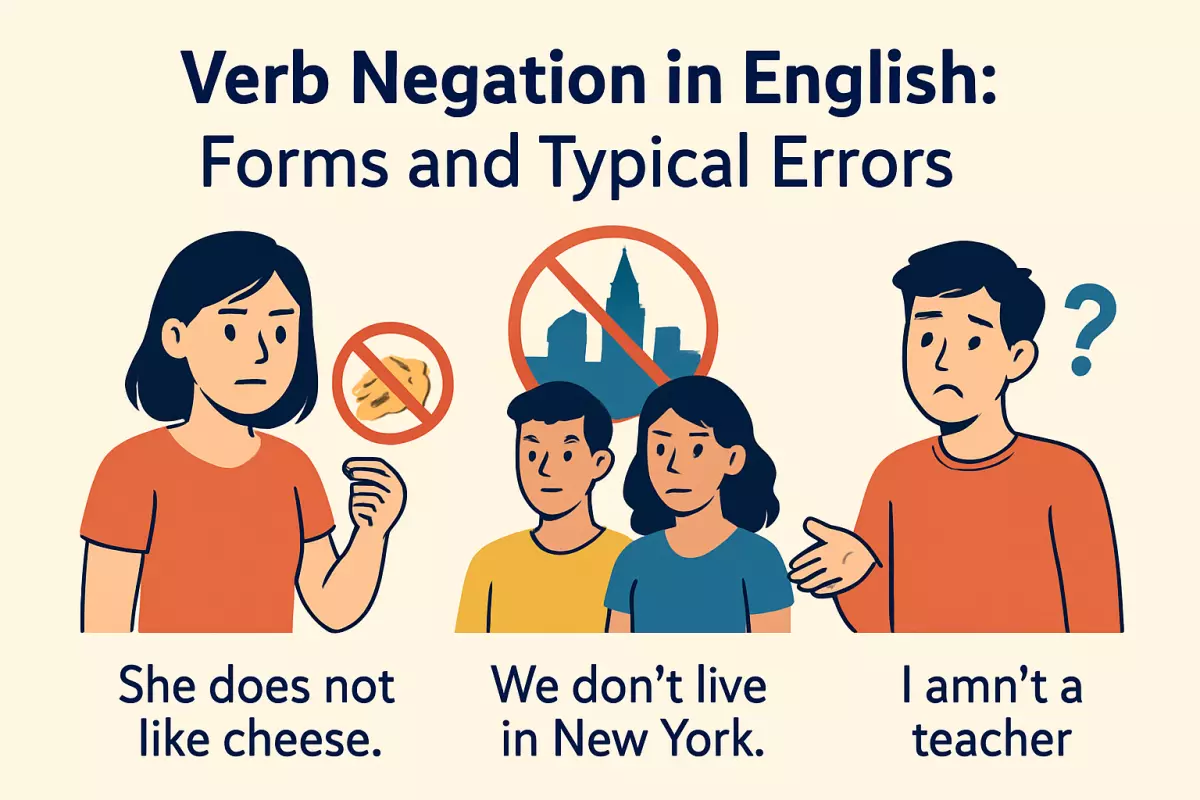 This article explains what verb negation means in English and how to form negatives with be, do, have, and modal verbs.
Negating English verbs can seem tricky at first, but it becomes much easier once you learn the main patterns. This guide explains how to form negatives in everyday speaking and writing, including when to use do, does, and did, and how to avoid common mistakes such as leaving out an auxiliary verb or creating an unintended double negative.
What verb negation means in English
Negative verb forms tell the reader or listener that an action, state, or event is not true, not happening, or not intended. In English, this is usually done by adding not (or its contraction -n’t) to an auxiliary verb, or by using do-support when there is no auxiliary available.
Core idea: where the negative marker goes
In standard patterns, not attaches to the first auxiliary (or modal) in the verb phrase. If the clause has no auxiliary, English inserts do/does/did so that not has something to attach to.
- With an auxiliary: auxiliary + not + main verb → She is not working.
- With a modal: modal + not + base verb → They cannot come.
- With no auxiliary: do/does/did + not + base verb → He does not know.
- With “be” as the main verb: be + not → I am not ready.
What negation can mean in practice
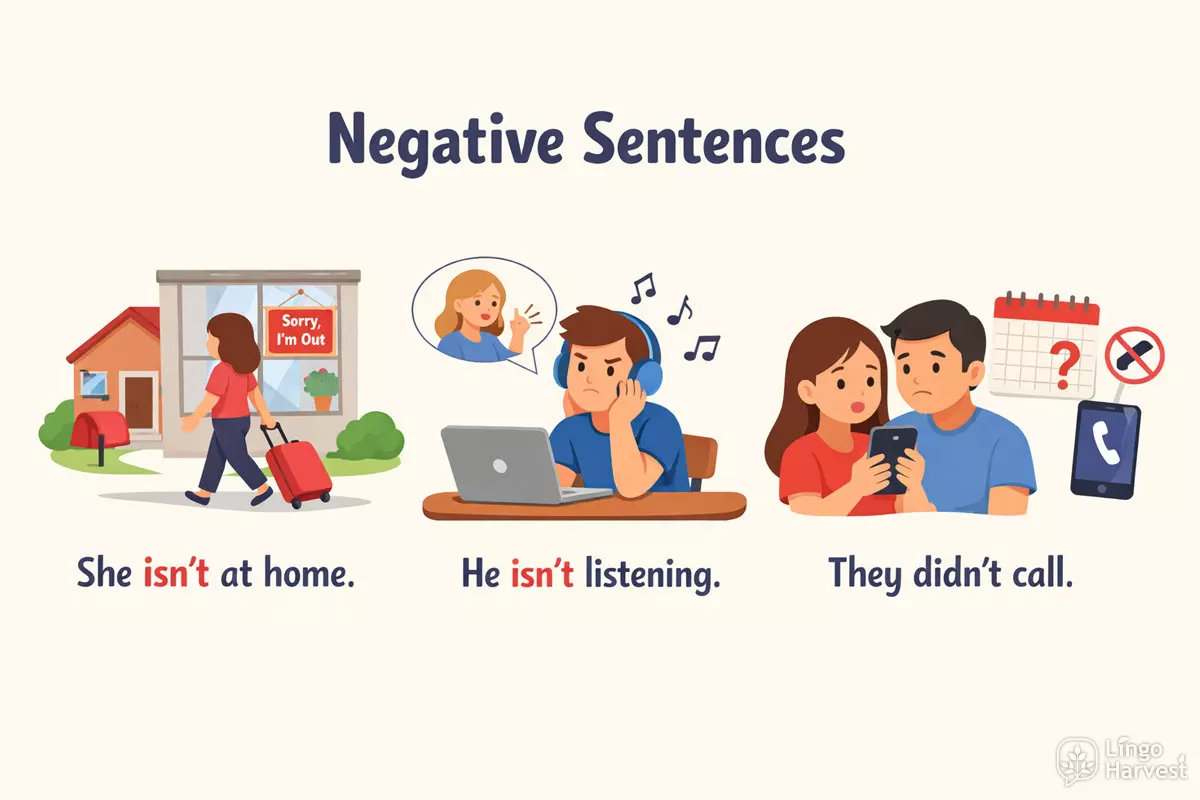
Negating a verb does more than simply “make it false.” It can deny a fact, reject a claim, express refusal, or indicate that something is not required or not allowed. The exact meaning depends on the verb type (state vs. action), tense, and the presence of modals.
- Denial of a present fact/state: She isn’t at home.
- Denial of a current action: He isn’t listening.
- Denial of a past event: They didn’t call.
- Negated ability: I can’t swim.
- Negated permission: You can’t park here.
- Negated obligation: You don’t have to pay today. (no necessity)
- Strong prohibition: You mustn’t touch that.
- Negated intention/plan: We aren’t going to buy it.
- Negated expectation: It won’t take long.
- Negated completion (present perfect): I haven’t finished.
- Negated experience: She hasn’t been to Japan.
- Negated result (passive): The package wasn’t delivered.
Common placement patterns learners should notice
English has a few high-frequency structures where the negative element appears in predictable positions. Learning these as “chunks” helps avoid typical errors such as negating the main verb directly or doubling tense marking.
- Do-support in the present simple: ✅ He doesn’t work on Sundays. ❌ He works not on Sundays.
- Do-support in the past simple: ✅ She didn’t see it. ❌ She didn’t saw it.
- Negative with “be” (no do): ✅ They aren’t tired. ❌ They don’t be tired.
- Negative with modals (no do): ✅ You shouldn’t worry. ❌ You don’t should worry.
- Negative questions (inversion): Aren’t you coming? / Don’t they know?
- Short answers: No, I’m not. / No, he doesn’t. / No, we can’t.
- Contractions in speech and informal writing: isn’t, aren’t, don’t, doesn’t, didn’t, won’t, can’t
- “Not” after the first auxiliary in longer verb phrases: She has not been working.
- Negative infinitives: Try not to interrupt.
- Negative -ing clauses: He left without saying goodbye. / Not knowing the answer, she guessed.
Negatives with be, do, and have
English uses three high-frequency verbs to build most negative statements: be (as a main verb), do (as an auxiliary for most other verbs), and have (for perfect tenses and sometimes for possession). The core pattern is simple: place not after the auxiliary or after the verb be. Typical errors come from choosing the wrong helper verb or putting not in the wrong position.
1) Negative forms with be (no do)
When be is the main verb, it takes not directly. Do not add do/does/did.
- Pattern: be + not (am not / is not / are not / was not / were not)
- Contractions: isn’t, aren’t, wasn’t, weren’t; am not usually stays uncontracted in standard writing (informal: I’m not).
- ✅ She is not ready. → She isn’t ready.
- ❌ She doesn’t be ready. → ✅ She isn’t ready.
- ✅ They were not at home.
- ❌ They didn’t be at home. → ✅ They weren’t at home.
- ✅ I’m not sure. (common spoken and written form)
- With there is/are: There isn’t any milk. / There aren’t any seats.
2) Negative forms with do (for most lexical verbs)
If the main verb is not an auxiliary and not be, English typically uses do to carry the negative. The main verb stays in the base form.
- Present simple: do/does + not + base verb
- Past simple: did + not + base verb
- Contractions: don’t, doesn’t, didn’t
- ✅ I do not understand. → I don’t understand.
- ✅ He does not work on Fridays. → He doesn’t work on Fridays.
- ❌ He doesn’t works on Fridays. → ✅ He doesn’t work on Fridays.
- ✅ They did not call me. → They didn’t call me.
- ❌ They didn’t called me. → ✅ They didn’t call me.
- With frequency adverbs: She doesn’t usually eat breakfast. (adverb after the auxiliary)
- With questions in the negative: Don’t you agree? / Didn’t he tell you?
3) Negative forms with have: perfect tenses vs. possession
Have behaves in two different ways. As an auxiliary in perfect tenses, it directly takes not. For possession, modern standard English usually uses do (don’t have), while have not is more formal or dialect-dependent.
- Perfect tenses: have/has/had + not + past participle
- Contractions in perfect: haven’t, hasn’t, hadn’t
- ✅ I have not finished. → I haven’t finished.
- ✅ She has not seen it. → She hasn’t seen it.
- ✅ We had not met before. → We hadn’t met before.
- ❌ She didn’t have seen it. → ✅ She hasn’t seen it.
- Possession (common): I don’t have a car. / He doesn’t have time.
- Possession (more formal): I have not any money is uncommon; prefer I don’t have any money or I have no money.
- BrE informal alternative: I haven’t got any money. / She hasn’t got a clue.
Common placement and agreement problems to watch
- Put not after the auxiliary: ❌ She not is coming → ✅ She is not coming.
- Do not double-mark tense: ❌ didn’t went → ✅ didn’t go
- Choose one negative marker in standard English: ❌ I don’t know nothing → ✅ I don’t know anything / I know nothing
- Use be directly for identity/state: ❌ He doesn’t be tired → ✅ He isn’t tired
- Use have (not do) for perfect aspect: ❌ They don’t have finished → ✅ They haven’t finished
Negatives with modal verbs
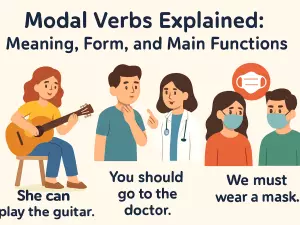
With modals (can, could, may, might, must, shall, should, will, would), negation is usually formed by placing not directly after the modal. The main verb stays in the base form (no -s, no -ed, no to).
Core pattern
- Modal + not + base verb: She cannot come today.
- Modal + n’t + base verb (common in speech and informal writing): They won’t agree.
- Question + negative: Can’t you wait a minute?
- Negative tag questions: You shouldn’t say that, should you?
Common forms and contractions (and what learners mix up)
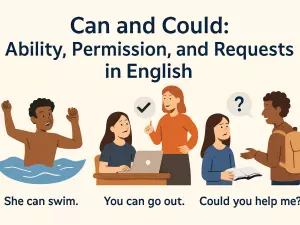
- ✅ I can’t swim. ❌ I don’t can swim. (No do-support with modals.)
- ✅ She won’t help. ❌ She willn’t help. (Use won’t, not willn’t.)
- ✅ You shouldn’t worry. ❌ You shouldn’t to worry. (No to after a modal.)
- ✅ He couldn’t finish. ❌ He couldn’t finished. (Base verb after the modal.)
- ✅ We might not go. ✅ We mightn’t go. (Both exist; mightn’t is less common in some varieties.)
- ✅ You mustn’t touch it. ❌ You don’t must touch it.
- ✅ She may not know. (Often preferred in careful writing.)
- ✅ I shan’t be late. (Rare; mainly British and formal/old-fashioned.)
Meaning differences to watch
- mustn’t = prohibition: You mustn’t park here. (It is not allowed.)
- don’t have to = no obligation: You don’t have to come early. (It is optional.)
- can’t = inability or logical impossibility: She can’t be 10; she’s in college.
- may not can mean “possibly not” or “not allowed” depending on context: You may not enter. / He may not remember.
Perfect and continuous negatives with modals
- Modal + not + have + past participle: They shouldn’t have said that.
- Modal + not + be + -ing: She might not be coming tonight.
- ✅ He can’t have forgotten. ❌ He can’t has forgotten. (Use have, not has.)
- ✅ We won’t be waiting. ❌ We won’t waiting. (Use be before -ing.)
Placement choices: “not” vs “n’t” and emphasis
- Contractions are typical in speech and informal writing: I can’t talk now.
- Full “not” can sound more formal or emphatic: I cannot accept this.
- For contrast, speakers may stress not: You must not do that (strong warning).
- Avoid double negatives unless you deliberately want a nonstandard effect: ❌ I can’t get no help.
Negative questions and short forms
English often forms negative questions by combining an auxiliary verb with not. In speech and informal writing, this usually appears as a contraction (short form). These patterns are common in real conversation, but they also produce frequent learner errors with word order, contractions, and meaning.
Core patterns (with and without contraction)
- Aux + not + subject + base form (more formal): Do not you agree? (rare) → more natural: Do you not agree?
- Aux + subject + not (formal but natural): Do you not agree?, Is she not coming?
- Contracted negative + subject (very common): Don’t you agree?, Isn’t she coming?
- Be behaves like an auxiliary: Aren’t they ready? / Are they not ready?
- Modal verbs follow the same logic: Can’t you wait? / Can you not wait?
- Perfect and continuous use the first auxiliary: Haven’t you finished?, Isn’t he working?
- No auxiliary in the affirmative → add do/does/did: You like it. → Don’t you like it?
Meaning and typical uses
- Checking an expectation: Isn’t it supposed to rain today? (speaker expects “yes”)
- Surprise: Didn’t you get my message?
- Polite suggestion: Why don’t we take a break?, Wouldn’t it be better to call first?
- Soft criticism: Shouldn’t you be studying?
- Inviting agreement (tag-like effect): Don’t you think this is too expensive?
Common short forms and where mistakes happen
- Don’t / doesn’t / didn’t: ✅ Doesn’t she know? ❌ Don’t she know?
- Isn’t / aren’t / wasn’t / weren’t: ✅ Weren’t they invited? ❌ Wasn’t they invited?
- Haven’t / hasn’t / hadn’t: ✅ Haven’t you seen it? ❌ Didn’t you seen it?
- Can’t / couldn’t / won’t / wouldn’t / shouldn’t / mustn’t: ✅ Shouldn’t we leave now? ❌ Don’t we should leave now?
- Word order: ✅ Why don’t you call? ❌ Why you don’t call?
- Contraction limits: am not rarely contracts in standard English questions; use Aren’t I…? in many varieties: Aren’t I invited? (common), or Am I not invited? (more formal).
- “Not” placement changes emphasis: Do you not agree? can sound more deliberate or formal than Don’t you agree?
Useful example set (natural, high-frequency)
- Don’t you have a key?
- Doesn’t he work on Fridays?
- Didn’t they tell you?
- Isn’t this your bag?
- Aren’t we meeting at six?
- Wasn’t it cheaper before?
- Haven’t you finished yet?
- Hasn’t she replied?
- Can’t you hear that noise?
- Won’t you sit down? (can sound formal or old-fashioned in some contexts)
- Wouldn’t it be easier to email?
- Shouldn’t we double-check the address?
- Why don’t you ask the teacher?
- Why didn’t you call me?
- Is he not coming after all?
- Are you not aware of the rule?
Double negatives and why they are wrong
In standard English, using two negative words in the same clause usually creates a logical clash: the negatives cancel each other or make the meaning unclear. Many learners produce these forms by transferring patterns from other languages or by combining a negative verb with a negative pronoun/adverb.
What counts as a double negative in English?
A double negative typically happens when not (or another negator like never) is used together with a negative indefinite word such as no, nothing, nobody, or nowhere in the same clause.
- Negative verb + negative pronoun: “don’t” + “nothing/nobody/no one”
- Negative verb + negative adverb: “don’t” + “never/nowhere”
- Negative verb + negative determiner: “don’t” + “no” + noun
- Two negative adverbs together: “never” + “hardly/scarcely” (often treated as nonstandard or awkward)
Preferred pattern: one negative per clause
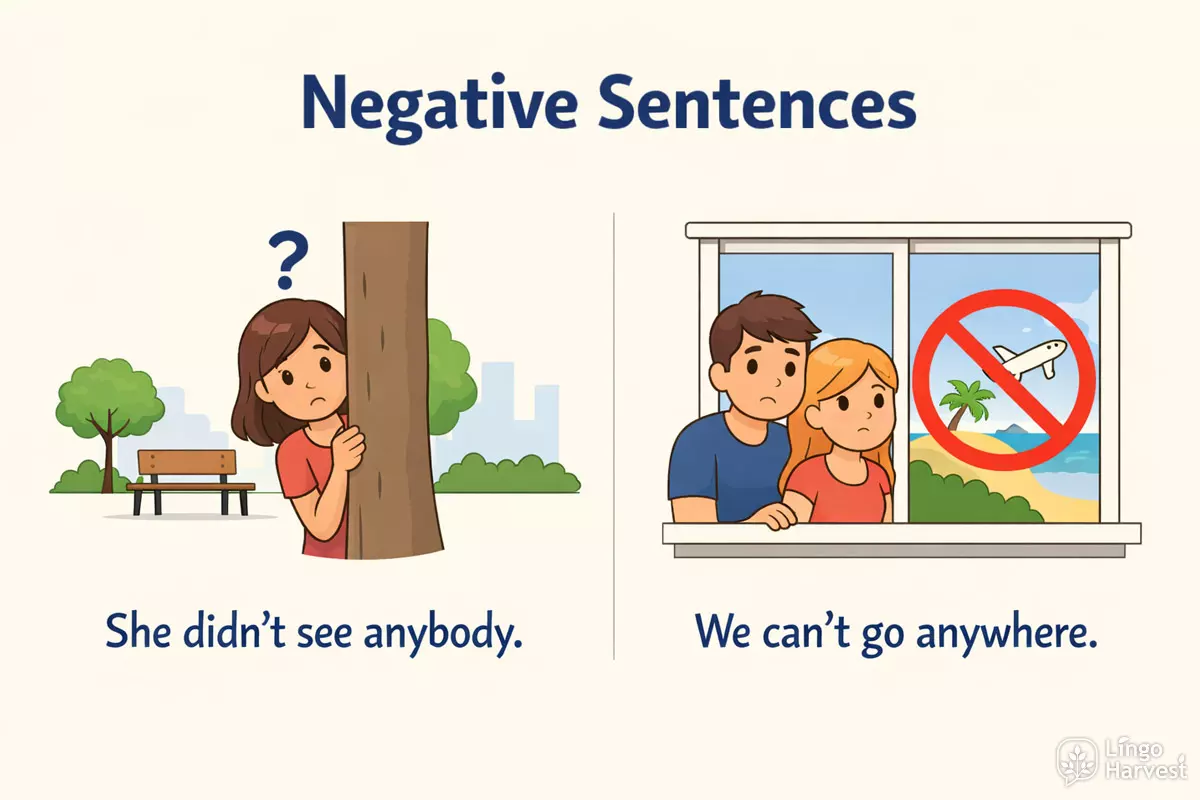
Standard usage usually keeps one negative marker in a clause. If the verb is negative, the other word is normally changed to an any- form (anyone, anything, anywhere), or the sentence is rephrased so the negative appears only once.
- ❌ I don’t know nothing. → ✅ I don’t know anything.
- ❌ She didn’t see nobody. → ✅ She didn’t see anybody.
- ❌ We can’t go nowhere. → ✅ We can’t go anywhere.
- ❌ He doesn’t have no time. → ✅ He doesn’t have any time.
Common error patterns and clean corrections
- ❌ I didn’t do nothing. → ✅ I didn’t do anything.
- ❌ They don’t want no help. → ✅ They don’t want any help.
- ❌ We haven’t got no money. → ✅ We haven’t got any money.
- ❌ She can’t find it nowhere. → ✅ She can’t find it anywhere.
- ❌ I don’t know no one here. → ✅ I don’t know anyone here.
- ❌ He didn’t tell me nothing. → ✅ He didn’t tell me anything.
- ❌ You can’t trust nobody. → ✅ You can’t trust anybody.
- ❌ I won’t buy nothing. → ✅ I won’t buy anything.
- ❌ She didn’t invite nobody. → ✅ She didn’t invite anybody.
- ❌ We don’t need no permission. → ✅ We don’t need any permission.
- ❌ There isn’t no reason to worry. → ✅ There isn’t any reason to worry.
- ❌ I can’t say nothing about it. → ✅ I can’t say anything about it.
- ❌ He didn’t go nowhere yesterday. → ✅ He didn’t go anywhere yesterday.
- ❌ We don’t have nothing to eat. → ✅ We don’t have anything to eat.
- ❌ I can’t see nothing without my glasses. → ✅ I can’t see anything without my glasses.
Important note: nonstandard emphasis vs. standard writing
In some dialects and in informal speech, multiple negatives can be used for emphasis (negative concord). However, in standard academic and professional writing, these forms are treated as errors. If the goal is clear, neutral English, keep to the “single negative” pattern and switch other words to any- forms.
Word order in negative sentences
In English negatives, the key pattern is that not attaches to an auxiliary (or to the verb be). If there is no auxiliary in the affirmative form, English usually adds do/does/did so that not has a place to go. This is why many learner mistakes happen around auxiliaries, contractions, and questions.
Core placement rules
- With be: put not after am/is/are/was/were. Example: “She is not ready.”
- With modal verbs (can, could, will, would, should, must, may, might): put not after the modal. Example: “They cannot park here.”
- With other auxiliaries (have, has, had; am/is/are as progressive): put not after the first auxiliary. Example: “I haven’t finished.” / “He isn’t working today.”
- No auxiliary in the affirmative (simple present/past): use do-support and place not after do/does/did. Example: “She does not agree.” / “We did not go.”
- Keep the main verb in base form after do/does/did. ❌ “He doesn’t likes it.” → ✅ “He doesn’t like it.”
- In multi-auxiliary verb phrases, negate the first auxiliary, not the main verb. Example: “She hasn’t been invited.”
Common word-order errors and fixes
- ❌ “I not understand.” → ✅ “I don’t understand.”
- ❌ “He not is coming.” → ✅ “He isn’t coming.”
- ❌ “They didn’t went.” → ✅ “They didn’t go.”
- ❌ “She doesn’t can drive.” → ✅ “She can’t drive.” (Don’t use do with modals.)
- ❌ “We haven’t went.” → ✅ “We haven’t gone.” (Past participle after have.)
- ❌ “He is not can attend.” → ✅ “He can’t attend.”
- ❌ “I didn’t to call.” → ✅ “I didn’t call.”
- ❌ “She not has finished.” → ✅ “She hasn’t finished.”
- ❌ “They are not understand.” → ✅ “They don’t understand.” (Use be only if it is part of the verb phrase.)
- ❌ “He doesn’t is here.” → ✅ “He isn’t here.”
Negative questions and inversion
- Questions invert the auxiliary and subject, and not stays with the auxiliary: “Do you not agree?”
- Contracted negative questions place the contraction before the subject: “Don’t you agree?” / “Isn’t she coming?”
- With modals: “Can’t they stay?” / “Shouldn’t we call first?”
- With perfect/progressive: “Haven’t you finished?” / “Isn’t he working today?”
Placement with adverbs and objects
- Not comes before the main verb when there is an auxiliary: “She doesn’t often eat out.” / “She doesn’t often eat out.”
- Objects and complements follow the main verb, not the negator: ❌ “I don’t coffee drink.” → ✅ “I don’t drink coffee.”
- Be + adjective/noun: “He isn’t happy.” / “She isn’t a doctor.”
- Negating an infinitive: place not before to in careful writing: “I decided not to go.”
- Negating a gerund: place not before the -ing form: “He apologized for not calling.”
Typical learner errors and corrections
Most problems with negative forms come from mixing patterns: using do-support when it isn’t needed, forgetting the auxiliary when it is needed, or placing not in the wrong position. The items below show frequent mistakes and the standard correction.
- Missing do in the present simple
❌ She not like coffee. → ✅ She doesn’t like coffee.
Pattern: Present simple negatives (except be) need do/does + not. - Missing did in the past simple
❌ They not went yesterday. → ✅ They didn’t go yesterday.
Pattern: Past simple negative is did + not + base verb. - Using the wrong verb form after didn’t
❌ I didn’t went. → ✅ I didn’t go.
Pattern: After didn’t, use the base form, not the past form. - Double marking the negative in standard English
❌ I don’t know nothing. → ✅ I don’t know anything.
Note: Double negatives exist in some dialects, but they are usually treated as non-standard in formal writing. - Negating be with do
❌ He doesn’t be tired. → ✅ He isn’t tired.
Pattern: be negates directly: am/is/are/was/were + not. - Negating modal verbs with do
❌ She doesn’t can drive. → ✅ She can’t drive.
Pattern: Modals negate directly: can/could/will/would/should/must + not. - Wrong word order with modals
❌ He can not to come. → ✅ He can’t come.
Pattern: Modal + not + base verb (no to). - Confusing contractions and spacing
❌ He doesnt work. → ✅ He doesn’t work.
❌ We aren t ready. → ✅ We aren’t ready.
Pattern: Standard contractions use an apostrophe. - Using no where not is required
❌ I’m no hungry. → ✅ I’m not hungry.
Tip: no usually modifies a noun (no time, no idea); not negates verbs and adjectives. - Using not with an indefinite pronoun incorrectly
❌ I didn’t see nobody. → ✅ I didn’t see anybody.
Pattern: In negatives, prefer any- words (anyone/anything/anywhere) in standard usage. - Negating the wrong part of the sentence (scope problems)
❌ I don’t think he is coming (when you mean “I think he isn’t coming”).
✅ I think he isn’t coming. / I don’t think he’s coming (softer, less direct).
Tip: Place the negative where the meaning belongs; English often uses “I don’t think…” to soften opinions. - Placing not after the main verb in continuous tenses
❌ She is working not today. → ✅ She isn’t working today.
Pattern: Auxiliary + not + -ing form (is not working). - Mixing up negatives in the present perfect
❌ I haven’t went there. → ✅ I haven’t gone there.
Pattern: have/has + not + past participle. - Omitting the auxiliary in perfect forms
❌ She not finished yet. → ✅ She hasn’t finished yet.
Pattern: Perfect tenses require have/has (or had). - Incorrect negative questions
❌ Why you don’t like it? → ✅ Why don’t you like it?
Pattern: In questions, the auxiliary comes before the subject. - Confusing mustn’t and don’t have to
❌ You mustn’t pay (when you mean “it’s not necessary”). → ✅ You don’t have to pay.
Meaning: mustn’t = prohibited; don’t have to = not required. - Using any in affirmative sentences when you mean “none”
❌ I have any money. → ✅ I don’t have any money. / I have no money.
Pattern: any commonly appears in negatives and questions; in affirmatives it usually means “it doesn’t matter which.” - Using not with infinitives after certain verbs
❌ I decided to not go (often acceptable, but can sound awkward in some styles).
✅ I decided not to go.
Tip: Both exist; not to + verb is the more common neutral pattern.
When checking your own sentences, identify the verb type first: be, a modal, or “other verbs” that need do/does/did. Then place not right after the auxiliary and keep the main verb in the correct form (base form after do; participle after have).
Homework: verb negation practice tasks
Focus on choosing the correct negative form for the tense and structure (auxiliary verbs, do-support, modals, and negatives with be). Write full sentences, and pay attention to word order, contractions, and meaning differences such as not vs never.
Task 1: Add the correct negative (basic forms)
Rewrite each sentence in the negative. Keep the same tense and meaning.
- She works on Saturdays.
- They are ready.
- I went to the meeting.
- He has finished the report.
- We will agree.
- It rains a lot here in July.
- You were late yesterday.
- Maria can drive.
- The students have been studying.
- I am listening.
Show answers
- She doesn’t work on Saturdays.
- They aren’t ready.
- I didn’t go to the meeting.
- He hasn’t finished the report.
- We won’t agree.
- It doesn’t rain a lot here in July.
- You weren’t late yesterday.
- Maria can’t drive.
- The students haven’t been studying.
- I’m not listening.
Task 2: Fix typical errors (find and correct)
Each sentence contains a common negation mistake. Rewrite it correctly.
- He don’t like coffee.
- She didn’t went yesterday.
- They no are coming.
- I haven’t saw that film.
- We didn’t were at home.
- She doesn’t can swim.
- He isn’t work today.
- I not understand this part.
- They aren’t have any time.
- It didn’t happened.
Show answers
- He doesn’t like coffee.
- She didn’t go yesterday.
- They aren’t coming.
- I haven’t seen that film.
- We weren’t at home.
- She can’t swim.
- He isn’t working today.
- I don’t understand this part.
- They don’t have any time.
- It didn’t happen.
Task 3: Choose the best option (meaning and pattern)
Select the correct choice (A or B). Write the full corrected sentence.
- A) I’m not agree. B) I don’t agree.
- A) She hasn’t any siblings. B) She doesn’t have any siblings.
- A) He didn’t use to smoke. B) He doesn’t used to smoke.
- A) You mustn’t park here. B) You don’t must park here.
- A) We haven’t been there. B) We didn’t been there.
- A) I can’t hardly hear you. B) I can hardly hear you.
- A) They weren’t able to attend. B) They didn’t able to attend.
- A) She never doesn’t call. B) She never calls.
Show answers
- B) I don’t agree.
- B) She doesn’t have any siblings.
- A) He didn’t use to smoke.
- A) You mustn’t park here.
- A) We haven’t been there.
- B) I can hardly hear you.
- A) They weren’t able to attend.
- B) She never calls.
Task 4: Translate into natural English negatives
Translate each idea into English. Use a natural negative structure (not a word-for-word translation).
- Я не знаю.
- Мы не работаем по воскресеньям.
- Он не был дома вчера.
- Она ещё не закончила.
- Тебе не нужно спешить.
- Я никогда там не был(а).
- Они не смогут прийти.
- Это не имеет смысла.
Show answers
- I don’t know.
- We don’t work on Sundays.
- He wasn’t at home yesterday.
- She hasn’t finished yet.
- You don’t need to hurry.
- I’ve never been there.
- They won’t be able to come. / They can’t come.
- It doesn’t make sense.
Task 5: Personalization drill (build your own correct negatives)
Write one true negative sentence for each prompt. Use contractions in half of your sentences and full forms in the other half.
- Present simple: something you do not do on weekdays.
- Past simple: something you did not do last weekend.
- Present continuous: something you are not doing right now.
- Present perfect: something you have not done yet this month.
- Future: something you will not do tomorrow.
- Modal: something you cannot do (ability) or must not do (rule).
- Be: a situation you are not in (e.g., “I’m not…”, “They aren’t…”).
- Negative adverb: one sentence with never (avoid double negatives).
Self-check before submitting: ✅ one auxiliary per clause (don’t add do if there is already be, have, or a modal); ✅ base verb after do/does/did; ❌ avoid double negatives like don’t never unless you intentionally mean “sometimes”.