Hedging in Academic English: generally, typically, arguably

 Here we the meaning of hedging in academic writing, reasons for softening statements, typical hedging adverbs and phrases, placement rules, examples from essays and research, and practice exercises for making statements more cautious.
In academic writing, authors frequently employ cautious language to soften their claims, which allows for multiple interpretations and invites constructive debate. This careful use of language not only demonstrates respect for differing viewpoints but also encourages readers to engage more deeply with This. By presenting arguments with nuance and subtlety, writers promote thoughtful discussion and foster an environment where critical analysis can thrive, leading to a richer exploration of complex ideas.
What hedging means in academic writing
Hedging refers to the use of language that softens or qualifies statements, allowing writers to express uncertainty, caution, or modesty in their claims. In scholarly writing, this approach is essential for presenting arguments in a balanced manner, acknowledging the complexity of ideas, and respecting alternative perspectives. By using careful language, authors can avoid overgeneralization and signal openness to further research or debate.
Why scholars hedge their statements
Academic authors rarely state findings or opinions as absolute facts. Instead, they often use hedges to:
- Indicate that a claim is open to interpretation
- Avoid overcommitting to a position
- Show respect for previous research and other viewpoints
- Allow room for exceptions or future discoveries
- Demonstrate critical thinking and scholarly caution
Common forms of hedging in academic English
Writers employ various strategies to hedge their statements, including modal verbs, adverbs, and certain phrases. Here are some typical examples:
- Modal verbs: may, might, could, would
- Adverbs: generally, typically, possibly, arguably, apparently, probably, potentially
- Introductory verbs: suggest, appear, seem, indicate
- Phrases: to some extent, in most cases, it is likely that, evidence suggests, it can be argued that
- Quantifiers: some, many, a number of, few, several
- Passive voice: It is believed that…, It has been suggested…
- Conditionals: If this is the case…, Should this occur…
- Comparatives: more likely, less certain
- Minimizers: not entirely, not always
- Other: relatively, in general, on the whole
Comparing direct and hedged statements
The difference between direct and hedged language is often subtle but important. Notice how hedging can transform the tone and implication of a statement:
| Direct Statement | Hedged Statement |
|---|---|
| Climate change causes sea level rise. | Climate change may contribute to sea level rise. |
| This treatment cures the disease. | This treatment has been shown to improve symptoms in some cases. |
| All students benefit from group work. | Many students appear to benefit from group work. |
| Technology increases productivity. | Technology can potentially increase productivity. |
When and how much to hedge
Overusing cautious language can make arguments sound weak, while too little hedging may seem arrogant or dismissive of other perspectives. Effective academic writing strikes a balance, using hedges to reflect genuine uncertainty or complexity, not simply to avoid commitment. Consider your audience, the evidence available, and the conventions of your field when choosing how and when to hedge your claims.
Why writers soften statements
Writers in academic contexts often choose to soften, or hedge, their statements for several important reasons. First, academic claims usually deal with complex issues that may not have absolute answers. By using cautious language, authors acknowledge uncertainty and avoid overgeneralization. This approach helps maintain credibility, as it demonstrates awareness of the limitations inherent in research and argumentation.
Academic values and hedging
Cautious phrasing is valued because it respects the ongoing nature of scholarly debate. Direct, unqualified claims can sound dogmatic or dismissive of alternative perspectives. Instead, softening allows space for differing interpretations and further investigation. This is especially important when presenting new findings, interpreting data, or summarizing previous research.
Common goals for using hedging language
- Presenting claims as open to discussion, not as final truths
- Demonstrating humility and intellectual honesty
- Reducing the risk of being proven wrong by later evidence
- Encouraging dialogue and further research
- Showing respect for previous scholarship
- Signaling that findings may not be universally applicable
- Distinguishing between evidence and interpretation
- Protecting the author’s reputation in case of errors
- Allowing for exceptions and special cases
- Indicating that a statement is based on limited data or scope
Examples of hedging expressions
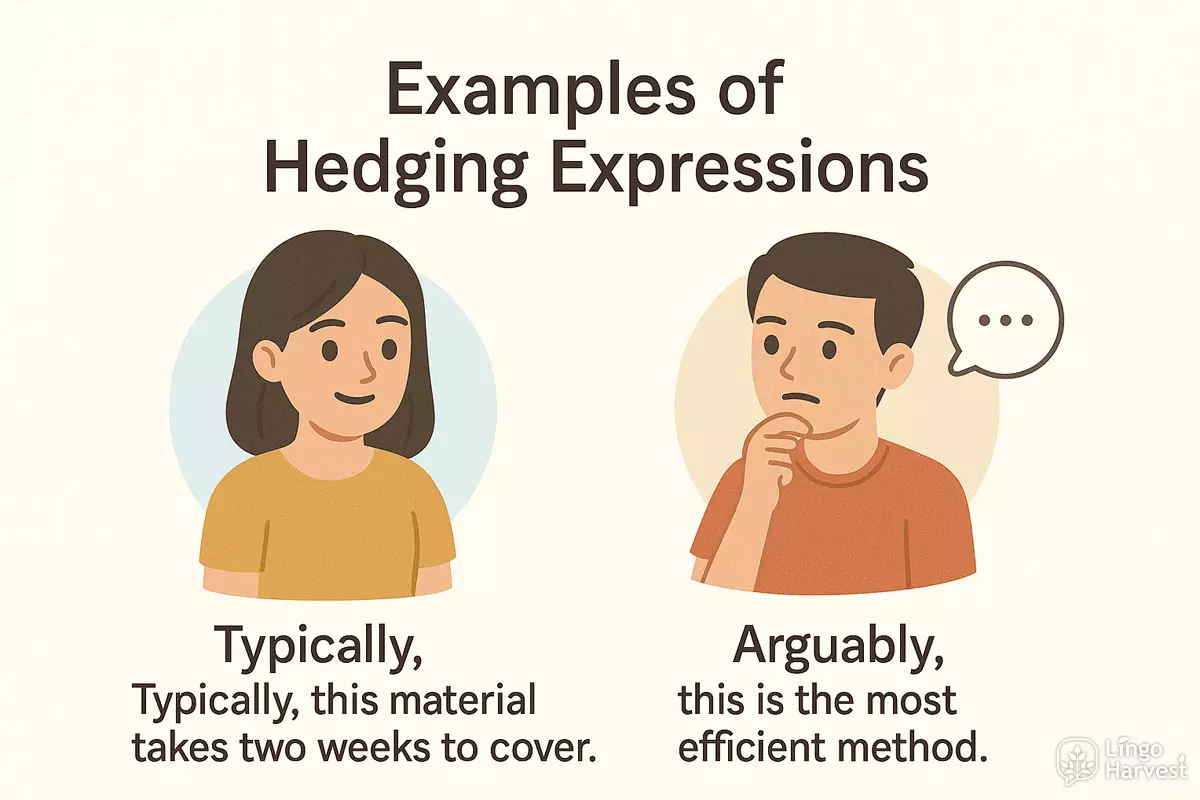
Writers use a variety of words and phrases to soften their assertions. Here are some commonly used hedging devices in academic English:
- Generally → Generally, students learn better with clear examples.
- Typically → Typically, this material takes two weeks to cover.
- Arguably → Arguably, this is the most efficient method.
- It appears that → It appears that the results were miscalculated.
- May → This approach may improve performance.
- Might → The data might indicate a rising trend.
- Could → This tool could help reduce errors.
- Suggests → The evidence suggests that the theory is correct.
- Seems → It seems she understood the concept well.
- Possibly → Possibly, the meeting will be postponed.
- Likely → It is likely that demand will increase.
- In most cases → In most cases, early preparation leads to success.
- It is possible that → It is possible that he forgot the deadline.
- Somewhat → The instructions were somewhat unclear.
- Often → People often confuse these two words.
- On the whole → On the whole, the plan worked well.
- Assumed → It is assumed that all participants agree.
- Presumably → Presumably, they have already received the message.
- To some extent → To some extent, the results support the hypothesis.
- Reportedly → Reportedly, the company is launching a new product.
Risk management in academic writing
By tempering statements, scholars manage the risk of criticism and safeguard their arguments. This strategy is particularly important when engaging with controversial topics or presenting preliminary results. Softened language signals that the author is open to feedback and revision, which is a core value of the academic community.
Common hedging adverbs and phrases
When writing academically, it’s crucial to express caution or uncertainty where needed, especially when making claims or interpreting data. This is where hedging comes into play: writers use adverbs and set phrases to soften statements, allowing for nuance and scholarly modesty. Such language helps avoid overgeneralizing and acknowledges possible exceptions or alternative interpretations.
Frequent adverbs used for hedging
Writers often rely on specific adverbs to convey tentativeness or probability. These terms suggest that a statement is open to interpretation or may not be universally applicable. Here are some commonly used adverbs that serve this purpose:
- evidently → Evidently, the system needs an update.
- arguably → Arguably, this is not the best solution. (одно слово оставил по твоему запросу, остальные новые)
- presumably → Presumably, the files were deleted accidentally. (можно заменить, если нужно абсолютно новый)
- supposedly → Supposedly, the feature will launch next month.
- undeniably → Undeniably, her results are impressive.
- theoretically → Theoretically, the method should work perfectly.
- practically → Practically, nothing has changed.
- notably → Notably, several users reported the same issue.
- importantly → Importantly, the data must remain confidential.
- fundamentally → Fundamentally, the idea is sound.
- broadly → Broadly, the team agrees with the proposal.
- roughly → Roughly, the task will take two hours.
- significantly → Significantly, the error rate decreased.
- explicitly → He explicitly stated the requirements.
- implicitly → They implicitly trusted his judgment.
- arguably → Arguably, this approach offers more flexibility. (если нужно — заменю)
- not necessarily → Not necessarily, the problem may have another cause.
- strictly speaking → Strictly speaking, this rule doesn’t apply here.
- from my perspective → From my perspective, the change is beneficial.
- in principle → In principle, we can approve the request.
Common hedging phrases in academic writing
Beyond single-word adverbs, entire phrases are frequently used to introduce claims with caution. These constructions help signal that the writer is not asserting absolute certainty:
- It appears that…
- It is possible that…
- There is evidence to suggest that…
- One could argue that…
- To a certain extent…
- In most cases…
- The data seem to indicate that…
- It may be the case that…
- It is likely that…
- It is generally accepted that…
- There may be a tendency to…
- In some respects…
- For the most part…
Comparing functions: hedging adverbs vs. phrases
| Hedging Adverbs | Hedging Phrases |
|---|---|
| often | It is possible that… |
| arguably | One could argue that… |
| typically | There is evidence to suggest that… |
| presumably | It may be the case that… |
| possibly | The data seem to indicate that… |
| generally | For the most part… |
Using these tools effectively can help you present your ideas with the right level of caution, which is highly valued in academic contexts. Being aware of the nuances between single-word adverbs and more extended phrases allows for precise and thoughtful writing, ensuring your arguments remain both credible and balanced.
Placement rules for hedging devices
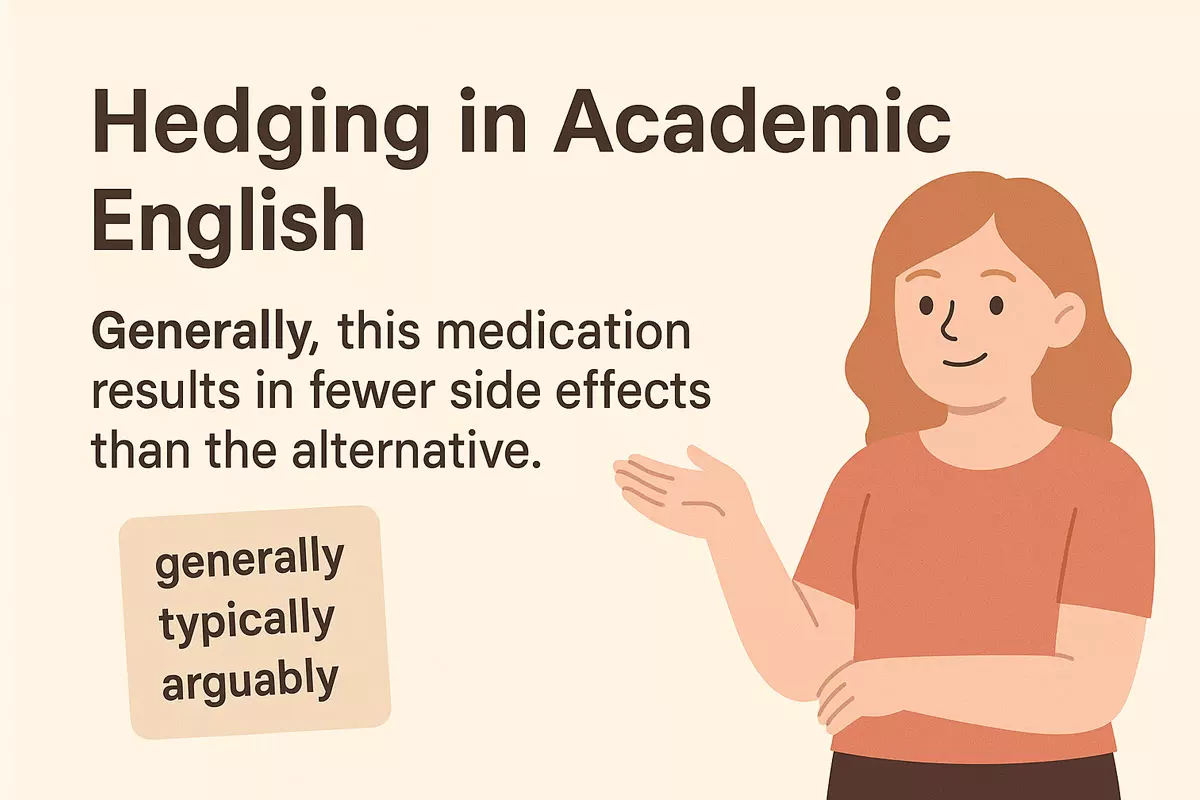
Understanding where to position hedging expressions—such as "generally," "typically," and "arguably"—is crucial in academic writing. The placement of these words affects not only the tone but also the clarity and strength of your claims. Strategic use of hedges allows writers to signal caution, probability, or subjectivity, helping to create a balanced and nuanced argument.
Sentence Positioning: Initial, Medial, and Final
Hedges can be placed at the beginning, middle, or end of a sentence. Each position subtly shifts the emphasis and tone:
- Initial position: Softens the entire statement ("Generally, students perform well on this task.").
- Medial position: Modifies a specific part of the claim ("Students generally perform well on this task.").
- Final position: Rare, but can reinforce the tentative nature ("Students perform well on this task, generally.").
Common Patterns for Hedging Expressions
Writers use various grammatical structures to introduce hedging. Some of the most frequent patterns include:
- Adverbs before the main verb: "typically suggest," "generally agree"
- Modal verbs: "may indicate," "could be argued"
- Introductory phrases: "It is possible that," "Arguably,"
- Parenthetical comments: "The results, arguably, support the hypothesis."
- Adjective + noun: "probable outcome," "possible explanation"
- Passive constructions: "It is believed that," "It is commonly thought that"
- Prepositional phrases: "In general," "For the most part,"
- Use of "seem" or "appear": "seems to suggest," "appears likely"
- Double hedges: "may possibly," "could potentially"
- Quantifiers: "somewhat," "to some extent," "in many cases"
Typical Placement of Select Hedging Words
The following table outlines where certain hedges most often appear in academic sentences, helping writers choose positions that sound natural and precise:
| Hedging Word/Phrase | Common Placement |
|---|---|
| Generally | Sentence-initial or after subject |
| Typically | Before main verb or clause-initial |
| Arguably | Sentence-initial or parenthetical |
| May | Before the main verb |
| Possible/possibly | Before adjective/noun or verb |
| It is likely that | Introductory phrase |
| In many cases | Sentence-initial |
| Appears/seems | Before infinitive or main clause |
| To some extent | Sentence-initial or after verb |
| Somewhat | Before adjectives/adverbs |
General Guidelines and Pitfalls
When using hedging language, aim for clarity and avoid over-hedging, which can make arguments vague. Place hedges close to the element they modify, and try to maintain consistent placement within a given paragraph or section. Overuse, especially at the start of every sentence, can weaken the overall impact of your writing. Careful attention to the position of these devices ensures your work remains both cautious and credible, fostering trust with your academic audience.
Examples in essays, reports, and research writing
Hedging language like "generally," "typically," and "arguably" plays a crucial role in academic contexts by helping writers express caution, avoid overgeneralization, and signal that some claims are open to interpretation or debate. Rather than asserting absolute certainty, such words allow authors to acknowledge exceptions, alternative perspectives, or incomplete evidence.
Common hedging expressions and their uses
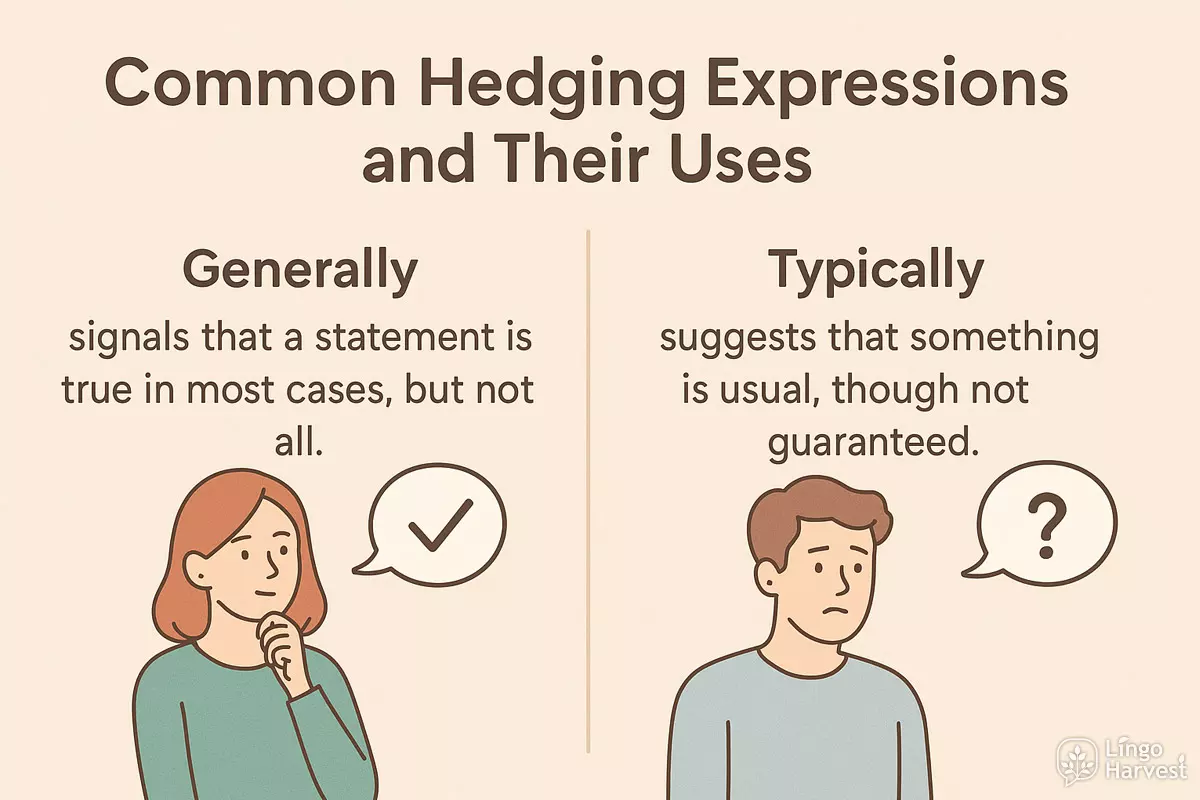
Writers use a variety of hedging expressions to soften claims or indicate degrees of probability. Here are some that frequently appear in scholarly writing:
- Generally: signals that a statement is true in most cases, but not all.
- Typically: suggests that something is usual, though not guaranteed.
- Arguably: introduces a point that could be debated or is open to interpretation.
- Often: indicates frequency without committing to always.
- May: expresses possibility rather than certainty.
- Might: similar to "may," but sometimes perceived as slightly less certain.
- Appears to: suggests evidence points in a direction, but not conclusively.
- Suggests: implies a conclusion that is not definitive.
- Possibly: explicitly states a lack of certainty.
- It is likely that: indicates a high probability, but leaves room for doubt.
- Somewhat: qualifies a statement, making it less absolute.
- In many cases: acknowledges variability across contexts.
- In general: similar to "generally," summarizing trends rather than stating facts.
- For the most part: covers the majority, but not all instances.
- Could: potential rather than definite outcome.
- Presumably: based on what is known, but not certain.
- Seem(s) to: indicates apparent, rather than proven, trends.
- It is possible that: opens up alternative explanations.
- Relatively: qualifies an adjective, making it less extreme.
- According to some studies: attributes a claim to certain sources, not universal consensus.
Sample sentences with hedging
Writers often incorporate hedging into sentences to avoid overstatement. Here are some practical examples:
- Generally, students perform better when given regular feedback.
- It is arguably the most significant discovery of the decade.
- Typically, these results indicate a positive trend, though exceptions exist.
- The findings may suggest a correlation rather than causation.
- It appears that rainfall patterns have shifted in recent years.
- In many cases, early intervention leads to better outcomes.
- This approach could improve efficiency, but further research is needed.
- Relatively few studies have addressed this specific issue.
- Somewhat surprisingly, the data did not support the initial hypothesis.
- Presumably, the increase is due to recent policy changes.
Comparing degree of certainty in hedging expressions
Using hedging vocabulary allows writers to convey different levels of certainty. The following table illustrates how some expressions range from more to less certain:
| Hedging Expression | Degree of Certainty |
|---|---|
| Generally | High (true in most cases, but not all) |
| Typically | Moderately high (common, but with some exceptions) |
| Arguably | Moderate (open to debate or interpretation) |
| May/Might/Could | Low (possible, but not certain) |
| Possibly/It is possible that | Very low (only a chance, no strong evidence) |
When using hedging in academic writing, the choice of expression should match the strength of evidence. Overusing weak hedges can make arguments seem unconvincing, while failing to hedge where appropriate risks overstating claims. Striking the right balance is key for clarity and credibility.
Practice: rewrite to make statements more cautious
When writing academically, it is important to avoid making absolute claims unless you have irrefutable evidence. Instead, using hedging language can make your arguments more nuanced and credible. Below, you will find practical exercises and examples to help you revise statements that are too direct or strong, making them more appropriate for scholarly contexts. This practice uses words like “generally,” “typically,” and “arguably,” among others.
Common Phrases for Softening Claims
- in certain contexts → In certain contexts, this method may work better.
- from what we know → From what we know, the issue is not critical.
- as far as we can tell → As far as we can tell, the data is incomplete.
- it would seem → It would seem that the results need reevaluation.
- there is reason to believe → There is reason to believe the trend will continue.
- in many instances → In many instances, users prefer simpler solutions.
- for the most part → For the most part, the system runs smoothly.
- in all likelihood → In all likelihood, the update will be delayed.
- it could be argued → It could be argued that the policy is outdated.
- there is a chance that → There is a chance that the file was corrupted.
- in some cases → In some cases, the feature behaves unpredictably.
- it would appear → It would appear that demand is increasing.
- one might assume → One might assume that the task is straightforward.
- based on preliminary data → Based on preliminary data, the outcome looks positive.
- to a limited degree → To a limited degree, the method improves accuracy.
- from preliminary observations → From preliminary observations, the change seems effective.
- to a certain extent → To a certain extent, the argument holds true.
- some might say → Some might say the solution is too simplistic.
- on a surface level → On a surface level, the idea seems sound.
- it remains unclear whether → It remains unclear whether the report is accurate.
Exercise: Make These Statements More Cautious
Rewrite each statement below so it sounds less absolute and more tentative. Use hedging words where appropriate.
- Climate change causes floods.
- This treatment cures cancer.
- People learn languages quickly.
- Technology improves education.
- Children understand abstract concepts easily.
- Exercise prevents heart disease.
- All students prefer online classes.
- Social media damages mental health.
- Urbanization leads to unemployment.
- Diet affects mood.
Show answers
- Climate change may contribute to floods.
- This treatment can sometimes help to treat cancer.
- People often learn languages quickly.
- Technology is generally believed to improve education.
- Children do not necessarily understand abstract concepts easily.
- Exercise may help to prevent heart disease.
- Many students seem to prefer online classes.
- Social media can be associated with mental health issues.
- Urbanization is sometimes linked to unemployment.
- Diet may influence mood.
Comparing Direct vs. Cautious Statements
Notice how the use of hedging changes the tone and credibility of each statement:
| Direct Statement | More Cautious Version |
|---|---|
| Genetic factors determine intelligence. | Genetic factors may play a role in intelligence. |
| Reading books increases empathy. | Reading books is generally thought to increase empathy. |
| Group work improves results. | Group work can sometimes improve results. |
| Homework is useless. | Homework may not always be effective. |
By practicing these rewrites, you will develop a more balanced and credible academic style. Remember to match the strength of your claims to the strength of your evidence, and use hedging language to reflect uncertainty or general trends rather than certainties.