Fillers vs True Adverbs: really, actually, literally

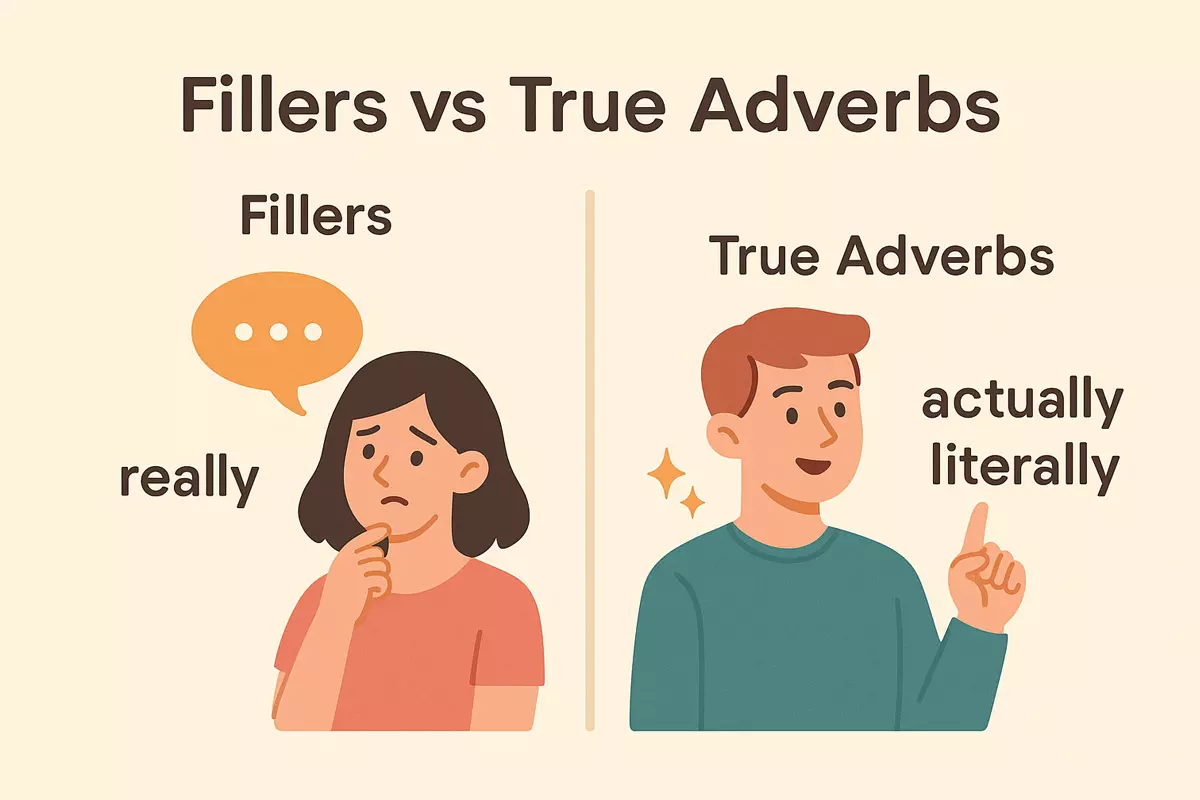 Here we how fillers differ from meaningful adverbs, their effect on tone and clarity, and the correct use of really, actually, and literally. It also discusses overuse, gives examples, and offers practice in editing out fillers.
Words like really, actually, and literally frequently appear in our speech and writing, but they do not always fulfill their intended grammatical purpose. Sometimes, these terms act as unnecessary fillers rather than meaningful modifiers, which can weaken the clarity and impact of our communication. By becoming more aware of how and when we use such words, we can make our language more precise and effective, ensuring that every word contributes to our intended message.
Difference between fillers and meaningful adverbs
When we speak or write, words like really, actually, and literally can play two very different roles. Sometimes they add substance and clarify meaning; other times, they’re just extra noise—so-called “fillers.” Distinguishing between genuine adverbs and empty fillers helps make language more precise and effective.
What are filler adverbs?
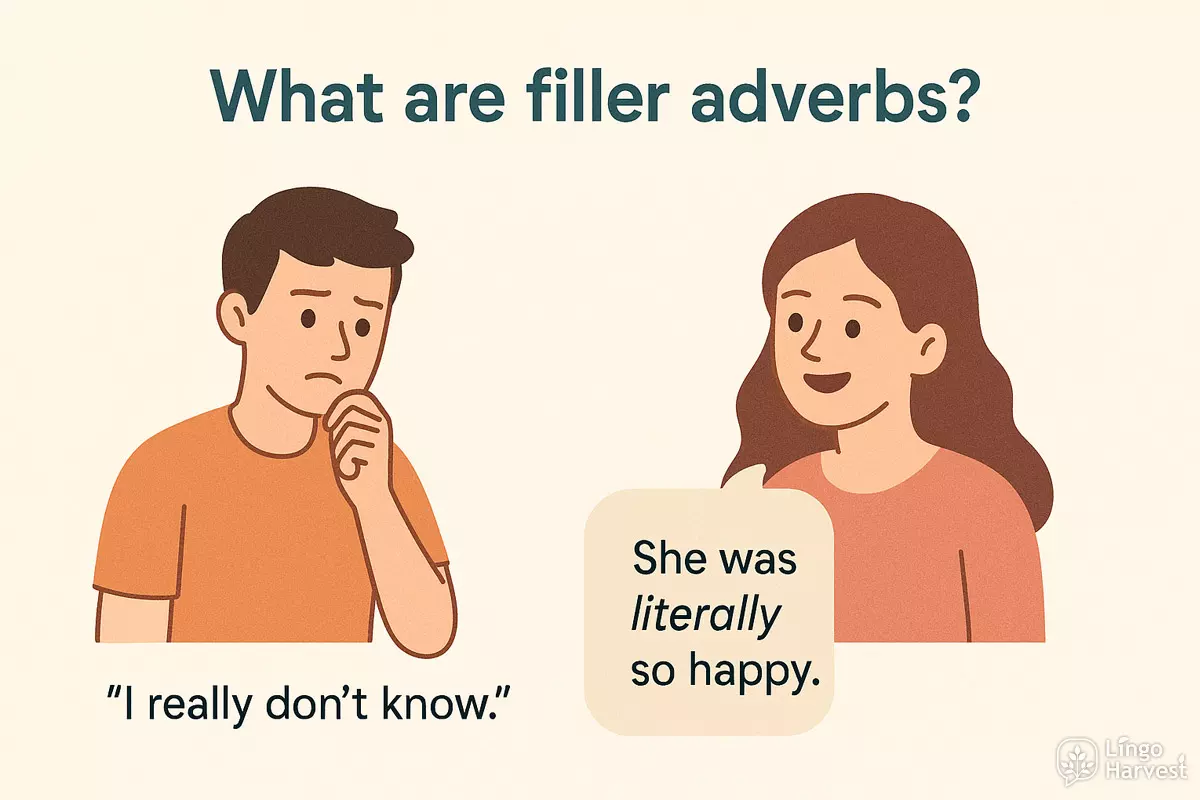
Filler adverbs are words that sneak into sentences without adding real meaning or detail. Speakers often use them out of habit, to buy time, or to sound more conversational. In these cases, the word could be removed without changing the message:
- “I really don’t know.” (No extra emphasis—just a habit.)
- “She was literally so happy.” (Here, literally doesn’t mean ‘in a literal sense’.)
- “He actually left early.” (If ‘actually’ doesn’t contrast expectation, it’s just filler.)
How do meaningful adverbs work?
In contrast, meaningful adverbs clarify, intensify, or change the sense of a statement. They offer new information or highlight something important. For example:
- “She literally ran a marathon.” (Emphasizes the literal, not figurative, meaning.)
- “I actually finished the project early.” (Contrasts with what was expected.)
- “He really loves jazz.” (Adds genuine emphasis.)
Quick comparison
| Filler Use | Meaningful Use |
|---|---|
| “I really think it’s fine.” (No extra emphasis; just habitual.) |
“He really saved the day.” (Strong emphasis on the action.) |
| “She literally died laughing.” (Not literal; just exaggeration.) |
“The instructions were literally unclear.” (Means exactly as stated.) |
| “I actually have no idea.” (No contrast to expectation.) |
“She actually won the contest!” (Unexpected outcome.) |
| “It’s really cold, you know?” (‘Really’ adds little or no force.) |
“This literally changes everything.” (Indicates a true, significant shift.) |
Spotting the difference in real-life speech
If you can remove the adverb without losing meaning or clarity, it’s probably just a filler. When the word changes the tone, intensity, or the factual detail, it’s meaningful. Here’s a quick checklist for identifying them:
- ✅ Adds emphasis or contrast? (Meaningful)
- ✅ Changes the factual meaning? (Meaningful)
- ❌ Habitual with no real effect? (Filler)
- ❌ Used for hesitation or speech flow only? (Filler)
Paying attention to the role these adverbs play can help you speak and write with more precision, making your communication clearer and more engaging.
How fillers affect tone and clarity
Using words like "really," "actually," and "literally" as fillers can subtly change the impression your writing or speech leaves. While these words can intensify a statement or clarify intent, their overuse often leads to vagueness or even undermines the message. Instead of adding precision, fillers may make sentences sound hesitant or unnecessarily wordy.
Impact on Communication
Fillers often give the impression of uncertainty or exaggeration. In formal writing, their presence may weaken arguments or distract from the main point. In conversation, they can serve as softeners or signals of politeness, but frequent repetition can dilute meaning and reduce the listener’s trust in the speaker’s statements.
- Emphasis vs. Excess: Using "literally" or "really" for emphasis can be effective, but constant use blunts their impact.
- Clarity: Fillers may obscure what you actually mean, making it harder for readers or listeners to follow your point.
- Tone: They can make statements sound less confident or more informal than intended.
- Credibility: Over-reliance on these words may make arguments seem exaggerated or insincere.
Common Filler Adverbs and Their Effects
The table below highlights how these adverbs function differently when used as fillers versus as true adverbs, affecting both message and style.
| Word | As a Filler | As a True Adverb |
|---|---|---|
| really | Weakens statements if overused; can signal uncertainty ("I really think...") | Strengthens or intensifies meaning ("She really likes music") |
| actually | May sound defensive or condescending ("Actually, I...") | Clarifies factual accuracy ("He actually finished early") |
| literally | Often used for exaggeration, which can confuse ("I literally died laughing") | Specifies exactness ("He literally ran five miles") |
| basically | Can make explanations vague or oversimplified ("Basically, it's fine") | Summarizes or simplifies accurately ("Basically, the process works like this...") |
| seriously | Might sound like an afterthought or filler ("Seriously, you should try it") | Expresses genuine intent or importance ("She seriously considered the offer") |
| honestly | May raise doubt about previous honesty ("Honestly, I didn't know") | Signals truthful intent ("He answered honestly") |
| totally | Used to agree or exaggerate ("Totally, I get it") | Indicates completeness ("She totally forgot the meeting") |
| just | Softens statements, sometimes making them less direct ("I just wanted to say...") | Limits scope ("I just finished the report") |
Guidelines for Clearer Expression
- Be mindful of adverb frequency—use them purposefully.
- Replace vague fillers with precise language whenever possible.
- Read sentences aloud to check if a filler adds value or simply takes up space.
- In formal writing, aim for directness and clarity by avoiding unnecessary intensifiers.
Recognizing the subtle ways in which filler adverbs shape tone and understanding helps writers and speakers make more deliberate choices, leading to clearer and more effective communication.
Correct grammatical uses of really/actually/literally
Understanding when to use "really," "actually," and "literally" as true adverbs (rather than as fillers) helps communicate your meaning with clarity and precision. Each word serves a distinct grammatical function, and using them properly avoids confusion or exaggeration.
How these adverbs function
- Really intensifies meaning, often acting as a modifier for adjectives or verbs. It suggests something is true to a significant degree.
- Actually clarifies factual correctness or introduces contrast, frequently used to correct misunderstandings or highlight reality.
- Literally emphasizes that something is true in a non-figurative sense, countering exaggeration or metaphor.
Examples of proper usage
- She really enjoys classical music. (intensifies 'enjoys')
- He actually arrived on time, despite the traffic. (contrasts with expectation)
- I literally ran five miles this morning. (non-figurative, not an exaggeration)
- This is really important. (emphasizes importance)
- The rumors are actually true. (confirms factual truth)
- My phone literally exploded. (if it truly did, not just overheated)
- She really wants to help. (strengthens 'wants')
- Do you actually know the answer? (asks about factual knowledge)
- He literally jumped out of his chair. (if he physically did so)
- This tastes really good. (intensifies 'good')
- Is that actually what happened? (seeks factual confirmation)
- The mountain was literally covered in snow. (direct, not metaphorical)
Quick comparison of their grammatical roles
| Word | Primary Function | Example in Context |
|---|---|---|
| Really | Intensifies degree (adverb) | She is really tired. |
| Actually | Expresses factual truth or contrast | He actually finished early. |
| Literally | Indicates non-figurative meaning | The room was literally freezing. |
Common mistakes and how to avoid them
- Using literally for emphasis in place of "really" when the meaning is not literal. ❌ "I literally died laughing." (Use "really" unless you mean actual death.)
- Employing actually as a filler with no factual correction or contrast. ❌ "So, actually, I was just thinking..."
- Placing really before non-gradable adjectives (e.g., "unique," "perfect"). ❌ "That's really unique." ("Unique" is absolute.)
Choosing the right adverb strengthens your point and keeps your language accurate. These words add nuance when used thoughtfully, rather than as empty fillers.
When these adverbs become overused
Frequent use of words like "really," "actually," and "literally" can make speech or writing sound less precise and more repetitive. Instead of adding clarity, these terms often become verbal tics—words we reach for out of habit rather than necessity. This can weaken the impact of what’s being communicated and even cause listeners or readers to tune out.
Common signs of excessive use
- The same intensifier appears in almost every sentence: "I was really tired, and it was really late, so I was really annoyed."
- Adverbs are added where they're not needed: "I literally died laughing" (when nobody actually died).
- They replace more descriptive language: choosing "really big" instead of "enormous" or "huge."
Effects on clarity and credibility
Overreliance on these adverbs can dilute your message. Instead of emphasizing a point, repeated fillers may make statements seem exaggerated or insincere. For example, if someone says, "I actually finished the project," it may sound as if finishing was unexpected—or that the speaker doubts their own words. Likewise, "literally" is often misused, leading to confusion or even humor when the intent was seriousness.
Alternatives to overused adverbs
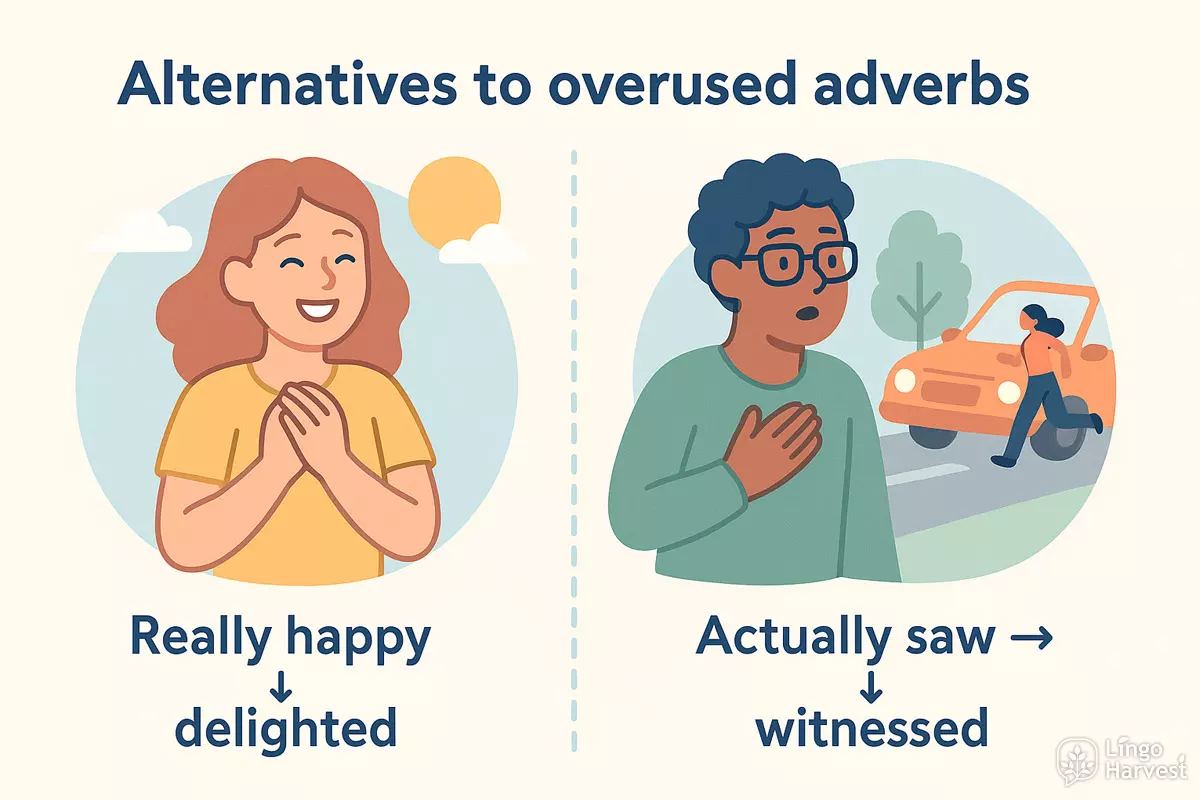
Consider swapping out these habitual words for more precise vocabulary, or omitting them altogether when they add no real meaning. Here are some options:
- Very tired → exhausted
- Really happy → delighted
- Actually saw → witnessed
- Literally freezing → freezing
- Really important → crucial
- Actually don’t know → unsure
- Really fast → rapid
- Literally burning → on fire (if true!)
- Really loud → deafening
- Actually helpful → beneficial
- Really small → tiny
- Literally overflowing → brimming
- Really scared → terrified
- Actually tried → attempted
- Really old → ancient
- Literally impossible → impossible
- Really smart → brilliant
- Actually believe → trust
Why moderation matters
Using intensifiers and clarifiers sparingly makes them more powerful when you do choose them. Your language becomes more vivid and trustworthy, and your audience is more likely to pay attention to what you’re saying. Thoughtful word choice is a simple but effective way to improve both spoken and written communication.
Examples in spoken and written English
Understanding how "really," "actually," and "literally" function as both fillers and true adverbs is easier when you look at how they're used in different contexts. In everyday conversation, these words often serve to add emphasis or to give the speaker time to think. In formal writing, their roles shift, and they're typically used with more precision.
Spoken English: Common Patterns
- Filler: "I was, like, really just waiting for the bus."
- True adverb: "She really enjoys classical music."
- Filler: "Actually, I think we should leave now."
- True adverb: "He actually completed the marathon."
- Filler: "Literally, it was the worst day ever."
- True adverb: "The volcano literally erupted yesterday."
- Filler: "So, like, literally, what are we doing?"
- Filler: "Really, I mean, who does that?"
- True adverb: "She literally jumped out of her seat when she heard the news."
- True adverb: "Actually, he is the manager, not the assistant."
Written English: Precise Usage
In writing, especially academic or professional contexts, "really," "actually," and "literally" are used less as fillers and more to clarify meaning or add emphasis. Overuse or misuse—especially of "literally"—is often frowned upon.
- "The experiment really demonstrates the hypothesis."
- "She actually won the competition, despite the odds."
- "The instructions literally state to mix the liquids slowly."
- "His performance really impressed the judges."
- "The author actually predicted this trend in 2010."
Comparison Table: Filler vs. True Adverb Usage
| Word | Filler Example | True Adverb Example |
|---|---|---|
| really | "I was really, um, surprised." | "She really loves jazz music." |
| actually | "Actually, I don't know." | "He actually arrived early." |
| literally | "It was literally so cool." | "The dog literally jumped the fence." |
In summary, the way these adverbs are used can change their function. In speech, they often act as fillers or discourse markers, while in writing, precise use as modifiers is preferred. Paying attention to context helps distinguish between these roles.
Short practice: remove or replace fillers
Fillers like really, actually, and literally often appear in speech and writing. Sometimes they add clarity, but often they can be removed or replaced by more precise words. Practicing how to spot and edit these can make your language clearer and more professional.
Identify and edit unnecessary fillers
Below are sentences containing common fillers. Try to either remove the filler or replace it with a more accurate word or phrase. In some cases, the statement is stronger or more direct without the filler.
- She really likes chocolate.
- This is literally the best day ever.
- I actually finished my homework early.
- He was really tired after the trip.
- I'm actually not sure about that.
- It was literally freezing outside.
- They really need your help.
- She was actually surprised by the results.
- The movie was literally three hours long.
- I really appreciate your advice.
Show answers
- She likes chocolate. (Or: She loves chocolate.)
- This is the best day ever.
- I finished my homework early. (Or: I managed to finish my homework early.)
- He was tired after the trip. (Or: He was exhausted after the trip.)
- I'm not sure about that. (Or: I have doubts about that.)
- It was freezing outside.
- They need your help. (Or: They urgently need your help.)
- She was surprised by the results.
- The movie was three hours long.
- I appreciate your advice. (Or: I value your advice.)
Alternative words and phrases
Instead of using vague intensifiers or unnecessary adverbs, choose words that express your meaning more precisely. Here are alternatives to common fillers:
- really → very, extremely, truly, absolutely, definitely, clearly, strongly
- actually → in fact, as a matter of fact, in reality, truly, to be honest
- literally → exactly, precisely, truly, in fact, without exaggeration
Practice: Fill in with a stronger word or remove the filler
Choose the best way to improve each sentence: either remove the filler or replace it with a stronger, more accurate word.
- He really enjoys science fiction novels.
- She literally jumped for joy.
- I actually saw her at the store.
- This cake is really sweet.
- It was actually quite difficult.
- They really need to finish the report today.
- He literally ran the entire way home.
- She actually knows three languages.
- The room is really cold tonight.
- The task was actually easier than I expected.
Show answers
- He enjoys science fiction novels. (Or: He loves science fiction novels.)
- She jumped for joy. (Or: She leapt for joy.)
- I saw her at the store. (Or: I happened to see her at the store.)
- This cake is sweet. (Or: This cake is extremely sweet.)
- It was quite difficult. (Or: It was challenging.)
- They need to finish the report today. (Or: They urgently need to finish the report.)
- He ran the entire way home. (Or: He sprinted all the way home.)
- She knows three languages. (Or: She speaks three languages fluently.)
- The room is cold tonight. (Or: The room feels unusually cold tonight.)
- The task was easier than I expected. (Or: The task turned out to be simple.)
Tips for editing fillers
- Read your sentence aloud—does the filler add meaning or can it be cut?
- If you want to emphasize, try a more expressive verb or adjective.
- Reserve fillers for casual speech or when you need to show emotion or surprise.
- For formal writing, be direct and concise.