Adjective Complementation Patterns (easy to do / difficult to understand)

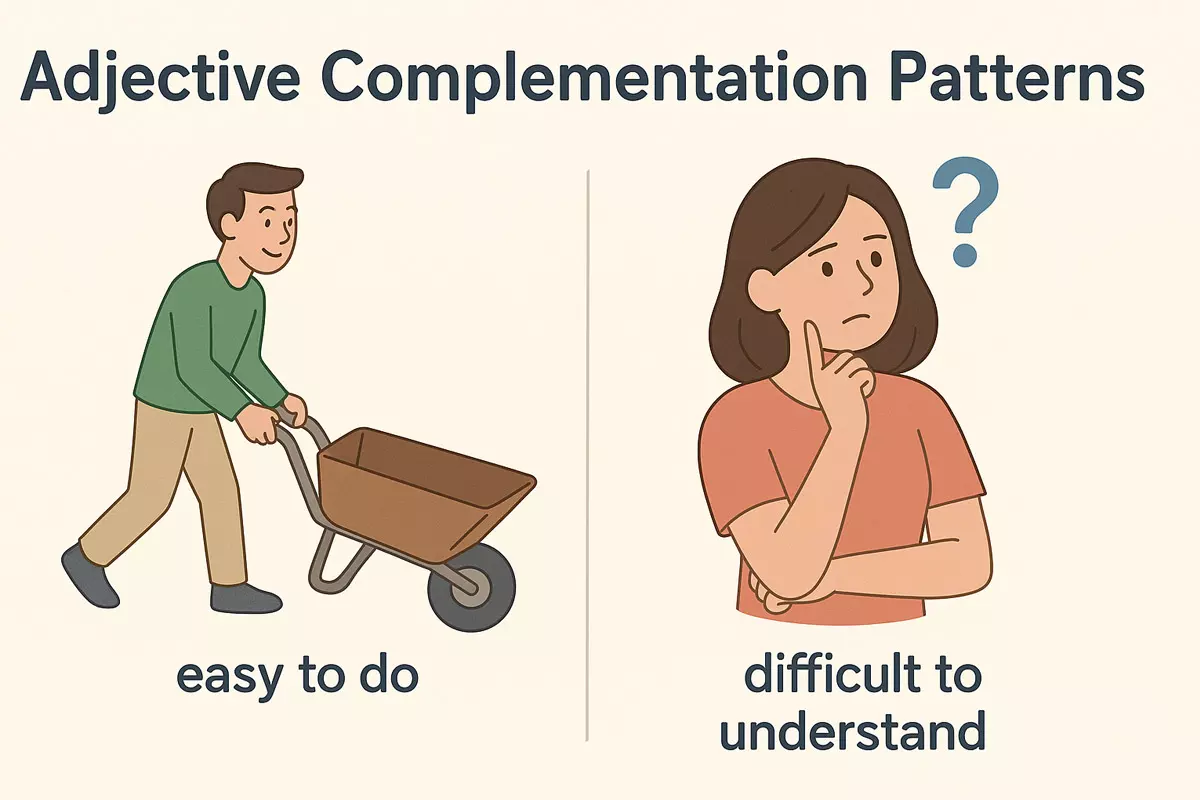 The article defines complementation, reviews common adjective plus to-infinitive patterns, and lists key adjective plus preposition combinations for B1-B2 learners. It also explains the difference between easy to do and easy doing, with examples and practice sentences.
Have you ever noticed how we often describe something as easy to explain but hard to understand? This contrast highlights interesting patterns in English, especially in the way adjectives combine with verbs or clauses. The pairing of words like simple or challenging with actions helps us communicate not just what we do, but how we feel about doing it. By paying attention to these combinations, we can better express the complexity or simplicity of different tasks in everyday conversation.
What complementation means
When we talk about complementation in grammar, we're referring to the way certain words—like adjectives—need or allow extra information to complete their meaning. This extra part, known as a “complement,” often comes right after the adjective and helps explain or clarify what is being described. For instance, in phrases like easy to follow or hard to believe, the words to follow and to believe are complements that finish the idea started by the adjective.
Not every adjective requires a complement, but many do when expressing attitudes, opinions, or potential. Some adjectives sound odd or incomplete without this extra piece. The complement can take different forms—most commonly an infinitive phrase (like to understand), a clause (such as that he left), or sometimes a prepositional phrase (of doing).
Types of complements with adjectives
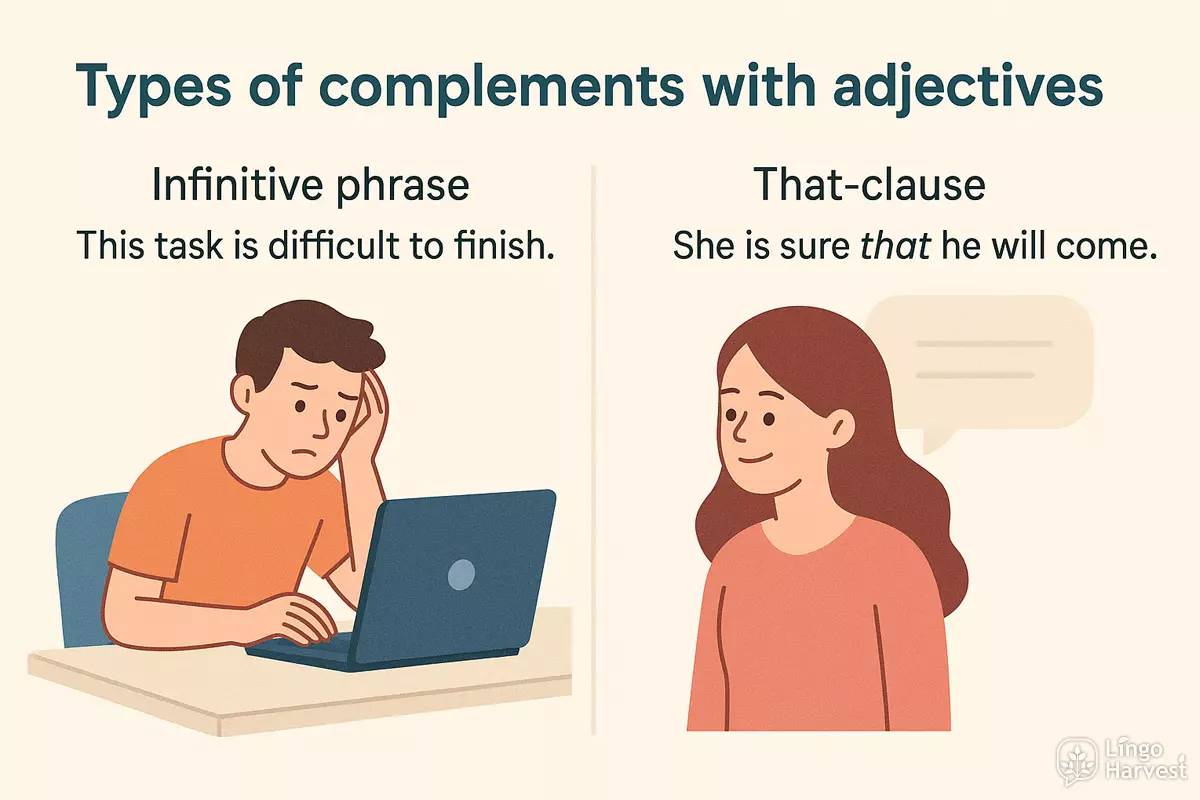
- Infinitive phrase: This task is difficult to finish.
- That-clause: She is sure that he will come.
- Prepositional phrase: He is proud of his achievements.
- Gerund phrase: They are busy preparing dinner.
- Wh-clause: We’re curious how she did it.
Complements are not the same as modifiers; while modifiers add detail, complements are essential for the meaning to be complete. For example, saying “This problem is easy” is fine, but “This problem is easy to solve” gives a full idea of what is easy.
Common adjectives that typically take complements
- Easy (easy to do)
- Difficult (difficult to understand)
- Afraid (afraid to speak)
- Likely (likely to happen)
- Sure (sure that it’s true)
- Proud (proud of his work)
- Ready (ready to leave)
- Happy (happy to help)
- Sorry (sorry for being late)
- Keen (keen to participate)
- Surprised (surprised that she called)
- Reluctant (reluctant to agree)
- Capable (capable of winning)
- Unlikely (unlikely to succeed)
- Willing (willing to try)
- Good/bad (good at drawing / bad at math)
- Aware (aware that it’s risky)
- Certain (certain that he knows)
- Glad (glad to see you)
- Sorry (sorry to bother you)
Recognizing how adjectives connect with complements helps you use more precise and natural expressions in English. It’s a key skill for both writing and speaking clearly.
Common adjective + to-infinitive patterns
Understanding how adjectives combine with to-infinitive structures helps learners express opinions, feelings, and possibilities more naturally. These combinations are frequent in both spoken and written English and often describe how people feel about actions or the likelihood of events.
Typical adjectives used before to-infinitives
Many adjectives easily connect with a to-infinitive clause. Here are some of the most commonly used:
- easy (easy to understand)
- difficult (difficult to explain)
- hard (hard to believe)
- impossible (impossible to solve)
- possible (possible to achieve)
- important (important to remember)
- necessary (necessary to prepare)
- dangerous (dangerous to touch)
- safe (safe to eat)
- nice (nice to meet you)
- strange (strange to see)
- pleasant (pleasant to talk to)
- interesting (interesting to watch)
- helpful (helpful to know)
- fun (fun to play)
- wrong (wrong to assume)
- right (right to try)
- surprised (surprised to hear)
How these patterns work in sentences
When an adjective is followed by a to-infinitive, it usually refers to the subject of the sentence. For example, in "This book is easy to read," the book is what is easy to read. Sometimes, though, we use a preparatory 'it' structure: "It is important to arrive on time."
Pattern comparison: with or without a subject
| Pattern | Example Sentence |
|---|---|
| Adjective + to-infinitive (direct subject) | This puzzle is hard to solve. |
| It + be + adjective + to-infinitive | It is hard to solve this puzzle. |
| Adjective + for someone + to-infinitive | This book is easy for children to read. |
| It + be + adjective + for someone + to-infinitive | It is dangerous for kids to swim here. |
Common uses and meaning
These adjective + to-infinitive combinations often express opinions about activities, or describe how suitable, likely, or appropriate an action is. For instance, "possible to fix" suggests something can be repaired, while "dangerous to enter" warns about a risky action.
Summary tips
- Most adjectives in these patterns describe how easy, safe, or suitable an action is. - The to-infinitive usually refers to an action related to the subject. - For more specific meaning, add a "for + person" phrase: "easy for me to learn." - Some combinations are fixed and widely used, such as "nice to meet you." Mastering these structures makes your English more fluent and precise.
Adjective + preposition combinations for B1-B2
Understanding how adjectives work with prepositions is essential for expressing opinions, feelings, and relationships between ideas at intermediate levels. These pairs often have set patterns that learners need to memorize, as the preposition cannot be easily guessed from the adjective’s meaning. Let’s explore some common combinations and see how they are used in sentences.
Common adjective + preposition patterns
Many adjectives are naturally followed by specific prepositions. For example, we say “interested in,” not “interested on.” Learning these patterns helps avoid mistakes and makes your English sound more natural.
- afraid of – She is afraid of spiders.
- angry about – He was angry about the delay.
- good at – They are good at solving problems.
- famous for – Paris is famous for its art museums.
- interested in – I am interested in history.
- tired of – She’s tired of waiting.
- worried about – We are worried about the test.
- proud of – He is proud of his achievements.
- responsible for – You are responsible for the project.
- married to – She is married to a doctor.
- similar to – This exercise is similar to the last one.
- different from – My opinion is different from yours.
- excited about – We are excited about the trip.
- keen on – He’s keen on playing tennis.
- afraid of – The children are afraid of the dark.
- interested in – She’s interested in learning French.
- used to – I am used to getting up early.
Patterns with explanations
Some adjectives use prepositions in ways that are not logical if translated directly. For instance, “good at” describes skill, while “good for” means beneficial. Compare:
| Adjective + Preposition | Example Sentence |
|---|---|
| good at | She is good at drawing. ✅ |
| good for | Vegetables are good for your health. ✅ |
| famous for | Italy is famous for its food. |
| responsible for | He is responsible for the results. |
Tips for mastering these combinations
Instead of translating word-for-word, try to learn each adjective together with its usual preposition. Reading and listening to real English will help you notice these patterns. Practice by making your own sentences, and check them with a teacher or language partner when possible. These adjective-preposition structures are important for clear and correct communication, especially when describing feelings, abilities, or relationships. With regular practice, you’ll find them becoming a natural part of your vocabulary.
Difference between easy to do / easy doing
Understanding how adjectives like easy combine with verbs is essential for natural English. The most common and correct form is “easy to do,” not “easy doing.” These patterns, called adjective complementation, follow specific rules and affect both grammar and meaning.
“Easy to do”: The Standard Pattern
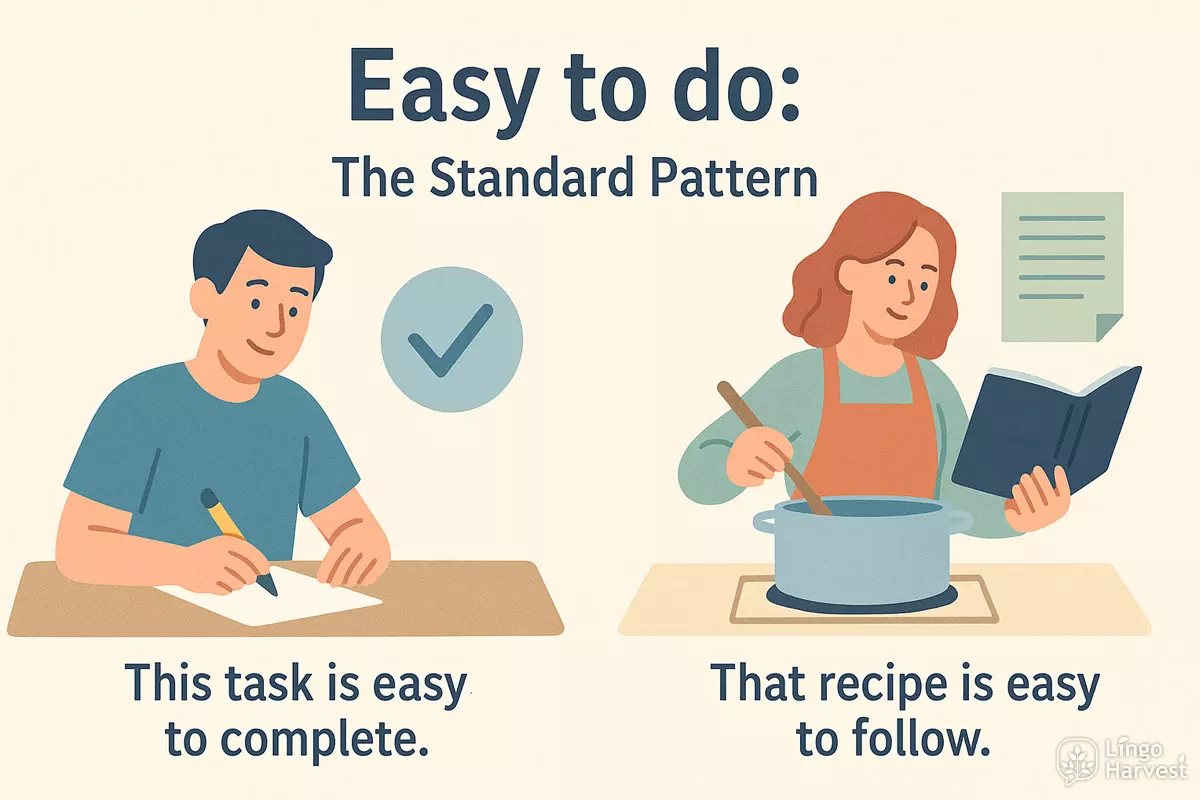
After adjectives such as easy, difficult, hard, or impossible, we typically use the infinitive form (to + verb). This structure expresses that something is not complicated to perform:
- This task is easy to complete.
- That recipe is easy to follow.
- The instructions were easy to understand.
- These shoes are easy to put on.
- The exam was easy to pass.
- Her name is easy to remember.
- The song is easy to sing.
- It’s easy to forget small details.
- This software is easy to install.
- That book is easy to read.
This construction is idiomatic and correct in nearly all situations.
“Easy doing”: Rare and Non-standard
Using “easy” followed by a gerund (doing) is rarely correct. Native speakers almost never say “easy doing” as a general pattern. The gerund form may appear in rare set phrases, but not in the sense of “simple to perform.”
- “It’s easy doing business with you.” ❌ (Non-standard; use “easy to do business with you”)
- “That’s easy doing.” ❌ (Uncommon and odd in most contexts)
There are a few fixed, informal expressions where “doing” can follow “easy,” but these are idiomatic and not productive grammar patterns. For example, “Easy does it!” is a set phrase meaning “Go slowly/carefully.”
Quick Comparison
| Form | Usage Example |
|---|---|
| easy to do (adjective + infinitive) | This puzzle is easy to do. ✅ |
| easy doing (adjective + gerund) | That’s easy doing. ❌ (Not natural/standard) |
Summary
Choose “easy to do” and similar infinitive patterns for clarity and correctness. The gerund form (“easy doing”) is almost never used in standard English to mean something is simple or not difficult. Stick to “easy to + verb” for natural, idiomatic sentences.
Examples in explanations and descriptions
When learning about adjective complementation patterns, seeing real sentences is essential. These constructions often appear in explanations to clarify why something is simple or challenging, or to describe situations more precisely. Typical patterns include adjectives followed by an infinitive or a that-clause, helping to give more detail or context.
Common patterns with adjectives and complements
Some adjectives are frequently used with infinitives (to + verb) or with that-clauses. Here are several patterns you’ll regularly encounter:
- easy to use → This app is easy to use for beginners.
- difficult to explain → The concept is difficult to explain without examples.
- hard to predict → The weather here is hard to predict in winter.
- impossible to ignore → Her talent is impossible to ignore.
- ready to start → Everyone was ready to start the meeting.
- afraid to ask → He was afraid to ask for help.
- happy to help → She is always happy to help her colleagues.
- likely to succeed → The project is likely to succeed with enough support.
- certain to fail → Without funding, the plan is certain to fail.
- dangerous to touch → The chemicals are dangerous to touch without gloves.
- strange to hear → It was strange to hear him laugh like that.
- excited to meet → She was excited to meet her new team.
- eager to learn → The students were eager to learn more.
- safe to eat → The doctor confirmed the mushrooms were safe to eat.
- surprised to see → I was surprised to see him at the event.
- reluctant to leave → They were reluctant to leave the beach.
- keen to try → He is keen to try the new software.
These combinations are used to clarify meaning, such as:
- “This software is easy to use.”
- “The instructions were difficult to understand.”
- “She was happy to help with the project.”
Infinitive vs. that-clause complements
Some adjectives can take either an infinitive or a that-clause, depending on the context. For instance:
- “He is certain to win the race.” (infinitive)
- “He is certain that he will win the race.” (that-clause)
Comparison of patterns
Below is a table comparing adjectives that commonly use different complementation structures:
| Adjective | Typical Complement | Example Sentence |
|---|---|---|
| easy | to + verb | “The test was easy to pass.” |
| afraid | to + verb / that-clause | “He was afraid to speak.” “She was afraid that she’d fail.” |
| surprised | to + verb / that-clause | “We were surprised to see him.” “I was surprised that he arrived early.” |
| likely | to + verb / that-clause | “She is likely to win.” “It’s likely that she will win.” |
| happy | to + verb | “They are happy to help.” |
| dangerous | to + verb | “It’s dangerous to swim here.” |
| possible | to + verb / that-clause | “It’s possible to solve this.” “It’s possible that he knows.” |
| reluctant | to + verb | “She was reluctant to leave.” |
Usage in definitions and descriptions
Writers and speakers use these adjective + complement patterns to clarify instructions or provide detailed explanations. For example, a manual might say, “The application is easy to install,” or a teacher might note, “Some concepts are difficult to explain.” Such patterns help readers or listeners understand not just the adjective, but the circumstances or actions being described. In summary, using adjectives with complements allows for more informative and precise communication, especially when explaining processes or describing qualities.
Practice: complete sentences with correct patterns
When using adjectives like "easy," "difficult," "impossible," or "important," we often follow them with specific complement patterns. Practicing these structures helps you produce natural, accurate sentences. Below, you’ll find fill-in-the-blank tasks, a list of adjectives commonly used with infinitive or gerund complements, and a comparison of different adjective complementation patterns.
Complete the sentences
Fill in the blanks using the correct verb forms or phrases so that the sentences are grammatically correct and sound natural.
- It’s ______ (easy / forget) your keys at home when you’re in a hurry.
- This book is ______ (difficult / understand) without background knowledge.
- She found it ______ (impossible / finish) the project on time.
- Learning a new language is ______ (challenging / master), but rewarding.
- It was ______ (important / remember) to call her before leaving.
- He is ______ (afraid / ask) for help when he needs it.
- This software is ______ (simple / use) even for beginners.
- The instructions were ______ (confusing / follow).
- It’s ______ (fun / learn) new skills online.
- The exam was ______ (tough / pass) for most students.
Show answers
- easy to forget
- difficult to understand
- impossible to finish
- challenging to master
- important to remember
- afraid to ask
- simple to use
- confusing to follow
- fun to learn
- tough to pass
Common adjectives with infinitive complements
Some adjectives are typically followed by an infinitive (to + verb). Here’s a list of such adjectives:
- easy (easy to do)
- difficult (difficult to understand)
- hard (hard to believe)
- impossible (impossible to predict)
- important (important to remember)
- nice (nice to meet you)
- dangerous (dangerous to climb)
- safe (safe to eat)
- expensive (expensive to buy)
- fun (fun to watch)
- pleasant (pleasant to talk to)
- unusual (unusual to see)
- strange (strange to hear)
- simple (simple to explain)
- tough (tough to answer)
- interesting (interesting to read)
- annoying (annoying to deal with)
- helpful (helpful to know)
- necessary (necessary to act)
- common (common to find)
Comparing adjective complementation patterns
Some adjectives can take different complement patterns, such as infinitive, gerund, or a clause. Here’s a quick comparison:
| Adjective | Pattern | Example |
|---|---|---|
| easy | to + verb | easy to use |
| worth | verb + -ing | worth reading |
| afraid | to + verb / of + -ing | afraid to speak / afraid of flying |
| happy | to + verb / that + clause | happy to help / happy that you came |
| ready | to + verb / for + noun | ready to leave / ready for class |
| interested | in + -ing | interested in learning |
| good | at + -ing | good at drawing |
| hard | to + verb | hard to understand |
| fun | to + verb | fun to watch |
| necessary | to + verb | necessary to prepare |
By practicing with these patterns and examples, you’ll become more confident in choosing the right structure after adjectives in your own writing and speaking.