Ambiguous Modifiers: misplaced and dangling modifiers

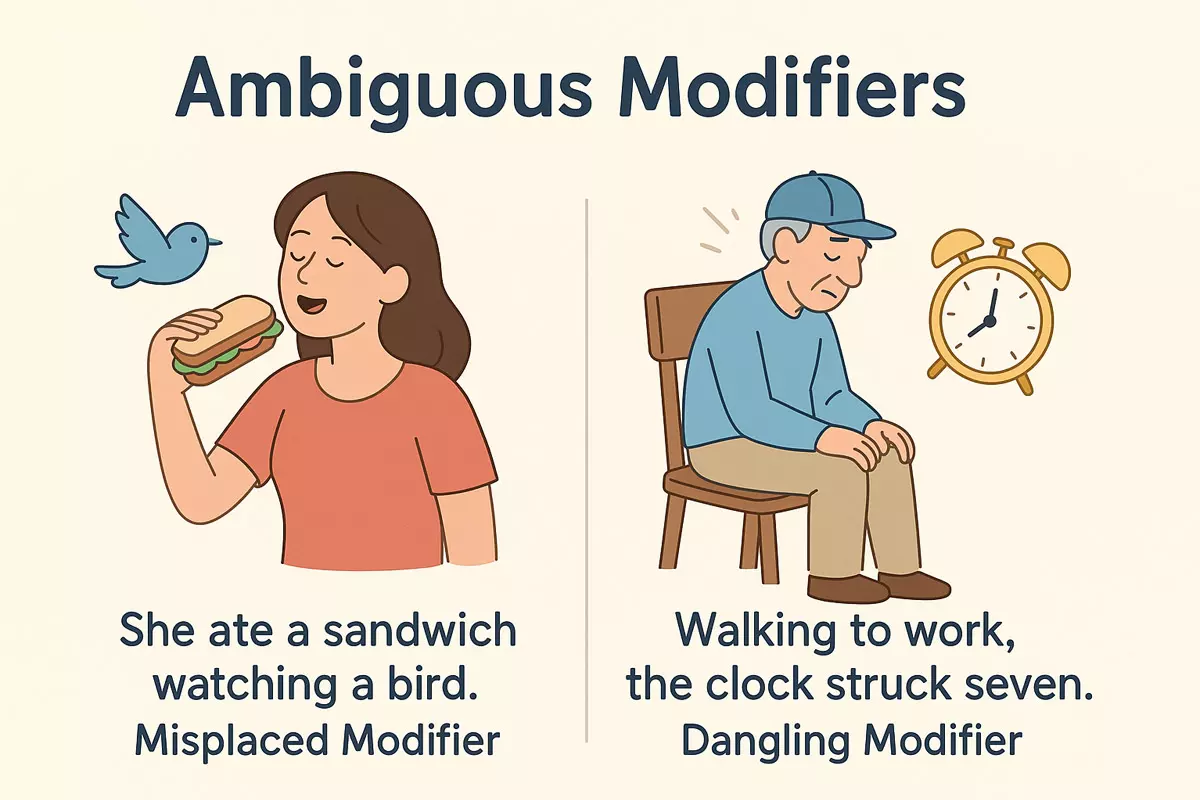 Here we what ambiguity in modification is, defines misplaced and dangling modifiers, and explains how their incorrect placement changes meaning. It also offers rules for fixing ambiguous modifiers, real examples, and practice exercises for correction.
Misplaced or oddly positioned descriptive phrases can distort a sentence’s intended meaning, sometimes causing confusion or accidental humor. Recognizing and correcting these misplaced or dangling modifiers is essential for producing clear, precise, and effective writing. By ensuring that descriptive phrases are logically and clearly connected to the words they modify, writers can communicate their ideas more accurately and avoid misunderstandings. Careful attention to sentence structure helps maintain clarity and improves the overall quality of writing.
What ambiguity in modification means
Ambiguity in modification occurs when it’s unclear which word or phrase a modifier is intended to describe. This lack of clarity can make sentences confusing, misleading, or even humorous by accident. Both misplaced and dangling modifiers are common sources of this problem, as they can cause readers to interpret a sentence in more than one way. The result is uncertainty about the intended meaning, which can undermine communication.
How modifiers create confusion
When the placement of a descriptive word or phrase allows for multiple interpretations, readers may struggle to identify the correct relationship between words. This often happens when modifiers are positioned too far from the words they’re meant to describe, or when the sentence structure omits the thing being modified entirely. In both cases, the sentence’s meaning becomes ambiguous, and the reader is left to guess the writer’s intent.
Common signs of ambiguous modification
- Sentences that can be read in two or more ways
- Modifiers not clearly attached to any specific word
- Unintended humor or confusion in phrasing
- Questions like “Who is doing what?” or “What exactly happened?”
- Readers pausing to reinterpret a sentence
Examples of ambiguity in modifiers
2
- “She saw the man with the telescope.” (Who has the telescope?)
- “Walking down the street, the flowers were beautiful.” (Who was walking?)
- “Only John said he would help.” (Did only John say it, or did John only say it?)
- “He nearly drove his kids to school every day.” (Did he almost do it, or did he drive them nearly every day?)
- “Covered in chocolate, Mary ate the strawberries.” (Was Mary covered in chocolate?)
- “I saw a dog chasing a cat in my pajamas.” (Who wore the pajamas?)
- “Eager to impress the judges, the dance was performed flawlessly.” (Who was eager?)
- “The students discussed the exam questions in the hallway.” (Were questions in the hallway?)
- “Running quickly improves your health.” (Is running quickly, or does quickly improve health?)
- “He served sandwiches to the children on paper plates.” (Who was on the plates?)
Why clarity matters
Clear modifiers help readers understand precisely what is being described, preventing misunderstandings. Ambiguous modification can make writing seem careless and lead to miscommunication, especially in formal or academic contexts. Taking time to ensure modifiers are placed next to the words they describe is a simple way to improve both clarity and professionalism in writing.
Definition of misplaced and dangling modifiers
Modifiers are words or phrases—often adjectives, adverbs, or modifying clauses—that provide additional detail about another element in a sentence. When these descriptive elements are not placed next to the word they are meant to modify, or when the word they are supposed to describe is missing altogether, the result can be confusion or ambiguity. This is where misplaced and dangling modifiers come into play.
What is a misplaced modifier?
A misplaced modifier occurs when a descriptive word or phrase is positioned too far from the word it intends to modify. This can lead to sentences where the meaning is unclear or unintentionally humorous. The key issue is that the reader might attach the modifier to the wrong part of the sentence, which distorts the intended meaning.
- Example: She almost drove her kids to school every day. (Did she "almost drive," or did she "almost every day"?)
- Corrected: She drove her kids to school almost every day.
What is a dangling modifier?
A dangling modifier is a descriptive phrase at the beginning or end of a sentence that does not clearly and logically refer to any word in the sentence. This happens when the word the modifier is meant to describe is absent, leaving the modifier "dangling" without a subject.
- Example: Walking down the street, the trees were beautiful. (Who was walking?)
- Corrected: Walking down the street, I thought the trees were beautiful.
Key differences and summary
While both misplaced and dangling modifiers can create confusion, they differ in how the ambiguity arises. One involves incorrect placement; the other involves an absent subject. Understanding these differences helps writers construct clearer, more precise sentences.
| Type | Common Problem | Example (Incorrect) | Correction |
|---|---|---|---|
| Misplaced Modifier | Modifier is too far from the word it describes | She served sandwiches to the children on paper plates. | She served the children sandwiches on paper plates. |
| Dangling Modifier | No clear word to modify in the sentence | After reading the book, the movie was a disappointment. | After reading the book, I found the movie a disappointment. |
| Misplaced Modifier | Ambiguity due to position | I nearly watched the whole documentary. | I watched nearly the whole documentary. |
| Dangling Modifier | Implied subject is missing | While swimming in the lake, the boat passed by. | While swimming in the lake, we saw the boat pass by. |
Common signs of ambiguous modifiers
- Sentences that seem illogical or humorous by accident ❌
- Modifier phrases not clearly attached to a specific subject
- Uncertainty about who is performing the action described
- Essential details buried far from the words they describe
- Possible multiple interpretations of a single sentence
Recognizing and correcting misplaced and dangling modifiers improves clarity and helps ensure your writing accurately conveys your intended meaning.
Why incorrect placement changes meaning
The position of modifiers in a sentence is crucial because it determines which word or phrase they describe. When a modifier is not placed next to the word it’s meant to modify, it can lead to confusion or even a completely different interpretation. Readers naturally connect modifiers to the nearest logical word, so shifting their location can create ambiguity or humorous misunderstandings.
How misplacement creates ambiguity
Misplaced or dangling modifiers often result in sentences that sound odd or imply something unintended. For example, consider the difference between “She almost drove her kids to school every day” and “She drove her kids to school almost every day.” The first suggests she didn’t actually drive them, while the second means she did, but not every day. The effect is that a sentence’s meaning can be subtly or drastically altered just by moving a single word or phrase.
- “Running quickly, the finish line was crossed by John.” (Implies the finish line was running.)
- “Covered in chocolate, Mary ate the strawberries.” (Suggests Mary was covered in chocolate.)
- “Only I spoke to the manager.” (No one else did.)
- “I only spoke to the manager.” (I didn’t do anything else with the manager.)
- “I spoke only to the manager.” (I didn’t speak to anyone else.)
- “Walking to the store, the rain started.” (Implies the rain was walking.)
- “Eager to impress, the speech was memorized by Tom.” (Implies the speech was eager.)
- “Nearly lost all her money.” (Did she lose it, or almost?)
- “He served sandwiches to the children on paper plates.” (Are the children on plates?)
- “We saw a puppy and a kitten on the way to the park.” (Who was on the way?)
Common consequences of misplaced and dangling modifiers
- Unintentional humor or absurdity
- Loss of clarity and precision
- Miscommunication or confusion for readers
- Potential for altered facts or misleading statements
- Awkward or ungrammatical constructions
Comparison: Correct vs. Incorrect Placement
| Incorrect Modifier Placement | Clear, Corrected Version |
|---|---|
| “Hiking the trail, the birds chirped loudly.” | “Hiking the trail, I heard the birds chirp loudly.” |
| “After reading the book, the movie was disappointing.” | “After reading the book, I found the movie disappointing.” |
| “While eating, the phone rang.” | “While I was eating, the phone rang.” |
| “Driving down the street, the trees looked beautiful.” | “Driving down the street, I saw the beautiful trees.” |
| “To improve his results, the experiment was repeated.” | “To improve his results, he repeated the experiment.” |
Careful placement of modifiers ensures your sentences are clear and your intended meaning is preserved. When modifiers float too far from what they describe, you risk muddling your message and confusing your audience.
Clear rules for repairing ambiguous modifiers
Misplaced and dangling modifiers can muddle your message or create unintentional humor. To write clearly, focus on placing descriptive phrases close to the words they modify and ensuring every modifier has a logical target in the sentence. Here are practical guidelines and strategies for fixing these common pitfalls.
Best practices for correcting misplaced modifiers
- Place modifiers next to what they describe. Keep adjectives, adverbs, and modifying phrases as close as possible to the words they are intended to qualify.
- Revise sentences for clarity. If a modifier could refer to more than one element, restructure the sentence to eliminate confusion.
- Avoid stacking modifiers. Too many modifiers in succession can obscure meaning. Break up long modifying phrases if needed.
- Watch for introductory phrases. When a sentence starts with a modifying phrase, check that the subject immediately follows and matches the intended meaning.
How to fix dangling modifiers
- Identify missing subjects. Make sure every introductory phrase logically fits with the subject of the main clause.
- Rewrite for explicit connection. If the intended subject isn’t clear, rewrite the sentence so the modifier clearly refers to the correct noun or pronoun.
- Avoid vague pronouns. Use specific nouns whenever possible to ensure clarity.
Common repair strategies (with examples)
3
- Move the modifier: She almost drove her kids to school every day → She drove her kids to school almost every day.
- Rewrite the modifier as a clause: Running to catch the bus, the rain started pouring → As she was running to catch the bus, the rain started pouring.
- Clarify the subject: After eating, the plates were cleared → After eating, we cleared the plates.
- Use active voice: To improve results, the experiment was repeated → To improve results, researchers repeated the experiment.
- Eliminate ambiguity: He served sandwiches to the children on paper plates → He served the children sandwiches on paper plates or He served sandwiches on paper plates to the children, depending on the meaning.
- Split long modifying phrases: With a smile on her face and joy in her heart, she greeted everyone → She greeted everyone with a smile on her face and joy in her heart.
- Check for logical sequence: While walking down the street, the birds chirped loudly → While I was walking down the street, the birds chirped loudly.
- Replace with clearer wording: Having finished the assignment, the TV was turned on → Having finished the assignment, she turned on the TV.
- Limit use of introductory modifiers: If a sentence feels awkward, try moving the modifier to a later position.
- Read aloud: Sometimes, reading a sentence out loud reveals awkward or unclear modifier placement.
Quick reference: ambiguous vs. clear modifier placement
| Ambiguous | Clear |
|---|---|
| Walking down the street, the flowers caught my eye. | As I walked down the street, the flowers caught my eye. |
| She saw a puppy and a kitten on the way to the store. | On the way to the store, she saw a puppy and a kitten. |
| Nearly, everyone failed the test. | Nearly everyone failed the test. |
| Covered in chocolate, Mary ate the cake. | Mary ate the cake covered in chocolate. |
By applying these rules and strategies, you can avoid confusion and ensure your writing is precise and easy to follow. Always review sentences for potential ambiguity, especially after editing or restructuring.
Examples from essays and everyday writing
Writers often run into trouble with ambiguous modifiers, especially misplaced and dangling modifiers, in both academic essays and casual communication. These errors can make sentences confusing or unintentionally humorous. Let's look at some real-world samples, drawn from student papers and daily conversation, to see how these modifiers crop up and how sentences can be clarified.
Misplaced Modifiers in Action
Misplaced modifiers are words or phrases that are separated from the word they describe, often leading to confusion. Here are some common examples:
- She almost drove her kids to school every day. (Did she almost drive, or did she almost do it every day?)
- He served sandwiches to the children on paper plates. (Were the children on paper plates?)
- We saw a puppy and a kitten on the way to the store. (Who was on the way to the store?)
- Only John said he was sorry. (Did only John speak, or did he only say he was sorry?)
- She nearly wrote 100 pages for her thesis. (Did she write almost 100 pages, or did she almost write them but didn’t?)
- He posted a photo of his friend laughing. (Was the friend laughing, or was he laughing as he posted?)
Dangling Modifiers in Sentences
A dangling modifier is a descriptive phrase that doesn't clearly refer to any word in the sentence. This often leads to confusion or unintended meanings. Some typical cases include:
- Walking down the street, the flowers were in full bloom. (Who was walking?)
- After reading the book, the movie was disappointing. (Who read the book?)
- To improve his results, the experiment was repeated. (Who wanted to improve?)
- While driving to work, the radio suddenly stopped playing. (Was the radio driving?)
- At five years old, the piano was too big to play. (Was the piano five years old?)
Corrected Versions Side by Side
To see how clarity improves with proper placement, compare these pairs:
| Unclear Modifier | Clear Revision |
|---|---|
| Running quickly, the finish line seemed impossible to reach. | Running quickly, she found the finish line impossible to reach. |
| Covered in chocolate, Mary ate the strawberries. | Mary ate the strawberries covered in chocolate. |
| While reading, the phone rang loudly. | While she was reading, the phone rang loudly. |
| Driving home, the storm made visibility poor. | Driving home, he found that the storm made visibility poor. |
| Having finished the assignment, the computer was shut down. | Having finished the assignment, she shut down the computer. |
Quick Tips for Avoiding Ambiguity
- Place descriptive phrases close to the word they modify.
- Always specify who is performing the action, especially in introductory phrases.
- Read sentences aloud to catch confusing or humorous interpretations.
- Revise sentences where a modifier could logically refer to more than one word.
By reviewing these typical patterns from essays and daily language, writers can spot and fix ambiguous modifiers, making their communication clearer and more precise.
Practice: rewrite to correct modifier placement
Misplaced and dangling modifiers can confuse your reader or even change your intended meaning. To improve clarity, it's important to recognize these ambiguous constructions and practice revising them so that modifiers are placed next to the words they actually modify.
Identify and fix the confusion
Below are several sentences containing misplaced or dangling modifiers. Try to spot the ambiguity and rewrite each sentence for clearer meaning. Focus on moving the modifier so it sits logically next to the word it describes.
- Running down the street, the backpack fell off my shoulder.
- She almost drove her kids to school every day.
- Covered in chocolate, Ben enjoyed the cake.
- After reading the book, the movie seemed disappointing.
- While walking to the store, the rain started pouring.
- Having finished the assignment, the computer was turned off.
- He nearly watched the entire series in one night.
- To improve her grades, extra study sessions were scheduled.
- Hiking the mountain, the view was breathtaking.
- While making dinner, the phone rang.
- Staring at the stars, time seemed to stand still.
- After eating, the dishes were washed.
- Jumping up and down, excitement filled the room.
- Reading the instructions carefully, the solution became clear.
- While sleeping, the alarm clock went off.
Common patterns and corrections
- Start the sentence with the person or thing doing the action described by the modifier.
- Place the modifier directly before or after the word it modifies.
- Rewrite to remove ambiguity when the subject is missing or implied.
Comparison: ambiguous vs. corrected modifier placement
| Ambiguous Modifier | Clear Version |
|---|---|
| While eating, the phone rang. | While I was eating, the phone rang. |
| Covered in snow, we admired the trees. | We admired the trees covered in snow. |
| To win the prize, the tickets must be purchased. | To win the prize, you must purchase the tickets. |
| Walking through the park, the flowers were beautiful. | Walking through the park, I saw beautiful flowers. |
| After finishing the meal, the bill was paid. | After finishing the meal, we paid the bill. |
| At the age of five, the family moved to Canada. | When he was five, the family moved to Canada. |
| Nearly lost, I found my keys in the couch. | I nearly lost my keys, but I found them in the couch. |
| Driving to work, the traffic was terrible. | Driving to work, I encountered terrible traffic. |
| While waiting for the bus, the rain started. | While I was waiting for the bus, the rain started. |
| Being a holiday, the office was closed. | Because it was a holiday, the office was closed. |
Try it yourself
Choose any five sentences from the list above and rewrite them so that the modifier is clearly and logically placed. If you’re unsure, refer to the table for guidance on common patterns.
Show answers
- Running down the street, I felt my backpack fall off my shoulder.
- She drove her kids to school almost every day.
- Ben enjoyed the cake covered in chocolate.
- After I read the book, the movie seemed disappointing.
- While I was walking to the store, the rain started pouring.
- After I finished the assignment, I turned off the computer.
- He watched nearly the entire series in one night.
- To improve her grades, she scheduled extra study sessions.
- While I was hiking the mountain, the view was breathtaking.
- While I was making dinner, the phone rang.
- While I was staring at the stars, time seemed to stand still.
- After I ate, I washed the dishes.
- As the children were jumping up and down, excitement filled the room.
- After I read the instructions carefully, the solution became clear.
- While I was sleeping, the alarm clock went off.