Nominal vs Adverbial Modifiers (advanced writing skill, но B2)

 Here we how nominal and adverbial modifiers differ, how modifiers help clarify relationships between ideas, and placement rules for pre- and post-modifiers. It also gives examples, highlights common mistakes, and offers practice identifying modifier types.
Learning to distinguish between modifiers that serve as nouns and those that function as adverbs is essential for improving your writing. Noun modifiers typically provide specific information about another noun, clarifying the subject and adding detail, while adverbial modifiers describe actions, indicating how, when, where, or why something happens. By understanding how these modifiers influence the meaning of your sentences, you can make your writing clearer, more precise, and more engaging for your readers. Developing this skill is a key step toward writing with greater sophistication and effectiveness.
Difference between nominal and adverbial modification
Understanding how modifiers function in a sentence is crucial for advanced writing. Nominal and adverbial modifiers serve different purposes and attach to different parts of a sentence, influencing meaning in unique ways.
Nominal Modification: Definition and Features
Nominal modifiers describe or restrict nouns or noun phrases. They add detail to the subject or object, answering questions like "which one?", "what kind?", or "whose?". These modifiers appear before or after the noun they modify and often include adjectives, noun adjuncts, possessives, prepositional phrases, and relative clauses.
- Adjective: a beautiful garden
- Noun adjunct: a chicken soup
- Possessive: Anna’s book
- Prepositional phrase: the house on the hill
- Relative clause: the man who called
Adverbial Modification: Definition and Features
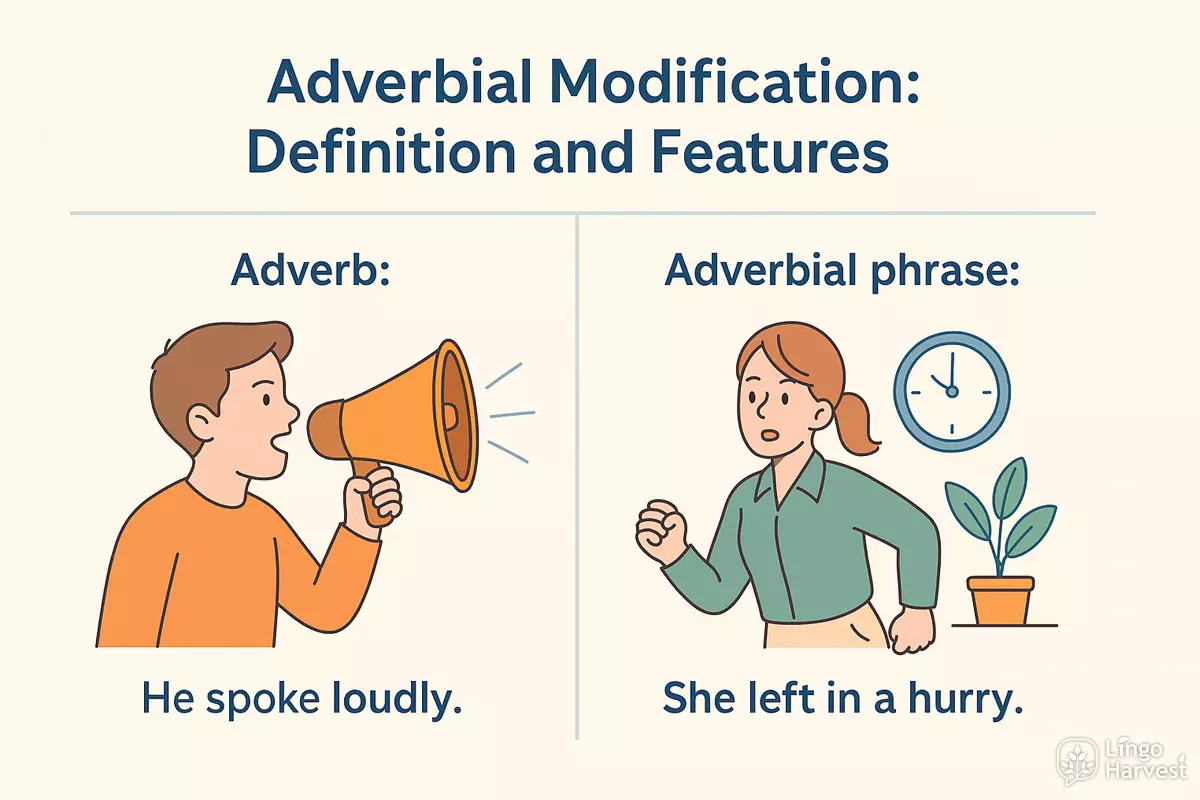
Adverbial modifiers provide information about verbs, adjectives, or entire clauses. They clarify time, place, manner, reason, degree, or frequency, usually answering questions such as "how?", "when?", or "why?". Adverbials can be single words, phrases, or clauses.
- Adverb: He spoke loudly.
- Adverbial phrase: She left in a hurry.
- Prepositional phrase: They arrived after midnight.
- Adverbial clause: I’ll call you when I arrive.
- Frequency: He rarely eats out.
Comparing Nominal and Adverbial Modifiers
The main distinction lies in what they modify and how they shape meaning. Nominal modifiers attach to nouns, while adverbial modifiers relate to verbs, adjectives, or clauses. To see the contrast more clearly, here’s a structured comparison:
| Modifier Type | Main Function & Example |
|---|---|
| Nominal Modifier | Adds detail to a noun or noun phrase a red car |
| Adverbial Modifier | Gives context to a verb, adjective, or whole clause He ran quickly |
| Typical Questions Answered | Nominal: Which one? What kind? Adverbial: How? When? Where? Why? |
| Common Forms | Nominal: adjectives, noun adjuncts, prepositional phrases Adverbial: adverbs, adverbial phrases/clauses, prepositional phrases |
Key Takeaways ✅
- Nominal modifiers refine or specify nouns; adverbial modifiers add context to actions or states.
- Both are essential for clear, precise, and advanced writing.
- Recognizing the type of modifier helps avoid ambiguity and enhances sentence variety.
How modifiers clarify relationships between ideas
Understanding the function of modifiers helps writers express complex relationships within sentences. Modifiers—whether nominal or adverbial—provide additional details that shape meaning and guide the reader’s interpretation. By specifying time, manner, reason, or qualities, these elements make connections between actions, objects, and circumstances much clearer.
Nominal and adverbial modifiers: connecting ideas
Nominal modifiers typically describe or limit nouns, giving more information about what kind of person, place, or thing is involved. Adverbial modifiers, on the other hand, explain how, when, where, or why something happens. By choosing the right type, writers can clarify whether a detail belongs to the subject, the action, or the context.
- Nominal modifier example: The annual conference was successful. (Specifies which conference)
- Adverbial modifier example: The conference ended quickly. (Describes how it ended)
Making logical connections explicit
Modifiers act as bridges between concepts. They reduce ambiguity and help readers follow the logic of your argument or narrative. For example, adverbial phrases can signal cause and effect, contrast, or sequence, while nominal phrases can indicate ownership, category, or quality.
| Modifier Type | Relationship Clarified | Example |
|---|---|---|
| Nominal | Specifies which noun, adds detail or category | The science teacher explained the experiment. |
| Adverbial | Describes time, reason, manner, or place | She spoke with confidence during the meeting. |
| Nominal (possessive) | Shows ownership or association | Maria’s advice was helpful. |
| Adverbial (purpose) | Indicates reason or goal | He left early to catch the bus. |
Common signals and examples
Writers often use certain words or phrases to clarify logical relationships. Here are some common patterns:
- Because of (shows cause): The flight was delayed because of fog.
- Despite (shows contrast): Despite the rain, the event continued.
- For + noun (purpose): She bought a cake for the celebration.
- By + verb-ing (method): He improved by practicing daily.
- During (time): During the meeting, questions were answered.
- With + noun (manner): She answered with patience.
- After (sequence): After lunch, we continued working.
- In order to (purpose): He called in order to confirm the time.
- Without (lack of something): He left without saying goodbye.
- Whose (possessive): The student whose project won was proud.
- Which (identifying): The book which you recommended was excellent.
By carefully selecting and positioning modifiers, you can guide your reader through your ideas, making your writing more precise and coherent. This skill is especially important in academic and professional contexts, where clarity and logical flow are essential.
Placement rules for pre-modifier and post-modifier structures
When constructing sentences, the position of modifiers—words or phrases that add information to nouns and verbs—greatly affects meaning and clarity. Modifiers can appear before (pre-) or after (post-) the element they describe, and each placement follows specific conventions in English.
Pre-modifiers: Before the Head Noun
Pre-modifiers are usually single words or short phrases that come directly before the noun they modify. These are most commonly adjectives, nouns used as modifiers, or participles. For example:
- old book → She found an old book in the attic.
- wooden table → They ate dinner at a wooden table by the window.
- running water → We stopped near a stream with running water.
- science project → He won first place with his science project.
- blue sky → The children played outside under a bright blue sky.
- delicious meal → We enjoyed a delicious meal at the new restaurant.
- famous actor → A famous actor visited the school for a charity event.
- broken window → The storm left a broken window in the hallway.
- annual meeting → The annual meeting will be held next Monday.
- financial crisis → The company struggled during the financial crisis.
These modifiers are placed as close as possible to the noun to avoid confusion.
Post-modifiers: After the Head Noun
Post-modifiers tend to be longer or more complex phrases, such as prepositional phrases, relative clauses, or certain participial phrases. They provide additional, often essential, information about the noun.
- The man with the hat
- The book on the table
- The students who passed the exam
- The car parked outside
- The ideas discussed yesterday
- The girl wearing a red dress
- The report submitted last week
- The house at the end of the street
- The message sent by email
- The problem to solve
These elements follow the noun and are separated by a comma only if they are non-defining (not essential to the meaning).
Comparison of Pre- and Post-modifier Patterns
| Pre-modifier Example | Post-modifier Example |
|---|---|
| the red car | the car with a red roof |
| a young scientist | a scientist who just graduated |
| an expensive restaurant | a restaurant in the city center |
| a broken window | the window that was broken last night |
| the main reason | the reason for our delay |
Tips for Clear Modifier Placement
- Keep modifiers close to the word they describe to avoid ambiguity.
- Use pre-modifiers for short, simple details; use post-modifiers for longer or more complex information.
- Misplaced modifiers can change meaning or confuse the reader.
- Relative clauses and prepositional phrases usually follow the noun.
- Adverbial modifiers often go at the end of a clause or sentence, or before the main verb.
Understanding these patterns helps you write sentences that are both precise and easy to read, especially when distinguishing between nominal and adverbial structures.
Examples in descriptions, reports, and explanations
When writing academic texts or formal documents, choosing between nominal and adverbial modifiers can shape the clarity and style of your sentences. Nominal modifiers (often nouns or noun phrases) provide concise, information-rich details, while adverbial modifiers (adverbs, prepositional phrases, or clauses) show how, when, where, or why something happens. Understanding how to use each type appropriately is key for effective communication, especially at an upper-intermediate level.
Usage in Descriptive Writing
Writers often use nominal modifiers to make descriptions more compact and formal. Compare the following examples:
- Nominal: "Data analysis methods"
- Adverbial: "Methods for analyzing data"
- Nominal: "Customer feedback survey"
- Adverbial: "Survey conducted with customers for feedback"
Nominal modifiers tend to be shorter and more direct, fitting well in technical descriptions or scientific reports.
Patterns in Reports
In reports, the choice between these structures can affect emphasis and readability. Here are some typical patterns:
- Performance improvement strategies → Strategies to improve performance
- Market growth prediction → Prediction about market growth
- Employee satisfaction level → Level at which employees are satisfied
- Water quality measurement → Measurement of water quality
- Budget allocation plan → Plan for allocating the budget
Notice how nominal forms pack information tightly, while adverbial forms often clarify relationships or processes.
Comparison Table: Nominal vs Adverbial Modifiers
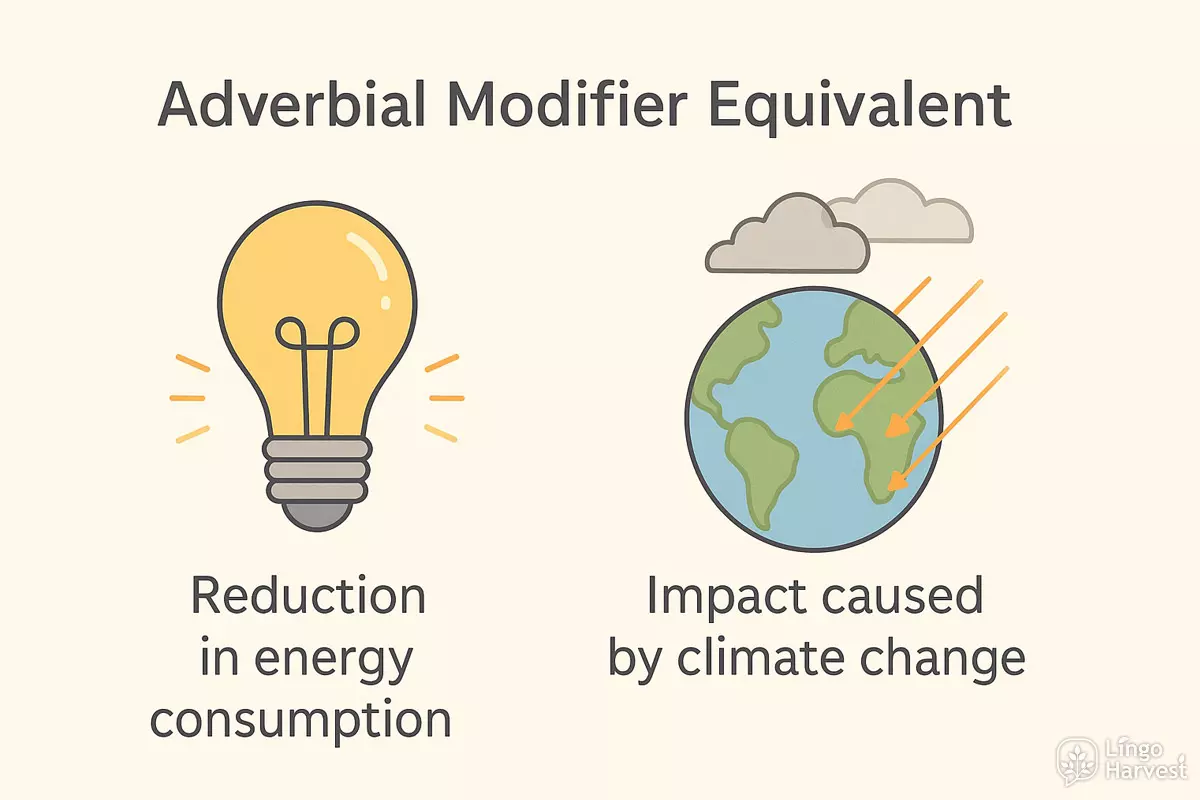
| Nominal Modifier Example | Adverbial Modifier Equivalent |
|---|---|
| Energy consumption reduction | Reduction in energy consumption |
| Climate change impact | Impact caused by climate change |
| Machine learning application | Application using machine learning |
| Risk assessment process | Process for assessing risks |
| Project management skills | Skills needed for managing projects |
| Internet access issues | Issues arising from accessing the internet |
| Customer service evaluation | Evaluation of customer service |
| Resource distribution plan | Plan for distributing resources |
Choosing the Right Structure in Explanations
When explaining processes or results, adverbial modifiers often make cause, manner, or time clearer. For instance:
- The experiment was conducted under high pressure. (adverbial)
- We observed changes after the intervention. (adverbial)
- They discussed the problem in detail. (adverbial)
In contrast, nominal modifiers are usually best for headings, titles, or concise summaries.
Summary of Key Points
- Nominal modifiers offer compactness and formality—ideal for titles and technical writing.
- Adverbial modifiers clarify time, manner, place, or reason—useful for process explanations.
- Switching between structures can change a sentence’s focus and readability.
- Practice transforming between forms to improve flexibility in advanced writing.
Common mistakes and how to avoid them
Mixing up nominal and adverbial modifiers is frequent, especially at B2 level. Learners sometimes use a noun phrase where an adverbial phrase is required, or vice versa, which can make sentences sound awkward or even change the intended meaning.
Misplacing Modifiers
Placing a modifier in the wrong part of the sentence can confuse the reader about what is being modified. For example, putting an adverbial modifier too close to a noun may make it look like a nominal modifier.
- Incorrect: She completed the project in a hurry yesterday. (Ambiguous: Was the project or the completion hurried?)
- Better: She completed the project yesterday in a hurry.
Confusing Form and Function
Sometimes, students use a noun modifier (nominal) when an adverbial is needed to express time, place, or manner.
- Incorrect: The meeting room discussion was interesting. (Should be about a discussion in the meeting room, not a discussion called "meeting room")
- Better: The discussion in the meeting room was interesting.
Overusing "of" Phrases
Relying too much on "of" can make writing heavy and unclear. English often prefers shorter nominal modifiers.
- Wordy: The report of the team of marketing...
- Better: The marketing team’s report...
Table: Comparing Nominal and Adverbial Modifiers
| Modifier Type | Example | Typical Use | Common Error |
|---|---|---|---|
| Nominal Modifier | research paper | Describes what kind of noun | Using as adverb: He spoke research paper. |
| Adverbial Modifier | with enthusiasm | Describes how something is done | Using as noun modifier: enthusiasm speech |
| Nominal Modifier | summer vacation | Specifies type of vacation | Misused for time: He left summer vacation. |
| Adverbial Modifier | during summer | States when an action happens | As noun: summer homework (if time is meant) |
Avoiding Repetition and Redundancy
Learners sometimes use both types of modifiers together unnecessarily, which leads to redundancy.
- Too much: He gave a speech with confidence speech.
- Correct: He gave a confident speech. or He gave a speech with confidence.
Checklist for Avoiding Errors ✅
- Check if you need to describe a noun (nominal) or add information about the action (adverbial).
- Place modifiers as close as possible to what they modify.
- Limit "of" phrases where possible; prefer noun+noun or possessive forms.
- Review for ambiguity: does your modifier clearly show what it describes?
- Don’t mix types in the same phrase unless necessary for meaning.
- Practice by rewriting sentences with both forms and compare the meanings.
- Look out for set phrases in English that use one type specifically.
- Remember, not all languages use modifiers the same way; English often prefers concise forms.
Careful attention to these patterns helps make your advanced writing clear, precise, and natural.
Practice: identify the type of modifier
Understanding how to distinguish between nominal and adverbial modifiers is essential for precise academic and advanced writing. Below, you will find a set of exercises and examples to test your ability to recognize different modifier types in context. Read each sentence carefully and decide whether the highlighted modifier is nominal (modifies a noun) or adverbial (modifies a verb, adjective, or another adverb).
Task 1: Decide the Modifier Type
For each sentence, identify whether the underlined section functions as a nominal or adverbial modifier.
- The book on the table is mine.
- She left the room without saying a word.
- After the meeting, everyone returned to work.
- The students in the front row asked many questions.
- He completed the assignment with great enthusiasm.
- The report submitted yesterday was approved.
- During the winter, energy usage increases.
- The man wearing a blue jacket is the manager.
- She spoke with confidence during the interview.
- The company founded in 1998 expanded rapidly.
Show answers
- Nominal (modifies "book")
- Adverbial (modifies "left")
- Adverbial (modifies "returned")
- Nominal (modifies "students")
- Adverbial (modifies "completed")
- Nominal (modifies "report")
- Adverbial (modifies "increases")
- Nominal (modifies "man")
- Adverbial (modifies "spoke")
- Nominal (modifies "company")
Task 2: Modifier Patterns
Review these common patterns for both modifier types. Match each to its function:
- Prepositional phrase after a noun (e.g., "the girl with red hair")
- Prepositional phrase after a verb (e.g., "She arrived after midnight")
- Participle phrase after a noun (e.g., "the document signed by the director")
- Participle phrase after a verb (e.g., "He left smiling")
Show answers
- Nominal
- Adverbial
- Nominal
- Adverbial
Quick Reference Table: Modifier Identification Cues
| Modifier Type | Typical Position & Function |
|---|---|
| Nominal Modifier | Directly follows or precedes a noun; adds detail or restricts meaning of the noun Examples: "students with laptops", "the broken window" |
| Adverbial Modifier | Usually modifies a verb, adjective, or adverb; indicates manner, time, reason, or place Examples: "She left quickly", "He arrived after lunch" |
Task 3: Create Your Own Examples
Write two sentences: one where you use a nominal modifier and one with an adverbial modifier. Underline the modifier in each sentence.
Show answers
- Nominal example: The cake on the counter is for dessert.
- Adverbial example: She finished her work before dinner.
Practicing with authentic sentences helps you internalize the distinction between these two types of modifiers. As you review your writing, look for opportunities to clarify meaning by choosing the right modifier for your purpose.