Colors and Shapes: Basic Adjectives with Pictures

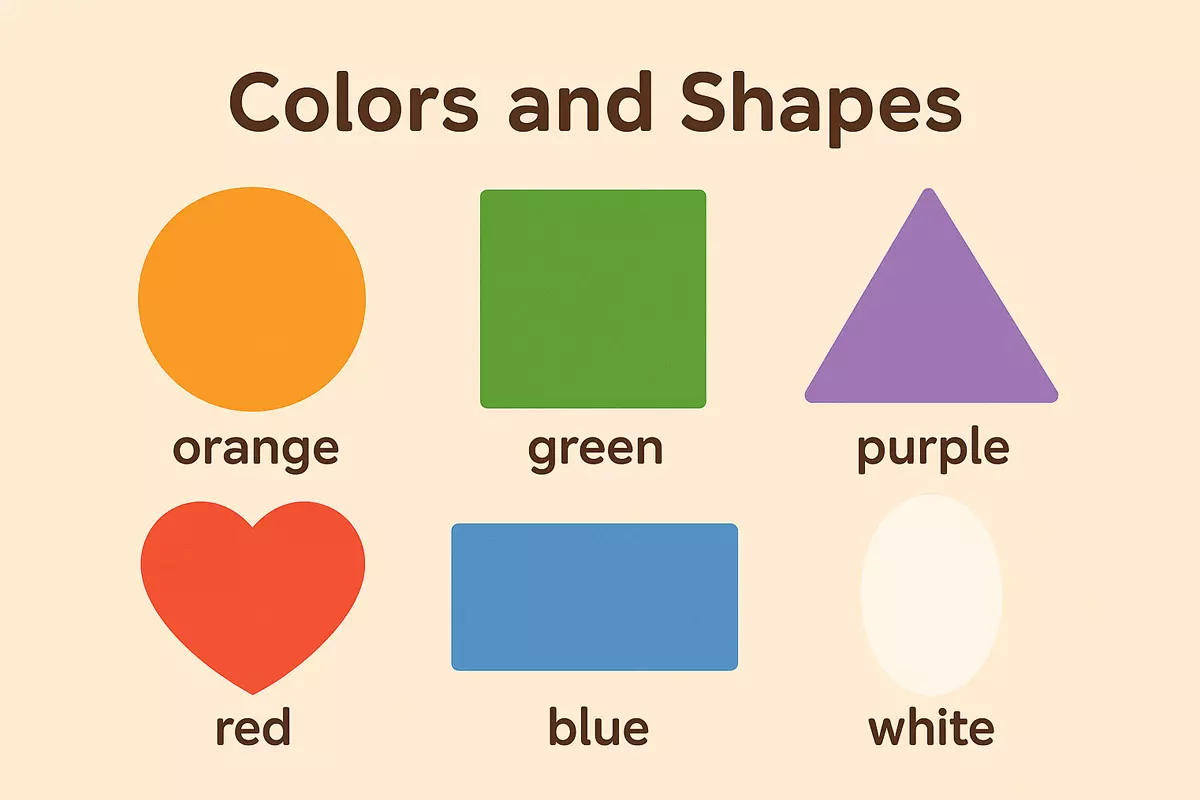 Learn to use basic color and shape words, describe objects, and understand word order with colors. Here we shade variations, simple style and design terms, common errors, and practical exercises for describing real-life items.
Bright colors and simple shapes are everywhere in our daily lives, and knowing how to describe them helps us communicate more clearly and creatively. This article introduces you to essential adjectives and descriptive terms, making it easier to express what you see and feel. Through practical examples and helpful explanations, you will learn how to talk about the world around you with greater confidence, whether you are describing objects, scenes, or your own experiences. Expanding your vocabulary in this area not only improves your language skills but also enriches your ability to share ideas and connect with others.
Core Color Words and Shade Variations
Understanding basic color adjectives is essential for describing objects and their visual qualities. While there are a handful of primary color words that most learners start with, the language of color expands quickly with common shades and related terms. These variations help to add detail, making your descriptions more precise and vivid.
Essential Color Adjectives
- Red
- Blue
- Yellow
- Green
- Orange
- Purple
- Pink
- Brown
- Black
- White
- Gray (or Grey)
- Beige
- Gold
- Silver
Common Shade Variations
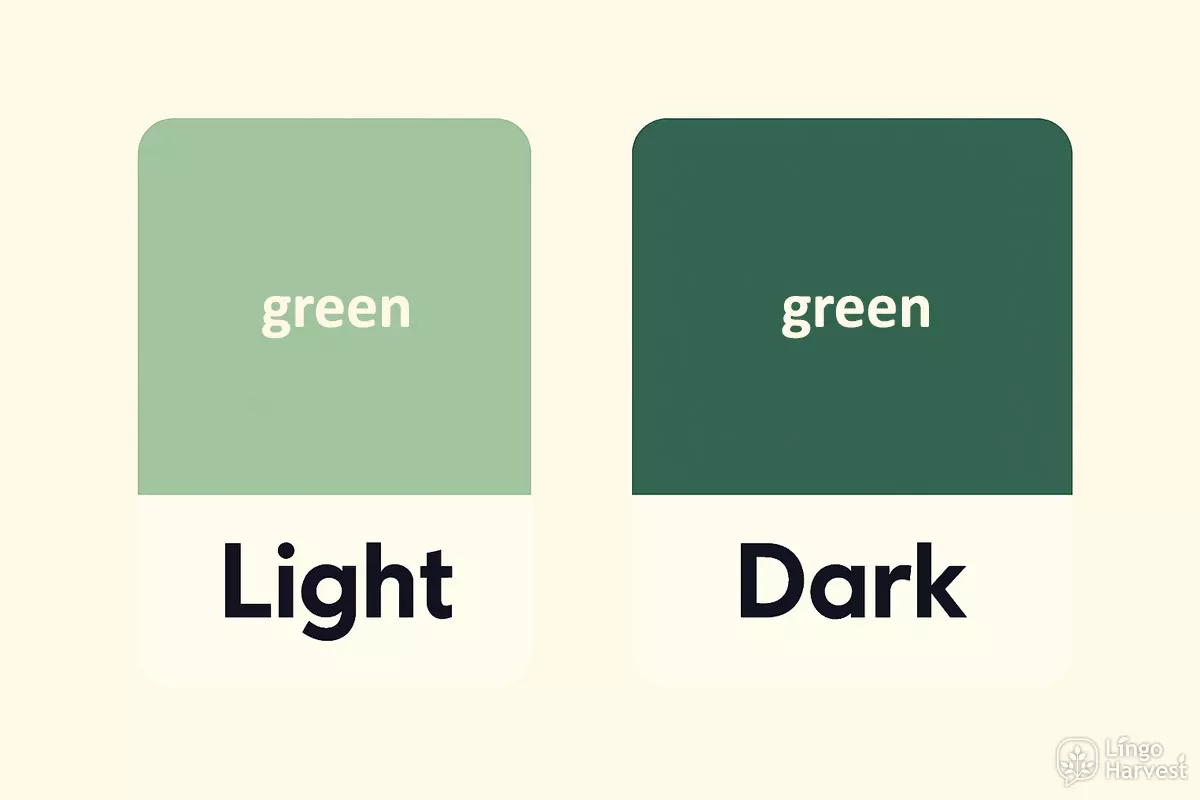
Shade adjectives are useful for talking about lighter or darker versions of a color. For example, you might say “light blue” for a pale sky color or “dark green” for a deep forest tone. Here are some typical ways to modify color words:
- Light (e.g., light pink, light gray)
- Dark (e.g., dark brown, dark blue)
- Pale (e.g., pale yellow)
- Bright (e.g., bright red, bright green)
- Deep (e.g., deep purple)
- Neon (e.g., neon orange)
- Pastel (e.g., pastel blue)
- Vivid (e.g., vivid pink)
- Muted (e.g., muted gray)
- Rich (e.g., rich gold)
Comparing Color Modifiers
Adjectives describing shade, brightness, or intensity can be combined with basic color words to create more nuanced expressions. The table below shows how different modifiers change the impression of a color:
| Modifier | Example Color Phrase |
|---|---|
| Light | light green |
| Dark | dark blue |
| Bright | bright yellow |
| Pale | pale pink |
| Pastel | pastel purple |
| Neon | neon green |
| Deep | deep red |
| Muted | muted orange |
These combinations allow you to describe everything from a vivid red apple to a pale blue sky or a dark brown table. With practice, using color adjectives and their variations will make your spoken and written descriptions much clearer and more engaging.
Basic Shapes and Object Descriptions
Understanding how to talk about forms and describe items around us is a key part of using adjectives in everyday language. Shapes help us identify and compare things, while descriptive words give more detail about their features, such as size, texture, or purpose.
Common Geometric Forms
When describing objects, it’s helpful to know the names of standard shapes. Here are some of the most frequently used:
- Circle – round, like a coin or a clock face
- Square – four equal straight sides and four right angles
- Rectangle – four sides, opposite sides equal in length
- Triangle – three sides and three corners
- Oval – shaped like an egg, longer than it is wide
- Diamond – like a square turned on its corner
- Star – points that radiate out from the center
- Heart – two rounded curves at the top, meeting in a point at the bottom
- Pentagon – five straight sides
- Hexagon – six straight sides
- Cylinder – like a can or a tube
- Cone – pointed at one end and circular at the other
- Sphere – perfectly round, like a ball
- Cube – six equal square faces, like a dice
Describing Objects: Useful Adjectives
Once you know the shape, you can add more detail by using descriptive words. Here are some adjectives that often combine with shapes to give a clearer picture:
- Flat
- Curved
- Pointed
- Sharp
- Round
- Soft
- Hard
- Thin
- Thick
- Long
- Short
- Wide
- Narrow
- Small
- Large
Examples: Matching Objects and Descriptions
Below is a table pairing familiar items with their shapes and a possible descriptive adjective. This makes it easier to visualize how these words are used in real contexts:
| Object | Shape + Description |
|---|---|
| Plate | Round, flat |
| Book | Rectangular, thick |
| Ball | Sphere, soft |
| Box | Square, hard |
| Pencil | Cylinder, long |
| Traffic sign | Triangle, pointed |
| Window | Rectangle, wide |
| Leaf | Oval, thin |
| Ice cream cone | Cone, narrow |
| Gemstone | Diamond, shiny |
Combining these shape names and adjectives gives you the vocabulary to describe almost any everyday item clearly. This approach is especially useful for beginners or anyone looking to expand their descriptive language skills.
Word Order with Colors
When describing objects using color adjectives in English, the color usually comes before the noun and after any other descriptive adjectives. This means you say "a red ball," not "a ball red." If you add more details, like size or shape, there's a typical sequence: opinion, size, shape, color, and then the noun. For example, you would say "a big round yellow balloon."
Common Patterns
Understanding the standard placement of color words helps your sentences sound natural. Here are some patterns to guide you:
- Color + Noun: blue car, green apple
- Size + Color + Noun: small pink box, large white dog
- Shape + Color + Noun: round red button, square brown table
- Opinion + Color + Noun: beautiful orange sunset, ugly gray building
- Number + Color + Noun: two black pens, five purple flowers
- Material + Color + Noun: wooden yellow chair, metal silver spoon
- Multiple Colors: black and white cat, red and blue flag
- Adjective Order: lovely small green plant, ugly big yellow truck
- With Shapes: oval pink stone, triangular green sign
- With Patterns: striped blue shirt, spotted brown cow
Color Placement in Sentences
The position of color adjectives can change in special cases. For example, when using linking verbs like "be," the color often comes after the noun: "The apple is green." But when the color describes the noun directly, it comes first: "the green apple."
| Correct Order | Incorrect Order |
|---|---|
| A blue circle | A circle blue ❌ |
| Three red squares | Red three squares ❌ |
| Big yellow star | Yellow big star ❌ |
| Small green triangle | Triangle green small ❌ |
| Oval black stone | Black oval stone ❌ |
| Beautiful white swan | White beautiful swan ❌ |
In summary, color adjectives are placed directly before the noun they describe, after any size, shape, or opinion adjectives. Practicing these patterns will help you use descriptive words about colors and shapes naturally in your sentences.
Talking About Style and Design Simply
Describing objects using basic adjectives for color and shape helps you communicate ideas about appearance clearly. When speaking or writing about objects, rooms, or designs, even simple words can make your meaning easy to understand. You don’t need complicated vocabulary—just a few common adjectives and a sense of what you want to express.
Common Words for Describing Appearance
Here are some of the most useful words for talking about how things look. These can be mixed and matched to create clear, simple descriptions:
- bright
- dark
- pale
- vivid
- round
- square
- flat
- curved
- smooth
- rough
- striped
- spotted
- solid
- transparent
- shiny
- dull
- long
- short
- wide
- narrow
Sample Sentences for Everyday Use
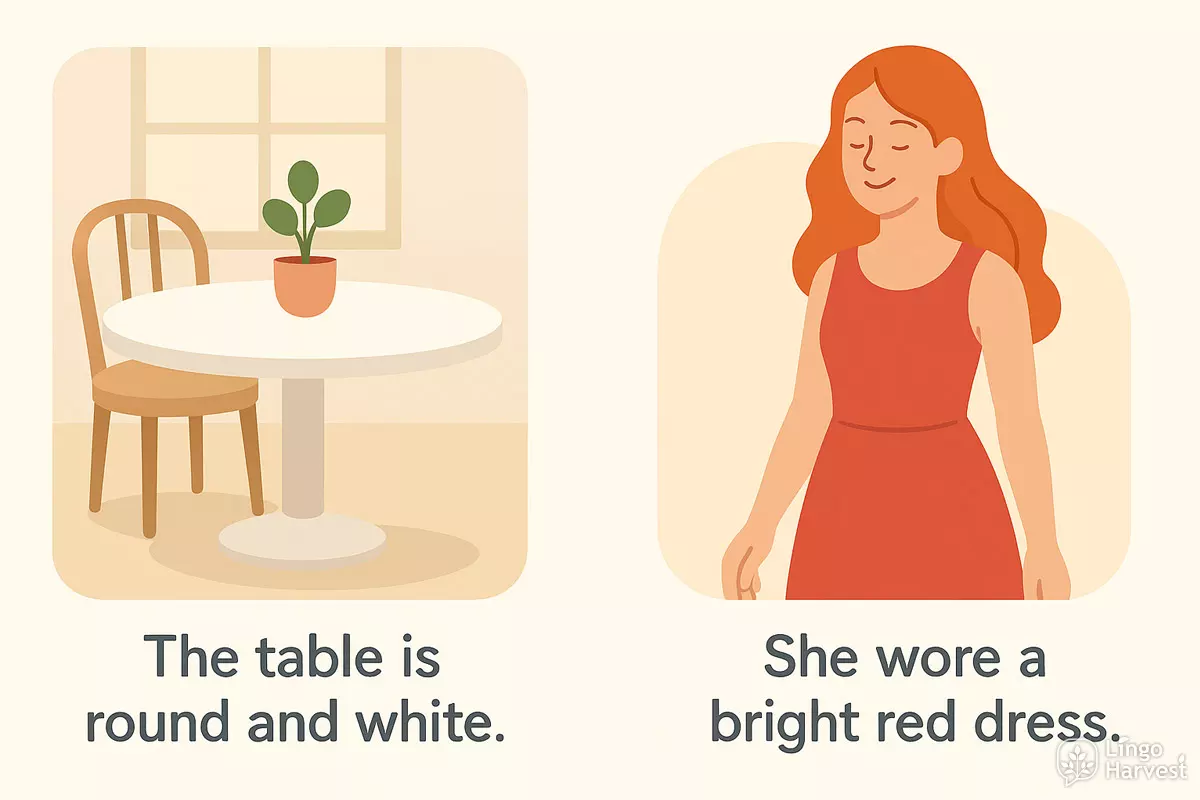
Combining simple adjectives helps you describe almost any object. Here are some example sentences you might use in daily conversation:
- The table is round and white.
- She wore a bright red dress.
- That box is square and flat.
- The wall is pale blue and smooth.
- He drew a long, curved line.
- The mug has a striped pattern.
- The window is transparent and shiny.
- My notebook is solid black.
Comparing Styles and Designs
It’s helpful to see how simple words can be combined to compare and contrast different objects. Here’s a table showing some basic examples of how to use adjectives to describe and compare:
| Object | Simple Description |
|---|---|
| Chair | Dark, square, wooden |
| Ball | Bright, round, smooth |
| Carpet | Pale, rectangular, soft |
| Window | Transparent, flat, shiny |
| Box | Solid, brown, square |
By practicing with these simple words and combinations, you can start to describe style and design in a way that’s both effective and easy to understand. Try using these adjectives the next time you talk about something you see or use every day.
Short Visual Descriptions
Understanding how to describe objects using basic adjectives is easier when you can picture them. Simple words like "red," "square," "small," and "round" help us quickly identify and talk about what we see. Below, you’ll find clear examples of how these descriptive terms are used with visuals in mind. Think of each phrase as a snapshot—a way to capture the look of something in just a few words.
Common Color and Shape Adjectives with Example Phrases
- Red ball – a round object colored bright red
- Blue square – a shape with four equal sides, filled with blue
- Green triangle – a three-sided figure in a green shade
- Yellow star – a five-pointed symbol in yellow
- Black circle – a simple, solid black ring or dot
- White rectangle – a shape with two longer sides, colored white
- Orange oval – an egg-shaped form in orange
- Purple heart – a heart symbol filled with purple
- Pink diamond – a four-sided figure with equal angles, colored pink
- Brown hexagon – a six-sided polygon in brown
- Gray pentagon – a five-sided figure in gray
- Small blue dot – a tiny, round spot colored blue
- Large red square – a big, four-sided shape in red
- Long yellow rectangle – a yellow shape that is much longer than it is wide
- Short green line – a brief, straight mark in green
Comparing Descriptive Phrases
It’s helpful to see how these adjectives combine to form clear, visual language. Here’s a structured comparison of ways to describe similar objects using both color and shape.
| Adjective Phrase | Visual Description |
|---|---|
| Blue circle | A round, blue-colored shape |
| Red triangle | A three-pointed, red figure |
| Yellow square | A four-sided shape, filled with yellow |
| Green oval | An elongated, green form |
| Pink heart | A heart shape colored pink |
| Black rectangle | A long, black four-sided figure |
| Orange star | A star with five points, colored orange |
| Purple diamond | A diamond-shaped figure in purple |
By combining simple adjectives for color and shape, you can create vivid, yet brief, descriptions for almost any object you see. This approach is especially useful for learners and in situations where quick identification matters.
Common Mistakes
Learners often run into confusion when describing objects using color and shape words. Mixing up adjective order, misusing plural forms, or forgetting to match adjectives with nouns can all lead to misunderstandings. Let’s look at where things often go wrong and how to avoid these typical errors.
Adjective Order Mix-ups
In English, adjectives generally follow a specific order. Placing color and shape in the wrong sequence can make sentences sound unnatural. For example, "a circle red" is incorrect, while "a red circle" is the standard form.
Singular and Plural Confusion
Adjectives do not change for singular or plural nouns in English, but it’s easy to accidentally add an -s to the adjective, especially when translating from other languages. For instance, "reds cars" is incorrect; it should be "red cars."
Common Adjective Errors: List
- Saying "the blue square big" instead of "the big blue square."
- Using "triangle yellow" instead of "yellow triangle."
- Writing "circles green" instead of "green circles."
- Using "round blue" for "blue circle" (mixing shape and color as adjectives incorrectly).
- Describing "a rectangle orange" instead of "an orange rectangle."
- Using "the square is circle" instead of "the square is circular" or "the object is a circle."
- Adding -s to colors: "blues" for "blue" when not referring to the plural noun.
- Using "the red big ball" instead of "the big red ball."
- Mixing up noun and adjective: "a square green" instead of "a green square."
- Forgetting articles: "blue triangle" instead of "a blue triangle" when needed.
Visual Comparison of Correct and Incorrect Usage
| Incorrect Example | Correct Example |
|---|---|
| The circle red | The red circle |
| Rectangles yellows | Yellow rectangles |
| Big green a square | A big green square |
| Triangle blue | Blue triangle |
| A square is circle | A square is circular |
Misunderstanding Adjective Use
It’s easy to forget that adjectives for colors and shapes should come before the noun they describe. In English, we say "a yellow star," not "a star yellow." Also, be careful not to use the noun form of shapes as adjectives unless the language allows it (e.g., "circular" is the adjective, not "circle").
Tips to Avoid Errors
- Remember: adjective order is size, color, shape, then noun (e.g., "big red circle").
- Do not add -s to adjectives for plural nouns.
- Check if you need an article ("a," "an," "the") before the adjective and noun.
- Practice with real objects and pictures to reinforce correct patterns.
Practice: Describe Real Objects Around You
Looking around your room or workspace is a great way to practice using adjectives for colors and shapes. Noticing the details of everyday items helps build your vocabulary and confidence in describing things clearly. Try to focus on combining different adjectives to give a full picture of what you see.
How to Observe and Describe
Start by picking any object nearby. Ask yourself:
- What color is it?
- What shape is it?
- Is it big or small? Long or short?
- Does it have any special features (like patterns or textures)?
Combine your answers into simple sentences. For example: "The book is blue and rectangular." or "That mug is round and white."
Common Adjectives for Real Objects
Here are some adjectives you can use to describe both color and shape. Try matching each with real items around you.
- Red, green, blue, yellow, purple, orange, brown, black, white, pink, gray
- Round, square, rectangular, triangular, oval, flat, tall, short, wide, narrow, thin, thick, curved, straight
Practice Exercise: Describe Objects Around You
Pick five things you can see now. Write a sentence for each, using at least one color and one shape adjective. For example:
- The chair is black and square.
- My notebook is green and rectangular.
- The lamp is tall and white.
- The clock is round and silver.
- The pillow is blue and soft.
Show answers
- Answers will vary, but should include at least one color and one shape adjective for each object.
- Examples: "The table is brown and rectangular." "My phone is black and flat." "The plant pot is round and orange."
Describing Objects: Sample Table
Below is a table with examples of objects, their color, and their shape. Use this as a model for your own sentences.
| Object | Color | Shape |
|---|---|---|
| Pencil | Yellow | Long and thin |
| Wall clock | White | Round |
| Book | Blue | Rectangular |
| Cushion | Red | Square |
| Mirror | Silver | Oval |
Quick Challenge
Describe three more objects near you, using a different color and shape for each.
Show answers
- Possible answers: "The folder is purple and rectangular." "The plate is white and round." "The eraser is pink and small."
Practicing with real items helps you remember new adjectives and use them naturally. As you get better, try adding more details like texture or pattern: "The striped pillow is soft and square," or "The shiny vase is tall and blue."