Adverbs in Argumentation and Essays (logically, consequently)

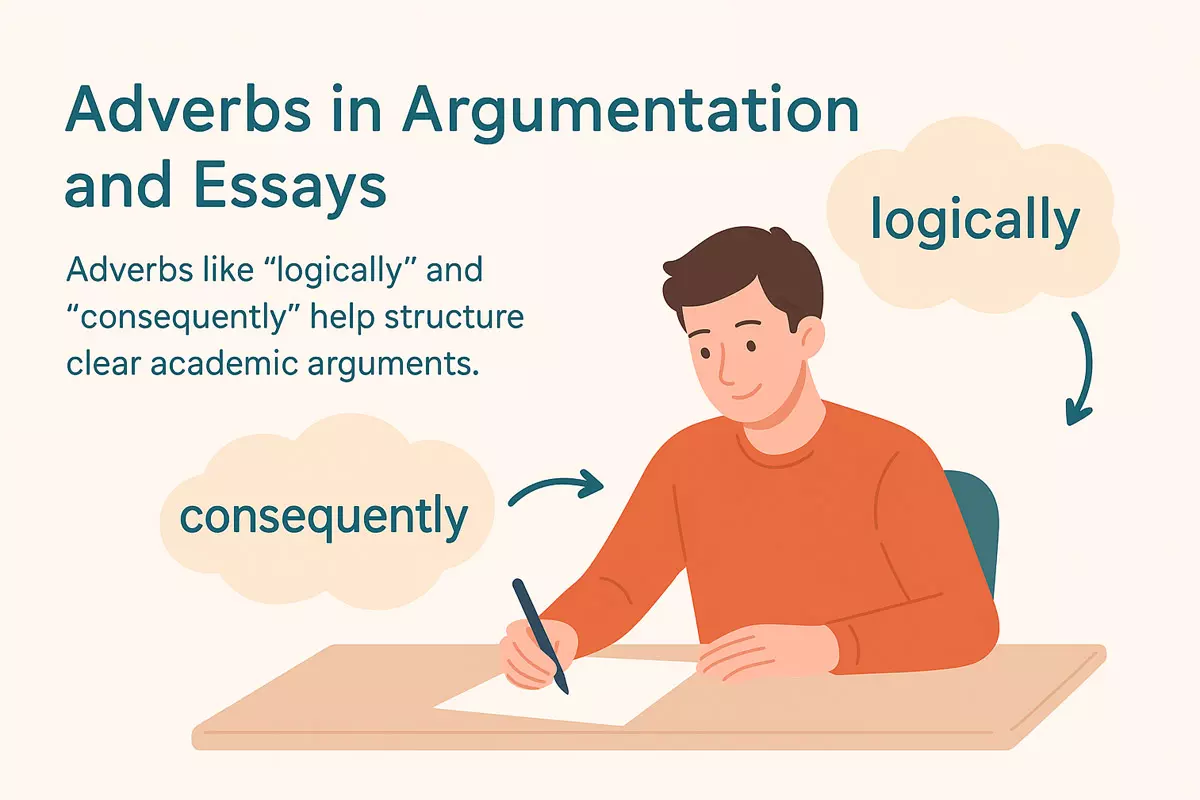 Here we how adverbs like logically, consequently, therefore, and similarly enhance logical flow in writing. It covers their meanings, correct placement in academic sentences, building coherent arguments, and provides examples and practice.
Skillfully placed modifiers like logically or consequently can significantly enhance the flow and clarity of persuasive writing by signaling relationships between ideas. When writers understand how to use these transitional words effectively, they are better able to guide readers through their arguments and demonstrate clear reasoning. This not only strengthens the connections between points but also makes the overall message more coherent and convincing, which is essential in persuasive communication.
How adverbs create logical flow in writing
Adverbs play a crucial role in connecting ideas and guiding readers through complex arguments. By linking sentences and clauses, they help writers clarify relationships such as cause and effect, contrast, sequence, and emphasis. This makes academic writing, essays, and argumentative texts easier to follow and more persuasive.
Connecting Ideas Clearly
Transitional adverbs, like "consequently," "therefore," and "however," signal shifts in logic or reasoning. These words alert readers to what comes next—whether it’s a result, a contradiction, or additional evidence. For example, "logically" signals that what follows is a reasoned conclusion, while "alternatively" introduces another possibility.
Examples of Logical Adverbs
Writers use a wide range of adverbs to create cohesion and logical progression. Here are several commonly used ones:
- consequently → The team missed the deadline; consequently, the launch was postponed.
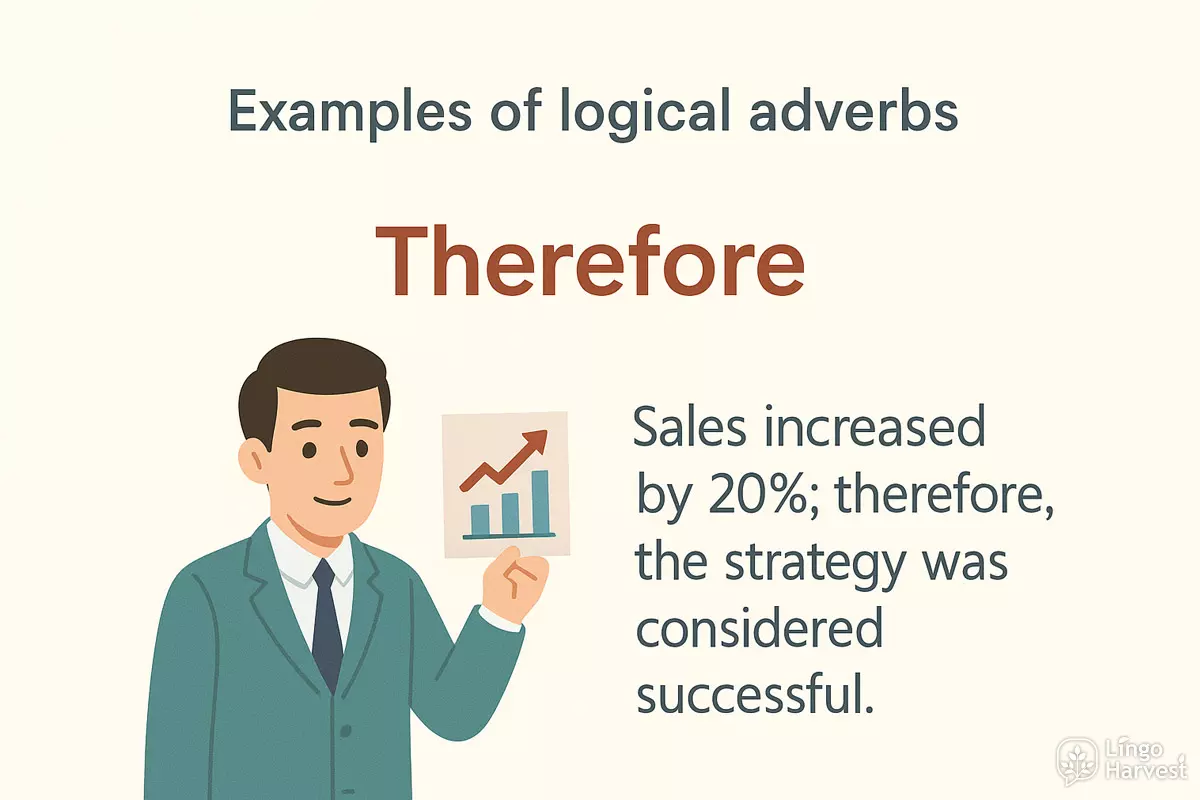
- therefore → Sales increased by 20%; therefore, the strategy was considered successful.
- thus → He didn’t update the file, thus causing confusion for everyone.
- however → She studied hard; however, the exam was still difficult for her.
- nevertheless → It was raining heavily; nevertheless, they continued the event outdoors.
- meanwhile → She prepared the presentation; meanwhile, he checked the data accuracy.
- subsequently → The system crashed; subsequently, all operations were delayed.
- alternatively → You can submit the form online; alternatively, you may visit the office.
- similarly → The first group performed well; similarly, the second group succeeded.
- otherwise → You must sign the document; otherwise, the request cannot be processed.
- additionally → The plan improves productivity; additionally, it reduces costs.
- furthermore → The product is eco-friendly; furthermore, it is affordable.
- logically → Logically, the next step is to validate the results.
- hence → The demand has increased; hence, more staff are needed.
- nonetheless → The task was challenging; nonetheless, she completed it successfully.
- accordingly → We revised the budget; accordingly, the timeline was adjusted.
- specifically → They requested a report, specifically one detailing expenses.
- explicitly → The instructions explicitly state that safety gear is required.
- simultaneously → Both servers failed simultaneously, causing a brief outage.
- ultimately → They faced many setbacks, but ultimately they reached their goal.
Functions of Logical Adverbs
Adverbs in argumentative writing serve several purposes:
- Sequence: "subsequently," "meanwhile"
- Cause and effect: "therefore," "thus," "consequently"
- Contrast: "however," "nevertheless," "nonetheless"
- Addition: "furthermore," "additionally"
- Clarification: "specifically," "explicitly"
- Alternative: "alternatively," "otherwise"
Impact on Reader Comprehension
Strategically placed adverbs help readers anticipate the structure of an argument, reducing confusion. For instance, using "consequently" before a result or "however" before a contrasting point signals how the information fits into the overall reasoning. This creates a smooth, logical flow from one idea to the next.
| Adverb | Function in Argumentation |
|---|---|
| Consequently | Shows result or outcome |
| However | Introduces contrast or exception |
| Furthermore | Adds supporting information |
| Logically | Signals rational conclusion or inference |
| Meanwhile | Indicates simultaneous events or actions |
| Alternatively | Presents another option or scenario |
| Specifically | Clarifies or narrows focus |
In summary, adverbs guide the reader through the writer’s reasoning, making essays and arguments much easier to follow. Skillful use of these words not only clarifies relationships between ideas but also strengthens the overall coherence of the text.
Meaning of logically, consequently, therefore, similarly
Understanding how certain adverbs are used in argumentation and essays can help present ideas with clarity and coherence. Words like "logically," "consequently," "therefore," and "similarly" serve specific functions to connect thoughts, show relationships, and guide the reader through a line of reasoning.
Function and Usage
These linking adverbs signal different types of logical connections:
- Logically – introduces a conclusion or inference that follows from the previous statements.
- Consequently – shows a result or effect caused by what was mentioned before.
- Therefore – signals a deduction or outcome based on the preceding information.
- Similarly – draws a parallel between two cases, highlighting likeness or equivalence.
Position in Sentences
These adverbs most often appear at the start of sentences or clauses, followed by a comma. They can also be placed after the subject for emphasis, but this is less common in formal writing.
Examples in Context
To see how these adverbs clarify argument structure, review the following sample sentences:
- Logically, if all humans are mortal and Socrates is human, Socrates must be mortal.
- She forgot her umbrella. Consequently, she got wet in the rain.
- The data was incomplete; therefore, the results were inconclusive.
- Many mammals care for their young. Similarly, birds often feed their chicks.
Comparison of Meaning and Use
| Adverb | Function/Typical Use |
|---|---|
| Logically | Signals reasoning or inference; often introduces a logical step. |
| Consequently | Marks a result or effect stemming from previous information. |
| Therefore | Links cause and effect; introduces a conclusion or deduction. |
| Similarly | Indicates a comparison or parallel between two ideas or situations. |
Quick Reference: When to Use Each
- Use logically for analytical steps or when outlining reasoning.
- Choose consequently to highlight direct outcomes.
- Apply therefore for drawing formal conclusions.
- Pick similarly to establish analogies or parallels.
Mastering these adverbs helps structure arguments, making essays more persuasive and easier to follow. Their correct application demonstrates both logic and clarity in written communication.
Placement in formal academic sentences
Adverbs such as "logically" and "consequently" play a crucial role in shaping the flow and clarity of arguments in academic writing. Their positioning within a sentence can subtly alter emphasis and meaning, so understanding where to place them is essential for precision and formality. Adverbs indicating logical relationships often appear at the start of a sentence, especially when introducing a new point, connecting ideas, or signaling a conclusion. However, they can also be placed mid-sentence or after the subject, depending on the desired tone and structure.
Common positions for logical adverbs
- Sentence-initial: Logically, this leads to the following conclusion.
- After the subject: This result consequently supports the hypothesis.
- Before the main verb: The author logically argues that…
- After the main verb: The theory was, consequently, revised.
Placement patterns and effects
Strategic placement affects both clarity and formality. Initial position is preferred for transitions and emphasis, while mid-sentence placement can make the connection less abrupt and more integrated.
| Position | Example |
|---|---|
| At the beginning | Consequently, the results support the hypothesis. |
| After the subject | The experiment logically demonstrates the theory. |
| Before the main verb | The researcher consequently concludes that... |
| After the verb (with commas) | The findings were, logically, expected. |
| Before a clause | The data, consequently, indicate a trend. |
Guidelines for effective use
- Use sentence-initial placement for transitions or when summarizing an argument.
- Insert adverbs after the subject for a subtler, more integrated tone.
- Avoid overusing adverbs; rely on them to clarify logic, not to fill space.
- Place adverbs before the verb for emphasis on the logical process.
- Separate adverbs with commas when they interrupt the sentence flow.
Choosing the right position for adverbs like "logically" and "consequently" improves both the coherence and persuasiveness of academic essays. Careful placement ensures your argument reads as both rigorous and natural.
Building coherent argument paragraphs
Effective argument writing relies on more than just presenting facts; it requires clear logical flow between ideas. Adverbs play a crucial role in guiding readers through reasoning, showing relationships such as cause, contrast, or consequence. Words like “logically” and “consequently” act as signposts, helping to clarify connections and maintain coherence within and between paragraphs.
Using adverbs to structure reasoning
Transitional adverbs are valuable for connecting claims and evidence smoothly. For example, “consequently” signals a result, while “logically” indicates a deduction or inference. Employing these terms at key points—such as the start of a sentence or clause—can make arguments more persuasive and easier to follow.
- Logically: introduces reasoning based on previous statements (e.g., “Logically, if the evidence is flawed, the conclusion may be unreliable.”)
- Consequently: shows an outcome or result (e.g., “Consequently, the policy failed to achieve its goals.”)
- Therefore: summarizes a logical result (e.g., “Therefore, stricter regulations are necessary.”)
- However: signals contrast or exception (e.g., “However, this view is not universally accepted.”)
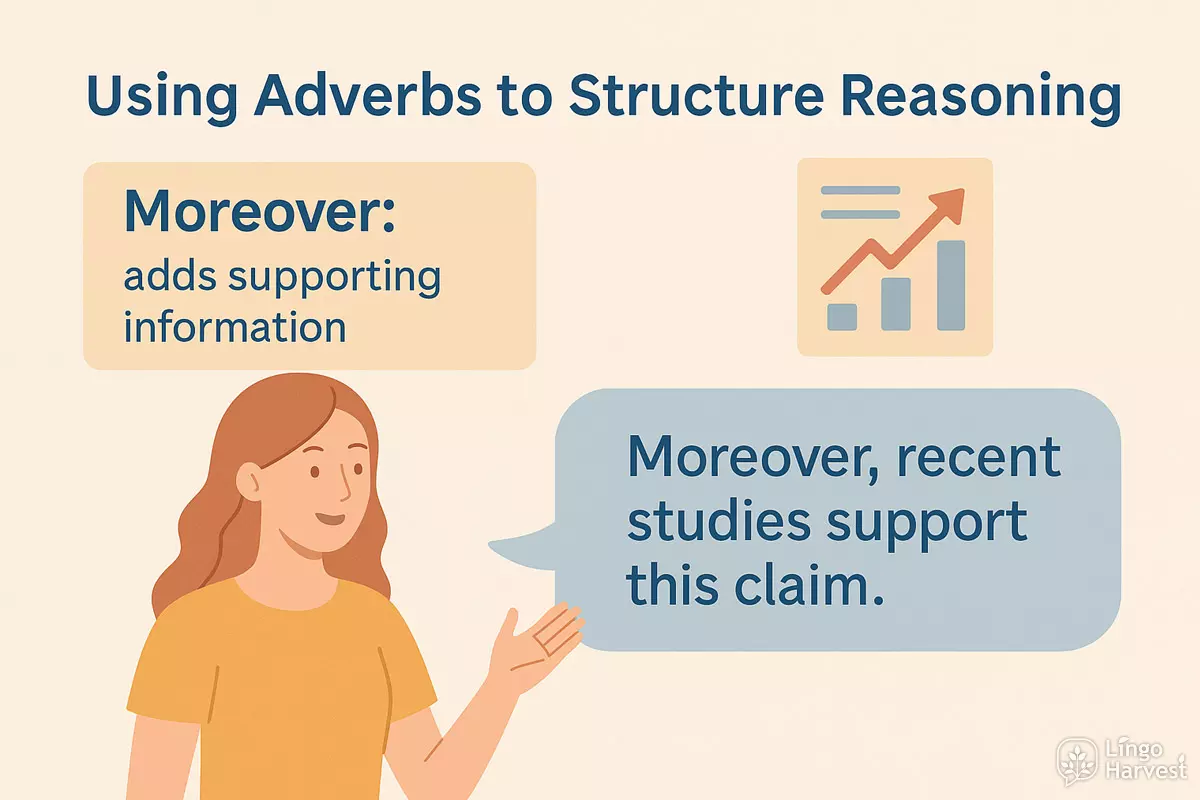
- Moreover: adds supporting information (e.g., “Moreover, recent studies support this claim.”)
- Hence: introduces a conclusion drawn from previous points (e.g., “Hence, the argument stands.”)
- Furthermore: builds on earlier points (e.g., “Furthermore, evidence suggests a rising trend.”)
- Nevertheless: contrasts with a previous statement (e.g., “Nevertheless, the approach remains popular.”)
- Similarly: draws a comparison (e.g., “Similarly, other countries have seen success.”)
- Conversely: presents the opposite perspective (e.g., “Conversely, critics argue the opposite.”)
- Subsequently: indicates a sequence (e.g., “Subsequently, the results were published.”)
- Thus: signals a consequence or summary (e.g., “Thus, the hypothesis was confirmed.”)
- In contrast: highlights a difference (e.g., “In contrast, the alternative is less effective.”)
- On the other hand: presents an alternative view (e.g., “On the other hand, some experts disagree.”)
- Additionally: introduces further evidence (e.g., “Additionally, there is economic data to consider.”)
- Otherwise: shows an alternative outcome (e.g., “Otherwise, the plan might fail.”)
- Indeed: emphasizes a point (e.g., “Indeed, this is a significant challenge.”)
- Alternatively: offers another option (e.g., “Alternatively, new methods could be explored.”)
- Consequently: points to a direct effect (e.g., “Consequently, enrollment numbers dropped.”)
Patterns for effective argument development
Integrating adverbs thoughtfully can help writers avoid abrupt shifts or unsupported claims. For instance, starting a paragraph with “logically” prepares the reader for a deductive step, while “consequently” signals a transition to outcomes or implications. Overusing the same adverbs, however, can make writing repetitive. Varying transitional terms keeps essays engaging and clear.
Comparing common argumentative adverbs
| Adverb | Function in Argument | Example Sentence |
|---|---|---|
| Logically | Introduces reasoning or inference | Logically, the data supports the hypothesis. |
| Consequently | Shows direct result or consequence | Consequently, the experiment was redesigned. |
| However | Signals contrast or exception | However, some participants disagreed. |
| Therefore | Summarizes a logical conclusion | Therefore, further research is needed. |
| Moreover | Adds supporting detail or evidence | Moreover, the findings align with previous studies. |
| Thus | Indicates a result or summary | Thus, the claim remains valid. |
| Nevertheless | Contrasts with previous information | Nevertheless, the project continued. |
| Similarly | Shows a parallel or comparison | Similarly, other cases have been reported. |
Thoughtful use of these adverbs not only clarifies an essay’s structure but also helps readers grasp the intended flow of logic. By signaling relationships and transitions, these words make academic writing more accessible and persuasive.
Examples from sample essays
When reading argumentative essays, you’ll notice that writers often use linking adverbs to clarify the flow of logic. Words such as “logically” and “consequently” help guide readers from one idea to the next, making arguments more coherent. Below, you'll find real-world examples and common patterns for using these adverbs in academic writing.
Sample Sentences Using Logical Adverbs
- Logically, if the evidence is flawed, the conclusion cannot be trusted.
- Many experts disagree; consequently, the policy remains controversial.
- Some believe the method is outdated. Consequently, they advocate for reform.
- The data is incomplete. Logically, further research is required.
- She failed to address the counterargument; consequently, her essay appears biased.
- There is no clear solution. Logically, compromise is necessary.
- The results were unexpected. Consequently, the hypothesis was revised.
- His premise is weak. Logically, his conclusions are questionable.
- Public opinion has shifted. Consequently, new policies have emerged.
- The cause was misidentified. Logically, the interventions failed.
- The experiment lacked controls; consequently, the findings are unreliable.
- The author relies on outdated sources. Logically, the argument loses credibility.
Placement and Function in Sentences
Writers typically place adverbs like “logically” at the beginning of a sentence to signal reasoning, while “consequently” often introduces results or effects. These choices help readers track the structure of complex arguments.
Comparison of Usage Patterns
| Adverb | Typical Use in Essays |
|---|---|
| Logically | Introduces reasoning or deduction, often at the start of a sentence: Logically, the next step is to gather more data. |
| Consequently | Signals result or effect, frequently after a semicolon or as a sentence opener: The experiment failed; consequently, the theory was revised. |
| Therefore | Connects evidence to conclusions, usually in formal arguments: The facts are clear; therefore, action must be taken. |
| Thus | Summarizes or concludes reasoning, often in summaries: Thus, the claim is unsupported. |
Tips from Model Essays
- Use adverbs sparingly to avoid repetition or monotony.
- Vary sentence structure by placing adverbs at the start, mid-sentence, or after a conjunction.
- Ensure the chosen adverb matches the logical relationship you want to express (cause, effect, deduction, etc.).
- Review published essays to see how experienced writers integrate these words for clarity and emphasis.
Practice: insert linking adverbs into a paragraph
Understanding how to use linking adverbs such as "logically" and "consequently" can make your arguments clearer and more persuasive. These adverbs connect ideas smoothly and help readers follow your reasoning. To master their usage, it’s helpful to practice placing them naturally within paragraphs.
Task: Complete the Paragraph with Linking Adverbs
Below is a short argumentative paragraph with several blanks. Your task is to insert suitable linking adverbs from the provided list into each blank to improve the flow and logical connections. Choose from: logically, consequently, moreover, however, therefore, in contrast, for example, similarly, nevertheless, as a result.
Many students believe that studying late at night is effective. _______, research shows that concentration levels decrease after midnight. _______, those who stay up late may struggle to recall information the next day. _______, it makes sense to prioritize sleep over late-night study sessions. _______, some students continue to prefer late-night work. _______, they may feel more productive at night, but this perception is often misleading.
Show answers
- However, research shows that concentration levels decrease after midnight.
- Consequently, those who stay up late may struggle to recall information the next day.
- Logically, it makes sense to prioritize sleep over late-night study sessions.
- Nevertheless, some students continue to prefer late-night work.
- For example, they may feel more productive at night, but this perception is often misleading.
Summary
Linking adverbs help create clear, logical, and well-structured writing. They show relationships between ideas — such as cause and effect, contrast, sequence, or emphasis — and guide the reader smoothly through your argument. Using a varied range of connectors makes your text more coherent and professional.
When choosing a linking adverb, consider the function you need: to contrast ideas, add information, explain results, or illustrate examples. Selecting precise connectors not only strengthens your reasoning but also improves the overall flow and clarity of your essay.
Quick Exercise: Choose the Best Linking Adverb
Read each sentence and select the most appropriate linking adverb from the list above:
- He forgot to set his alarm. _______, he was late for the exam.
- The data supports the hypothesis. _______, further research is needed.
- Some people prefer to work in silence. _______, others enjoy background music.
- The road was closed. _______, we had to take a longer route.
- The task was difficult. _______, she managed to complete it on time.
- The weather was terrible. _______, the event continued as planned.
- The team trained hard. _______, they won the championship.
- She loves big cities. _______, her brother prefers quiet villages.
- The instructions were unclear. _______, many users made mistakes.
- He didn’t follow the safety rules. _______, he injured his hand.
Show answers
- As a result
- Nevertheless
- In contrast
- Therefore
- However
- Nevertheless
- Consequently
- On the other hand
- As a result
- Therefore
Practicing with linking adverbs helps you develop more coherent and persuasive written arguments. Try creating your own sentences or paragraphs using the list above to further enhance your writing skills.