Adjectives for Storytelling and Fiction Writing

 Here we how adjectives influence imagery in fiction, outlines types of descriptive adjectives for narratives, and explains their effect on tone and mood.
Selecting effective descriptive words can elevate any story, turning basic narratives into engaging and memorable experiences. Whether you are writing an imaginative fantasy or a realistic slice-of-life piece, the use of strong adjectives and adverbs allows you to create detailed settings, convey characters' feelings, and add depth to every interaction. Carefully chosen modifiers not only enhance the atmosphere but also help readers connect with the story on a deeper level, making your writing more compelling and immersive.
How adjectives shape imagery in fiction
Adjectives play a crucial role in helping readers visualize settings, characters, and emotions within a story. By choosing evocative descriptors, writers can create vibrant mental pictures and evoke specific moods. Instead of telling readers what to feel, skillful use of adjectives allows them to experience the world through sensory details and subtle cues.
Evoking Sensory Details
Descriptive words attached to nouns help paint a fuller picture. For example, compare “the house” with “the crumbling, moss-covered house.” The added descriptors offer not just a visual, but also subtle hints about atmosphere and possible backstory. This technique applies across all senses—sight, sound, touch, taste, and smell.
- Visual: shimmering, scarlet, jagged, dusky, translucent
- Auditory: muffled, shrill, booming, melodic, rasping
- Tactile: gritty, velvety, icy, prickly, slick
- Olfactory: pungent, musty, floral, smoky, briny
- Gustatory: tangy, bitter, syrupy, bland, zesty
Setting Tone and Mood
The adjectives a writer selects can dramatically shift the emotional landscape. Consider the difference between “a cheerful morning” and “a bleak morning.” Each creates a distinct expectation for the reader, shaping how the scene is interpreted and felt.
Comparing Adjective Usage: Vivid vs. Neutral
Writers often choose between plain and specific adjectives to control imagery strength. Here’s a structured comparison:
| Neutral Description | Vivid, Image-Rich Variation |
|---|---|
| old tree | gnarled, ancient oak |
| dog | scruffy, mud-spattered terrier |
| wind | biting, relentless wind |
| road | winding, overgrown path |
| dress | tattered, emerald-green gown |
Tips for Effective Imagery
Writers can enhance their scenes by:
- Choosing adjectives that appeal to multiple senses
- Matching word choice to the story’s tone
- Varying specificity to avoid repetition
- Using fresh or unexpected combinations for originality
- Balancing detail with pacing—sometimes less is more
In summary, carefully selected adjectives enable writers to craft immersive, memorable scenes that linger in the reader’s mind. The right descriptive language brings fiction to life, making every scene more vivid and engaging.
Types of descriptive adjectives for narratives
Writers rely on a rich variety of descriptive adjectives to paint vivid scenes and bring characters to life. These modifiers can express everything from a character’s mood to the atmosphere of a setting, and they help readers visualize the world within the story. By understanding the different categories, authors can select the most fitting words for any narrative moment.
Physical Appearance
Adjectives in this group focus on how people, objects, or places look. These details set the visual tone and help readers imagine what’s happening.
Descriptive Visual Qualities
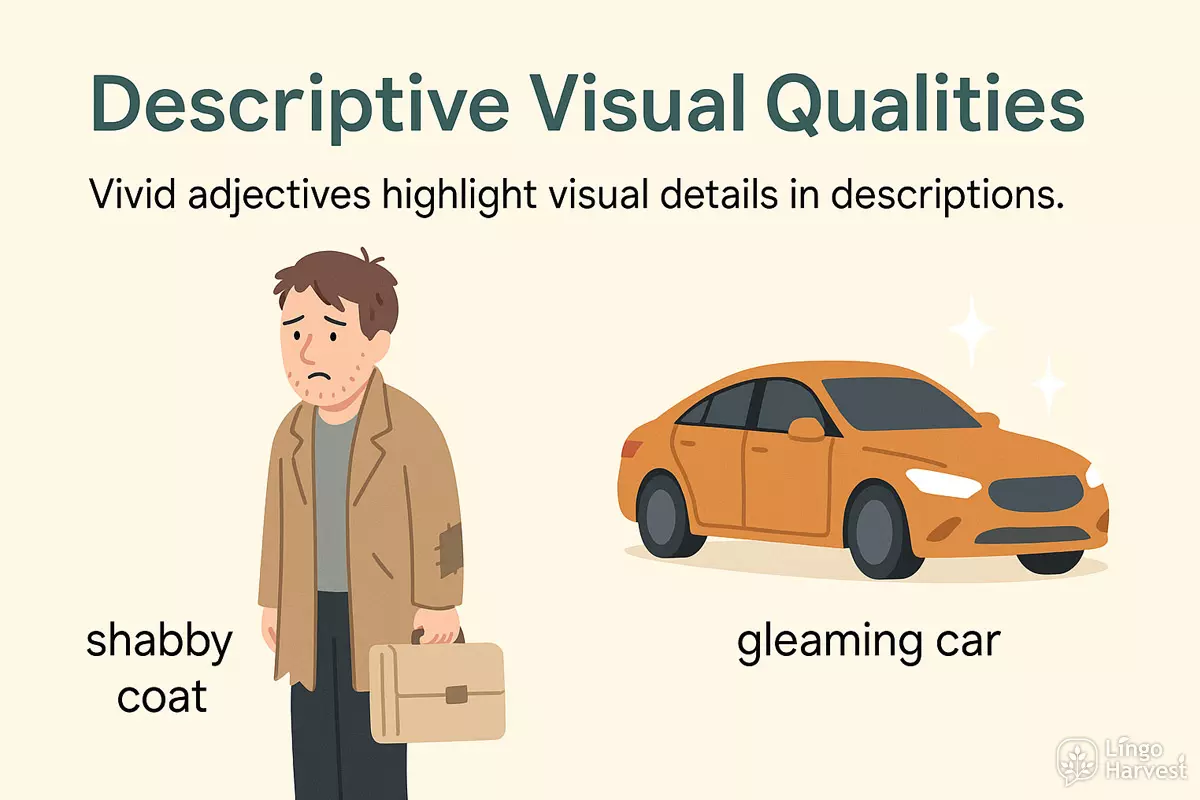
- shabby → He wore a shabby coat to the interview.
- gleaming → A gleaming car was parked outside the hotel.
- towering → They walked under towering pine trees.
- wrinkled → She folded the wrinkled letter carefully.
- tangled → The cat played with a tangled ball of yarn.
- crimson → She chose a crimson dress for the evening.
- glittering → The stage was decorated with glittering lights.
- shadowy → A shadowy figure stood near the doorway.
- faded → He found a faded photograph in the attic.
- polished → The polished floor reflected the sunlight.
Emotional Qualities
Adjectives that suggest inner feelings, moods, or emotional tension.
- anxious → He felt anxious before the exam.
- elated → She was elated after hearing the good news.
- brooding → He sat by the window with a brooding expression.
- cheerful → The children returned home cheerful and excited.
- sullen → His sullen attitude ruined the meeting.
- hopeful → They remained hopeful despite the setbacks.
- resentful → She sounded resentful about the decision.
- ecstatic → The team was ecstatic after their victory.
- overwhelmed → She became overwhelmed by the sudden pressure.
- uneasy → He felt uneasy walking through the dark street.
Atmosphere and Setting
Adjectives that create mood, tone, and environment in a scene.
- gloomy → The gloomy room was lit by a single lamp.
- serene → They enjoyed a serene morning by the lake.
- oppressive → The oppressive heat made it hard to breathe.
- festive → Colorful banners created a festive atmosphere.
- desolate → The desolate road stretched for miles.
- mysterious → A mysterious whisper echoed through the hall.
- sweltering → We waited in the sweltering sun for hours.
- picturesque → The town looked picturesque after the snowfall.
- rustic → They rented a rustic cabin for the weekend.
- vibrant → The vibrant marketplace was full of energy.
Character Traits
Adjectives used to describe personality, habits, or consistent behavior.
- generous → She was generous with her time and advice.
- timid → The timid student avoided speaking in class.
- cunning → The cunning fox escaped the trap.
- reckless → His reckless decisions caused trouble again.
- stubborn → The child remained stubborn about bedtime.
- meticulous → He kept meticulous notes during the lecture.
- charismatic → The charismatic leader inspired everyone.
- naive → She was too naive to see his intentions.
- pragmatic → His pragmatic thinking helped solve the crisis.
- ambitious → The ambitious intern worked late every day.
Comparing Adjective Types
Sometimes, it’s useful to compare how different adjective types function in storytelling. Here’s a simple overview:
| Category | Purpose in Narrative |
|---|---|
| Physical Appearance | Creates visual imagery of characters, objects, or settings |
| Emotional Qualities | Conveys feelings, moods, or psychological states |
| Atmosphere and Setting | Establishes mood and sensory environment |
| Character Traits | Defines personality, motivation, and behavioral patterns |
Choosing the right descriptive adjective depends on the narrative need—whether it’s to show how a stormy night feels, how a villain looks, or what kind of person your protagonist becomes. Mixing these types thoughtfully makes fiction more immersive and memorable.
Tone and mood through adjective choice
Choosing the right adjectives can dramatically affect how readers experience a story. The words you select not only describe people, places, and things, but also create emotional undercurrents and shape the reader’s expectations. For example, describing a room as “gloomy” versus “sunlit” immediately leads to very different emotional responses. Writers often use adjectives to subtly signal whether a scene is meant to feel tense, joyful, mysterious, or melancholic. The cumulative effect of well-chosen descriptive words can immerse readers in the mood you want them to feel, even before any action unfolds.
How adjectives influence atmosphere
Adjectives can guide the reader’s emotional response by coloring the narrative with specific shades of meaning. Consider how these options set different atmospheres:
- Ominous clouds gathered over the village. (foreboding)
- Cheerful laughter echoed through the park. (uplifting)
- Bleak corridors stretched ahead. (hopelessness)
- Vivid flowers lined the path. (energy, positivity)
Comparing adjective effects in fiction
To see how word choice shapes a scene, compare similar sentences with different adjectives. Notice how each set conjures a different emotional landscape.
| Adjective Set | Mood Evoked |
|---|---|
| dreary, desolate, shadowy | Creates a somber, unsettling atmosphere |
| lush, radiant, inviting | Suggests warmth, comfort, and positivity |
| frigid, sterile, silent | Evokes coldness, isolation, and unease |
| wild, chaotic, vibrant | Conveys energy, unpredictability, or excitement |
| ancient, crumbling, mysterious | Imparts a sense of history and intrigue |
Tips for intentional adjective use
- Match your descriptive words to the intended emotion of each scene.
- Be mindful of subtle connotations—some adjectives carry emotional weight beyond their surface meaning.
- Vary your vocabulary to keep the narrative fresh and avoid repetition.
- Read scenes aloud to sense whether the mood feels consistent and effective.
Thoughtful adjective selection is a powerful tool for fiction writers, helping to guide the reader’s emotional journey and reinforce the intended mood of each scene.
Avoiding over-description and cliché phrases
Striking the right balance when using adjectives is essential for vivid storytelling. Overloading sentences with too many descriptive words can slow down the narrative and distract readers from the action or emotion. Equally, relying on worn-out expressions can make your writing feel generic and unoriginal. Instead, focus on choosing words that genuinely enhance your scenes and characters.
Recognizing Over-Description
Writers often fall into the trap of painting every detail, believing it adds depth. In reality, excessive description can clutter the story. Ask yourself if each adjective provides new information or simply restates what’s already clear. For example, “the tall, towering, lofty building” repeats the same idea. Instead, select the most precise word and trust your reader’s imagination.
- Use adjectives to reveal character or mood, not just physical traits.
- Omit modifiers that don’t change the image or tone.
- Let verbs and nouns do the heavy lifting when possible.
Cliché Phrases to Avoid
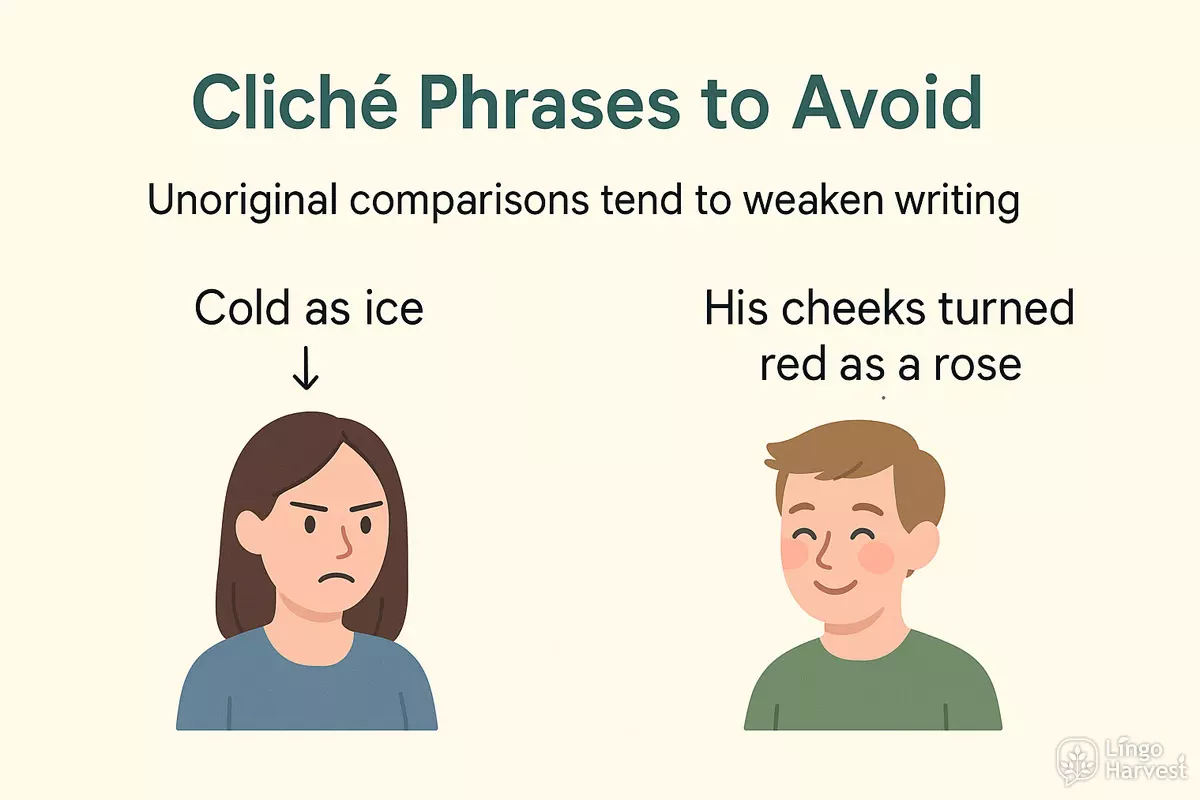
Clichés are familiar phrases that have lost their impact through overuse. Swapping them for fresh, specific language will make your writing stand out. Here are some tired expressions to watch for:
- Cold as ice → Her stare was cold as ice.
- Red as a rose → His cheeks turned red as a rose.
- Pitch black → The room went pitch black during the storm.
- Blindingly bright → The sunlight was blindingly bright this morning.
- Strong as an ox → He may be quiet, but he is strong as an ox.
- Quiet as a mouse → The child sat quiet as a mouse in the corner.
- Burning with rage → She left the meeting burning with rage.
- Brave as a lion → The firefighter was brave as a lion.
- Dark and stormy → It was a dark and stormy night outside.
- Crystal clear → The instructions were crystal clear.
- Deafening silence → A deafening silence filled the room.
- White as snow → Her dress was white as snow.
- Sharp as a tack → He’s sharp as a tack and learns fast.
- Light as a feather → The scarf felt light as a feather.
- Old as time → The tradition is old as time.
Tips for Fresh, Effective Description
- Opt for sensory details unique to your setting or character.
- Replace generic modifiers with specific, concrete images.
- Read your sentences aloud to catch awkward or repetitive wording.
- Limit yourself to one or two adjectives per noun for stronger impact.
- Experiment with metaphors and similes that feel original to your story’s world.
Refining your use of descriptive language takes practice and careful editing. By avoiding unnecessary embellishment and steering clear of clichés, you help readers engage more deeply with your narrative, making every detail count.
Examples from short narrative passages
Using descriptive words in fiction helps create vivid imagery and bring stories to life. By weaving in carefully chosen adjectives, writers can evoke specific moods, clarify characters, and set the tone for a scene. Below, you’ll find short excerpts and sample sentences that showcase how modifiers can transform simple statements into engaging narrative moments.
Sample snippets with effective adjective use
- The ancient oak tree loomed over the quiet village, its gnarled branches casting twisted shadows at dusk.
- She wore a crimson scarf that fluttered in the bitter wind, her determined eyes fixed on the distant horizon.
- His shaky hands betrayed his nervous excitement as he opened the mysterious letter.
- In the silent alley, a stray cat watched with unblinking eyes.
- The looming storm threatened the fragile peace of the sleepy town.
- A brilliant sunrise painted the cloudless sky with vivid colors.
- Her warm laughter brightened the gloomy morning.
- The rusty gate creaked open, revealing a forgotten garden overgrown with wild roses.
- He navigated the crowded market with careful steps, avoiding the rowdy vendors.
- The timid boy clung to his tattered backpack, eyes darting around the noisy classroom.
Adjective impact: before and after comparison
| Plain Sentence | With Descriptive Adjectives |
|---|---|
| The house stood on the hill. | The crumbling house stood on the lonely hill. |
| She opened the door. | She opened the heavy, wooden door. |
| The child smiled. | The curious child smiled with bright eyes. |
| The dog barked. | The small, anxious dog barked sharply. |
| The street was empty. | The deserted street was eerily empty. |
Tips for applying adjectives in storytelling
- Choose words that match the mood you want to convey.
- Avoid overloading sentences; select the most impactful adjective.
- Use sensory descriptors to help readers visualize and feel the scene.
- Vary your vocabulary to keep the narrative fresh and engaging.
By analyzing how descriptive words shape narrative passages, writers can better understand their power in fiction and use them purposefully to enhance storytelling.
Practice: rewrite using vivid adjectives
Bringing stories to life often means swapping dull, generic adjectives for ones that paint a more vibrant picture in the reader’s mind. Practicing this technique can deepen your descriptive skills and help you craft memorable characters, settings, and moods.
Try it yourself: Enhance with vivid adjectives
Below, you'll find a set of plain sentences. Your task is to rewrite each one, replacing the basic adjectives with more evocative or specific options. Think about the mood or image you want to create, and choose words that spark the imagination.
- The big house stood on the hill.
- She wore a nice dress.
- The old tree stood in the yard.
- He had a bad day.
- They walked into a dark room.
Need inspiration? Here are some vivid adjectives to consider:
- towering, sprawling, crumbling
- elegant, tattered, dazzling
- ancient, gnarled, majestic
- dismal, disastrous, exhausting
- gloomy, shadowy, pitch-black
- shimmering, radiant, windswept
- whispering, eerie, bustling
- frosty, sweltering, rain-soaked
- mysterious, suffocating, inviting
- sleepy, vibrant, desolate
Comparison: Basic vs. Vivid Adjectives
| Plain sentence | Rewritten with vivid adjectives |
|---|---|
| The big house stood on the hill. | The towering, weather-beaten mansion loomed atop the windswept hill. |
| She wore a nice dress. | She wore a shimmering, sapphire-blue gown. |
| The old tree stood in the yard. | The ancient, gnarled oak stood proudly in the overgrown yard. |
| He had a bad day. | He endured a dismal, nerve-wracking day. |
| They walked into a dark room. | They walked into a shadowy, suffocating room. |
When you practice swapping out bland adjectives, you build a toolkit for making your fiction more colorful and immersive.
Show answers
- The towering, weather-beaten mansion loomed atop the windswept hill.
- She wore a shimmering, sapphire-blue gown.
- The ancient, gnarled oak stood proudly in the overgrown yard.
- He endured a dismal, nerve-wracking day.
- They walked into a shadowy, suffocating room.