Adjectives for Business English: key, major, strategic

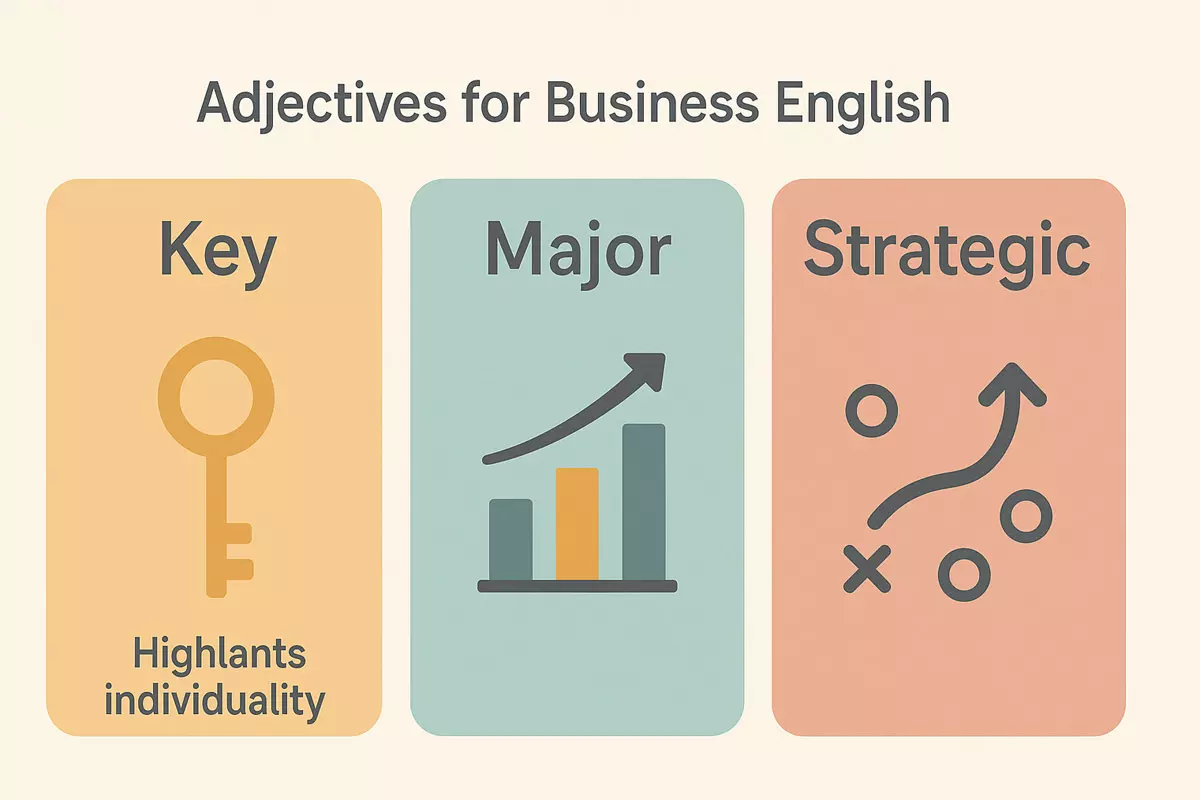 Here we how adjectives improve business communication, outlines common business descriptors, and explains their meanings.
In today's competitive business environment, using well-chosen descriptive language can make your communication more compelling and effective. Selecting the right words not only enhances clarity but also helps convey your ideas with confidence and authority. By mastering impactful modifiers, professionals can ensure that their messages stand out, resonate with their audience, and achieve the desired results. Developing this skill is essential for anyone seeking to succeed and make a lasting impression in professional settings.
How adjectives strengthen business communication
Well-chosen adjectives bring clarity and nuance to professional conversations. When describing projects, strategies, or performance, specific modifiers help colleagues understand priorities and expectations. For example, calling a customer "key" versus "potential" signals their importance to the business. Adjectives like "major," "strategic," or "critical" guide decision-making by highlighting what matters most.
Why precision matters in workplace language
Precision in language reduces misunderstandings and streamlines discussions. Using targeted adjectives allows teams to focus on urgent or high-impact issues. For instance, distinguishing between a "routine" update and a "significant" change sets the right level of urgency and resource allocation.
Common business adjectives and their impact
Selecting appropriate descriptors enhances messages, making them more actionable and persuasive. Here are useful adjectives that frequently appear in business English:
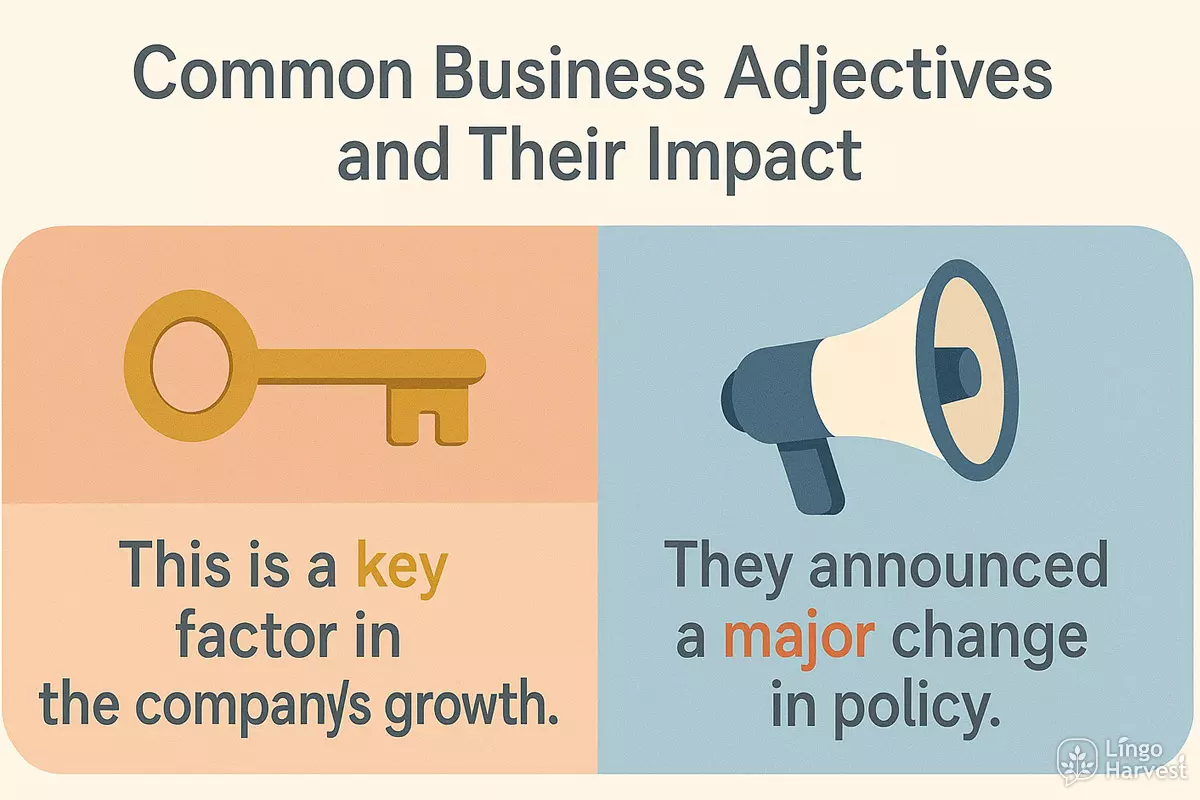
- Key → This is a key factor in the company’s growth.
- Major → They announced a major change in policy.
- Strategic → We need a strategic plan for expansion.
- Critical → Customer feedback is critical to improvement.
- Core → Innovation is a core value of the brand.
- Essential → Strong communication skills are essential for leadership.
- Primary → Our primary goal is to increase customer satisfaction.
- Emerging → They are investing in emerging technologies.
- Potential → This market has potential opportunities for growth.
- Significant → The company saw significant progress last quarter.
- Relevant → Your experience is highly relevant to the position.
- Competitive → We must maintain a competitive advantage.
- Innovative → The team introduced an innovative solution.
- Global → They are expanding their global presence.
- Operational → We implemented new operational procedures.
- Profitable → The new product became highly profitable.
- Effective → This method is the most effective so far.
- Long-term → We are focusing on long-term sustainability.
- Short-term → There will be short-term challenges to overcome.
- Robust → The system needs a robust security framework.
Clarifying intent and priority
Adjectives help express the level of priority, risk, or opportunity. For example, describing a partnership as "strategic" versus "tactical" changes how it is perceived and managed. These subtle distinctions support accurate planning and alignment across teams.
Comparing adjective choices in context
The impact of a sentence often depends on the chosen adjective. See how meaning shifts in the examples below:
| Sentence | Effect of the Adjective |
|---|---|
| We have a key meeting tomorrow. | Indicates high importance; likely essential for goals. |
| This is a major client for our company. | Shows the client’s significant impact on business. |
| Our focus is on strategic investments. | Highlights long-term planning and organizational priorities. |
| She led a critical project last year. | Emphasizes the project’s essential role in success. |
Adjectives, when used thoughtfully, fine-tune business communication. They help teams align on objectives, allocate effort wisely, and convey the right level of urgency or value in every message.
Common business descriptors and their meanings
Understanding the language used in business contexts can help you communicate more effectively and precisely. Certain adjectives are frequently used to describe projects, decisions, or roles within an organization. These words often carry nuanced meanings that can influence how your message is interpreted in a professional environment.
Key adjectives and what they signal
Business English relies on specific descriptors to indicate importance, size, or function. Here are some widely used terms and what they typically imply in a workplace setting:
- Key – Crucial or essential to success.
- Major – Large, significant, or highly influential.
- Strategic – Planned with a long-term goal in mind; related to overall direction.
- Core – Central or foundational to the business.
- Critical – Extremely important, often urgent.
- Operational – Related to day-to-day activities or processes.
- Emerging – New and growing in significance or relevance.
- Leading – At the forefront or most advanced.
- Global – International in scope or impact.
- Innovative – Characterized by new ideas or methods.
- Competitive – Able to perform better than others in the market.
- Proactive – Taking initiative rather than reacting to events.
- Efficient – Achieving results with minimum wasted effort.
- Scalable – Able to grow or expand in capacity.
- Robust – Strong and able to withstand stress or change.
- Profitable – Generating more revenue than cost.
- Flexible – Adaptable to different situations or changes.
- Comprehensive – Covering all or nearly all elements.
- Sustainable – Capable of being maintained over the long term.
- Dynamic – Characterized by constant change or activity.
How context changes meaning
The meaning of these adjectives may shift depending on how and where they are used. For instance, a “strategic partnership” usually refers to a collaboration with long-term benefits, while a “key client” is one whose business is vital to the company’s success.
Comparing common descriptors
Below is a comparison of several frequently used business adjectives, highlighting their typical usage and connotations:
| Descriptor | Typical Business Meaning |
|---|---|
| Key | Essential, highly important; often used for people, clients, or resources that are central to goals. |
| Major | Large in scale or impact; often used for projects, clients, or changes that affect the organization significantly. |
| Strategic | Related to long-term plans or objectives; implies careful planning and alignment with overall direction. |
| Critical | Urgently important; failure in this area could have serious consequences. |
| Core | Fundamental or central; describes elements that are indispensable to the business. |
Selecting the right descriptor helps ensure your message is clear, precise, and appropriate for the business context. Understanding these subtle differences can improve both written and spoken communication in professional settings.
Formal vs semi-formal tone in business contexts
Understanding when to use a formal or semi-formal tone can significantly impact how your message is received in professional environments. The choice of adjectives is a key element in establishing the right level of formality, especially when describing priorities, plans, or partnerships.
Distinguishing features of formal and semi-formal language
Formal tone is typically used in written communication such as reports, proposals, and official correspondence. It favors precise, unambiguous adjectives and avoids contractions or colloquial expressions. Semi-formal tone, on the other hand, is common in business emails, presentations, or conversations with colleagues, where clarity is still important, but the language is slightly more relaxed.
- Formal: essential, significant, strategic, primary, fundamental
- Semi-formal: important, major, key, big, main
Choosing the right adjective for the context
Selecting the appropriate adjective depends on your audience and the purpose of your message. For instance, when addressing senior management or external partners, words like strategic or fundamental convey a higher level of seriousness. In contrast, when communicating within your team, adjectives such as key or major are often sufficient and more relatable.
| Context | Preferred Adjectives |
|---|---|
| Official report to executives | Strategic, essential, significant, fundamental |
| Internal team meeting | Key, major, important, main |
| Client proposal | Critical, primary, core, vital |
| Email to colleague | Big, key, main, notable |
Tips for effective usage
- Match your tone to the relationship and expectations of your audience.
- Use more formal adjectives for documentation or when establishing authority.
- Opt for semi-formal choices to encourage open discussion or teamwork.
- Reserve superlatives and highly evaluative words for truly exceptional cases.
- Avoid mixing highly formal and informal adjectives in the same message.
Choosing the right level of formality and corresponding adjectives not only clarifies your intent but also helps build credibility and rapport in professional interactions.
Examples from emails, reports, and presentations
When communicating in formal business settings, choosing the right descriptive words can clarify your message and add professionalism. Words like "key," "major," and "strategic" often appear in business correspondence to highlight importance, scale, or purpose. Below are practical sample sentences and typical uses from written and spoken business contexts.
Sample Phrases for Business Correspondence
- Please review the key points before our meeting.
- This is a major concern for the upcoming quarter.
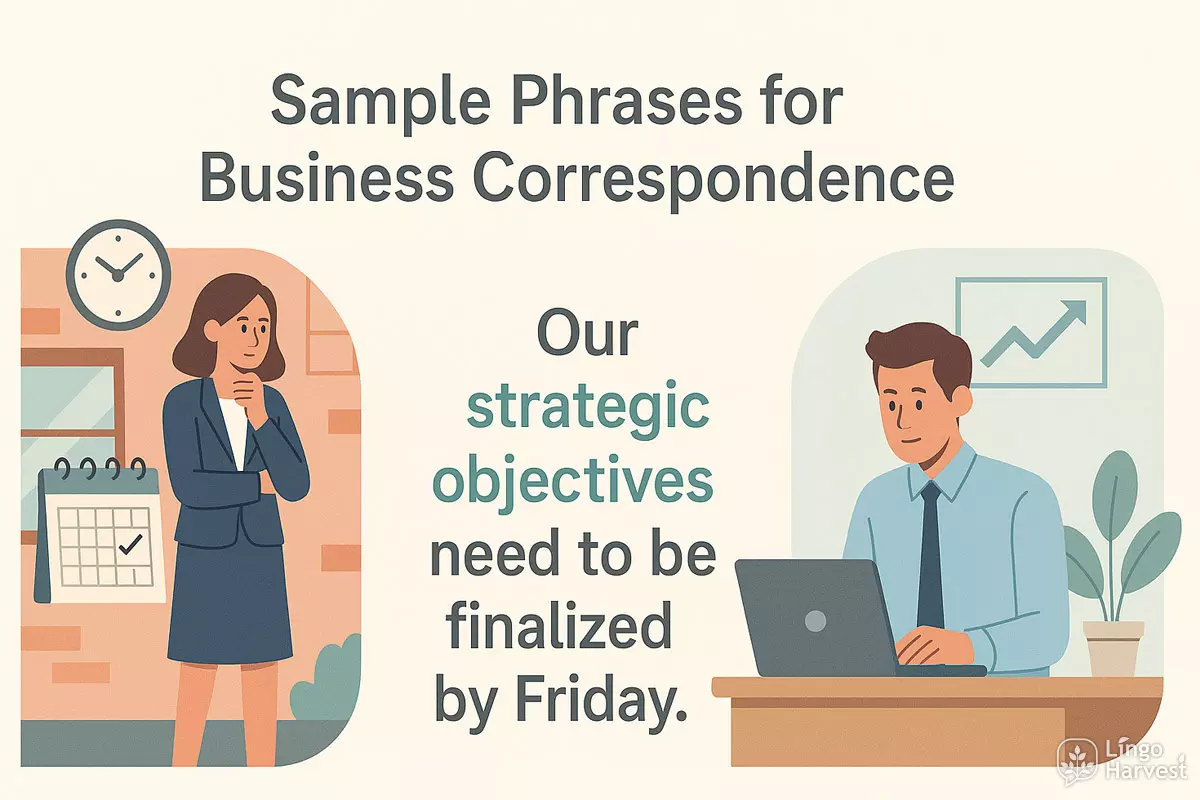
- Our strategic objectives need to be finalized by Friday.
- He played a key role in project delivery.
- We identified major risks in the initial phase.
- The strategic partnership will drive growth.
- This update covers all key performance indicators.
- They proposed a major change to the timeline.
- We are focusing on strategic investments next year.
- Her input was key to resolving the issue.
- The merger represents a major development for our company.
- Aligning with our strategic vision, we will expand into new markets.
- One key takeaway is the need for better coordination.
- This is a major milestone for the project team.
- Our strategic plan outlines next steps.
Usage Patterns in Business Documents
Often, these adjectives are paired with nouns that reflect business priorities, such as "stakeholder," "initiative," "decision," or "goal." For example, you might see "key stakeholders," "major initiative," or "strategic decision" in reports and presentations.
Comparison of Adjective Usage
| Adjective | Typical Context/Example |
|---|---|
| Key | Key factors, key issues, key members |
| Major | Major challenges, major clients, major updates |
| Strategic | Strategic priorities, strategic plan, strategic advantage |
These examples and patterns can help you use business adjectives more naturally, ensuring your communication is both precise and effective.
Practice: choose the best adjective for context
Applying adjectives like "key", "major", and "strategic" can significantly affect the clarity and professionalism of your business English. Below, you'll find exercises and examples to help you select the most appropriate adjective for common business situations.
Choose the Right Adjective
Try to complete each sentence by selecting the most suitable adjective from the options in brackets.
- Our ____ objective this quarter is to expand into new markets. (key / major / strategic)
- She played a ____ role in negotiating the contract. (key / major / strategic)
- This partnership is a ____ move to strengthen our position in Asia. (key / major / strategic)
- We faced several ____ challenges during the merger process. (key / major / strategic)
- The CEO announced a ____ investment in technology upgrades. (key / major / strategic)
- The company made a ____ decision to shift toward renewable energy. (key / major / strategic)
- Improving customer retention is a ____ priority for the team. (key / major / strategic)
- The report outlined a ____ weakness in our supply chain. (key / major / strategic)
- This new product could become a ____ advantage in the market. (key / major / strategic)
- The board approved a ____ restructuring plan for the next fiscal year. (key / major / strategic)
Show answers
- key
- key
- strategic
- major
- major
- strategic
- key
- major
- strategic
- major
Quick Reference: When to Use Each Adjective
Knowing when to use "key", "major", or "strategic" can boost your confidence in meetings and emails. Here’s a breakdown in a structured format:
| Adjective | Common Usage Examples | Typical Context |
|---|---|---|
| key | key factor, key player, key objective | Essential elements, critical roles |
| major | major change, major competitor, major investment | Large scale, significant impact or size |
| strategic | strategic decision, strategic partnership, strategic plan | Long-term planning, competitive advantage |
More Practice Sentences
Fill in the blanks with "key", "major", or "strategic" as appropriate.
- The company made a ____ acquisition last year to increase market share. (major / key / strategic)
- He is a ____ stakeholder in the project’s success. (major / key / strategic)
- Developing a ____ alliance helped us enter new markets. (major / key / strategic)
- One ____ benefit of this approach is improved efficiency. (major / key / strategic)
- The board discussed several ____ issues affecting profitability. (major / key / strategic)
- The leadership team set a ____ priority to improve customer satisfaction. (major / key / strategic)
- We identified a ____ opportunity to expand internationally. (major / key / strategic)
- The merger created a ____ shift in our competitive position. (major / key / strategic)
- The company took a ____ step toward digital transformation. (major / key / strategic)
- They emphasized the ____ importance of long-term planning. (major / key / strategic)
Show answers
- major
- key
- strategic
- key
- major
- key
- strategic
- major
- strategic
- key
Summary Tips
- Use key for elements that are essential or critical to success.
- Choose major for things that are large in scale or importance.
- Apply strategic when referring to long-term actions or planning for competitive advantage.
Practicing these distinctions will help you communicate more precisely in professional settings.