Brand, Company, and Product Names Used as Nouns

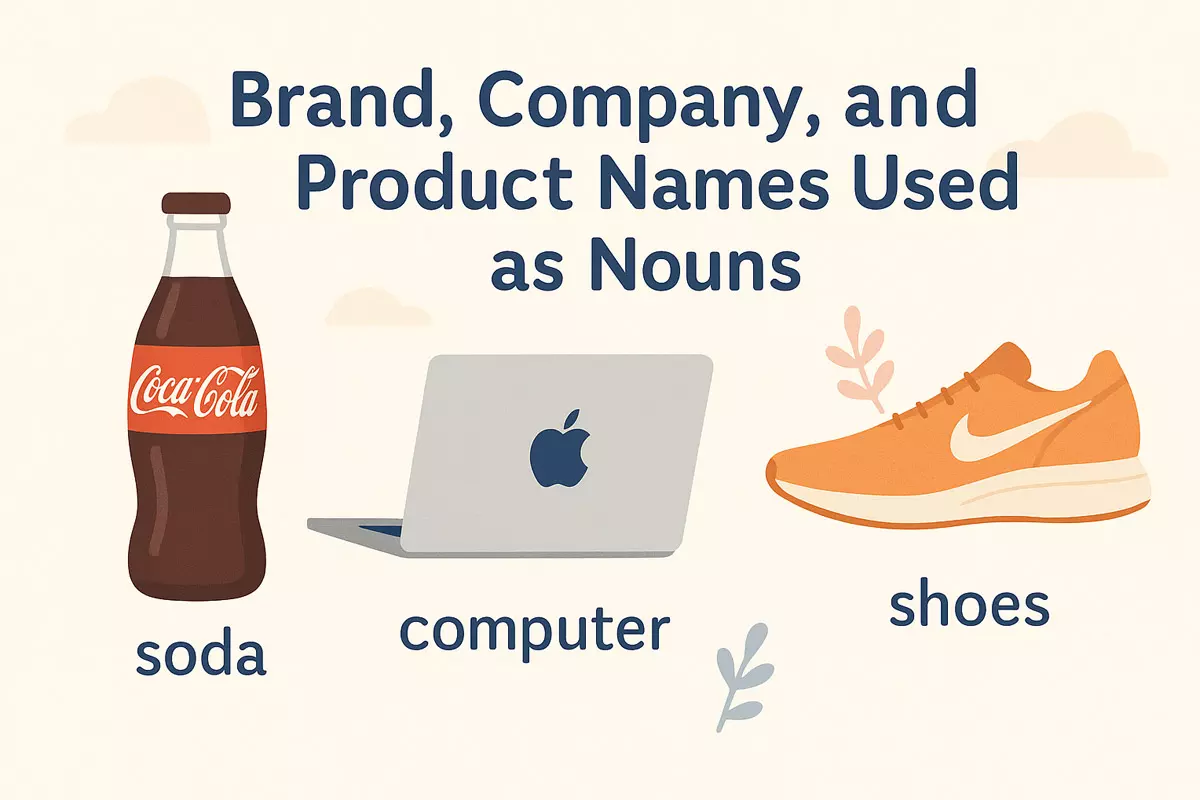 Here we how brand and product names function as nouns, including their use as subjects, objects, countable or uncountable nouns, and plurals. It also explains generic use in speech, capitalization rules, and provides sentence rewriting practice.
- How brand and product names function as nouns
- Using company names as grammatical subjects and objects
- Countable and uncountable use of brand names
- Plural forms of brand and product names
- Brand names used generically in everyday speech
- Capitalization rules for brand nouns
- Practice: rewrite sentences using correct brand noun forms
Everyday language is filled with examples of well-known brand names becoming so familiar that they are used as common words for products or activities, regardless of the actual manufacturer. This phenomenon demonstrates how certain companies and their products have become deeply embedded in our daily lives and culture, influencing the way we speak and think. As these brand names enter common vocabulary, they often lose their original association with a specific company and instead come to represent an entire category or action.
How brand and product names function as nouns
Brand and product labels frequently take on a grammatical role beyond their original purpose. Instead of serving only as identifiers for a company or item, these names often slip into everyday language as common nouns, representing entire classes of products or general concepts. This transition can influence both how people talk and how they perceive products, sometimes blurring the line between a brand and the thing it represents.
Everyday language and genericization
When a trademark or commercial name is used in place of a generic term, it’s called genericization. For example, people might say “Pass me a Kleenex” when they simply mean a tissue of any brand. Over time, such usage can make the brand name synonymous with the general item, regardless of manufacturer.
Examples of brand names used as nouns

Here are some common instances where commercial labels are used as if they were ordinary nouns in English conversations:
- “I need a Band-Aid.” (any adhesive bandage)
- “Let’s play with Legos.” (plastic construction bricks of any brand)
- “Hand me a Sharpie.” (any permanent marker)
- “Do you have a Thermos?” (any vacuum flask)
- “He bought a Jeep.” (any off-road vehicle, sometimes not the actual brand)
- “Can you Google it?” (search online, even with other search engines)
- “Use a Post-it for that note.” (sticky note, generic or branded)
- “Grab a Q-tip.” (cotton swab, any brand)
- “I’ll Xerox the document.” (photocopy, on any machine)
- “Let’s have some Jell-O.” (any gelatin dessert)
- “Put on some ChapStick.” (lip balm, regardless of manufacturer)
- “Pass the Tupperware.” (any food storage container)
- “He sent me a Zoom link.” (video call, even on other platforms)
- “Take an Advil.” (any ibuprofen tablet)
- “Hand me a Velcro strap.” (hook-and-loop fastener of any brand)
- “I need a Frisbee.” (flying disc toy)
- “Have a Popsicle.” (frozen juice treat, any brand)
- “Ride the Segway.” (self-balancing scooter, sometimes any model)
- “Give me a Coke.” (sometimes used for any cola drink, regionally)
- “Let’s use a Jacuzzi.” (any hot tub or whirlpool bath)
How usage changes meaning
The way these names are used can affect their meaning. When a commercial label becomes a stand-in for a whole category, it enters the language as a general term. This sometimes leads to confusion about what’s truly a brand and what’s not, and can even affect legal trademark status.
Patterns in noun usage
Brand terms can function as:
- Countable nouns (“three Band-Aids”)
- Uncountable nouns (“some Velcro”)
- Verbs in some cases (“to Google,” “to Xerox”)
Comparing brand names and generic nouns
| Brand Name (as noun) | Generic Equivalent |
|---|---|
| Kleenex | Tissue |
| Band-Aid | Adhesive bandage |
| Post-it | Sticky note |
| Frisbee | Flying disc |
| Q-tip | Cotton swab |
| Thermos | Vacuum flask |
| Xerox | Photocopy |
| ChapStick | Lip balm |
| Velcro | Hook-and-loop fastener |
| Jacuzzi | Hot tub |
Why this matters
Understanding how commercial names operate as nouns helps clarify communication and reveals how language evolves. It also highlights the fine line between protecting a trademark and seeing it become part of common speech. For speakers and writers, being aware of this phenomenon can make language use more precise and nuanced.
Using company names as grammatical subjects and objects
When talking about businesses in writing or conversation, it’s common to use their names as the subject or object of a sentence. For example, you might say “Apple announced new products” or “We visited Microsoft’s headquarters.” In both cases, the organization’s name functions like a typical noun, forming the core of the sentence’s meaning.
Patterns and Examples
Company names can fit naturally into many grammatical roles. Here are common ways they appear:
- Subject of a sentence: “Google released an update.”
- Direct object: “Analysts praised Tesla.”
- Indirect object: “The committee awarded Amazon a contract.”
- With possessives: “Facebook’s policies changed.”
- With prepositions: “He works for IBM.”
- In comparisons: “Spotify is growing faster than Pandora.”
- In passive constructions: “Netflix was acquired by a larger firm.”
- In lists: “Intel, Samsung, and Qualcomm compete in the same market.”
- As part of compound subjects or objects: “Apple and Google often collaborate.”
- With descriptive verbs: “Sony manufactures electronics.”
- As the recipient of actions: “Customers trust PayPal.”
- In reported speech: “Twitter said it would update its terms.”
Singular or Plural Usage
Most company names are treated as singular nouns in American English (“Amazon is expanding”), although British English sometimes uses plural verbs for companies (“Amazon are expanding”). Consistency within a document is important.
Special Cases: Company Name Forms
Some business names contain articles, acronyms, or special formatting. When using these as sentence elements, adjust the structure for clarity and flow. For example:
- “The Home Depot reported earnings.” (retaining the article as part of the name)
- “3M introduced a new product line.” (acronym as subject)
- “eBay attracts millions of sellers.” (lowercase ‘e’ at sentence start may need rewording if style guide requires capitalization)
Comparison of Grammatical Roles
Below is a table illustrating how corporate names can appear in different sentence positions and roles:
| Grammatical Role | Example with Company Name |
|---|---|
| Subject | Microsoft invested in cloud technology. |
| Direct Object | Investors watched Netflix rise. |
| Indirect Object | The board gave Ford a new CEO. |
| With Possessive | Uber’s app was redesigned. |
| After Prepositions | She interned at Deloitte. |
Takeaways
Company names function as regular nouns in most sentences, whether acting as agents, recipients, or possessors. The main consideration is clarity, especially when names include articles, symbols, or unusual capitalization. Adjust the sentence structure if needed, and maintain consistency for readability.
Countable and uncountable use of brand names
Brand names often shift between countable and uncountable forms depending on how people use them in speech or writing. Sometimes, a label that started as a specific company or product becomes a general term for similar items, and the way we treat it grammatically can change. The difference usually comes down to whether you’re talking about a single item, a category, or a substance.
When brand names act as countable nouns
Many well-known trademarks are used to refer to individual units or types, especially when discussing physical products. In these cases, you can use articles, plurals, and numbers. This is common in casual language or when a brand dominates its market.
- “I bought three Cokes.”
- “She owns two Teslas.”
- “Do you have any Sharpies?”
- “He wore a pair of Levis.”
- “We rented two Jeeps for the trip.”
- “They handed out Post-its at the meeting.”
- “I need some Band-Aids.”
- “The kids played with their Legos.”
- “She has several iPhones.”
- “He ate two Oreos.”
When brands are used as uncountable nouns
Sometimes, a brand name stands for a general substance, material, or experience, making it uncountable. In these cases, the word is not pluralized, and you don’t use an article or number directly before it.
- “I spilled Coke on my shirt.”
- “There’s Velcro on the pockets.”
- “The sofa is covered in Scotchgard.”
- “He used Wite-Out to fix the error.”
- “She washed the dishes with Dawn.”
- “That smell is definitely Febreze.”
- “Add some Kleenex to the shopping list.”
- “I need more ChapStick.”
- “We ran out of Tupperware.” (when referring to the material or concept, not individual containers)
- “He drew with Crayola.”
| Brand name as countable | Brand name as uncountable |
|---|---|
| “Two Pepsis, please.” | “There’s Pepsi on the floor.” |
| “Have you seen my Nikes?” | “This floor is made with Nike rubber.” |
| “Pass me a Kleenex.” | “Kleenex absorbs quickly.” |
| “Grab some Oreos.” | “Oreo flavor is popular.” |
Key points and usage patterns
- Countable use often appears when referring to individual items or units.
- Uncountable use is common when the brand represents a material, product substance, or abstract quality.
- Context and intent determine which form is natural in conversation or writing.
- Some brand names flexibly switch between both types depending on sentence structure.
- Overusing brand names as generic nouns can risk trademark dilution, but this is common in everyday language.
Understanding these patterns helps you use brand, company, or product names more naturally and accurately in English.
Plural forms of brand and product names
When people use brand or product names as nouns, forming the plural can get tricky. English speakers often want to apply regular rules, but not every name follows the same pattern. The approach depends on whether the name is a true noun, a trademarked term, or a coined word without a standard plural.
General patterns for pluralizing brand and product names
Most product and brand names take the standard -s or -es ending in the plural, just like common nouns. However, some names resist pluralization or sound odd when changed, especially if they remain capitalized or are treated as trademarks.
- One iPhone, two iPhones
- One Lego brick, several Lego bricks (though "Legos" is common in speech, it's discouraged by the company)
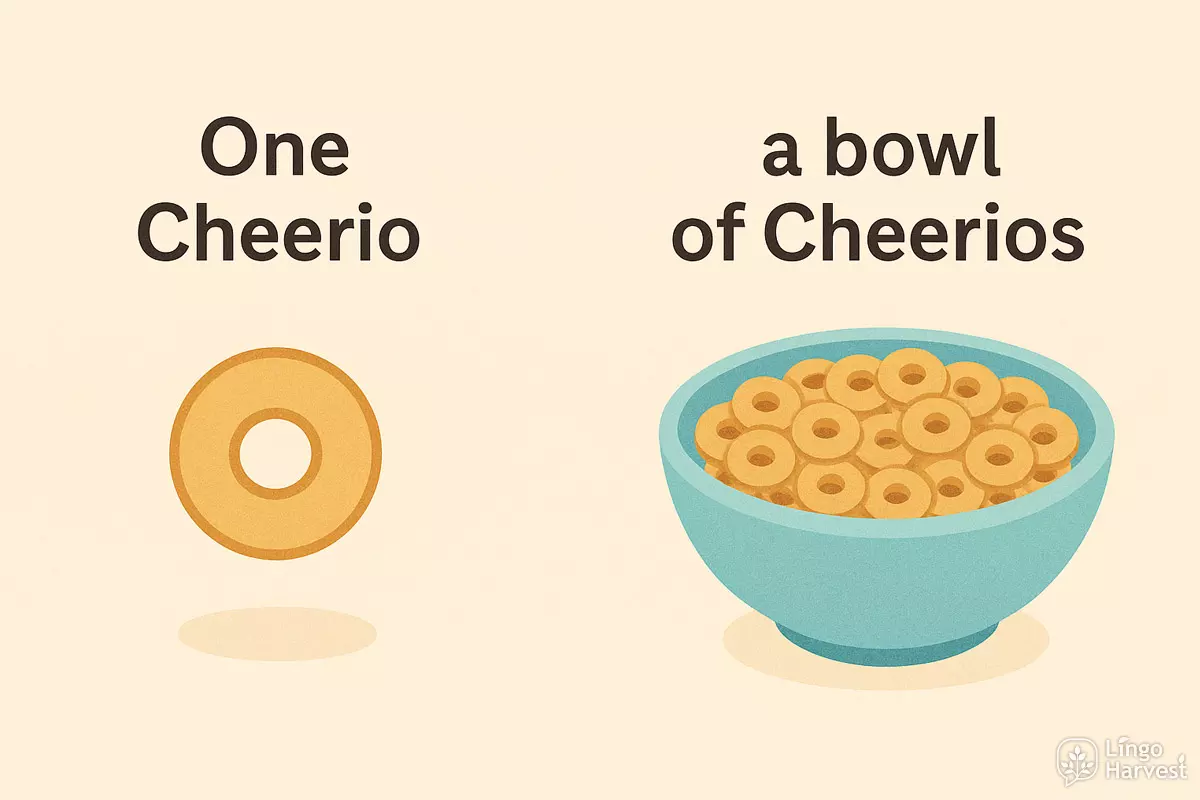
- One Cheerio, a bowl of Cheerios
- One Pepsi, three Pepsis
- One Jeep, lots of Jeeps
- One Kleenex, a box of Kleenex tissues (rarely "Kleenexes")
- One MacBook, several MacBooks
- One Rolex, many Rolexes
- One Tupperware container, piles of Tupperware containers (not "Tupperwares")
- One Band-Aid, a pack of Band-Aids
- One Post-it note, dozens of Post-it notes
- One Sharpie, a box of Sharpies
- One Xerox copy, hundreds of Xerox copies
- One Reebok shoe, a pair of Reeboks
- One Oreos cookie, a sleeve of Oreos
- One iPad, many iPads
- One Google search, several Google searches
- One Fitbit, several Fitbits
Irregularities and exceptions
Some names don't pluralize easily or are never used in the plural form. Trademark holders may also discourage or prohibit pluralization to protect their brand identity. For example, "Lego" prefers "Lego bricks" over "Legos," and "Tupperware" is usually treated as uncountable.
- ❌ "She has many Legos." ✅ "She has many Lego bricks."
- ❌ "I bought two Tupperwares." ✅ "I bought two Tupperware containers."
- ❌ "We handed out Kleenexes." ✅ "We handed out Kleenex tissues."
Comparison of regular and irregular plural forms
| Brand/Product Name | Common Plural Form | Preferred/Alternative Form |
|---|---|---|
| Oreo | Oreos | Oreo cookies |
| Lego | Legos | Lego bricks |
| Tupperware | Tupperwares | Tupperware containers |
| Kleenex | Kleenexes | Kleenex tissues |
| Pepsi | Pepsis | Pepsi cans/bottles |
| iPhone | iPhones | iPhone devices |
| Rolex | Rolexes | Rolex watches |
| Sharpie | Sharpies | Sharpie markers |
Tips for choosing the right plural
- For most brand names, simply add -s or -es if it sounds natural.
- If the plural feels awkward or the company discourages it, use a generic noun with the brand as a modifier (e.g., "Lego bricks").
- For brands that are also common nouns (like "Apple"), context will guide you.
- When in doubt, check the company’s style or usage guidelines.
In summary, the best approach is to consider both language convention and the brand’s own recommendations. Adapting product and company names to plural forms is usually straightforward, but attention to exceptions shows respect for both language and branding.
Brand names used generically in everyday speech
Everyday language is full of product and company names that have become shorthand for entire categories of goods or services. When people ask for a "Kleenex" instead of a tissue, or say they'll "Google" something rather than search online, they're using a trademarked name as a generic noun or verb. This phenomenon occurs when a brand becomes so dominant or well-known that its name is used regardless of the actual manufacturer.
Examples of common brand terms used as nouns or verbs
- Band-Aid – Often used to refer to any adhesive bandage.
- Velcro – Used for any hook-and-loop fastener, even if not made by the brand.
- Thermos – Used for any vacuum flask, regardless of brand.
- Dumpster – Applied to large trash bins, even though it began as a brand name.
- Jacuzzi – Used to describe any hot tub or whirlpool bath.
- Q-tip – Refers to any cotton swab.
- ChapStick – Used for any lip balm.
- Tupperware – Used for any plastic food storage container.
- Jet Ski – Used for any personal watercraft.
- Popsicle – Used for any frozen juice treat on a stick.
- Scotch Tape – Generic term for any clear adhesive tape.
- Post-it – Refers to any sticky note.
- Onesies – Used for infant bodysuits, though it's a Gerber trademark.
- Rollerblade – Used for any inline skates.
- Ping-Pong – Used for table tennis, though it's a registered trademark.
- Google – Used as a verb meaning to search online.
- Super Glue – Used for any instant adhesive.
- Sharpie – Used for any permanent marker.
- Frisbee – Used for any flying disc toy.
- Xerox – Used as a verb for photocopying, even with non-Xerox machines.
Patterns of genericization
This linguistic shift, known as genericization or genericide, often happens when a brand is first to market or becomes synonymous with a product. Sometimes, companies fight to protect their trademarks from becoming generic, while in other cases, the public's usage prevails.
Comparison of Generic vs. Brand Usage
| Brand Name | Generic Term | Example in a Sentence |
|---|---|---|
| Band-Aid | adhesive bandage | Could you hand me a Band-Aid for this cut? |
| search engine | I'll Google the address for you. | |
| Xerox | photocopy | I'll just Xerox these documents. |
| Velcro | hook-and-loop fastener | My shoes fasten with Velcro. |
| Popsicle | ice pop | She gave the kids Popsicles on a hot day. |
The transition from trademark to common noun or verb reflects both the success and the challenge for brands. Companies may embrace widespread recognition, but risk losing exclusive rights if their name becomes too generic. For speakers, these words often offer ease and clarity, even if the original brand is no longer involved.
Capitalization rules for brand nouns
When using brand, company, or product names as nouns, standard capitalization practices apply. Typically, these names retain their original capital letters regardless of their placement in a sentence. This helps maintain brand identity and ensures clarity for readers. It’s important to avoid altering the original styling unless the brand itself uses unconventional capitalization.
General principles for capitalizing brand names as nouns
- Always capitalize the first letter of each main word in the brand, company, or product name (e.g., Coca-Cola, Microsoft Office).
- If the brand uses unique capitalization (like iPhone or eBay), follow the official styling, even at the beginning of sentences.
- Do not add extra capital letters or change the format to fit standard grammar rules.
- Avoid lowercasing brand names, even if they appear mid-sentence, unless the brand is officially stylized that way.
- Genericized versions of brand names (like "kleenex" for any tissue) are often lowercase, but use the capitalized form when referring to the actual brand.
Examples of correct and incorrect capitalization
- ✅ Google is the most popular search engine.
- ❌ google is the most popular search engine.
- ✅ She bought an iPad last week.
- ❌ She bought an ipad last week.
- ✅ I enjoy drinking Pepsi with my lunch.
- ❌ I enjoy drinking pepsi with my lunch.
- ✅ We use Slack for team communication.
- ❌ We use slack for team communication.
Special cases and exceptions
- Brands with internal capitalization or lowercase initials (e.g., eBay, iMac): maintain the original casing, even if it looks unusual at sentence beginnings.
- When a brand name is used in plural or possessive forms, keep the original capitalization: two iPhones, Amazon's website.
- If a brand name becomes a common noun (e.g., thermos, aspirin), use lowercase, but only when not referencing the original trademark.
Common capitalization patterns for brand nouns
| Brand Name | Correct Capitalization Example | Incorrect Example |
|---|---|---|
| He logged into Facebook. | He logged into facebook. | |
| iPhone | I bought an iPhone. | I bought an iphone. |
| eBay | She sold it on eBay. | She sold it on Ebay. |
| LEGO | The kids played with LEGO. | The kids played with lego. |
| Adobe Photoshop | The image was edited in Adobe Photoshop. | The image was edited in adobe photoshop. |
| Send me a WhatsApp message. | Send me a whatsapp message. | |
| Follow us on Twitter. | Follow us on twitter. | |
| PlayStation | He loves his PlayStation. | He loves his playstation. |
| Google Maps | Check the route on Google Maps. | Check the route on google maps. |
| Netflix | We watched a movie on Netflix. | We watched a movie on netflix. |
In summary, always preserve the original capitalization of brand and product names, following official stylization and respecting unconventional cases. Consistency in these conventions is essential for clear, professional communication.
Practice: rewrite sentences using correct brand noun forms
Understanding how to use brand, company, and product names as nouns is important for clear and accurate communication. Below, you'll find exercises to help you recognize and correct common mistakes. Pay attention to how each sentence uses the brand or product name, and try to rewrite it using the correct noun form.
Exercise: Identify and Correct Brand Noun Usage
Rewrite each sentence so the brand, company, or product name is used appropriately as a noun. Consider whether the original sentence treats the name as a generic term or misuses it in a plural or possessive form.
- Can you pass me a Kleenex?
- We googled the answer during class.
- He bought a Coke, but actually wanted a Pepsi.
- She needs some Post-its for her notes.
- Did you get some Band-Aids for the trip?
- I’ll Uber to the party tonight.
- Let’s Zoom at 3 p.m.
- They grabbed some Oreos for dessert.
- I prefer using a Thermos for my coffee.
- He wore his new Nikes to the gym.
Show answers
- Can you pass me a tissue? (Kleenex is a brand name for facial tissues.)
- We searched for the answer on Google during class. (Use "search on Google" instead of "googled" in formal writing.)
- He bought a Coca-Cola, but actually wanted a Pepsi. (Use the full product name if referring to the brand.)
- She needs some sticky notes for her notes. (Post-it is a brand name for sticky notes.)
- Did you get some adhesive bandages for the trip? (Band-Aid is a brand name for adhesive bandages.)
- I’ll take an Uber ride to the party tonight. (Uber is a company name; "Uber ride" or "Uber car" clarifies the noun usage.)
- Let’s have a Zoom meeting at 3 p.m. (Zoom is a brand name for video conferencing; specify "meeting" for clarity.)
- They grabbed some chocolate sandwich cookies for dessert. (Oreo is a brand name for this type of cookie.)
- I prefer using a vacuum flask for my coffee. (Thermos is a brand of vacuum flasks.)
- He wore his new Nike sneakers to the gym. (Nike is a brand; use "Nike sneakers" or "Nike shoes" for clarity.)
Common Brand Name Noun Forms
Here are some common examples of how brand names are often misused as generic nouns. Review the correct forms and their generic equivalents:
- Kleenex → tissue
- Band-Aid → adhesive bandage
- Post-it → sticky note
- Thermos → vacuum flask
- Hoover (UK) → vacuum cleaner
- Frisbee → flying disc
- Jet Ski → personal watercraft
- Velcro → hook-and-loop fastener
- ChapStick → lip balm
- Rollerblade → inline skates
- Jacuzzi → hot tub
- Xerox → photocopy
- Sharpie → permanent marker
- Popsicle → ice pop
- Q-tip → cotton swab
- Tupperware → plastic food container
- Vaseline → petroleum jelly
- Onesies → infant bodysuit
Practice rewriting sentences in your everyday writing using the appropriate generic terms or the correct noun forms for brands. This will help maintain clarity and avoid trademark misuse.