Adverbs for Beginners: How, When, Where

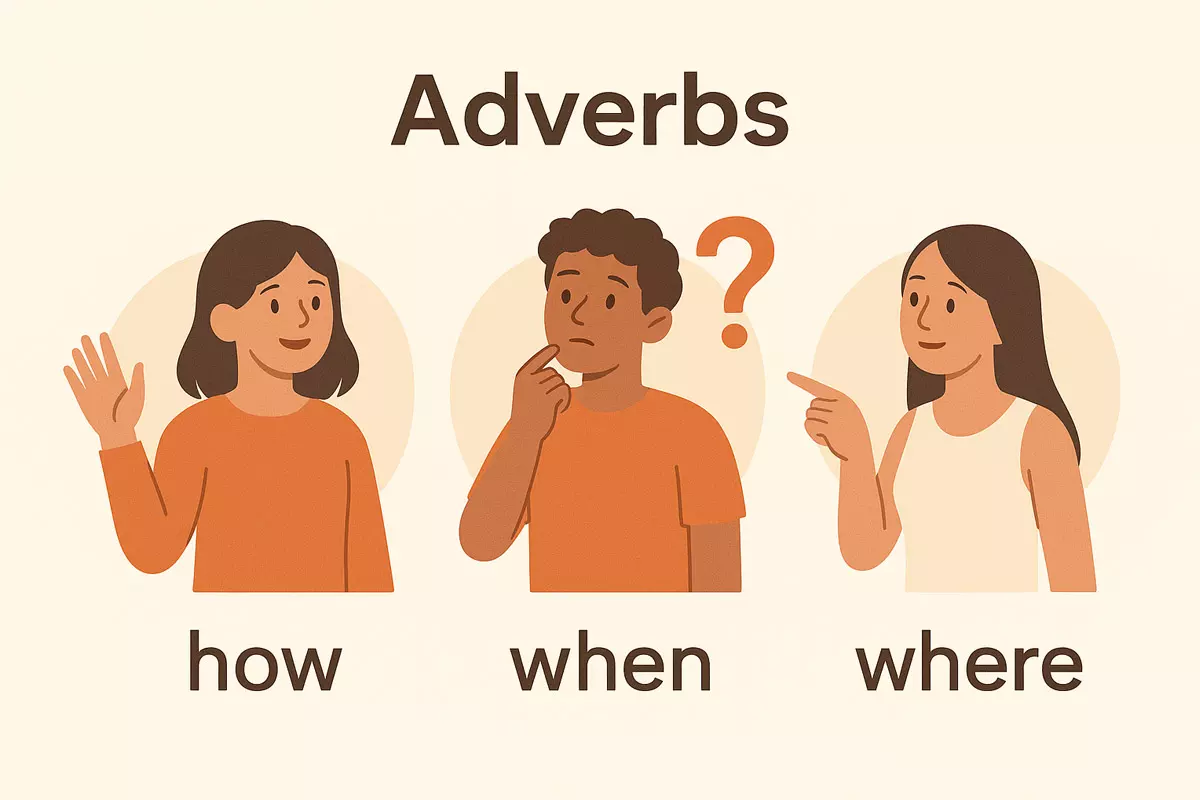 Here we how adverbs express manner, time, and place, how to form -ly adverbs, where to place them in sentences, word order with be and other verbs, the difference between strong and weak adverbs, common errors, and practice exercises.
Improving your ability to describe actions in detail can greatly enhance both your speaking and writing skills. By using words that specify how, when, and where events take place, you add clarity and vividness to your communication. This attention to detail not only makes your language more precise but also helps your audience visualize and understand your message more easily. Developing this skill will make your conversations and written work more interesting, engaging, and effective overall.
What Adverbs Do (manner, time, place)
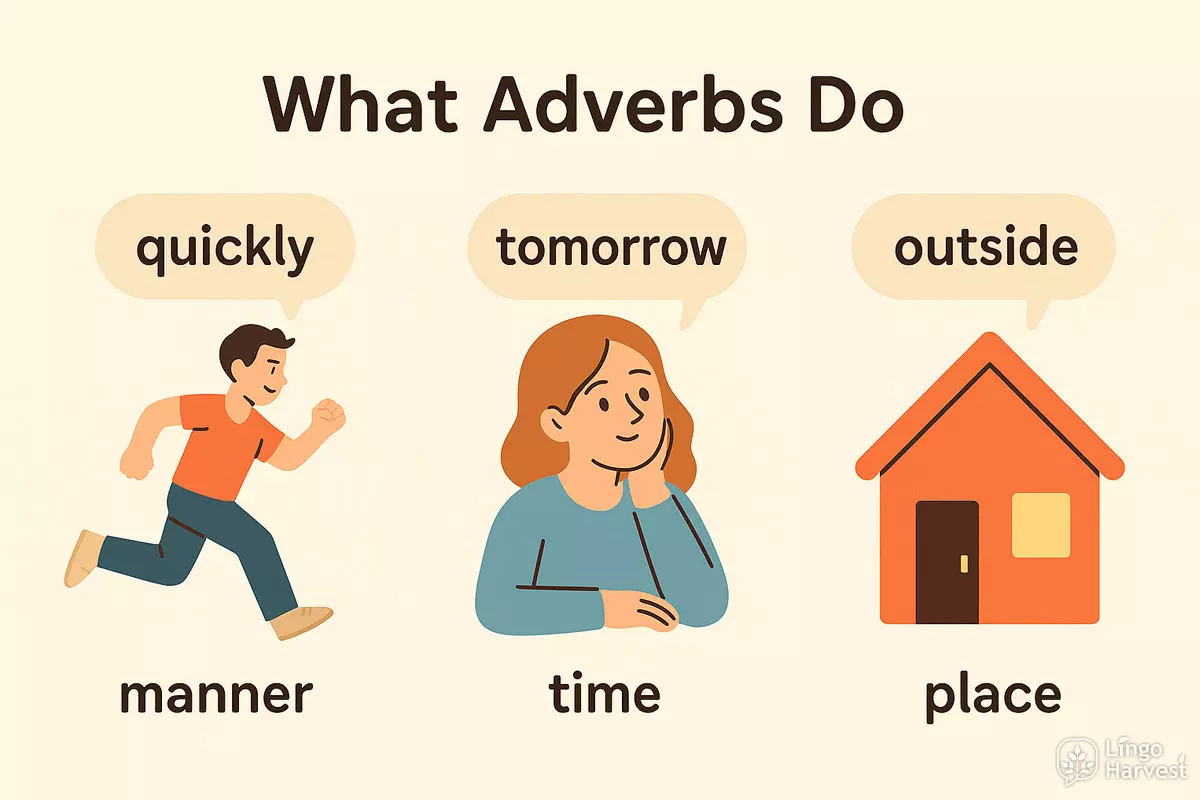
Adverbs add detail and precision to sentences by describing how, when, or where actions happen. Understanding these functions helps you communicate more clearly and naturally in English. Let’s look at the three main ways adverbs are used: to tell us about manner, time, and place.
How? (Manner)
Adverbs of manner explain the way something is done. They usually answer the question, “How?” and often end in -ly. These words typically come after the verb or the object in a sentence.
- quickly
- carefully
- loudly
- softly
- easily
- happily
- badly
- slowly
- politely
- quietly
Example: She answered the question confidently.
When? (Time)
Adverbs of time tell us when something happens. They can refer to specific points in time, frequency, or duration. These adverbs are flexible and can be placed at the beginning or end of a sentence, and sometimes before the main verb.
- now
- yesterday
- already
- soon
- today
- recently
- never
- often
- always
- still
- tonight
- yet
Example: He will call you tomorrow.
Where? (Place)
Adverbs of place indicate location or direction. They answer the question “Where?” and can refer to specific or general places. Most often, these come after the main verb or object.
- here
- there
- everywhere
- somewhere
- anywhere
- outside
- inside
- upstairs
- downstairs
- nearby
- abroad
- away
Example: Please wait outside.
Comparing Adverbs by Type
| Type | Typical Questions Answered | Sample Adverbs |
|---|---|---|
| Manner | How? In what way? | quickly, badly, gently, safely |
| Time | When? How often? | now, never, always, soon |
| Place | Where? To what place? | here, everywhere, abroad, nearby |
In summary, adverbs give important information about actions: they clarify the manner, specify the time, or point out the place. Recognizing the different types and where to use them will help you construct clearer and more accurate sentences.
Forming -ly Adverbs (quick → quickly)
Adverbs often describe how something happens, and in English, a common way to create them is by adding -ly to adjectives. This small change can help show the manner of an action. For example, the adjective "quick" becomes "quickly" when you want to express how someone does something.
Basic Pattern: Adjective + -ly
Most adverbs are formed by simply attaching -ly to the end of the adjective. Here are several examples:
- slow → slowly
- happy → happily
- careful → carefully
- loud → loudly
- quiet → quietly
- angry → angrily
- safe → safely
- clear → clearly
- polite → politely
- brave → bravely
- sad → sadly
- gentle → gently
- easy → easily
- beautiful → beautifully
- honest → honestly
Spelling Changes and Exceptions
Some adjectives need a spelling change before you add -ly:
- If the adjective ends in -y, change the y to i (happy → happily, easy → easily).
- Adjectives ending in -le often drop the e (gentle → gently, simple → simply).
- For adjectives ending in -ic, add -ally (automatic → automatically, basic → basically).
Some words are exceptions and do not follow the typical pattern. For example, "good" becomes "well," not "goodly." Likewise, a few adjectives have the same form as their adverb, like "fast" (He runs fast).
Overview: Adjective to Adverb Patterns
| Adjective | Adverb | Notes |
|---|---|---|
| quick | quickly | Regular: just add -ly |
| happy | happily | y → i + -ly |
| gentle | gently | Drop final -e |
| automatic | automatically | Add -ally |
| good | well | Irregular |
| fast | fast | No change |
Understanding these patterns helps you use adverbs naturally and accurately in your sentences. While most are straightforward, a few exceptions are worth memorizing. Use these guidelines as a reference when you want to describe actions more precisely.
Position in a Sentence: mid, end, front
Understanding where to place adverbs is essential for clear and natural English. Adverbs can appear in different parts of a sentence depending on what you want to emphasize and which type of adverb you’re using. Let’s explore the typical positions: middle (mid), end, and front.
Mid Position (usually before the main verb)
Most adverbs of frequency (like “always,” “never,” “often,” “usually”) are placed before the main verb but after the verb “be.” This position is common for short, simple adverbs. For example:
- She always wakes up early.
- They often visit their grandparents.
- We are never late.
- He usually eats breakfast at home.
- The cat sometimes sleeps on the sofa.
- I have already finished my homework.
- You will probably enjoy this movie.
- She can barely hear you.
- He has just arrived.
- They might soon join us.
End Position (at the end of the sentence)
Many adverbs, especially those showing manner (how), place (where), or time (when), are commonly found at the end of a sentence. This placement often gives extra detail and finishes the idea.
- She spoke quietly.
- We arrived yesterday.
- He waited outside.
- The children played happily.
- They will meet us at the park.
- I finished my work quickly.
- He left early.
- They danced beautifully.
- She travels every summer.
- We’ll see you soon.
Front Position (at the beginning of the sentence)
Placing an adverb at the front can highlight or emphasize information, especially with adverbs of time, place, or linking adverbs (like “however,” “fortunately,” “sadly”). This style is common in storytelling or formal writing.
- Yesterday, we visited a museum.
- Suddenly, the lights went out.
- Fortunately, nobody was hurt.
- Usually, he takes the bus.
- Later, they called me back.
- Sometimes, I read before bed.
- In the morning, she goes jogging.
- Quietly, he closed the door.
- Outside, it was raining.
- Afterwards, we had dessert.
Quick Comparison of Adverb Placement
| Position | Example Sentence |
|---|---|
| Mid | She always remembers my birthday. |
| End | She remembers my birthday always. |
| Front | Always, she remembers my birthday. |
| End | He finished his homework quickly. |
Remember, not all adverbs can go in every position, and word order can affect the meaning or emphasis. Practicing with different types of adverbs in various places will help you sound more natural and fluent.
Be vs Other Verbs: word order
Understanding where to place adverbs in sentences depends on whether you’re dealing with the verb be or another verb. This difference often confuses beginners, but getting it right makes your English clearer and more natural.
Position with be

When using be (am, is, are, was, were) as the main verb, adverbs of manner, frequency, time, and place usually come after the verb. For example:
- He is always polite.
- They are usually here in the morning.
- I am never late.
- She was quickly finished.
Notice that the adverb almost always follows be. This is different from most other verbs.
Position with Other Verbs
With action verbs (like eat, play, go), adverbs typically go before the main verb, especially with adverbs of frequency and degree. Adverbs of manner and place often come after the object or the verb phrase.
- She often eats breakfast early. (frequency)
- They quickly finished the project. (manner)
- We usually go to the park. (frequency)
- He plays the piano well. (manner)
- I put the keys here. (place)
- They meet on Fridays. (time)
For negative sentences, adverbs like never or rarely come before the main verb, but after the auxiliary.
| With be | With Other Verbs |
|---|---|
| She is usually tired. | She usually feels tired. |
| We are always on time. | We always arrive on time. |
| He was never late. | He never came late. |
| They are often at home. | They often stay at home. |
Common Adverbs and Placement Patterns
- always
- never
- usually
- often
- sometimes
- rarely
- quickly
- well
- already
- still
- here
- there
- today
- now
- soon
- late
- early
- together
- outside
- everywhere
To sum up, adverb placement depends on the main verb. Use the patterns above to help your sentences sound more natural. Practice by switching between be and other verbs to notice the change in word order.
Strong/Weak Adverbs and Clarity
Choosing the right adverb can make your sentences clearer and more impactful. Some adverbs add precision, while others are so vague that they weaken your message. For beginners, understanding which words to use and which to avoid is a crucial step in mastering English expression.
What Makes an Adverb Strong or Weak?
Adverbs can be considered strong when they add specific detail or emphasis. For example, “quickly” tells us how something happens, while “extremely” intensifies an adjective or another adverb. On the other hand, weak adverbs are often generic or redundant. Words like “very,” “really,” or “quite” might be overused and add little value to your sentence.
Examples: Impactful vs. Weak Choices
- He spoke softly (clear, specific) ✅
- She ran swiftly (vivid, memorable) ✅
- They barely finished on time (precise limit) ✅
- He was very tired (vague, could be stronger) ❌
- The answer is really easy (weak, not specific) ❌
- She sang beautifully (adds color) ✅
- He almost missed the bus (clear situation) ✅
- They completely forgot (total emphasis) ✅
- She definitely agreed (certainty) ✅
- He was quite happy (could be more precise) ❌
Comparing Common Adverbs
| Weak Adverb | Stronger Alternative |
|---|---|
| very | extremely, remarkably |
| really | truly, genuinely |
| quite | absolutely, thoroughly |
| almost | hardly, barely |
| just | precisely, exactly |
| pretty | fairly, reasonably |
Tips for Clearer Writing
- Replace vague adverbs with more descriptive ones when possible.
- Read sentences aloud to notice if an adverb adds real meaning.
- Use adverbs to clarify time, manner, or degree—not to fill space.
- Limit adverbs if a strong verb or adjective can do the job alone.
- Experiment with removing or replacing “very,” “really,” and “quite” for stronger impact.
Learning to distinguish between powerful and weak modifiers will help your writing sound more natural and effective. With practice, you’ll find your sentences become sharper and your communication clearer.
Common Mistakes (good vs well)
Many English learners confuse when to use "good" and when to use "well." This confusion happens because both words relate to quality, but their grammar roles differ. "Good" is an adjective, describing nouns, while "well" is usually an adverb, describing verbs. Understanding the distinction helps you sound more natural and accurate in your sentences.
How to Choose Between "Good" and "Well"
- Use good to describe a person, place, thing, or idea (nouns).
- Use well to describe how someone does something (verbs).
- Remember: "Well" can also be used as an adjective when talking about health.
Typical Examples and Corrections
- ❌ She sings good. → ✅ She sings well.
- ❌ He did good on the test. → ✅ He did well on the test.
- ❌ I don’t feel good. (when talking about health) → ✅ I don’t feel well.
- ✅ That was a good movie. (describing the movie, a noun)
- ✅ She is a good dancer. (describing "dancer")
- ❌ He plays the piano good. → ✅ He plays the piano well.
- ✅ You did a good job. (describing "job")
- ✅ You performed well. (describing "performed")
- ❌ I hope you are good soon. (about health) → ✅ I hope you are well soon.
- ✅ She gave a good answer. (describing "answer")
- ✅ He speaks English well. (describing "speaks")
Quick Reference: "Good" vs "Well"
| Function | Example |
|---|---|
| Adjective (describes nouns): good | She is a good friend. |
| Adverb (describes verbs): well | He runs well. |
| Adjective (health): well | I am not well today. |
| Incorrect usage | She sings good. → She sings well. |
Practice choosing the right word by focusing on what you are describing. If it’s a person, place, or thing, "good" is usually correct. If you’re describing how, when, or where an action happens, "well" is likely the right choice. Remember, using these words correctly makes your English clearer and more natural.
Practice: Add the Right Adverb
Understanding how to choose the correct adverb can make your sentences clearer and more precise. In this section, you'll find exercises that ask you to complete sentences using an appropriate adverb. Focus on the context—think about whether the sentence needs information about how, when, or where something happens.
Task 1: Fill in the Missing Adverb
Read each sentence and decide which adverb best completes it. Choose from: quickly, outside, always, yesterday, suddenly, happily, rarely, here, completely, soon.
- She finished her homework __________.
- They will arrive __________.
- We met __________ to play basketball.
- He __________ forgets his keys.
- The cat jumped __________ when it heard the noise.
- I saw him __________ at the park.
- The room was __________ dark.
- __________ did you visit your grandmother?
- She sings __________ in the choir.
- He __________ eats vegetables.
Show answers
- quickly
- soon
- outside
- always
- suddenly
- yesterday
- completely
- When
- happily
- rarely
Task 2: Choose the Correct Adverb
Select the best adverb for each sentence from the pairs in brackets.
- I will see you (tomorrow / loudly).
- He spoke (softly / outside) so he wouldn't wake the baby.
- The bus stops (rarely / here).
- She danced (beautifully / never).
- We will start the meeting (soon / slowly).
Show answers
- tomorrow
- softly
- here
- beautifully
- soon
Common Adverbs by Type
Below is a table showing common choices for different meanings. Use it as a reference when practicing or checking your answers.
| How (Manner) | When (Time) | Where (Place) |
|---|---|---|
| quickly | yesterday | here |
| slowly | today | there |
| happily | soon | outside |
| loudly | never | everywhere |
| silently | always | somewhere |
| carefully | often | inside |
Try creating your own sentences using adverbs from each column. Notice how the meaning changes depending on the choice of word.