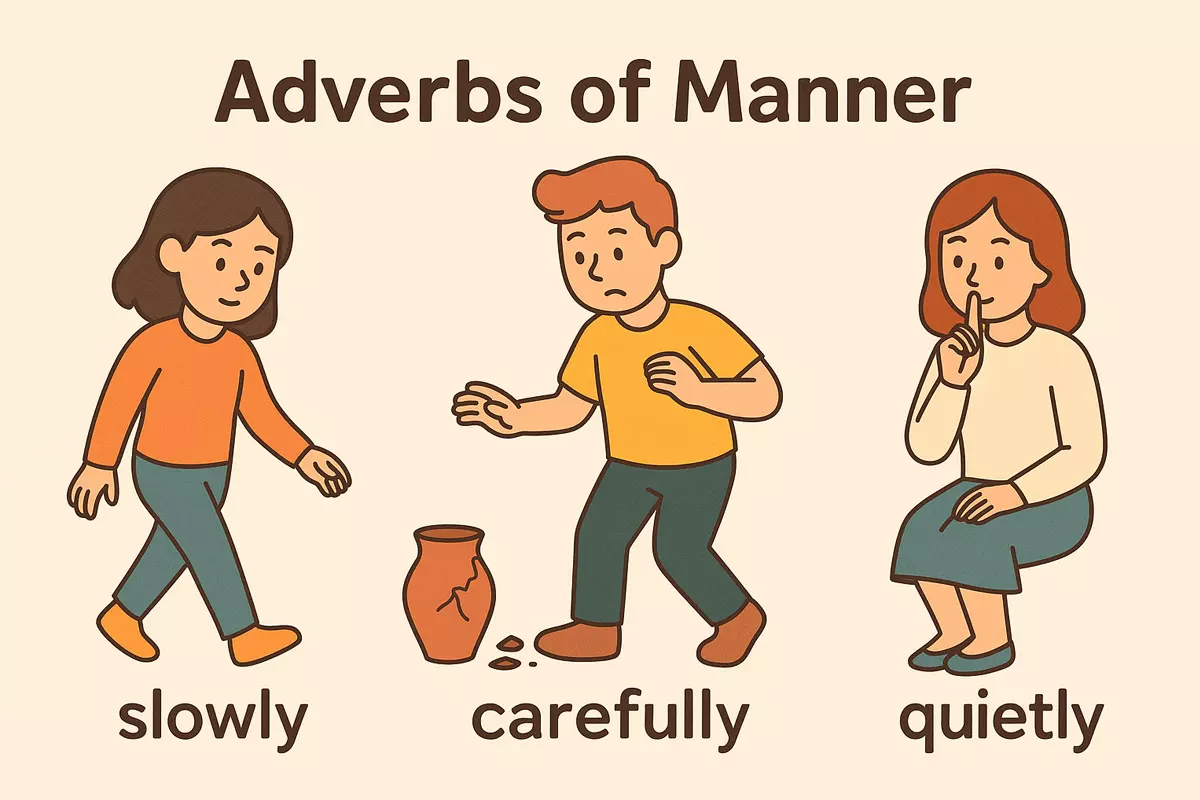
Adverbs of Manner: Slowly, Carefully, Quietly

 The article compares adverbs of manner with other adverb types, explains their forms and spelling, common positions, and effects on speech rhythm. It also addresses confusions like hard vs. hardly and offers practice to improve sentence style.
Descriptive words play a vital role in our language by adding vivid detail to our actions, helping us convey whether something is done carefully, quickly, or quietly. By choosing the right terms, we can paint a clearer picture for our readers or listeners, allowing them to understand precisely how an event unfolds. These words not only make our communication more engaging but also provide clarity and depth, ensuring that the meaning behind our actions is fully expressed and easily understood by others.
Manner vs Other Adverb Types
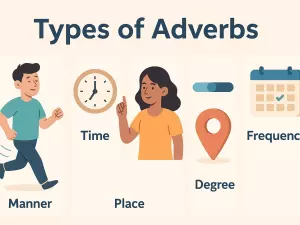
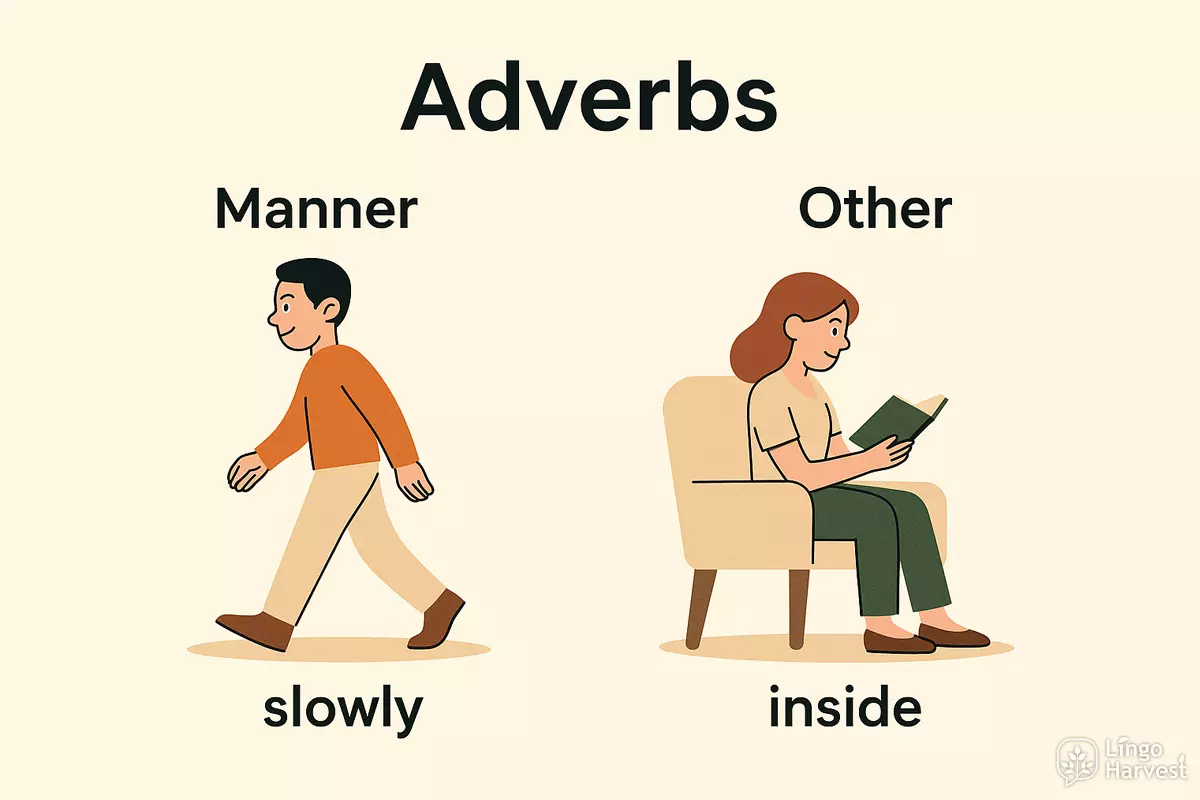
When exploring adverbs, it’s helpful to distinguish between those that describe how something is done and those that give other types of information. Adverbs of manner—like "slowly," "carefully," or "quietly"—specifically modify verbs to explain the way an action happens. In contrast, other adverb categories focus on aspects such as time, place, frequency, or degree.
How Manner Adverbs Differ
Adverbs of manner typically answer the question “How?” about a verb. For example, in “She spoke softly,” the adverb tells us the manner of speaking. Meanwhile, adverbs of time (“yesterday,” “soon”), place (“here,” “everywhere”), frequency (“always,” “rarely”), and degree (“very,” “almost”) provide different details.
Common Types and Examples
- Manner: quickly, gently, badly, perfectly, easily, loudly, silently, angrily, happily, smoothly
- Time: now, then, later, today, soon, already, recently, immediately, finally, yesterday
- Place: here, there, outside, upstairs, nearby, everywhere, nowhere, ahead, behind, abroad
- Frequency: always, never, often, sometimes, rarely, usually, occasionally, frequently, constantly, seldom
- Degree: very, too, quite, almost, enough, nearly, just, hardly, completely, absolutely
Comparing Adverb Functions
Each adverb type brings a unique contribution to a sentence, and their placement can also vary. Manner adverbs often come after the verb or verb phrase, while others may appear at the beginning or end of a sentence, or even before the main verb.
| Type | Sample Adverbs | Example Sentences |
|---|---|---|
| Manner | carefully, beautifully, quickly, silently | He painted carefully. They left quietly. |
| Time | today, soon, yesterday, already | She arrived yesterday. We will leave soon. |
| Place | here, everywhere, outside, above | The kids are playing outside. Look here. |
| Frequency | always, never, sometimes, rarely | I always read at night. She rarely eats sweets. |
| Degree | very, quite, almost, completely | He is very tired. The task is almost done. |
Understanding these distinctions helps you choose the right adverb for what you want to express. Whether you’re clarifying the way something happens or another aspect, selecting the appropriate type of modifier makes your meaning more precise.
Form and Spelling (-ly, irregular forms)
Adverbs of manner are usually formed by adding -ly to the base form of an adjective. This is the most common pattern and helps signal how an action is performed. For example, “slow” becomes “slowly,” and “careful” changes to “carefully.” However, not all words follow this rule, and some have special or irregular forms.
Regular Formation with -ly
Most adjectives can be turned into manner adverbs by attaching -ly. Here are some typical transformations:
- quick → quickly
- quiet → quietly
- happy → happily
- safe → safely
- polite → politely
- angry → angrily
- careful → carefully
- slow → slowly
- loud → loudly
- gentle → gently
Spelling Changes with -ly
Sometimes, the spelling of the adjective changes before adding -ly:
- Adjectives ending in -y: change -y to -i (happy → happily)
- Words ending in -le: replace -le with -ly (gentle → gently)
- Adjectives ending in -ic: add -ally (basic → basically)
Irregular Adverb Forms
Not every manner adverb ends in -ly. Some words have irregular forms or do not change at all from the adjective:
- good → well
- fast → fast
- hard → hard
- late → late
- early → early
- straight → straight
- high → high
- long → long
In these cases, it's important to memorize the correct adverb, as following the regular pattern would be incorrect (for example, “goodly” is not used for manner).
Comparison of Regular and Irregular Forms
| Adjective | Adverb (Regular or Irregular) |
|---|---|
| slow | slowly |
| careful | carefully |
| quiet | quietly |
| good | well |
| fast | fast |
| hard | hard |
| easy | easily |
| angry | angrily |
| gentle | gently |
| happy | happily |
Typical Positions and Emphasis
Adverbs that describe manner—such as "slowly," "carefully," and "quietly"—usually appear directly after the main verb or the object, depending on the sentence structure. This placement is the most natural for English speakers and helps clarify exactly how an action is performed. Sometimes, these adverbs can also be moved for emphasis, but this is less common and can add a specific nuance or highlight the manner of the action.
Common Placement Patterns
- After the verb: She spoke quietly.
- After the object (if there is one): He closed the door softly.
- At the beginning or end of the sentence for emphasis (less typical): Slowly, he walked away. or He walked away slowly.
Shifting for Emphasis
Moving an adverb of manner to the start of a sentence draws attention to how the action is done. This is a stylistic choice and can change the tone or focus. For example: Carefully, she placed the vase on the shelf. Here, "carefully" is highlighted, suggesting that the manner is particularly important.
Examples of Adverbs of Manner in Context
- He answered politely.
- They worked diligently on the project.
- She sang beautifully.
- The dog barked loudly.
- You must listen attentively.
- The baby slept peacefully.
- The chef cooked the meal skillfully.
- She finished the exam quickly.
- He explained the rules clearly.
- The cat moved silently.
- He answered the question honestly.
- They entered the room reluctantly.
- She waited patiently.
- He smiled warmly.
- The children played happily.
- She looked at him curiously.
Comparison Table: Placement and Emphasis
| Position | Example Sentence |
|---|---|
| After main verb | He ran quickly. |
| After object | She painted the wall carefully. |
| Sentence-initial (for emphasis) | Quietly, they left the room. |
| Sentence-final (for emphasis or style) | She finished her work eagerly. |
Key Points to Remember
- Most often, manner adverbs come after the verb or object.
- Moving the adverb can shift emphasis and draw attention to how something is done.
- Overusing unusual positions can sound unnatural.
Understanding where and how to place these words helps you sound more fluent and precise in English.
Sound and Rhythm in Speech
Adverbs of manner like slowly, carefully, and quietly play a significant role in shaping how spoken English feels and flows. These words not only describe actions but also influence the pace and melody of sentences. When you use such adverbs, you often change the natural rhythm or stress pattern, which can affect how clearly your message comes across.
How Adverbs Affect Pronunciation
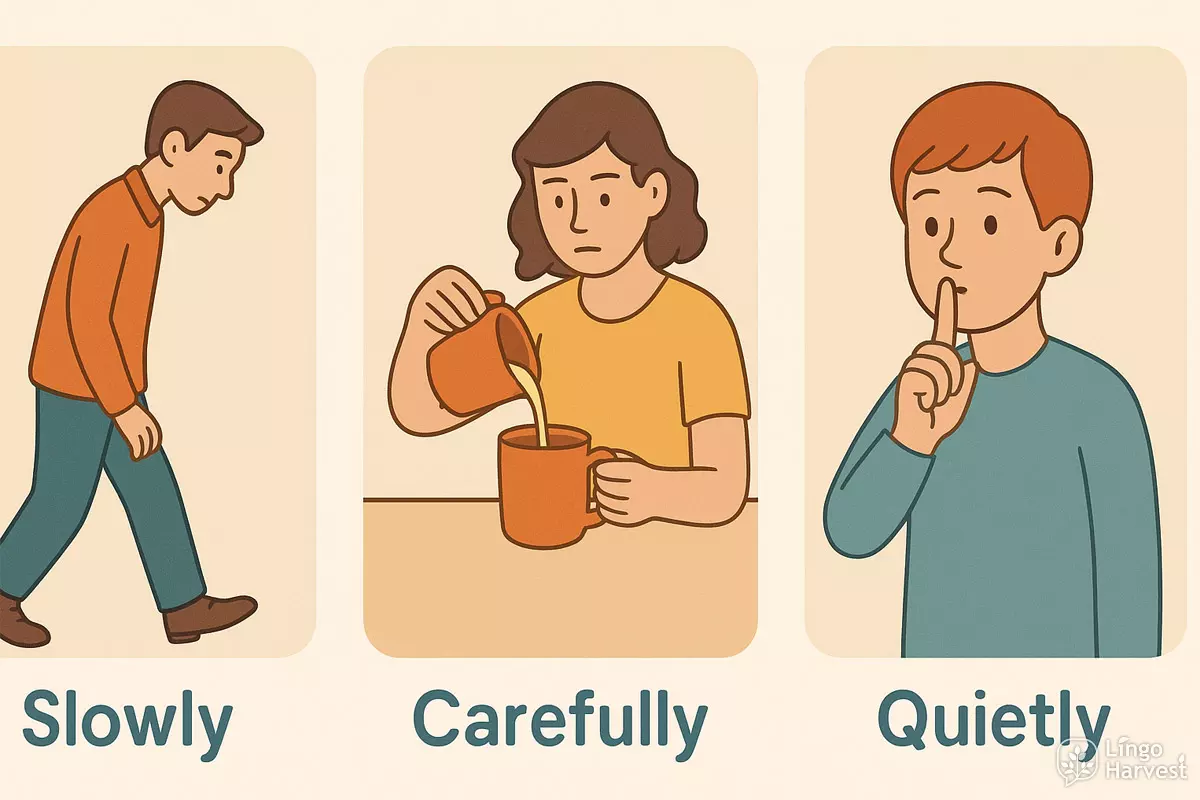
Placing an adverb of manner in a sentence can alter which words are emphasized. For example, in "She spoke quietly," the stress naturally falls on quietly to highlight how she spoke. This emphasis helps listeners pick up on important details and can make your speech more expressive.
- Slowly: Tends to draw out the rhythm, creating a calm or deliberate mood.
- Carefully: Often pronounced with clear, separated syllables, underlining caution.
- Quietly: Usually spoken with a softer tone, matching the meaning of the word.
- Quickly: Shortens the pause between words, speeding up the tempo.
- Loudly: Increases vocal volume and stress on the adverb itself.
- Badly: May carry a negative or apologetic intonation.
- Neatly: Can be said with crisp, precise articulation.
- Suddenly: Often inserted to break the expected rhythm, signaling surprise.
- Happily: Usually spoken with a brighter, higher tone.
- Angrily: May introduce a harsher or more abrupt sound.
- Gently: Spoken in a soft and smooth manner.
- Roughly: Might be delivered with a gruffer tone.
Placement and Sentence Flow
Where you put these modifiers in a sentence can also change how it sounds. Placing the adverb after the verb is common ("He answered slowly"), which often leads to a natural pause before the adverb. If you put it at the beginning ("Carefully, she placed the glass"), it can set the tone for the whole sentence and affect the listener’s expectations.
Examples in Context
Notice how the meaning and rhythm shift with different adverbs:
- He opened the door quietly.
- She typed quickly.
- They listened attentively.
- The child spoke shyly.
- The cat moved gracefully.
- He explained patiently.
- She laughed loudly.
- The teacher wrote neatly.
- The wind blew gently.
- The dog barked angrily.
Tips for Natural Delivery
To use adverbs of manner smoothly in conversation, practice matching your tone and pace to the adverb’s meaning. For instance, when saying "slowly," actually slow your speech a little. This alignment helps your listener understand both the words and the mood you want to convey.
Common Confusions (hard/hardly)
English learners often mix up hard and hardly because they look similar, but their meanings and uses are quite different. Understanding how each word functions helps avoid common mistakes, especially when describing actions or effort.
Understanding the Difference
- Hard is usually an adverb or adjective meaning "with a lot of effort" or "intensely." For example: "She works hard."
- Hardly is an adverb meaning "almost not" or "barely." It has a negative meaning. For example: "He hardly works" means he does very little work.
Because of this, a sentence can have a very different meaning depending on which word is used. Let’s look at some common patterns and examples to clarify:
- She studies hard. ✅ (She puts in a lot of effort studying.)
- She hardly studies. ❌ (She almost never studies.)
- They tried hard to win the game. (They made a big effort.)
- They hardly tried to win the game. (They made little or no effort.)
- I can hardly hear you. (I almost can’t hear you.)
- I hear you hard. ❌ (Incorrect; not natural in English.)
- He hit the ball hard. (He used a lot of force.)
- He hardly hit the ball. (He barely touched it.)
- We worked hard all day. (A lot of work was done.)
- We hardly worked all day. (Very little work was done.)
Quick Guide: Hard vs. Hardly
| Usage | Example Sentence |
|---|---|
| Hard (with effort, intensely) | She trains hard for the marathon. |
| Hardly (almost not, barely) | He hardly trains before races. |
| Hard (with force) | The rain fell hard last night. |
| Hardly (scarcely, just) | We hardly slept because of the storm. |
In summary, hard describes the manner or intensity of an action, while hardly means it happens very little or almost not at all. Remember, switching between these can change the meaning of your sentence completely.
Practice: Improve Sentence Style
Using adverbs of manner thoughtfully can transform simple statements into more vivid and precise descriptions. Let’s work on enhancing sentences by choosing the right adverbs and placement. This section provides targeted activities, examples, and tips to help you use words like "slowly," "carefully," and "quietly" for greater clarity and style.
Rewrite Sentences with Adverbs of Manner
Start by adding an appropriate manner adverb to each sentence below. Consider which adverb best fits the situation and how placement changes the tone.
- She opened the door. (How did she open it?)
- The children entered the room. (Describe their manner.)
- He placed the vase on the shelf. (What was his attitude?)
- The cat walked across the floor. (Make it more descriptive.)
- They listened to the announcement. (What was their behavior?)
Show answers
- She opened the door quietly.
- The children entered the room excitedly.
- He placed the vase on the shelf carefully.
- The cat walked across the floor slowly.
- They listened to the announcement attentively.
Choose the Best Adverb
Match each action to the most appropriate adverb of manner. Some actions may have more than one suitable answer, but focus on the best fit for each situation.
- Drive (a car)
- Speak (at a library)
- Handle (fragile objects)
- Run (during a race)
- Type (during an exam)
- a. quietly
- b. quickly
- c. carefully
- d. slowly
- e. calmly
Show answers
- Drive → e. calmly
- Speak (at a library) → a. quietly
- Handle (fragile objects) → c. carefully
- Run (during a race) → b. quickly
- Type (during an exam) → d. slowly (or carefully)
Transform Basic Sentences
Below is a comparison of simple statements and their improved versions using different manner adverbs. Notice how each adverb adds nuance to the action.
| Original Sentence | Enhanced with Manner Adverb |
|---|---|
| She answered the question. | She answered the question confidently. |
| He closed the window. | He closed the window quietly. |
| They finished the project. | They finished the project efficiently. |
| The dog barked. | The dog barked loudly. |
| She walked into the room. | She walked into the room gracefully. |
| He explained the rules. | He explained the rules clearly. |
| The baby slept. | The baby slept peacefully. |
| They waited for the bus. | They waited for the bus patiently. |
| The chef prepared the meal. | The chef prepared the meal carefully. |
| She finished her homework. | She finished her homework quickly. |
Tips for Stronger Writing with Manner Adverbs
- Use adverbs to clarify how an action is performed, not just to add detail.
- Place adverbs directly before or after the verb for emphasis, e.g., “He quietly left” or “He left quietly.”
- Choose specific adverbs that match the context; avoid overusing generic choices like “nicely” or “well.”
- Vary your sentence structure to keep your writing engaging.
- Remember: sometimes, a strong verb is better than adding an adverb.
By practicing these strategies, you’ll be able to express actions with more precision and style. Experiment with different manner adverbs to see how they change the impact of your sentences.