Adverbs of Time and Place: Today, Now, Here, There

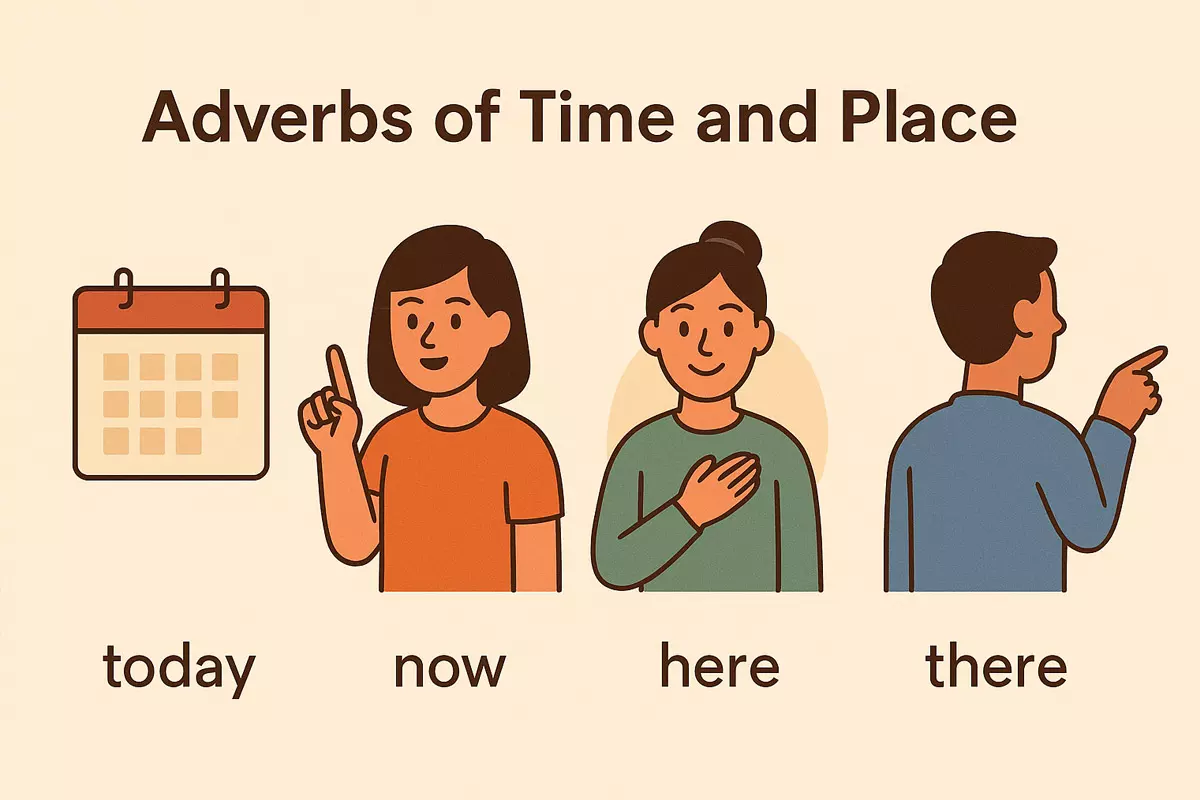 Here we how to use time words for now, past, and future, place words for position and movement, and rules for word order when using time and place. It also explains stacking adverbs, fixed phrases, and includes practice with a short story.
In English, we use specific words to indicate the time or place of an event, which helps make our communication clearer and more precise. For example, terms such as today, now, here, and there allow us to specify exactly when or where something occurs. By including these words in our sentences, we provide important context that helps listeners or readers understand the details of a situation. This use of time and place markers not only adds clarity but also makes our language more engaging and effective in conveying information.
Time Words for Now, Past, Future
Understanding when something happens is essential for clear communication. In English, adverbs and phrases that indicate time help us express whether an action is happening now, happened before, or will happen later. These temporal expressions are common in daily conversation and writing.
Words for the Present

To talk about actions or situations happening at this moment, we use specific words. Here are some common options:
- Now – I am studying now.
- Currently – She is currently working from home.
- Today – We have a meeting today.
- This week – I am busy this week.
- At the moment – He is not available at the moment.
- Right now – Please call me right now.
Expressions for the Past
When speaking about something that has already happened, these adverbs and phrases are helpful:
- Yesterday – I finished the report yesterday.
- Last night – We talked last night.
- Before – She lived in Paris before.
- Previously – He had previously visited Rome.
- A moment ago – The bus left a moment ago.
- Earlier – I called you earlier.
- In the past – People wrote letters in the past.
Talking About the Future
If you want to discuss events that will happen after now, these are the most common ways:
- Tomorrow – We will meet tomorrow.
- Later – I will do it later.
- Soon – The movie will start soon.
- Next week – Our exams are next week.
- In the future – Technology will improve in the future.
- Shortly – The plane will land shortly.
- Afterwards – Let’s have coffee afterwards.
Comparison of Time Adverbs
Some words are easily confused because they refer to similar time frames. Here’s a quick comparison to clarify their meanings:
| Adverb/Phrase | When? | Example Sentence |
|---|---|---|
| Now | At this moment | She is eating now. |
| Yesterday | One day before today | He left yesterday. |
| Tomorrow | One day after today | We will travel tomorrow. |
| Soon | A short time from now | Dinner will be ready soon. |
| Earlier | Before now, but not specific | I saw him earlier. |
| Later | After now, but not specific | Let’s talk later. |
Selecting the right temporal expression helps your listener understand exactly when something happened, is happening, or will happen. Try to use a variety of these words to make your English clearer and more natural.
Place Words for Position and Movement
Understanding how to describe where something happens or how it moves is essential for clear communication. Words like here and there help pinpoint locations or indicate direction. These adverbs of place often answer questions such as "Where?" or "In what direction?" and can show both static positions and movement.
Common Adverbs Indicating Place
There are many words in English that specify location or direction. Some describe a fixed spot, while others signal motion from one place to another. Here’s a list of frequently used terms:
- here
- there
- nearby
- everywhere
- anywhere
- nowhere
- upstairs
- downstairs
- inside
- outside
- above
- below
- ahead
- behind
- abroad
- away
- back
- around
- forward
- home
Static vs. Dynamic Usage
Some words express a location that does not change, while others describe movement. For example, “here” and “there” can be static (“She is here”) or dynamic (“Come here!”). The context usually makes the meaning clear.
| Adverb | Example Sentence |
|---|---|
| here | I'm staying here tonight. |
| there | They went there yesterday. |
| inside | The cat is inside the house. |
| outside | Let's play outside. |
| above | The lamp hangs above the table. |
| below | Your shoes are below the bed. |
| around | She looked around the room. |
| back | He came back quickly. |
Tips for Using Place Adverbs
- Place adverbs usually come after the main verb or the object: “She sat downstairs.”
- Some can be used at the beginning or end of a sentence for emphasis: “Here is your book.”
- They often help make directions and instructions clearer.
- Be mindful of context—some words can mean different things in different situations.
Mastering these expressions helps you give precise information about locations and movements, making descriptions more vivid and instructions easier to follow.
Word Order Rules with Time and Place
Understanding where to place adverbs such as today, now, here, and there in an English sentence helps your speech and writing sound natural. The position of these words often depends on what you want to emphasize and the type of sentence you are using—statement, question, or command.
General Placement Patterns
In most cases, adverbs of time and place appear at the end of the sentence. However, it’s also common to put them at the beginning for emphasis or style. If both time and place need to be mentioned, the standard order is: place before time.
- We will meet here tomorrow. ✅
- She is leaving there now. ✅
- Let’s go there today. ✅
Common Sentence Structures
Here are some typical patterns you’ll encounter:
- Subject + Verb + Object + Place + Time
- Place/Time (for emphasis) + Subject + Verb + Object
- Subject + Verb + Place/Time (short sentences)
Notice that starting a sentence with a time or place word adds special focus, especially in storytelling or instructions:
- Today, I want to talk about something important.
- Here, you can see the difference.
- I saw him there yesterday.
- We’re meeting now.
Comparison Table: Position of Adverbs in Sentences
| Sentence Position | Example |
|---|---|
| End of sentence (most common) | We are meeting here today. |
| Beginning for emphasis | Now, let’s begin the lesson. |
| Between auxiliary and main verb (less common) | She has now arrived. |
| After the verb to be | The meeting is here now. |
| After direct object (if present) | I’ll see you there tomorrow. |
Key Points to Remember
- Adverbs of place come before adverbs of time if both are used together.
- It’s fine to use adverbs like now or today at the start for emphasis.
- Short responses often use only the adverb: Here!, Now!, Today!
- In questions, adverbs can go at the end: Are you coming here today?
By following these patterns, you’ll make your English clearer and more accurate when describing time and place.
Stacking Multiple Adverbs (order of info)
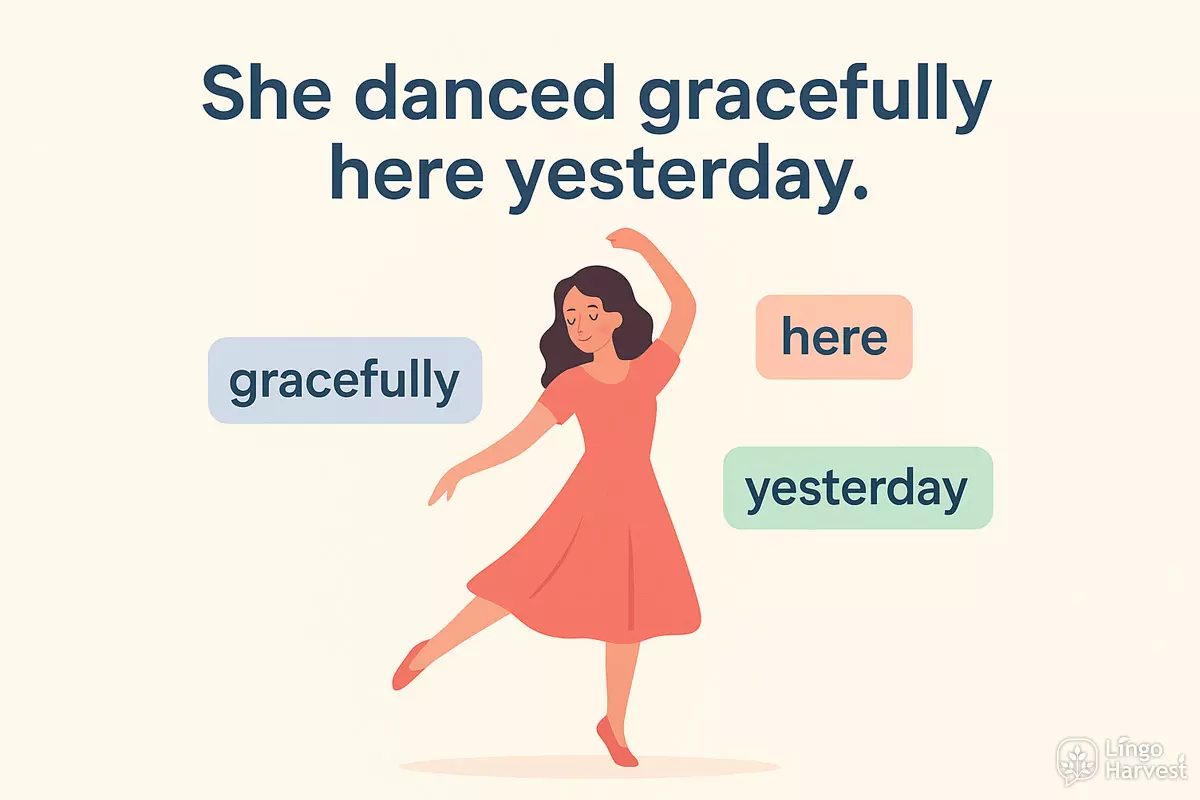
When more than one adverb appears in a sentence, their order can affect clarity and flow. English generally follows a typical sequence: manner, place, then time. This means words describing how an action is done usually come first, followed by where, and finally when. Consider these examples:
- She danced gracefully here yesterday.
- We will meet there tomorrow.
- He is working quietly in the library now.
Typical Patterns for Combining Adverbs
The sequence is not random. Native speakers expect a certain order, especially with time and place words like today, now, here, and there. Placing these in the standard order helps your sentences sound natural.
- Adverb of manner (how): quickly, quietly, carefully
- Adverb of place (where): here, there, at home, outside
- Adverb of time (when): now, today, yesterday, soon
Examples of Correct and Incorrect Orders
Here are some practical examples to show how stacking works best:
- She will arrive here tomorrow. ✅
- He is waiting there now. ✅
- We met yesterday here. ❌ (Less natural)
- They are practicing now at the gym. ❌ (Unusual order)
Expanded Example List
To illustrate the natural stacking of these adverbs, here are more concise patterns:
- Meet me here now.
- Let’s go there today.
- I saw her there yesterday.
- We’ll start here tomorrow.
- He works here every day.
- They played there last week.
- You can find me here in the morning.
- She left there at noon.
- I’ll wait here until 5 PM.
- We studied there all night.
- Come here right now.
- He will be there soon.
Summary of the Usual Sequence
Remember, the most natural order with adverbs like now, here, there, and today is usually: how + where + when. Rearranging these can make a sentence feel awkward, so stick to this structure for clarity and fluency.
Fixed Phrases and Collocations
In English, certain adverbs of time and place—such as "today," "now," "here," and "there"—often appear in set expressions and idiomatic combinations. Recognizing these patterns helps learners sound more natural and understand everyday speech more easily.
Common Expressions with "Today," "Now," "Here," and "There"
Many phrases use these adverbs to clarify timing or location, or to add emphasis. Here are some widely used examples:
- Right now
- Here and now
- From now on
- There you go
- Here we are
- Today is the day
- Now or never
- Here and there
- There you have it
- Now and then
- Here to stay
- There’s no time like the present
- Now that you mention it
- Here goes nothing
- Today’s the day
- There’s more to it
- Be here now
- Over there
- Stay here
- Just now
How Position Affects Meaning
Placement of these adverbs can subtly change the meaning or focus of a sentence. For example, "now" at the beginning of a sentence often signals a shift in topic or a new point, while at the end, it emphasizes urgency or present relevance.
| Phrase | Typical Use / Meaning |
|---|---|
| Right here | Emphasizes a precise location: "Put it right here." |
| Just now | Refers to something that happened a moment ago: "He left just now." |
| From there | Describes movement or consequence: "We went from there to the park." |
| Back then | Indicates a time in the past: "Back then, things were different." |
| By now | Suggests something should have happened already: "You should know by now." |
Tips for Using These Patterns
Using established word combinations with adverbs of time and place can make your speech and writing feel more fluent. Try to notice how native speakers use these phrases in context, and practice them in your own sentences to build confidence. Some collocations also carry idiomatic meanings, so pay attention to their usage beyond the literal sense.
Practice: Tell a Short Story with Adverbs
Telling stories is a great way to practice using adverbs of time and place such as "today," "now," "here," and "there." These words help your listener understand when and where things happen. Let’s see how you can build a simple story using different adverbs.
Step-by-Step Story Exercise
Follow the steps below to create your own mini-story. Focus on including at least one adverb of time (today, now) and one of place (here, there) in each sentence or part of your story.
- Choose a main character (for example: a boy, a cat, a teacher).
- Decide where your story happens (in the park, at school, at home).
- Use adverbs of time to show when things happen.
- Use adverbs of place to show where things happen.
Story Building Example
- Today, Anna wakes up early.
- She is here, in her room.
- Now, she is getting ready for school.
- Her bag is there, on the chair.
- She leaves the house and goes to the bus stop. Here, she meets her friend.
- Now, they are both waiting for the bus.
Notice how each sentence uses a different adverb to give more detail.
Practice: Complete the Story
Finish the following short story by adding suitable adverbs of time or place in the blanks:
- ______ , Tom is playing football.
- His ball is ______ on the grass.
- ______ , his friends arrive.
- They all run ______ to get the ball.
Show answers
- Today
- here
- Now
- there
Challenge: Make Your Own Sentences
Create sentences using each adverb below. Try to write a mini-story or a sequence of events. Use at least four adverbs from the list:
- today
- now
- here
- there
- yesterday
- tomorrow
- everywhere
- outside
- inside
- upstairs
- downstairs
- nearby
- away
- soon
- later
- before
- after
- back
Show answers
- Today, I am here at school.
- Now, my friends are outside.
- Yesterday, we played there in the park.
- Later, we will go upstairs to the library.
Practicing with these adverbs will help you make your stories clearer and more interesting. Remember to experiment with different combinations to see how the meaning changes.