Present Perfect Verb Forms and Typical Time Expressions

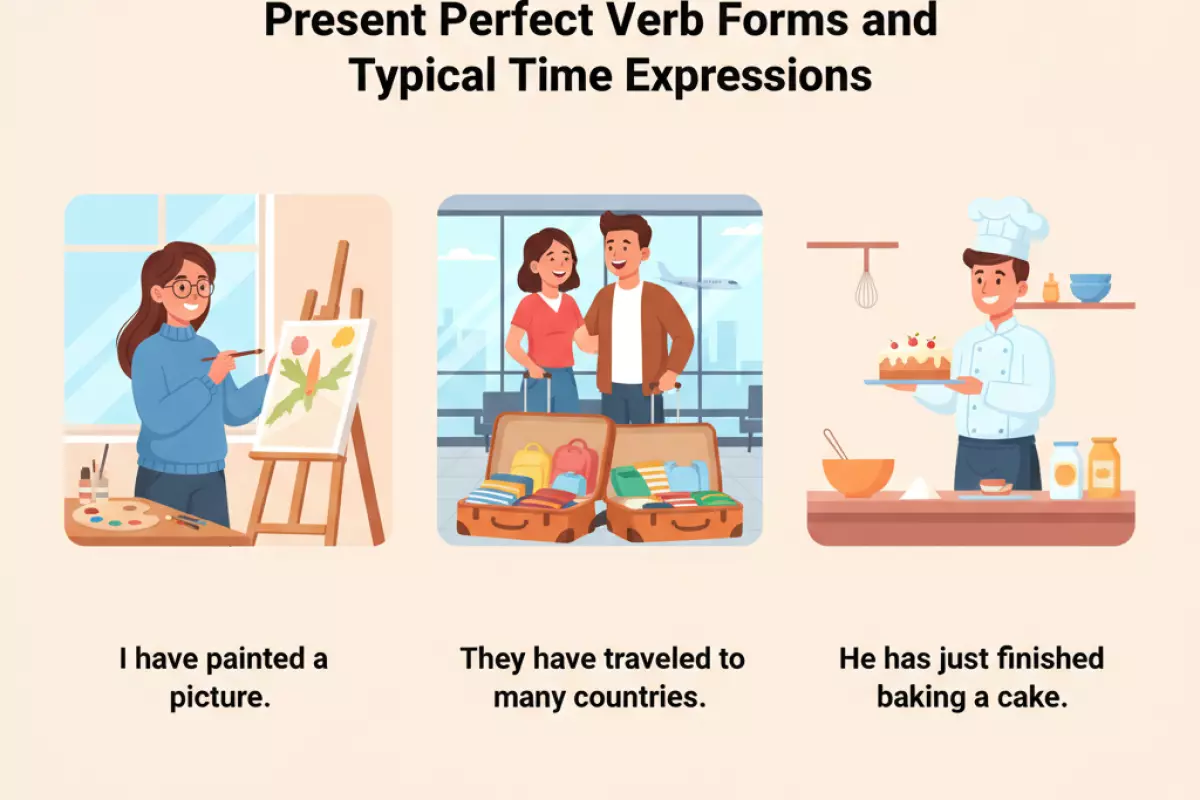 This article explains what the present perfect expresses and how to form it with have/has plus a past participle.
Have you ever wondered why we say I have lost my keys or She has lived here for years? This lesson explains how these present perfect patterns link past actions to the present, and how time words like already, just, yet, since, for, and recently shape meaning. You will learn when to use them to show a result now, an experience, or an action that started in the past and continues today.
What present perfect expresses
This tense links a past action or situation to “now.” The focus is usually on the result, the experience, or the time period up to the present, rather than on a finished past moment.
Core meanings and when to use them
- Life experience (at any time up to now): You talk about whether something has ever happened, without saying exactly when.
✅ I’ve visited Rome. / ❌ I’ve visited Rome last year. - Change over time: Something has developed from the past until the present.
✅ My English has improved a lot. - Accomplishments up to now: You report achievements in a period that includes the present.
✅ Scientists have discovered a new treatment. - Unfinished time period: The time frame is still open (today, this week, lately), so the action belongs to the period leading to now.
✅ I’ve had three meetings today. - Recent past with present relevance: The action is recent and the result matters now (often with “just,” “already,” “yet”).
✅ She’s just left, so she isn’t here now. - Current situation that started in the past (state): A state began earlier and continues now, often with “for” and “since.”
✅ I’ve lived here for ten years. / I’ve lived here since 2016. - Repeated actions up to now: Something has happened multiple times in an open period.
✅ We’ve seen that movie twice. - News and announcements: You introduce new information; details may follow in the past simple.
✅ The company has announced layoffs. (Details: It cut 200 jobs last week.)
Typical patterns learners can rely on
- Present result:
✅ I’ve lost my keys. (I can’t find them now.) - Experience questions:
✅ Have you ever tried sushi? / Have you been to Japan? - “So far / up to now / until now”:
✅ So far, we’ve raised $500. - “This week / this month / today” (unfinished):
✅ She’s traveled a lot this month. - “For” + duration:
✅ They’ve worked here for a long time. - “Since” + starting point:
✅ I haven’t eaten since breakfast. - “Just / already / yet”:
✅ I’ve already sent it. / I haven’t finished yet. / Have you done it yet? - Negative for a period (not…for / not…since):
✅ We haven’t spoken for weeks. / He hasn’t called since Monday. - “How long…?” with continuing situations:
✅ How long have you known her? - “Once / twice / many times” up to now:
✅ I’ve met him twice. - Open-ended quantity with “in my life / in years”:
✅ That’s the best meal I’ve had in years.
Common boundary: when past simple is required
- Use past simple when the time is finished or clearly stated as a completed past moment.
✅ I visited Rome in 2019. / ❌ I’ve visited Rome in 2019. - Use past simple for a sequence of completed past events in a story.
✅ I woke up, ate breakfast, and left. - Use the present perfect when the exact time is not the point and the connection to now matters.
✅ I’ve seen that film. (at some point; the experience is relevant now)
Form: have/has + past participle
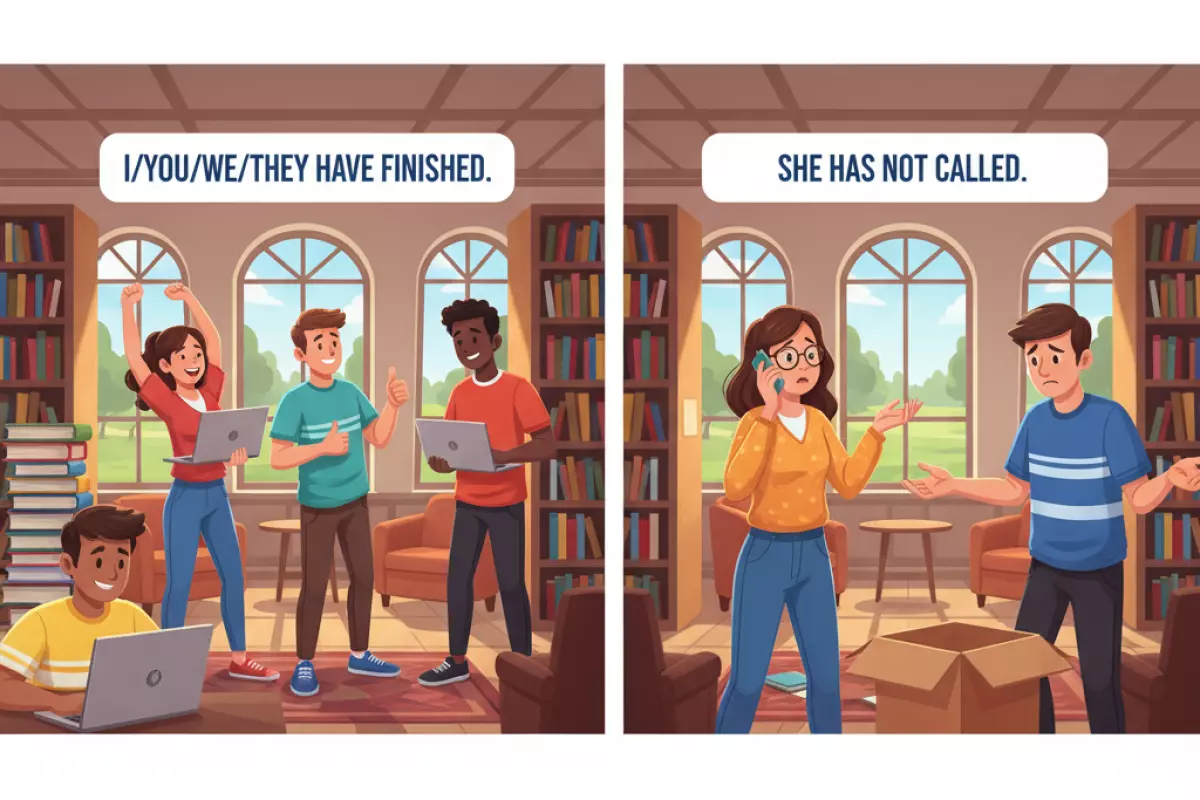
The present perfect is built with an auxiliary verb plus a past participle. Choose have or has based on the subject, then use the verb’s past participle (regular: usually -ed; irregular: a special form you must learn).
Basic patterns
- Affirmative: Subject + have/has + past participle
- I/You/We/They have finished.
- He/She/It has finished.
- Negative: Subject + have/has + not + past participle
- I have not seen it.
- She has not called.
- Common contractions: haven’t, hasn’t
- Yes/No questions: Have/Has + subject + past participle?
- Have you met the new manager?
- Has he arrived yet?
- Short answers:
- Yes, I have. / No, I haven’t.
- Yes, she has. / No, she hasn’t.
- Wh- questions: Wh-word + have/has + subject + past participle?
- Where have you put my keys?
- Why has she changed her mind?
Choosing have vs. has
- Use have with: I, you, we, they, and plural nouns (My friends have left).
- Use has with: he, she, it, and singular nouns (The train has departed).
- ✅ The team has won. → “Team” is treated as a single unit in many varieties of English.
Past participles: regular and irregular
- Regular participles usually end in -ed: worked, cleaned, played, started.
- Irregular participles vary and must be learned: gone, seen, done, written, built, bought.
- Be careful with verbs that have different past simple vs. participle forms:
- ✅ I have gone home. ❌ I have went home.
- ✅ She has done it. ❌ She has did it.
- ✅ We have seen it. ❌ We have saw it.
- ✅ They have taken the bus. ❌ They have took the bus.
High-utility example sentences (pattern practice)
- I have completed the report.
- They have moved to a new apartment.
- She has booked the tickets.
- We have decided to postpone the meeting.
- He has forgotten my name.
- You have improved a lot.
- The company has announced changes.
- My parents have visited us twice.
- It has stopped raining.
- Have you ever tried sushi?
- Has she already left?
- We haven’t received a reply.
- I haven’t finished yet.
- Why have they canceled the order?
- How long have you lived here?
Present perfect for experience
Use this meaning to talk about things someone has done (or hasn’t done) at least once in their life up to now. The exact time is not important or is unknown; the focus is on the fact that the experience exists.
Core pattern and meaning
- Form: have/has + past participle (I have visited, she has tried, they have seen).
- Typical idea: “At some point before now” rather than “yesterday/last year.”
- Common question: Have you ever + past participle? (asking about life experience).
- Common negative: haven’t/hasn’t + past participle (stating lack of experience).
- Common short answers: Yes, I have. / No, I haven’t. / Yes, she has. / No, she hasn’t.
Time expressions that fit this use
- ever (at any time up to now): Have you ever eaten sushi?
- never (not at any time up to now): I’ve never ridden a horse.
- before (earlier in life, time not specified): I’ve met him before.
- once / twice / three times (number of experiences): She’s been to Rome twice.
- many times / a few times: We’ve watched that film many times.
- already (sooner than expected, experience completed): I’ve already tried that app.
- yet (in questions/negatives, up to now): Have you tried it yet? / I haven’t tried it yet.
- so far / up to now (until this moment): So far, I’ve only visited two countries.
- in my life (explicit life-time frame): I’ve never seen snow in my life.
- recently / lately (near the present, still time-unspecific): Have you seen her recently?
Example sentences (experience focus)
- Have you ever studied another language?
- I’ve never tasted durian.
- She’s tried rock climbing once.
- We’ve visited that museum three times.
- They’ve met the new manager before.
- Have you finished the training course yet?
- I haven’t used this software before.
- He’s already read that book.
- So far, I’ve learned the basics.
- Have you ever lost your passport while traveling?
- I’ve never been afraid of flying.
- She hasn’t driven on the left side of the road before.
- We’ve eaten at that restaurant a few times.
- They’ve never heard of that band.
Common mistakes and how to fix them
- ❌ I have seen him yesterday. → ✅ I saw him yesterday. (specific finished time needs past simple)
- ❌ Did you ever try sushi? → ✅ Have you ever tried sushi? (life-experience question up to now)
- ❌ I have never went there. → ✅ I have never gone there. (use past participle, not past simple)
- ❌ She has been to Paris last year. → ✅ She went to Paris last year. / ✅ She has been to Paris. (choose one focus)
Useful contrast: “been to” vs. “gone to”
- has been to = the person visited and returned (experience): She has been to Japan.
- has gone to = the person went and is still there (not mainly about experience): She has gone to Japan (so she isn’t here now).
Present perfect for results and recent news
Use the present perfect to connect a past action to a result that matters now, or to report something that has just happened when the exact time is not the focus. The speaker’s attention is on the current situation (the evidence, the change, the update), not on when the action occurred.
Results you can see or feel now
This use answers questions like “What’s different now?” or “Why is this happening?” The cause is in the past, but the effect is present.
- Pattern: have/has + past participle to explain a present outcome.
- Typical context: a problem, a change, missing information, a completed task with a visible effect.
- ✅ She has lost her keys. (Result: she can’t get in now.)
- ✅ I’ve finished the report. (Result: it’s ready now.)
- ✅ They have moved to Berlin. (Result: they live there now.)
- ✅ We’ve cleaned the kitchen. (Result: it’s clean now.)
- ✅ He has broken his glasses. (Result: he can’t see well now.)
- ✅ The price has increased. (Result: it costs more now.)
- ✅ Someone has opened the window. (Result: it’s cold in here now.)
- ✅ My phone has died. (Result: I can’t call you now.)
- ✅ The train has been cancelled. (Result: we need a new plan now.)
- ✅ We’ve changed the schedule. (Result: the meeting time is different now.)
Recent news and announcements
Use the present perfect to introduce new information that is relevant now, especially in conversations, messages, and updates. It often appears with short “news” time expressions that keep the focus on the update rather than a finished time in the past.
- Common time expressions: just, already, yet, recently, lately, this week, today (when the period is still continuing).
- ✅ The CEO has just resigned. (fresh update)
- ✅ They’ve already announced the results. (the news is now known)
- ✅ Have you heard? The team has won. (introducing news)
- ✅ We haven’t received a reply yet. (status up to now)
- ✅ Sales have improved recently. (change up to now)
- ✅ I’ve seen three updates today. (today is still in progress)
Common contrasts and time traps
Choose the present perfect when the time is not specified or when the time period is still open. Switch to the past simple when you name a finished time (yesterday, last week, in 2020) or when the story is anchored to a specific moment.
- ✅ I’ve met her. (experience; no specific time) → ✅ I met her last year. (finished time)
- ✅ He has left. (he isn’t here now) → ✅ He left at 6. (specific time given)
- ❌ We have finished yesterday. → ✅ We finished yesterday.
- ✅ She has already sent it. (status now) → ✅ She sent it this morning at 9. (time anchored)
- ✅ Have you decided yet? (up to now) → ✅ Did you decide during the meeting? (finished event)
Since, for, already, yet, just, ever, never
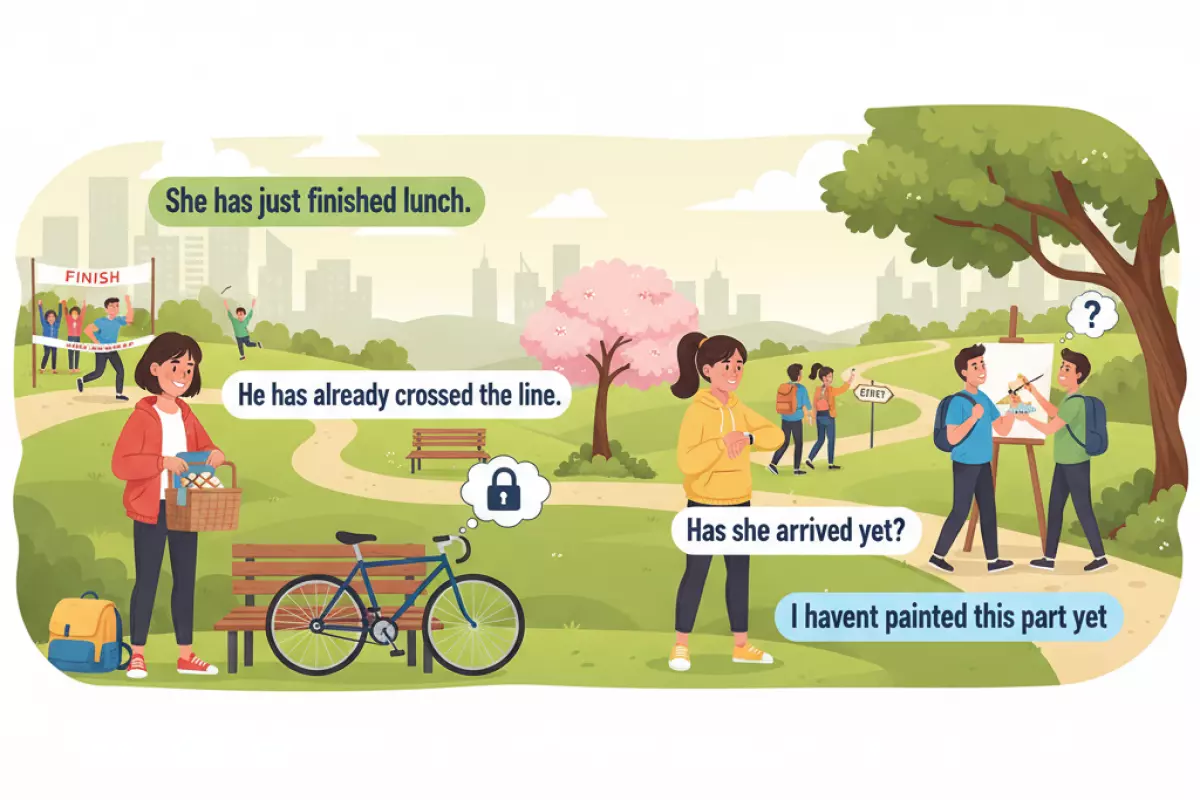
These common time words help you connect the present perfect to unfinished time, duration, and life experience. They also influence word order and whether a sentence sounds natural in statements, questions, or negatives.
Core patterns and placement
- Basic form: subject + have/has + past participle (+ object/complement).
- Typical placement:
- Already / just usually go between have/has and the past participle: “She has already finished.”
- Yet usually comes at the end: “Have you finished yet?” / “I haven’t finished yet.”
- Ever / never usually go between have/has and the past participle: “Have you ever tried it?” / “I’ve never tried it.”
- Since / for often come at the end (or after the main verb phrase): “I’ve lived here for three years.”
- Time focus:
- Since points to a starting point.
- For points to a length of time.
- Already / yet / just relate to timing and expectation.
- Ever / never relate to experience at any time up to now.
Since vs. for (start point vs. duration)
- Use “since” + a point in time (a date, a day, a moment, a clause):
- “I have worked here since 2021.”
- “She has been awake since 5 a.m.”
- “They have known each other since childhood.”
- “We have been friends since we met at university.”
- Use “for” + a period of time (how long):
- “I have worked here for three years.”
- “She has been awake for two hours.”
- “They have lived abroad for a long time.”
- “We have waited for 20 minutes.”
- Common learner fix: ❌ “since three years” → ✅ “for three years”
Already, yet, just (timing and expectation)
- Already suggests something happened sooner than expected or earlier than now:
- “He has already sent the email.”
- “We’ve already seen that movie.”
- In questions, it can show surprise: “Have you already finished?”
- Yet is common in questions and negatives to show something is expected but not done up to now:
- “Have you booked the tickets yet?”
- “I haven’t booked them yet.”
- Less common in affirmative statements (more natural: “already”): ❌ “I’ve done it yet.”
- Just means “a short time ago” (very recent past connected to now):
- “She has just arrived.”
- “I’ve just spoken to him.”
- “They’ve just finished lunch.”
Ever and never (experience up to now)
- Ever is typical in questions about life experience at any time until now:
- “Have you ever visited Japan?”
- “Have they ever worked remotely?”
- “Has he ever tried skiing?”
- Never expresses “not at any time up to now” and is already negative in meaning:
- “I have never eaten oysters.”
- “She has never missed a deadline.”
- ❌ “I haven’t never been there.” → ✅ “I’ve never been there.” / “I haven’t been there.”
- Answering an “ever” question:
- “Have you ever tried it?” → “Yes, I have.” / “No, I haven’t.” / “Yes, I have, once.” / “No, I’ve never tried it.”
Quick practice patterns (mix and match)
- Have/has + already + past participle: “We have already decided.”
- Have/has + just + past participle: “He has just called.”
- Have/has + never + past participle: “They have never complained.”
- Have/has + ever + past participle (question): “Have you ever met her?”
- Negative + past participle + yet: “I haven’t replied yet.”
- Question + past participle + yet: “Have you replied yet?”
- Present perfect + since + start point: “She has studied since Monday.”
- Present perfect + for + duration: “She has studied for two days.”
Present perfect vs past simple
Choose the present perfect when the time is not finished or not stated and the focus is on the result or life experience. Choose the past simple when you talk about a finished time in the past and the focus is on when it happened (a specific moment, date, or completed period).
| Use and meaning | Present perfect (have/has + past participle) | Past simple (V2 / did) |
|---|---|---|
| Finished time vs. unfinished/unspecified time | Time is not finished or not named: “I’ve worked here since 2022.” | Time is finished or named: “I worked there in 2022.” |
| Result now vs. event then | Emphasis on a present result: “She’s broken her phone (so she can’t call).” | Emphasis on the past event: “She broke her phone yesterday.” |
| Life experience (ever/never) | General experience up to now: “Have you ever visited Rome?” | Specific past trip: “Did you visit Rome on your last trip?” |
| Recent news vs. completed story details | Announce news: “The train has arrived.” | Add details: “It arrived at 6:10 and stopped at platform 3.” |
| Duration up to now (for/since) | Action/state continues: “We’ve lived here for ten years.” | Duration in a finished past period: “We lived there for ten years (then moved).” |
| “This week / today” (time still open) | Still within the period: “I’ve sent three emails today.” | When the period is treated as finished: “I sent three emails today, then I turned off my laptop.” |
Time expressions that usually signal each tense
- Present perfect is common with: already, just, yet, ever, never, recently, lately, so far, up to now, until now, in the last few days, over the past year, this week (still continuing), today (still continuing), for + period, since + start point.
- Past simple is common with: yesterday, last night/week/year, ago, in 2019, on Monday, at 5 o’clock, when I was a child, then, the other day, from 2010 to 2012, during the meeting, earlier (when it clearly means earlier in a finished time).
Typical patterns (with correct vs. incorrect choices)
- Finished time marker → use past simple: ✅ “I saw him yesterday.” ❌ “I’ve seen him yesterday.”
- Unfinished time marker → use present perfect: ✅ “I’ve seen him this week.” (the week isn’t over)
- “Ever/never” for experience → ✅ “She’s never tried sushi.” (no time given)
- Specific past moment → ✅ “She tried sushi at the party.”
- News first, details later → “The company has announced layoffs. It announced them on Tuesday after the board meeting.”
- Continuing situation → “They’ve known each other since college.” (still true now)
- Situation that ended → “They knew each other in college, but they lost touch later.”
- “How long…?” about a continuing state → “How long have you lived here?”
- “How long…?” about a finished situation → “How long did you live there before you moved?”
- With “just” (very recent) → “I’ve just finished the report.”
- With “ago” → “I finished the report two hours ago.”
- With “so far” → “So far, we’ve had three meetings.”
- With a completed sequence → “We had three meetings, agreed on the plan, and signed the contract.”
Quick decision check
- Ask “When?” If the sentence answers with a finished time (yesterday, last year, in 2020), choose the past simple.
- If “When?” is not important or not stated, and the meaning connects to now (result, experience, continuing time period), choose the present perfect.
- If you start with the present perfect to introduce a topic, switching to the past simple is natural when you give the story’s time and details.
Typical learner mistakes and corrections
Errors with the present perfect usually come from mixing it with the past simple, choosing the wrong time expression, or forming the verb incorrectly. The fixes are mostly pattern-based: decide whether the time is “finished” or “still connected to now,” then match the tense and the signal words.
Common usage problems (meaning and time)
- Using past simple with “ever/never” for life experience: ❌ I never went to Japan. → ✅ I have never been to Japan. (No finished time is given; it’s about experience up to now.)
- Using present perfect with a finished time: ❌ I have seen him yesterday. → ✅ I saw him yesterday. (“Yesterday” is a completed past time.)
- Forgetting that “last week / in 2019 / two days ago” block the present perfect: ❌ We have moved in 2019. → ✅ We moved in 2019.
- Using “since” with a duration instead of a starting point: ❌ I have lived here since three years. → ✅ I have lived here for three years. (“Since” + point in time; “for” + length.)
- Using “for” with a starting point: ❌ She has worked here for 2022. → ✅ She has worked here since 2022.
- Confusing “been” and “gone”: ❌ He has been to the shop, so he isn’t here. → ✅ He has gone to the shop, so he isn’t here. (“Gone” = not back yet; “been” = visited and returned / experience.)
- Using present perfect for a past event with no present result: ❌ Shakespeare has written many plays. → ✅ Shakespeare wrote many plays. (A completed life in the past.)
- Using past simple when the result matters now: ❌ I lost my keys. I can’t open the door. → ✅ I have lost my keys. (The current problem is important.)
- Mixing “already/yet” positions: ❌ Have you finished already? (often unnatural) → ✅ Have you finished yet? / I’ve already finished. (“Already” is more common in statements; “yet” in questions/negatives.)
- Using “yet” in affirmative statements: ❌ I have finished yet. → ✅ I haven’t finished yet. / I’ve already finished.
- Overusing “just” for any recent time: ❌ I have just finished yesterday. → ✅ I finished yesterday. / I’ve just finished. (“Just” suggests very recent and usually excludes finished past time phrases.)
- Choosing present perfect with “when” questions about a specific past time: ❌ When have you arrived? → ✅ When did you arrive? (“When” asks for a finished time.)
Form and structure problems (auxiliary + past participle)
- Missing the auxiliary “have/has”: ❌ She finished her homework already. → ✅ She has finished her homework already.
- Using “be” instead of “have”: ❌ I am visited London. → ✅ I have visited London.
- Using the past simple instead of the past participle: ❌ They have went home. → ✅ They have gone home.
- Regular -ed mistakes in spelling: ❌ I have stoped smoking. → ✅ I have stopped smoking. (Double consonant patterns matter.)
- Negative form built incorrectly: ❌ I haven’t saw it. → ✅ I haven’t seen it. (Haven’t/hasn’t + past participle.)
- Question form missing inversion: ❌ You have finished? → ✅ Have you finished?
- Third person singular confusion: ❌ He have lived here since 2020. → ✅ He has lived here since 2020.
- Double marking the past: ❌ Did you have seen it? → ✅ Have you seen it? / Did you see it? (Choose one tense pattern.)
Quick checks that prevent most errors
- Finished time mentioned? Use past simple (yesterday, last year, in 2010, two hours ago).
- No finished time, but “up to now” meaning? Use present perfect (ever, never, already, yet, recently, so far).
- Duration continuing to now? Use present perfect with for/since (for + period, since + starting point).
- Ask “Is there a present result?” If yes, the present perfect is often the better choice.
Homework: present perfect practice tasks
Use these activities to build accuracy with have/has + past participle, and to choose time expressions that match the meaning (life experience, unfinished time, recent results, and duration up to now). Complete the tasks in order; later items recycle the same patterns in new contexts.
1) Form focus: choose have/has and the past participle
- My sister ________ (finish) her report, so she can relax now.
- I ________ (not see) that movie, but I want to.
- They ________ (buy) a new router, and the Wi‑Fi is faster.
- ________ you ever ________ (eat) sushi?
- Our teacher ________ (give) us feedback on the first draft.
- We ________ (not decide) on a date yet.
- He ________ (break) his glasses again.
- It ________ (rain) a lot this week.
- How long ________ you ________ (know) your best friend?
- The bus ________ (just arrive).
Show answers
- has finished
- haven’t seen
- have bought
- Have; eaten
- has given
- haven’t decided
- has broken
- has rained
- have; known
- has just arrived
2) Time expressions: pick the best option
- I’ve lived here ________. (since 2022 / last year)
- She’s been busy ________. (today / yesterday)
- Have you called him ________? (yet / ago)
- We’ve met twice ________. (so far / in 2019)
- They’ve already started, but I haven’t joined ________. (yet / last night)
- He’s worked at that company ________ five years. (for / during)
- I haven’t had coffee ________ this morning. (yet / when)
- The team has improved a lot ________ the last few months. (over / at)
- Have you ever been to Canada ________? (before / last summer)
- We’ve had three meetings ________. (this week / the previous week)
Show answers
- since 2022
- today
- yet
- so far
- yet
- for
- yet
- over
- before
- this week
3) Present perfect or past simple? Choose the tense that fits
Decide whether the sentence needs a connection to now (present perfect) or a finished past time (past simple). Write the full sentence.
- I (lose) my keys. I can’t get in.
- I (lose) my keys yesterday, but I found them later.
- She (travel) to Spain three times.
- She (travel) to Spain in 2018.
- We (not finish) the project yet.
- We (not finish) the project last Friday.
- He (just send) the email, so check your inbox.
- He (send) the email at 9:05.
- They (live) in this apartment for two years.
- They (live) in that apartment for two years, then moved.
Show answers
- I’ve lost my keys. I can’t get in.
- I lost my keys yesterday, but I found them later.
- She’s traveled to Spain three times.
- She traveled to Spain in 2018.
- We haven’t finished the project yet.
- We didn’t finish the project last Friday.
- He’s just sent the email, so check your inbox.
- He sent the email at 9:05.
- They’ve lived in this apartment for two years.
- They lived in that apartment for two years, then moved.
4) Sentence building: follow the pattern
Rewrite each item using the cue word(s). Keep the meaning the same.
- I’m still waiting for her reply. (yet)
- He started learning English in 2020 and continues now. (since)
- We completed the tasks earlier than expected. (already)
- Did you ever try rock climbing? (ever)
- She hasn’t visited her grandparents recently. (lately)
- It’s the first time I see this app. (never before)
- They are not ready at the moment. (still)
- We began this lesson 30 minutes ago and we’re continuing. (for)
- He recently changed jobs. (just)
- I don’t know his last name. (never)
Show answers
- I haven’t received her reply yet.
- He has learned/has been learning English since 2020.
- We have already completed the tasks.
- Have you ever tried rock climbing?
- She hasn’t visited her grandparents lately.
- I’ve never seen this app before.
- They still haven’t got ready.
- We have studied/been studying for 30 minutes.
- He has just changed jobs.
- I have never known his last name.
5) Error check: correct the sentences
Each sentence has one typical mistake (auxiliary choice, participle form, or time phrase). Rewrite it correctly.
- She have finished her homework.
- I have saw him this morning.
- We’ve met last week.
- Have you ever went to Paris?
- They haven’t arrived already.
- He has been there yesterday.
- I’ve known her since three years.
- Has you cleaned your room yet?
- It has rain a lot this week.
- I haven’t done it yet already.
Show answers
- She has finished her homework.
- I have seen him this morning.
- We met last week.
- Have you ever been to Paris?
- They haven’t arrived yet.
- He was there yesterday.
- I’ve known her for three years. / I’ve known her since 2021. (example)
- Have you cleaned your room yet?
- It has rained a lot this week.
- I haven’t done it yet.
6) Production task: short writing with required signals
Write 8–10 sentences about a project, class, hobby, or routine changes. Include all of these signals at least once: already, yet, just, ever, never, since, for, this week, so far. Aim for meaning-based choices:
- Use already/just for completed actions with a present result.
- Use yet in negatives and questions when something is expected but not completed.
- Use since/for with states or ongoing situations that started in the past and continue now.
- Use ever/never for life experience without a finished past time.