Too, Very, Quite, Really: Making Descriptions Stronger

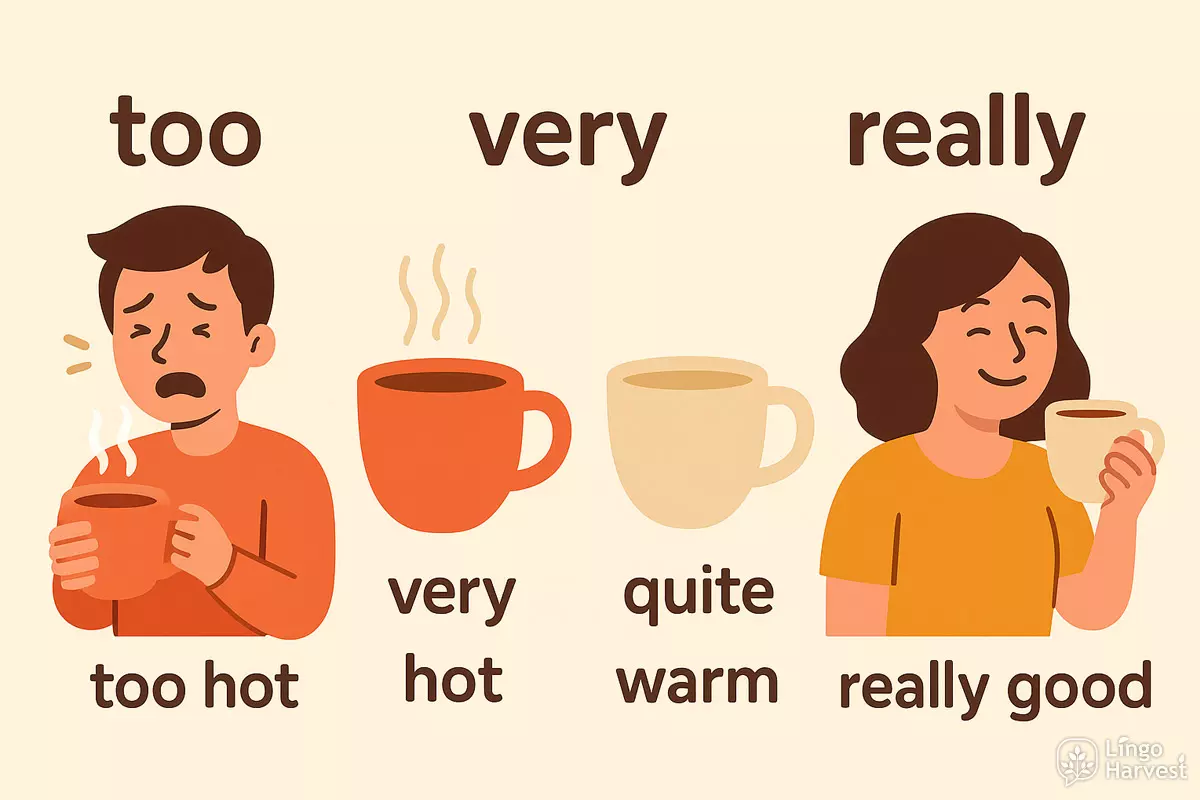 Here we how to use very, really, quite, and too to change the strength and feeling of what you say. It also discusses common mistakes, differences in British and American English, and offers practice to improve your descriptions.
If you want your descriptions to be more engaging, consider using intensifiers such as extremely, absolutely, or incredibly. These words help to emphasize your points and add energy to your writing, making your sentences more vivid and impactful. By carefully choosing and placing intensifiers, you can create a stronger connection with your readers and convey emotions or ideas more effectively. However, remember not to overuse them, as too many intensifiers can make your writing seem exaggerated or less credible.
Strength Scale and Emotional Tone
When we choose words like "too," "very," "quite," or "really," we're not just making statements stronger—we're shaping how they feel to the listener. Each intensifier has its own unique level of force and emotional coloring. Selecting the right one can make your description sound neutral, enthusiastic, doubtful, or even critical.
Degrees of Emphasis
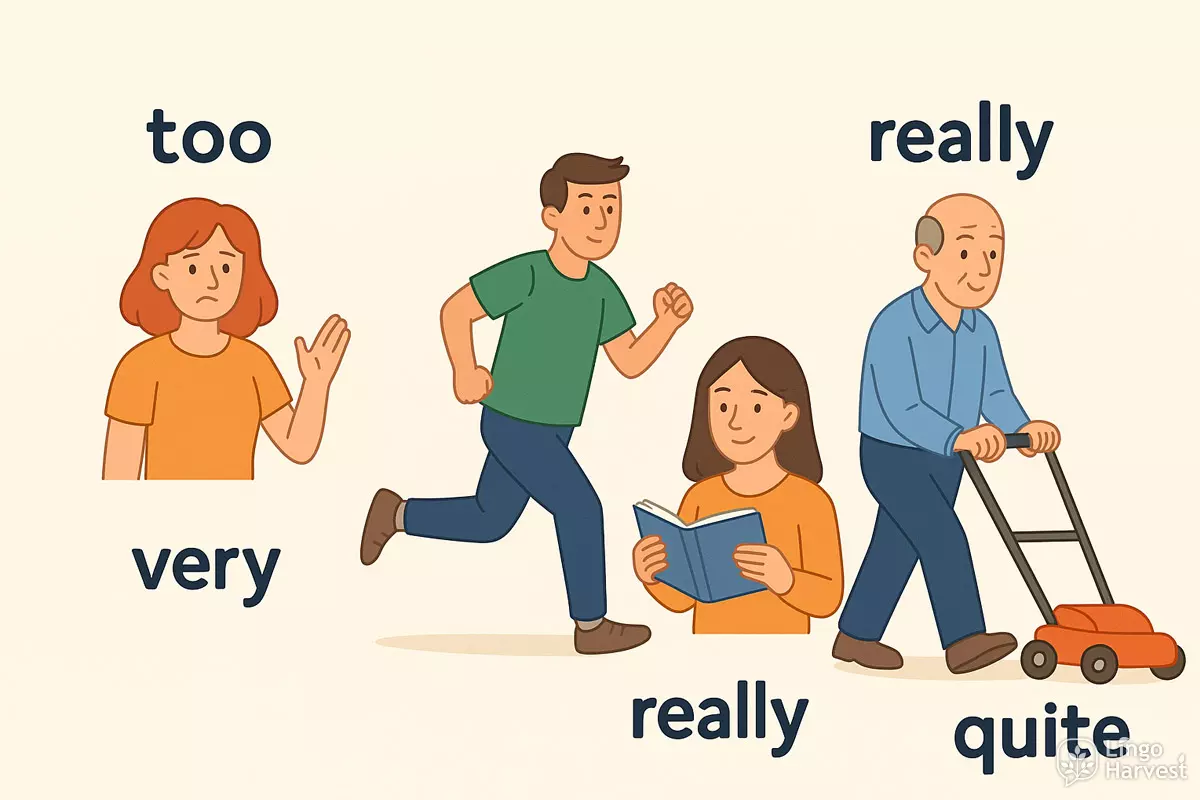
Wording matters for both the strength and the mood of a sentence. For example, "very" and "really" can both add emphasis, but "really" often sounds more conversational or emotionally charged. In contrast, "quite" can soften statements in some contexts, or add subtlety, especially in British English. "Too" often introduces a negative or problematic nuance, suggesting excess.
- too — suggests something is excessive, often negative (e.g., "too loud")
- very — adds straightforward intensity (e.g., "very cold")
- really — emphasizes with added emotion or informality (e.g., "really fun")
- quite — can mean "rather" or "completely," depending on context (e.g., "quite good")
Comparing Emotional Effects
The choice between these words can shift the emotional tone of your statement:
| Intensifier | Typical Effect on Tone |
|---|---|
| too | Negative, critical, or warning (❌ "too expensive" implies a problem) |
| very | Neutral to strong, often objective (✅ "very tall" simply states a high degree) |
| really | Emphatic, personal, sometimes informal (✅ "really helpful" shows strong approval) |
| quite | Subtle, sometimes understated or polite (✅ "quite nice" softens the praise) |
Example Sentences with Shifting Intensity
Using the same adjective with different intensifiers changes both strength and feeling:
- too tired → overexerted, possibly unable to continue
- very tired → strong fatigue, factual tone
- really tired → strong fatigue, personal or emotional
- quite tired → moderate fatigue, understated or polite
Quick Guide: Choosing the Right Intensifier
- Use too when you want to warn or complain
- Pick very for clear, factual emphasis
- Select really for a friendly or passionate touch
- Try quite for subtlety, modesty, or British-style understatement
By being mindful of these nuances, you can tailor your language for the exact impact you want—whether that's dramatic, neutral, or gently expressive.
Very vs Really: Subtle Difference
While both "very" and "really" are used to intensify adjectives and adverbs, they aren't always interchangeable. "Very" typically emphasizes the degree or extremity of a quality in a more formal, precise way. In contrast, "really" often adds a sense of emotion, informality, or personal involvement, making statements sound more conversational or subjective.
When to Use Each Intensifier
- Very is most appropriate with gradable adjectives (those that can be measured in degrees), such as "very tall," "very cold," or "very interesting."
- Really can be used with both gradable and non-gradable adjectives, such as "really amazing," "really impossible," or "really tired."
- "Very" tends to sound slightly more formal and is often found in written English or careful speech.
- "Really" is common in everyday conversation, adding warmth or emphasis beyond what "very" supplies.
Examples in Context
- She is very intelligent. (emphasizes degree, neutral tone)
- She is really intelligent. (emphasizes degree, adds enthusiasm)
- The exam was very difficult. (objective, measured)
- The exam was really difficult. (subjective, possibly surprising)
- I'm very sorry. (formal apology)
- I'm really sorry. (more heartfelt, informal)
- It’s very late.
- It’s really late.
- This is very important.
- This is really important.
- He was very tired after work.
- He was really tired after work.
- The story was very inspiring.
- The story was really inspiring.
- They live very far away.
- They live really far away.
Nuances and Naturalness
Native speakers often favor "really" when they want to sound more genuine or relatable, especially in speech. "Very" sometimes feels stiff or exaggerated if used too much in conversation. However, for strong, factual statements or formal writing, "very" can be more suitable. Overusing either can weaken your message, so variety is key.
Summary Table: Comparing Usage
| Aspect | Very | Really |
|---|---|---|
| Formality | More formal; common in writing | Informal; frequent in speech |
| Adjective Type | Mostly gradable adjectives | Gradable & non-gradable adjectives |
| Tone | Neutral, precise | Personal, emotional |
| Examples | very cold, very tall, very important | really cold, really tall, really amazing |
In summary, choosing between these two intensifiers depends on the desired tone, context, and level of formality. Mixing them thoughtfully will make your English sound more natural and expressive.
Quite: British vs American Meaning
Many English learners are surprised to discover that the word “quite” can mean different things depending on whether you’re speaking British or American English. This small adverb can change the strength of your description, sometimes making it weaker, sometimes stronger—depending on where you are or who you’re talking to.
How “Quite” Is Understood
In the UK, “quite” usually softens an adjective, meaning “fairly” or “somewhat.” In contrast, American speakers often use it to emphasize, giving the sense of “very” or “completely.” This difference can lead to misunderstandings, especially in conversations between people from both sides of the Atlantic.
| British English | American English |
|---|---|
| Means “fairly,” “somewhat,” or “not very” | Means “very,” “totally,” or “completely” |
| “That film was quite good.” → It was OK, not amazing. |
“That film was quite good.” → It was very good. |
| Often downplays excitement or approval | Usually adds emphasis or strong approval |
| “She’s quite nice.” → She’s nice, but not especially so. |
“She’s quite nice.” → She’s really nice. |
Common Examples and Their Interpretations
- “It’s quite cold today.”
UK: A little cold.
US: Very cold. - “He’s quite tired.”
UK: Somewhat tired.
US: Extremely tired. - “The answer is quite clear.”
UK: Reasonably clear.
US: Absolutely clear. - “She’s quite tall.”
UK: Tall, but not the tallest.
US: Very tall. - “That’s quite interesting.”
UK: Slightly interesting.
US: Really interesting. - “It was quite expensive.”
UK: Somewhat expensive.
US: Very expensive. - “He’s quite clever.”
UK: Clever to a degree.
US: Exceptionally clever. - “The food was quite tasty.”
UK: Tasty, but not outstanding.
US: Delicious. - “That’s quite a problem.”
UK: It’s a bit of a problem.
US: It’s a big problem. - “She finished quite quickly.”
UK: Fairly quickly.
US: Very quickly.
Tips for Learners
When speaking or writing, consider your audience. If you’re using English with British speakers, “quite” will usually soften your statement. With Americans, it will likely do the opposite—strengthening your description. When in doubt, choose more direct words like “very,” “really,” or “fairly” to avoid confusion.
Too for Problems or Complaints
When English speakers want to highlight a negative situation or express dissatisfaction, "too" is a common choice. This word suggests an excess—more than is wanted, needed, or acceptable. Unlike "very" or "really," which can strengthen both positive and negative descriptions, "too" almost always signals a problem or complaint. For example, if someone says, "It’s too cold in here," they are not simply describing the temperature—they are implying it’s uncomfortably cold and something should be done. The word "too" sets a limit and tells us that the situation has gone beyond what is reasonable or pleasant.
Common Patterns with "Too"
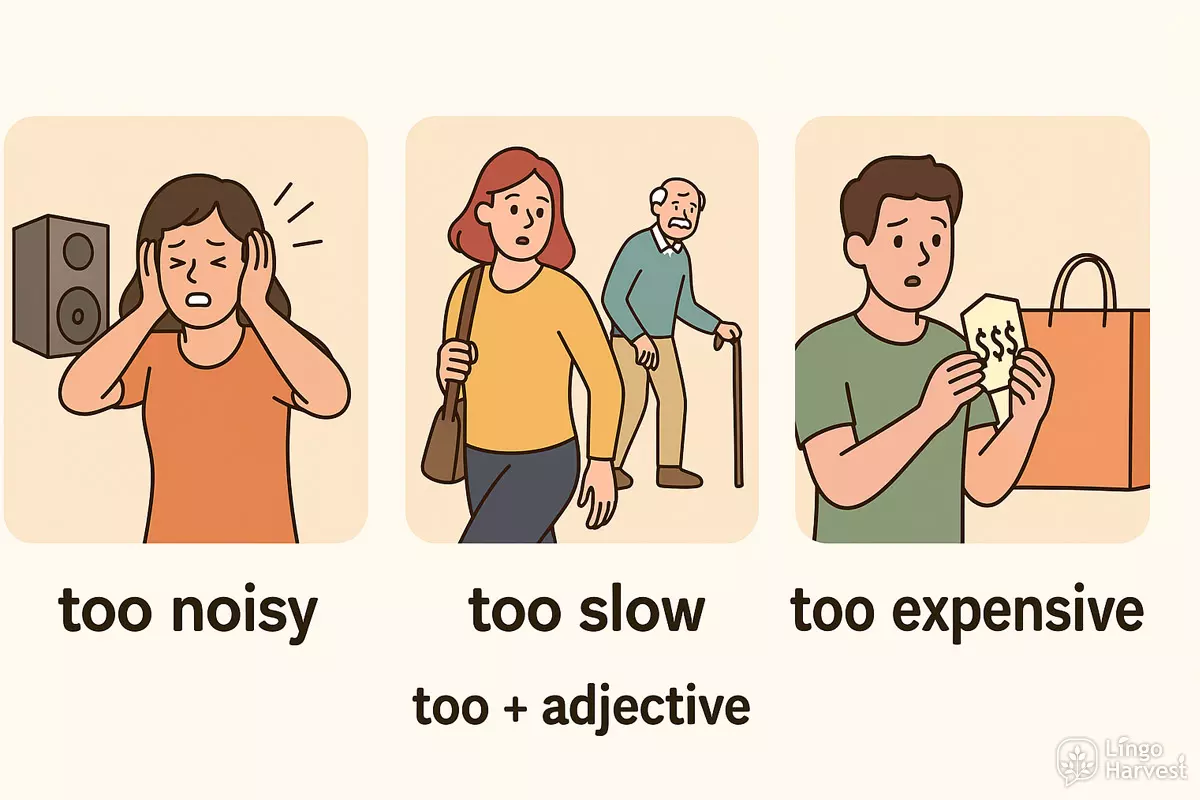
- too + adjective: too noisy, too slow, too expensive
- too + adverb: too quickly, too late, too often
- too much / too many + noun: too much homework, too many people
- too + adjective + (for someone) + to + verb: too heavy for me to lift
Examples of Complaints Using "Too"
- The coffee is too hot to drink. ❌
- This bag is too heavy for me. ❌
- The music is too loud.
- There are too many emails to answer.
- It’s too late to start the project now.
- He speaks too quickly for me to understand.
- That movie was too long.
- The shoes are too small.
- This assignment is too difficult.
- It’s too far to walk.
- They arrived too early.
- The instructions are too complicated.
- The weather is too cold for a picnic.
- She’s too tired to continue.
- The test was too easy (sometimes a complaint if it was not challenging).
- There’s too much noise outside.
- The rent is too high for me to afford.
- He’s too busy to help right now.
How "Too" Changes the Meaning
Adding "too" often shifts a neutral or positive statement into a negative one. Compare:
- Positive/Neutral: The soup is hot.
- Complaint: The soup is too hot.
In the second sentence, "too" suggests a problem: the soup cannot be eaten comfortably.
Summary Table: "Too" vs. Other Intensifiers
| Expression | Implication |
|---|---|
| This chair is very hard. | Strong description, but not necessarily a problem. |
| This chair is too hard. | Negative: it’s uncomfortable, a complaint is implied. |
| She works really fast. | Emphasizes speed, could be positive or neutral. |
| She works too fast. | Negative: speed is a problem (maybe mistakes happen). |
Key Takeaways
- Use "too" to express that something is excessive and causes inconvenience or dissatisfaction.
- It often introduces or emphasizes a problem.
- Remember: "too" usually points to something unwanted, while "very," "quite," and "really" can be neutral or positive.
Softening and Strengthening Speech
Language offers a variety of ways to adjust the intensity of our descriptions, allowing us to express opinions and observations with more precision. Words like "too," "very," "quite," and "really" help us make our statements stronger or milder, depending on what we want to convey. By carefully choosing these modifiers, we can sound more polite, more emphatic, or simply more accurate.
Making Statements Stronger
When we want to emphasize a quality or make an opinion sound more forceful, intensifiers are useful. These words amplify the adjective or adverb that follows them, highlighting the degree of the quality:
- Very: "The movie was very exciting."
- Really: "She is really talented."
- Too: "It's too loud in here."
- Extremely: "The weather is extremely hot."
- Absolutely: "That is absolutely amazing."
- So: "He’s so funny."
- Incredibly: "The cake was incredibly delicious."
- Totally: "She is totally fearless."
- Completely: "I am completely exhausted."
- Utterly: "The plan was utterly unsuccessful."
Softening Descriptions
There are also ways to make our language less direct or forceful, which can be helpful in polite conversation or when we want to avoid sounding too harsh. Softeners help us sound more considerate and less absolute:
- Quite: "The soup is quite good." (less strong than "very good")
- Rather: "It's rather cold today."
- A bit: "I’m a bit tired."
- Somewhat: "The answer is somewhat complicated."
- A little: "She’s a little upset."
- Fairly: "The test was fairly easy."
- Pretty: "He’s pretty smart."
- Not very: "The book was not very interesting."
- Kind of: "I’m kind of hungry."
- Sort of: "It’s sort of urgent."
Comparing Intensifiers and Softeners
The table below highlights typical examples, showing how the meaning shifts depending on the word used:
| Modifier | Example Sentence | Strength |
|---|---|---|
| Too | This coffee is too hot to drink. | ✅ Strong |
| Very | The room is very bright. | ✅ Strong |
| Quite | The task is quite easy. | Medium |
| A bit | I'm a bit tired. | ❌ Mild |
| Really | She is really good at chess. | ✅ Strong |
| Rather | It's rather noisy here. | Medium |
| Somewhat | The rules are somewhat confusing. | ❌ Mild |
| Absolutely | This is absolutely beautiful. | ✅ Strong |
| Not very | The results were not very surprising. | ❌ Mild |
| Fairly | The movie was fairly entertaining. | Medium |
Choosing between these modifiers depends on the effect you want to achieve. Using stronger words can make descriptions more vivid or urgent, while softer words are useful for diplomacy and understatement. Both approaches are valuable tools for anyone aiming to communicate clearly and effectively.
Common Mistakes in Daily Talk
When strengthening descriptions with words like "too," "very," "quite," and "really," it’s easy to slip into patterns that sound awkward or even change the intended meaning. Using these intensifiers incorrectly can make speech either confusing or less natural. Awareness of frequent pitfalls helps make your spoken English clearer and more effective.
Mixing Up Intensifiers
People often swap these words without realizing they don’t always mean the same thing. For example, "too" usually signals excess or a negative idea, while "very" simply emphasizes. Saying "too good" instead of "very good" can unintentionally suggest a problem.
- "too loud" (means excessively loud, likely a bad thing)
- "very loud" (simply means it’s really loud, no judgment implied)
- "quite cold" (in British English, often means fairly cold; in American English, it can mean really cold)
- "really tired" (strong emphasis, but not negative)
Overusing Intensifiers
Relying too much on these words can make descriptions sound exaggerated or unnatural. For instance, saying "very, very happy" instead of finding a more precise adjective like "ecstatic" often weakens communication.
Incorrect Combinations
Some adjectives don’t combine well with certain intensifiers. For example, "too delicious" is rarely used because it’s difficult to have food that’s excessively delicious. Here are some mismatched pairs to watch out for:
- "too perfect" ❌
- "very unique" ❌ ("unique" is already an absolute)
- "quite impossible" ❌
- "really dead" ❌
Comparing Common Usage
| Expression | Typical Meaning & Usage |
|---|---|
| Too hot | Hotter than wanted; negative feeling |
| Very hot | Strongly hot; neutral, just emphasis |
| Quite hot | Moderately hot (UK: fairly; US: very) |
| Really hot | Very hot; strong but informal |
| Too easy | Easier than necessary; may imply boredom |
| Very easy | Simple to do; just emphasizes ease |
| Quite easy | Moderately or very easy, depending on accent |
| Really easy | Very easy; informal, emphatic |
Misunderstanding Cultural Differences
The meaning of "quite" varies between British and American English. In the UK, "quite good" can mean only moderately good, whereas in the US, it often means very good. This can lead to confusion in cross-cultural conversations.
Summary List: Frequent Issues with Intensifiers
- Using "too" when you only want to emphasize, not imply a problem
- Doubling up on intensifiers ("really very tired")
- Choosing the wrong intensifier for absolute adjectives ("very dead")
- Repeating intensifiers in the same sentence ("very, very, very...")
- Misjudging how strong "quite" sounds in different English dialects
- Forgetting that some adjectives don’t need extra emphasis ("unique," "perfect")
- Mixing formal and informal intensifiers in the same context
- Not adjusting for the listener’s cultural background
Being mindful of these typical missteps helps you sound more natural and ensures your descriptions have the intended impact in everyday conversations.
Practice: Improve Description Sentences
Strengthening descriptive sentences often means choosing the right intensifier—such as "too," "very," "quite," or "really"—for the context. This section provides exercises to help you use these words more effectively and naturally in your writing.
Rewrite Weak Sentences
Below are sentences with bland or vague descriptions. Rewrite each sentence, replacing the underlined word with a stronger, more precise modifier using "too," "very," "quite," or "really."
- The soup is hot.
- It was a cold morning.
- Her answer was clear.
- The mountain is tall.
- This math problem is difficult.
- The movie was interesting.
- My backpack is heavy.
- The flowers are beautiful.
- The test was easy.
- He is tired.
Show answers
- The soup is too hot.
- It was a very cold morning.
- Her answer was quite clear.
- The mountain is really tall.
- This math problem is very difficult.
- The movie was quite interesting.
- My backpack is really heavy.
- The flowers are very beautiful.
- The test was quite easy.
- He is too tired.
Choose the Right Intensifier
Match each sentence with the most natural intensifier. Think about how "too," "very," "quite," and "really" change the meaning:
- I'm ______ hungry to wait for dinner. (A) too (B) very (C) quite (D) really
- She's ______ good at chess. (A) too (B) very (C) quite (D) really
- This street is ______ busy during rush hour. (A) too (B) very (C) quite (D) really
- It's ______ far to walk from here. (A) too (B) very (C) quite (D) really
- The answer was ______ simple. (A) too (B) very (C) quite (D) really
Show answers
- I'm too hungry to wait for dinner.
- She's really good at chess.
- This street is very busy during rush hour.
- It's too far to walk from here.
- The answer was quite simple.
Common Patterns with Intensifiers
Study these patterns showing how intensifiers interact with adjectives and adverbs. Notice the subtle shifts in meaning:
- too + adjective: suggests excess (negative or problematic) — "too spicy," "too loud"
- very + adjective: strong emphasis — "very fast," "very old"
- quite + adjective: moderate emphasis, sometimes positive — "quite nice," "quite big"
- really + adjective/adverb: strong but often more conversational — "really tired," "really well"
Transform the Sentences
Change the following sentences to make the descriptions more vivid by choosing an appropriate intensifier.
- The room is small.
- She is smart.
- The cake is sweet.
- His handwriting is messy.
- This book is boring.
Show answers
- The room is very small / quite small.
- She is really smart / very smart.
- The cake is too sweet.
- His handwriting is really messy.
- This book is quite boring / really boring.
Quick Reference: Intensifier Effects
| Intensifier | Common Use | Typical Meaning/Effect |
|---|---|---|
| too | too noisy, too late, too expensive | More than desirable/possible; negative |
| very | very happy, very old, very strong | Intensifies; strong positive or negative |
| quite | quite nice, quite difficult, quite early | Moderate emphasis; often positive or neutral |
| really | really good, really fast, really tired | Strong, conversational emphasis |
Practicing with these structures will help you choose the best intensifier for your message, making your writing more nuanced and precise.