Too Much vs Too Many vs Too: Expressing Excess in English

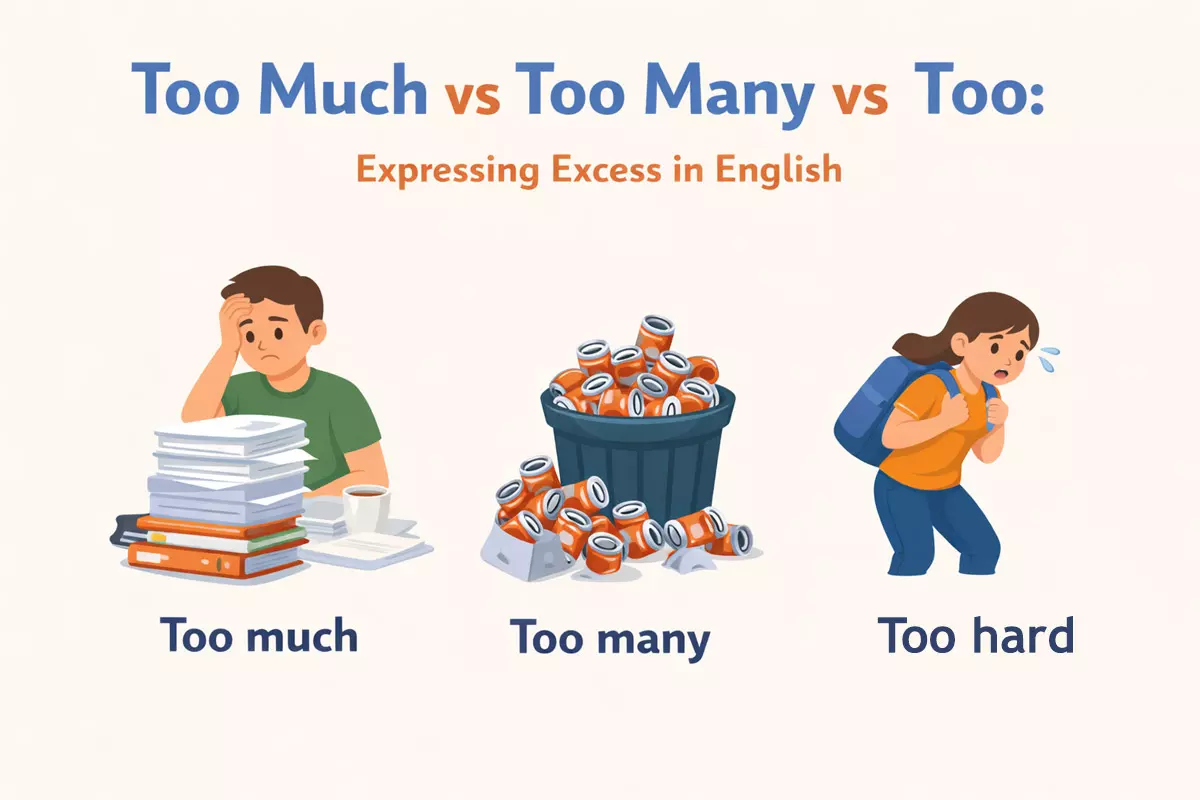 Here we the core meaning of excess in English, explains how to use too, too much, and too many with countable and uncountable nouns, highlights common mistakes, discusses word order, and gives practical examples and exercises.
- Core meaning of excess in English
- Difference between countable and uncountable nouns
- Using too with adjectives and adverbs
- Sentence position and word order patterns
- Common learner mistakes with excess expressions
- Meaning changes caused by incorrect form
- Examples from everyday situations
- Practice: choosing the correct excess form
Have you ever noticed that we say "too much noise," "too many people," or just "too late"? These expressions illustrate how English uses different words to talk about excess, depending on whether you’re describing something countable, like people, or uncountable, like noise or time. Mastering these subtle differences can be challenging, but doing so will make your speech sound more natural and accurate. Paying attention to such details helps you communicate more clearly and confidently in everyday situations.
Core meaning of excess in English
When talking about having more than what is needed or wanted, English speakers use specific words and patterns to express this idea. The language offers several ways to show that something is in surplus, whether it's a quantity, an amount, or an intensity. Understanding these expressions helps you communicate more precisely about situations where there is an overload or something goes beyond acceptable limits.
How English expresses “too much” or “too many”
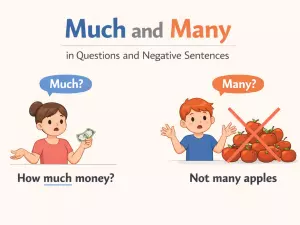
English distinguishes between countable and uncountable nouns when describing excess. For countable items like “apples” or “mistakes,” the phrase “too many” is used. For uncountable substances or concepts, such as “sugar” or “work,” “too much” is appropriate. Both forms highlight that the amount is higher than what is desirable, expected, or manageable.
- “There are too many emails in my inbox.” (countable)
- “You put too much salt in the soup.” (uncountable)
- “She spends too much time online.”
- “He has too many ideas to choose from.”
- “We drank too much coffee last night.”
- “Too many cars are causing traffic jams.”
- “There’s too much noise to concentrate.”
- “The teacher gave us too many assignments.”
- “You took on too much responsibility.”
- “He ate too many slices of cake.”
Using “too” for intensity or degree

Beyond quantity, “too” is also used to indicate that something has reached an excessive degree or level, often with adjectives or adverbs. In these cases, “too” by itself means “more than is good, necessary, or wanted.”
- “It’s too hot outside.”
- “She’s driving too fast.”
- “This bag is too heavy.”
- “He arrived too early.”
- “The movie was too long.”
- “That question is too difficult.”
- “My coffee is too sweet.”
- “You are too late.”
- “The music is too loud.”
- “This shirt is too small.”
Comparing excess expressions
Each structure has its own usage rules and applies to different types of words. Here’s a comparison to clarify when to use which form:
| Expression | Used With | Example |
|---|---|---|
| too much | Uncountable nouns | “There’s too much rain today.” |
| too many | Countable nouns | “Too many people showed up.” |
| too + adjective/adverb | Adjectives or adverbs | “The water is too cold.” |
Key points to remember
- “Too much” and “too many” focus on quantity—whether it’s countable or not.
- “Too” with adjectives or adverbs signals an excessive degree or intensity.
- All these forms indicate something is more than what is comfortable, acceptable, or needed.
Mastering these patterns helps you sound natural and precise when discussing situations where there’s simply more than enough.
Difference between countable and uncountable nouns
Understanding the distinction between countable and uncountable nouns is crucial when using expressions like "too much" and "too many." In English, whether a noun is countable or uncountable determines which of these phrases you should use to talk about excess.
What are countable nouns?
Countable nouns are items you can count as individual units. They have both singular and plural forms, and you can use numbers directly with them. For example, you can say "one apple," "three cars," or "ten chairs." These nouns work with words like "many," "few," and "several."
What are uncountable nouns?
Uncountable nouns refer to substances, concepts, or groups of things that cannot be separated into individual elements. These nouns do not have a plural form and cannot be counted with numbers directly. Typical examples include "water," "information," "rice," and "advice." With uncountable nouns, you use words like "much," "little," and "a bit of."
Key differences at a glance
| Countable Nouns | Uncountable Nouns |
|---|---|
| Can be counted: one, two, three, etc. | Cannot be counted directly |
| Have singular and plural forms (dog/dogs) | Generally only singular (milk, not milks) |
| Use "many," "a few," "several" | Use "much," "a little," "a bit of" |
| Example: books, chairs, coins | Example: sugar, knowledge, furniture |
Common examples
- Countable: apples, pens, children, bottles, ideas, cars, dogs, tickets, sandwiches, plants
- Uncountable: bread, money, music, air, equipment, homework, traffic, luggage, happiness, meat
When expressing excess, use "too many" with countable nouns (e.g., "too many cars") and "too much" with uncountable nouns (e.g., "too much information"). The word "too" alone can be used with adjectives or adverbs (e.g., "too noisy," "too quickly") and does not depend on whether a noun is countable or not.
Getting comfortable with these categories helps you communicate clearly about quantity and avoid common mistakes in English.
Using too with adjectives and adverbs
The word too is commonly paired with adjectives and adverbs to express the idea of excess or an undesirable degree. When you say something is "too hot" or "too quickly," you're indicating that the quality or action goes beyond what is acceptable, comfortable, or intended. This construction is direct and helps clarify when something is more than enough or even problematic.
How the pattern works
The typical structure involves placing too directly before the adjective or adverb. This signals that the characteristic or manner is excessive:
- too loud (excessive volume) → The music is too loud.
- too slow (not fast enough) → This computer is too slow.
- too expensive (costs more than desired) → This jacket is too expensive.
- too late (after the acceptable time) → I’m too late for the bus.
- too soon (before the right moment) → It’s too soon to go home.
- too cold (colder than comfortable) → The room is too cold.
- too difficult (more challenging than manageable) → This homework is too difficult.
- too quickly (at a speed that’s hard to handle) → You’re speaking too quickly.
- too bright (uncomfortably much light) → The screen is too bright.
- too often (more frequently than is good) → He checks his phone too often.
- too far (distance is greater than preferred) → The station is too far.
- too busy (more obligations than manageable) → I’m too busy this week.
- too small (not big enough) → This box is too small.
- too hard (more effort required than is reasonable) → This pillow is too hard.
- too noisy (unpleasantly loud) → This café is too noisy.
- too sharp (edge is more dangerous than necessary) → This knife is too sharp.
- too soft (not firm enough) → The mattress is too soft.
- too short (length is insufficient) → The rope is too short.
- too heavy (more weight than can be handled) → This bag is too heavy.
- too soon (earlier than ideal) → We arrived too soon.
Expressing consequences and results
Often, too is used to explain why something cannot happen or is problematic. This is frequently followed by an infinitive phrase (to + verb) to show the consequence:
- It’s too late to call now.
- He’s too tired to work tonight.
- The box is too heavy to lift alone.
- This soup is too hot to eat right away.
Quick comparison: too vs. very/so
| Expression | Meaning/Use |
|---|---|
| too cold | Colder than is acceptable or comfortable (negative) |
| very cold | Extremely cold, but not necessarily excessive or negative |
| so cold | Emphasizes the degree of coldness; can be neutral or negative depending on context |
| too quickly | Faster than is good or safe (negative consequence) |
| very quickly | At a great speed, but not necessarily problematic |
Common mistakes to avoid
- Don’t use “too” when you simply mean “very” or “so.” “Too” always suggests excess or a problem.
- Remember, “too” is not used for countable nouns on its own—use it with adjectives and adverbs, not with nouns like “apples” or “cars.”
- Be careful with tone: “too” often implies complaint or criticism, so it can sound negative.
In summary, too before adjectives and adverbs highlights that something is more than desirable, often leading to an unwanted effect. This structure is a clear way to communicate excess and its consequences in everyday English.
Sentence position and word order patterns
Understanding where to place "too much," "too many," and "too" in a sentence is essential for sounding natural in English. These expressions each follow their own typical patterns, depending on whether they describe countable or uncountable nouns, adjectives, or verbs. Let’s explore how these forms fit into everyday sentence structures.
Common placement patterns
- Too much usually comes before uncountable nouns (e.g., "too much information") or after verbs (e.g., "She talks too much").
- Too many is used before countable plural nouns (e.g., "too many books").
- Too by itself often modifies adjectives or adverbs (e.g., "too expensive," "too quickly").
Examples in context
- There is too much noise in the city.
- He has too many shoes.
- This bag is too heavy to carry.
- You’re driving too fast.
- They ate too much cake at the party.
- We received too many emails yesterday.
- She’s too tired to go out tonight.
- There are too many people in the room.
- It’s too cold to swim.
- He works too much on weekends.
Comparing usage: summary table
| Expression | Typical Word Order | Example |
|---|---|---|
| Too much | Too much + uncountable noun Verb + too much |
There’s too much traffic. He worries too much. |
| Too many | Too many + plural countable noun | Too many people arrived. |
| Too | Too + adjective/adverb | This coffee is too hot. She runs too slowly. |
Notable word order rules
- Never use "too many" with uncountable nouns (❌ "too many information" → ✅ "too much information").
- Place "too" directly before the adjective or adverb it modifies.
- When using "too much" or "too many" after a verb, they often function as direct objects (e.g., "He eats too much," "She buys too many").
Choosing the right form and position helps clearly express excess, whether you’re talking about quantities, qualities, or actions. This flexibility allows speakers to communicate both subtle and strong degrees of “too muchness” in English.
Common learner mistakes with excess expressions
English learners often mix up terms for expressing excess, especially when deciding between "too much," "too many," and "too." These errors can make sentences sound odd or even change the intended meaning. Knowing the right structure and which nouns or adjectives to pair with each phrase helps avoid confusion and makes communication clearer.
Mixing up "too much" and "too many"
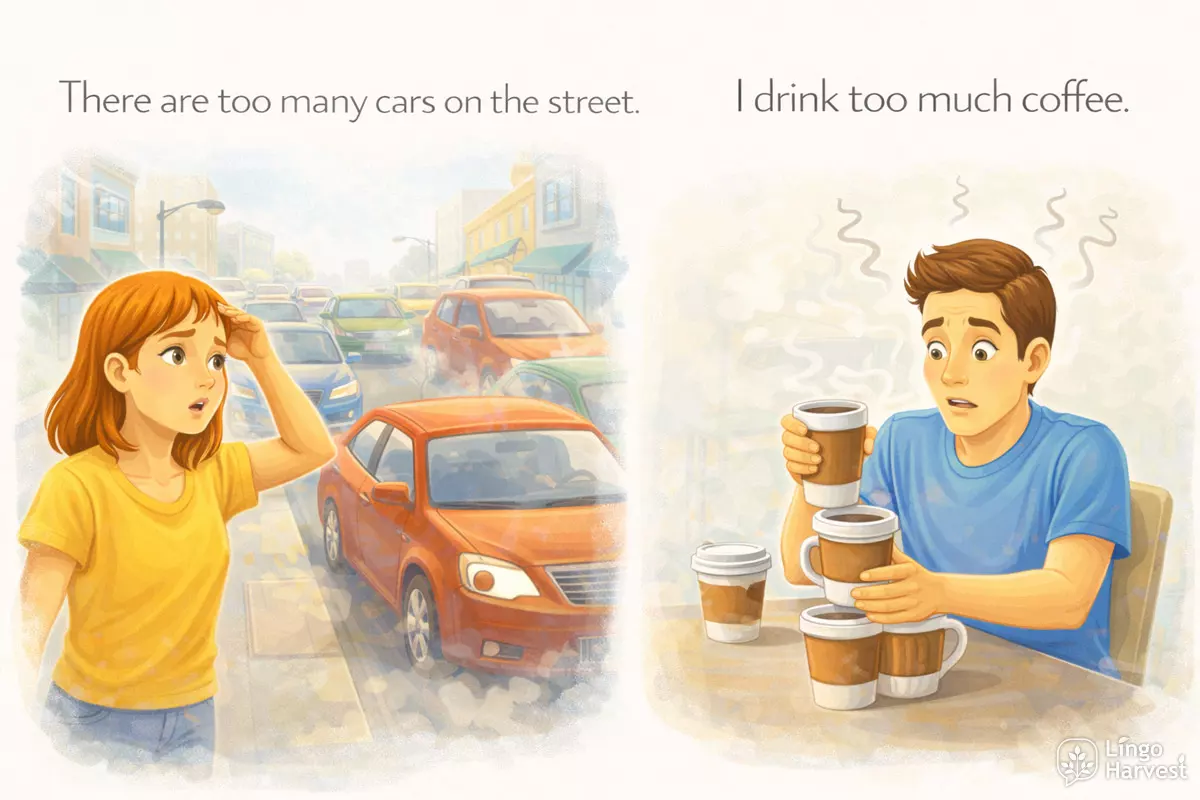
The most frequent slip is using "too much" with countable nouns or "too many" with uncountable ones. Remember, "too much" is for things you can’t count individually (like water or information), while "too many" is for things you can count (like books or apples).
| Incorrect Usage | Correct Usage |
|---|---|
| There are too much cars on the street. ❌ | There are too many cars on the street. ✅ |
| I drink too many coffee. ❌ | I drink too much coffee. ✅ |
| She has too many money. ❌ | She has too much money. ✅ |
| He ate too much cookies. ❌ | He ate too many cookies. ✅ |
Confusing "too" with "too much" or "too many"
Another pitfall is using "too" by itself before nouns, which is not correct in standard English. "Too" alone is used before adjectives and adverbs, not nouns. For nouns, you need to add "much" or "many" depending on countability.
- That bag is too heavy. (adjective)
- He runs too quickly. (adverb)
- We have too much homework. (uncountable noun)
- There are too many students. (countable noun)
Omitting "too" or using "much/many" alone
Learners sometimes drop "too," saying "much water" or "many people" to mean excess, but this just means "a lot of"—not "more than is good." Without "too," the sense of excess is lost.
Incorrect placement in sentences
Position is important. "Too much" and "too many" generally come before the noun, while "too" before adjectives/adverbs.
- Wrong: I have homework too much. ❌
- Right: I have too much homework. ✅
- Wrong: She eats fast too. ❌ (if you mean "too fast")
- Right: She eats too fast. ✅
Summary of typical errors
- Using "too much" with countable nouns: too much apples ❌
- Using "too many" with uncountable nouns: too many rice ❌
- Placing "too" before nouns: too money ❌
- Leaving out "too": much noise when meaning excessive noise
- Misplacing "too" in a sentence: work too much late instead of work late too much or work too much late at night
- Stacking: too much many (never correct)
- Confusing with "a lot of": He has a lot of money (not necessarily excessive), vs He has too much money (more than is good)
- Using "too" for positive meaning: This is too good! (often means "so good" in informal speech, but strictly implies excess)
- Using "too" with negative adjectives: This is too bad (correct, but always means "more bad than acceptable")
- Combining "too" with comparatives: too more or too better (not correct)
Careful attention to countability, position, and structure helps avoid these common slips and ensures more natural, precise English when talking about excess.
Meaning changes caused by incorrect form
Choosing the wrong word between too much, too many, and too can lead to confusion or unintended meanings. These expressions aren’t interchangeable, and using them incorrectly can change the sentence’s sense, sometimes making it ungrammatical or even the opposite of what you intended.
Common mix-ups and their impact
- Too much is only for uncountable nouns (e.g., water, information).
- Too many is for countable nouns (e.g., apples, cars).
- Too alone is used before adjectives and adverbs (e.g., too cold, too quickly).
Mixing these up can cause sentences to sound unnatural or make the meaning unclear. For instance, saying "too much apples" is incorrect—apples are countable, so it should be "too many apples."
Examples of Incorrect Forms and Their Effects
- Too much chairs ❌ (incorrect) → Too many chairs ✅ (correct)
- Too many information ❌ (incorrect) → Too much information ✅ (correct)
- Too hot tea (ambiguous/awkward) → Tea that is too hot (clear)
- Too many fast ❌ (nonsense) → Too fast ✅
- Too much quickly ❌ (incorrect) → Too quickly ✅
- Too many money ❌ (incorrect) → Too much money ✅
- Too much people ❌ (incorrect) → Too many people ✅
- Too many sugar ❌ (incorrect) → Too much sugar ✅
- Too late homework (ambiguous/awkward) → Homework that is too late (clear)
- Too many loud ❌ (incorrect) → Too loud ✅
Quick Comparison Table
| Incorrect Usage | Intended/Correct Form |
|---|---|
| too much chairs | too many chairs |
| too many advice | too much advice |
| too quickly sugar | too much sugar / too quickly (separate ideas) |
| too many loud | too loud |
Unintended Shifts in Meaning
Sometimes, using the wrong form doesn’t just sound odd—it can actually change what you’re trying to say. For example, “too much” before an adjective (too much happy) is not just incorrect, it can make the sentence confusing or meaningless. Similarly, “too” before a noun (too apple) does not work in English grammar at all.
To sum up, making sure you choose the right form preserves both the clarity and the intended meaning of your sentence. A small mistake with these words can be the difference between natural communication and misunderstanding.
Examples from everyday situations
Understanding when to use too much, too many, and too alone can be tricky, but looking at real-life contexts helps clarify the differences. Each expression is used in specific scenarios, often depending on whether the noun is countable or uncountable, or if an adjective is being modified.
Common scenarios using “too much,” “too many,” and “too”
Here are practical examples that show how these phrases appear in daily conversations:
- There is too much noise in the city at night. (Uncountable noun: noise)
- She ate too many cookies during the party. (Countable noun: cookies)
- He drives too fast on the highway. (Adjective: fast)
- You put too much sugar in my tea. (Uncountable noun: sugar)
- We have too many meetings this week. (Countable noun: meetings)
- The bag is too heavy to carry. (Adjective: heavy)
- There’s too much information to remember. (Uncountable noun: information)
- He owns too many shoes. (Countable noun: shoes)
- The soup is too hot to eat. (Adjective: hot)
- I spent too much money on dinner. (Uncountable noun: money)
- They invited too many people to the event. (Countable noun: people)
- This exam is too difficult for most students. (Adjective: difficult)
Quick reference: Choosing the right phrase
To help distinguish when to use each phrase, see the comparison below:
| Phrase | When to Use | Example |
|---|---|---|
| too much | With uncountable nouns | There’s too much rain today. |
| too many | With countable nouns | We have too many emails. |
| too + adjective/adverb | Before adjectives or adverbs | This coffee is too hot. |
Why these choices matter
Choosing the correct form is important for clarity. If you say “too many water,” it sounds unnatural because “water” is uncountable—so “too much water” is correct. With countable nouns like “books,” you need “too many books.” When describing qualities, just “too” plus the adjective or adverb fits best, as in “too late” or “too quickly.”
Practice: choosing the correct excess form
Getting comfortable with “too much,” “too many,” and “too” takes focused practice. Below, you’ll find a set of exercises to help you decide which form best fits different contexts. Pay attention to whether the noun is countable or uncountable, or if you’re modifying an adjective or adverb. This is the key to choosing the right word for expressing excess in English.
Quick Reference: When to Use Each Form
| Form | Usage | Example |
|---|---|---|
| too much | Before uncountable nouns | too much water |
| too many | Before countable plural nouns | too many books |
| too | Before adjectives/adverbs | too late too quickly |
Fill in the Blank
Complete each sentence with “too much,” “too many,” or “too.”
- There were __________ people at the concert, so we couldn’t see the stage.
- I ate __________ chocolate and now I feel sick.
- This bag is __________ heavy for me to carry.
- She talks __________ during meetings.
- We have __________ homework tonight.
- He spent __________ money on that car.
- It’s __________ cold to go swimming today.
- Don’t add __________ salt to the soup.
- There are __________ cars on this street.
- You’re driving __________ fast!
Show answers
- too many
- too much
- too
- too much
- too much
- too much
- too
- too much
- too many
- too
Identify the Error
Decide if the sentence uses the correct form. If not, rewrite it with the right word:
- There is too many noise in the room.
- This answer is too much complicated.
- He put too much sugar in his coffee.
- She has too many friends to count.
- There are too much cars on the road.
- I have too many homework today.
- This bag is too heavy to carry.
- It is too many people in the store.
- He talks too quickly for me.
- There is too many information on this page.
Show answers
- There is too much noise in the room.
- This answer is too complicated.
- ✅ (Correct as written)
- ✅ (Correct as written)
- There are too many cars on the road.
- I have too much homework today.
- ✅ (Correct as written)
- There are too many people in the store.
- ✅ (Correct as written)
- There is too much information on this page.
Tips for Mastery
- Use too much with things you cannot count individually (advice, traffic, time).
- Use too many with things you can count (chairs, emails, apples).
- Use too before adjectives and adverbs (expensive, late, loudly).
Practice by creating your own examples, and check if you can swap the noun for another countable or uncountable word to test your understanding.