Common Adverb Mistakes at A1-A2 Level

 Here we common A1-A2 English mistakes such as adjective vs adverb confusion, incorrect word order with be, frequency adverb misplacement, too vs very errors, redundancy, and provides clear repair strategies and practice.
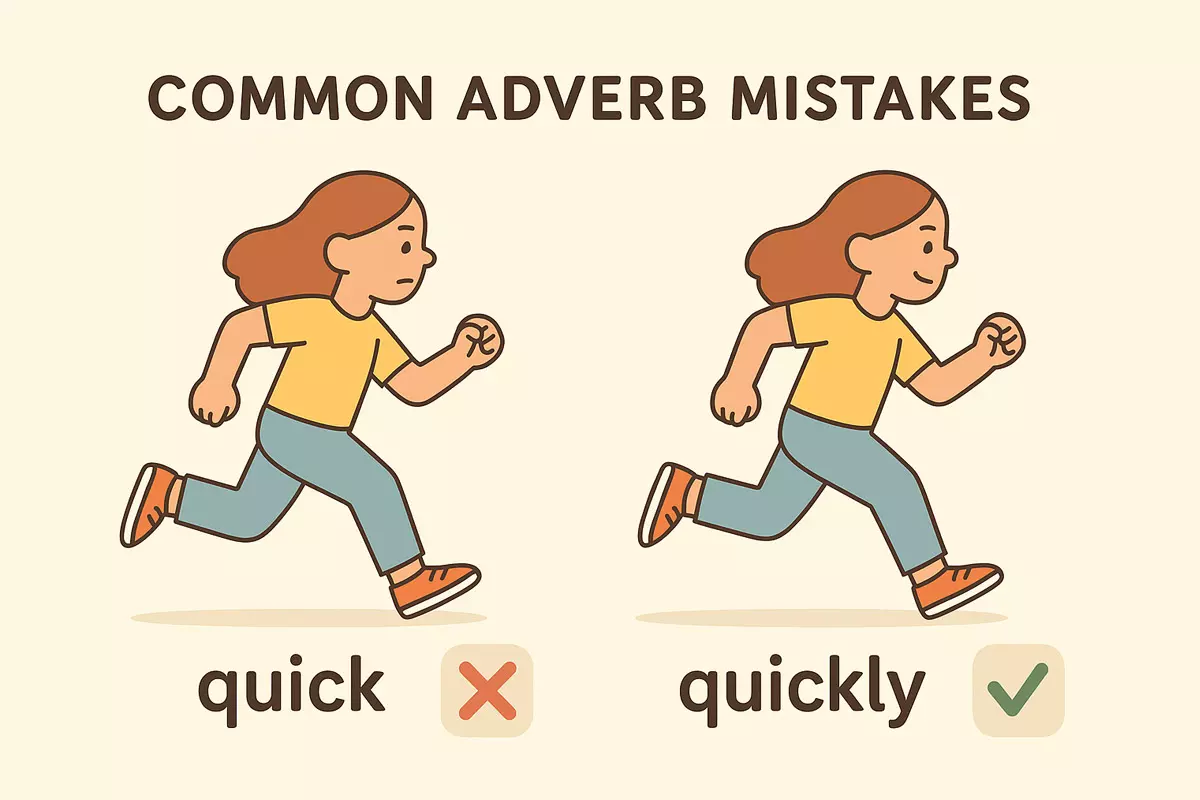
Learning to use adverbs can be tricky for beginners, as it is common to make small mistakes when first starting out with English. Many early learners struggle to figure out where adverbs should go in a sentence or which form to use, such as choosing between "quick" and "quickly." These errors can sometimes make sentences sound awkward or unclear, but with practice and exposure to correct examples, learners gradually improve their understanding and become more confident in using adverbs accurately.
Adjective vs Adverb Confusion
Many learners at the A1-A2 level mix up adjectives and adverbs, which can make sentences unclear or incorrect. This confusion often happens because both types of words can look similar, but they have different jobs in a sentence. Adjectives describe nouns, while adverbs describe verbs, adjectives, or other adverbs. Understanding when to use each is essential for clearer communication.
How to Tell the Difference
Adjectives usually answer questions like "What kind?", "Which one?", or "How many?" about a noun. Adverbs, on the other hand, often answer "How?", "When?", "Where?", or "To what degree?" about a verb or an adjective. For example, in "She is a quick runner," "quick" describes the noun "runner." In "She runs quickly," "quickly" describes the verb "runs."
Common Mistakes and Corrections
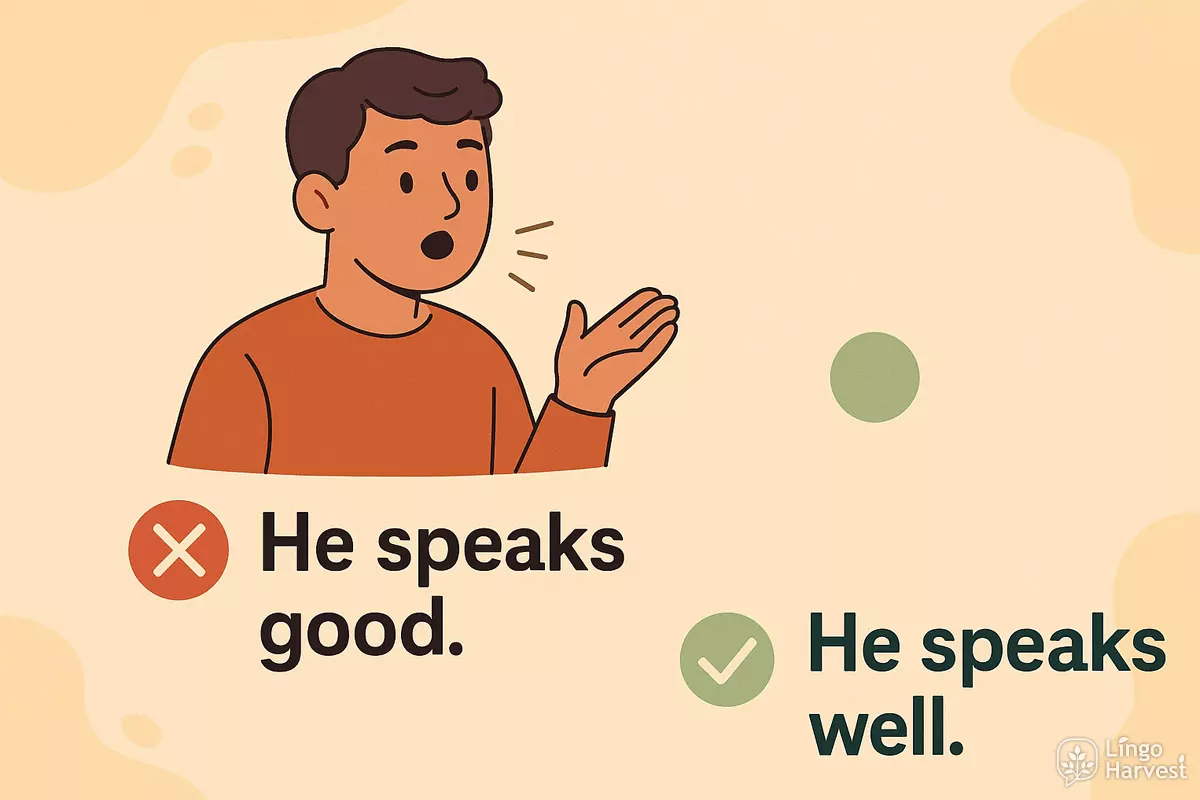
A frequent error is using an adjective instead of an adverb with verbs, or vice versa. Here are some examples to help clarify:
- ❌ He speaks good. → ✅ He speaks well.
- ❌ She sings beautiful. → ✅ She sings beautifully.
- ❌ I am happily today. → ✅ I am happy today.
- ❌ The soup tastes well. → ✅ The soup tastes good.
- ❌ He runs slow. → ✅ He runs slowly.
- ❌ She is a quickly learner. → ✅ She is a quick learner.
- ❌ They answered polite. → ✅ They answered politely.
- ❌ He feels badly. → ✅ He feels bad.
- ❌ The cat is quietly. → ✅ The cat is quiet.
- ❌ She dances graceful. → ✅ She dances gracefully.
Comparison Table: Adjective and Adverb Forms
| Adjective (Describes a noun) | Adverb (Describes a verb) |
|---|---|
| slow (He is a slow driver.) |
slowly (He drives slowly.) |
| careful (She is a careful student.) |
carefully (She writes carefully.) |
| happy (They are happy children.) |
happily (They play happily.) |
| loud (It was a loud noise.) |
loudly (The dog barked loudly.) |
| easy (This is an easy question.) |
easily (She answered easily.) |
| polite (He is a polite boy.) |
politely (He speaks politely.) |
| quiet (It is a quiet place.) |
quietly (She entered quietly.) |
| graceful (She is a graceful dancer.) |
gracefully (She dances gracefully.) |
| bad (It was a bad day.) |
badly (He behaved badly.) |
| beautiful (She has a beautiful voice.) |
beautifully (She sings beautifully.) |
Tips to Remember
Look for "-ly" endings, which are common in adverbs, but remember some irregular forms like "good" (adjective) and "well" (adverb). Always check what you are describing: a noun or a verb? Practice with different examples to build confidence and accuracy.
Wrong Word Order with Be
Many learners at A1 and A2 levels struggle with adverbs in sentences that use the verb “be.” A common error is placing adverbs in the wrong position, especially with “am,” “is,” and “are.” This can make sentences sound unnatural or confusing.
In English, adverbs of frequency (like always, often, never, sometimes) usually go after the verb “be.” However, speakers often put these adverbs before the verb by mistake, copying the pattern from their native language or from other verbs. Compare:
- ✅ She is always happy. (correct)
- ❌ She always is happy. (incorrect)
- ✅ We are never late. (correct)
- ❌ We never are late. (incorrect)
Where Should the Adverb Go?
With most verbs, adverbs of frequency come before the main verb. But with “be,” the adverb usually follows directly after it. This is different from word order with action verbs:
| Verb Type | Correct Word Order | Example |
|---|---|---|
| Be | Subject + be + adverb | He is often tired. |
| Other verbs | Subject + adverb + verb | He often eats pizza. |
| Be (negative) | Subject + be + not + adverb | They are not usually here. |
| Other verbs (negative) | Subject + do/does + not + adverb + verb | They do not usually come. |
Common Adverbs After "Be"
Here are some frequent adverbs that typically follow “be”:
- always
- usually
- often
- sometimes
- never
- rarely
- hardly ever
- just
- already
- still
- also
- really
- almost
- probably
- certainly
- definitely
- simply
- quite
Tips for Remembering Word Order
- With “be,” put the adverb right after the verb.
- For negatives, “not” comes first, then the adverb: She is not always tired.
- Check examples when in doubt. Reading or listening to real English helps you notice the correct pattern.
- Practice by making your own sentences with “am,” “is,” and “are” plus adverbs.
Getting this structure right is a simple way to make your English sound more natural and clear. With practice, correct placement of adverbs will become automatic.
Frequency Adverbs Misplacement
Many A1-A2 learners struggle with where to put adverbs like always, usually, and never in English sentences. This often leads to sentences that sound unnatural or confusing. Getting the position right helps your sentences flow and makes your meaning clear.
Common Mistakes with Word Order
Adverbs of frequency usually go before the main verb but after the verb “be”. Placing them incorrectly is a frequent error. Here are examples of typical mistakes and the correct forms:
- ❌ I eat always breakfast at 8. → ✅ I always eat breakfast at 8.
- ❌ She is late always. → ✅ She is always late.
- ❌ They go usually to school by bus. → ✅ They usually go to school by bus.
- ❌ We are never tired in the morning. (Correct usage!)
- ❌ He drinks coffee never. → ✅ He never drinks coffee.
Typical Frequency Adverbs
Here are some common adverbs that describe how often something happens:
- always
- usually
- often
- sometimes
- rarely
- occasionally
- never
- frequently
- hardly ever
- seldom
Position Patterns: Before or After?
To help you remember where to place these adverbs, look at the patterns below:
| Adverb Placement Rule | Example Sentence |
|---|---|
| Before the main verb | I often play tennis. |
| After the verb “be” | She is usually happy. |
| After the subject but before negative verbs | He never doesn’t help. (Incorrect) |
| Never double negatives with “never” | Never use: “He doesn’t never help.” |
Key Tips to Avoid These Errors
- Place the adverb directly before the main verb: They always arrive early.
- After “be”: We are sometimes late.
- Do not use “never” with other negatives: He never eats meat. (Not: He doesn’t never eat meat.)
- Do not put the adverb at the end: She studies often. (Better: She often studies.)
Too vs Very Errors
Many English learners at the beginner level struggle with the difference between “too” and “very.” These words both intensify adjectives, but they are not interchangeable. Understanding when to use each one is important for clear and natural communication.
“Very” simply makes an adjective stronger and is used to show a high degree, but not excess. For example, “very cold” means “really cold.” In contrast, “too” means “more than is needed or wanted”—it has a negative meaning, suggesting a problem or something undesirable. For example, “too cold” means “so cold that it is a problem.”
Common Mistakes at A1-A2 Level
- Using “too” with a positive meaning: ❌ “This cake is too delicious.” (should be “very delicious”)
- Using “very” for negative situations: ❌ “It’s very hot to go outside.” (should be “too hot to go outside”)
- Mixing up sentence patterns: ❌ “I am too happy today.” (should be “very happy” unless there is a negative effect)
How to Use “Too” and “Very” Correctly
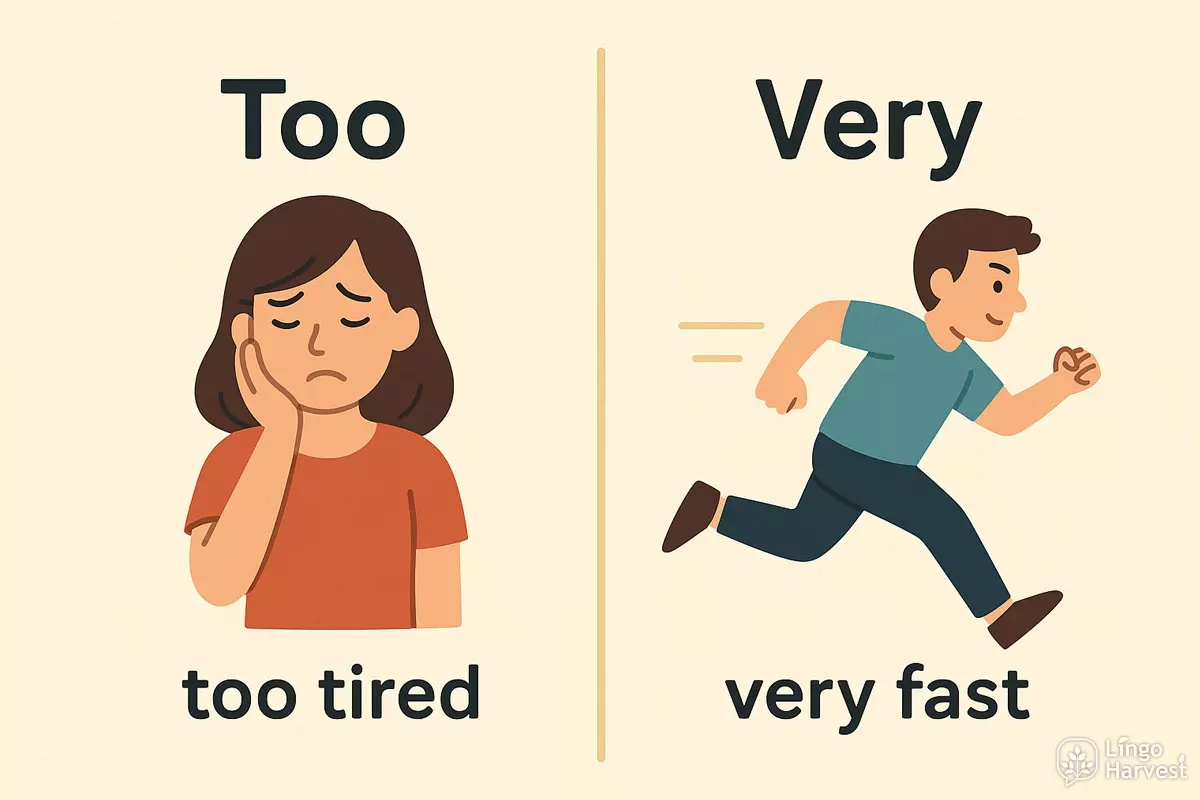
Remember these basic patterns:
- Very + adjective/adverb: “very tired,” “very fast”
- Too + adjective/adverb (+ to + verb): “too tired to work,” “too fast to see”
- “Too” is often followed by a reason or result: “too noisy for me to sleep.”
| Example | Correct Usage | Meaning |
|---|---|---|
| It’s very cold. | ✅ “Very” for strong, but not excessive, feelings or qualities. | It is really cold, but not a problem. |
| It’s too cold. | ✅ “Too” shows excess or a problem. | It is so cold that it causes difficulty. |
| The bag is too heavy to carry. | ✅ “Too + adjective + to + verb” pattern. | It is impossible to carry the bag because it is very heavy. |
| He is very tired. | ✅ “Very” for a strong feeling. | He is really tired, but maybe he can still do something. |
| He is too tired to study. | ✅ “Too” for an excessive state causing a problem. | He cannot study because he is extremely tired. |
Tips for Avoiding Confusion
- Use “very” for emphasis in positive or neutral contexts.
- Use “too” when something is more than what is needed, wanted, or possible.
- If you are unsure, check if the sentence means a problem or excess—if yes, use “too.”
Mastering the difference between these intensifiers helps you express yourself more accurately in English conversations and writing.
Double Adverbs and Redundancy
Using more than one adverb in a sentence often leads to mistakes, especially for beginners. Many learners try to add emphasis by repeating adverbs or combining words with the same meaning. This can make sentences confusing or unnatural. Understanding which combinations are unnecessary helps to keep writing and speech clear.
What Are Double Adverbs?
Double adverbs happen when two adverbs are used together, even though one would be enough. Sometimes, both words mean almost the same thing, so the second word adds no new information. For example, saying “very quickly fast” is not correct, because “quickly” and “fast” both describe speed.
Common Redundant Adverb Patterns
Here are some typical examples where extra adverbs or unnecessary repetition can appear:
- very quickly fast ❌ (should be very quickly or very fast)
- really truly ❌ (choose one: really or truly)
- completely finished already ❌ (use completely finished or finished already)
- absolutely totally ❌ (pick absolutely or totally)
- so very much ❌ (usually just so much or very much)
- too extremely ❌ (use too or extremely)
- always forever ❌ (either always or forever)
- quite nearly ❌ (choose quite or nearly)
- almost nearly ❌ (use almost or nearly)
- again once more ❌ (pick again or once more)
- absolutely sure certain ❌ (just absolutely sure or absolutely certain)
- just only ❌ (use just or only)
- soon quickly ❌ (select soon or quickly)
Why Is Redundancy a Problem?
Too many adverbs can sound awkward, and sometimes even change the meaning. In English, it is best to choose the single, most accurate adverb. This makes sentences easier to understand and more natural.
How to Fix These Errors
When checking your sentences, look for places where two adverbs are used together. Ask yourself if both are necessary, or if one word is enough. Usually, removing one makes the sentence correct.
Clearer Sentences: Examples
Here are some pairs of sentences showing incorrect and correct usage:
- She answered very quickly fast. ❌ → She answered very quickly. ✅
- I am really truly sorry. ❌ → I am truly sorry. ✅
- We almost nearly missed the bus. ❌ → We almost missed the bus. ✅
- You are absolutely totally right. ❌ → You are absolutely right. ✅
By avoiding unnecessary repetition, your English will sound more fluent and natural. Always aim for clear, simple sentences with just the right amount of detail.
Clear Repair Strategies
Many beginners make predictable errors with adverbs, but with a few targeted techniques, these issues can be fixed quickly. The first step is to identify the most common problems, such as confusing adverb position, mixing up adjectives and adverbs, or using the wrong adverb form. Once you know what to watch for, you can use practical methods to correct your sentences as you speak or write.
Step-by-Step Correction Techniques
- Read the sentence aloud and pause at the adverb. Does it sound natural? If not, try moving it in the sentence.
- Check if you need an adverb or adjective: Is it describing a verb (how?), or a noun (what kind)?
- Look for "-ly" endings for adverbs in English. Not all adverbs end in "-ly", but many do.
- Compare with model sentences from textbooks or trusted resources.
- Swap in a different adverb to see if it fits better (for example, "quickly" instead of "quick").
- Ask a classmate or teacher to check your usage, especially in writing.
Common Fixes for A1-A2 Adverb Errors
Here’s a handy reference for frequent beginner mistakes and how to adjust them:
| Mistake | Correction |
|---|---|
| I speak English good. | I speak English well. |
| She runs very quick. | She runs very quickly. |
| He always is happy. | He is always happy. |
| They go never to school. | They never go to school. |
| I can easily to do it. | I can easily do it. |
| She sings beautiful. | She sings beautifully. |
| He drives careful. | He drives carefully. |
| Usually I am getting up at 7. | I usually get up at 7. |
Useful Reminders for Self-Correction
- Adverbs often answer “how?”, “when?”, “where?”, or “how often?”
- Position adverbs of frequency (always, usually, often) before the main verb, but after “to be” (She is always late.)
- Not all words ending in "-ly" are adverbs (for example, "friendly" is an adjective).
- Double-check for extra or missing "-ly" endings.
- If in doubt, simplify the sentence and rebuild it step by step.
By practicing these strategies and regularly reviewing your sentences, you’ll be able to spot and fix adverb mistakes with confidence. Over time, these habits will help you use adverbs more naturally and accurately.
Practice: Correct the Sentences
Let’s put your knowledge of adverbs to the test. Below you will find sentences that contain typical errors made by beginners. Your task is to spot the mistake and write the correct version. Focus on common issues such as the position of adverbs, confusing adjectives with adverbs, and irregular adverb forms.
Identify and Correct the Mistakes
- She speaks very good English.
- He runs quick to school.
- I always am hungry in the morning.
- They can plays football wellly.
- My sister sings beautiful.
- We do our homework careful.
- Tom sometimes is late for class.
- The children are playing outside happy.
- Anna drives very dangerous.
- He never drinks coffee at night.
- You did this exercise perfect.
- The dog barks loud at night.
Common Adverb Corrections
- Use well (adverb), not good (adjective), to describe verbs.
- Most adverbs are formed by adding -ly to adjectives (quick → quickly, careful → carefully).
- Adverbs of frequency (always, sometimes, never) usually go before the main verb but after the verb "be".
- Some adverbs have irregular forms: good → well, fast → fast, hard → hard.
- Don’t use double adverbs (e.g., wellly is incorrect).
- Use adjectives after linking verbs (be, seem, feel), not adverbs (e.g., "She is happy," not "She is happily").
- Be careful with adverb placement in a sentence.
Adverb vs. Adjective: Examples
| Incorrect | Correct |
|---|---|
| He runs quick. | He runs quickly. |
| She sings beautiful. | She sings beautifully. |
| You did it perfect. | You did it perfectly. |
| They work careful. | They work carefully. |
| Anna drives dangerous. | Anna drives dangerously. |
Show answers
- She speaks English very well.
- He runs quickly to school.
- I am always hungry in the morning.
- They can play football well.
- My sister sings beautifully.
- We do our homework carefully.
- Tom is sometimes late for class.
- The children are playing outside happily.
- Anna drives very dangerously.
- He never drinks coffee at night. (Correct as is)
- You did this exercise perfectly.
- The dog barks loudly at night.