Sound More Natural: 15 Easy Adverbs You Can Start Using Today

 Here we why 15 common adverbs are effective in everyday conversation, provides meanings, usage notes, example sentences, tone tips, mini dialogues, a quiz, and practice exercises to help you use these adverbs instead of basic words.
If you want your conversations to flow more smoothly, expanding your vocabulary with a handful of simple, everyday adverbs can make a noticeable difference. By choosing words like actually, clearly, or simply, you can express your thoughts with greater ease and sound more natural. These small adjustments help you convey your ideas more effectively and create a relaxed, authentic tone in any discussion. With just a bit of practice, you’ll notice how your language feels more confident and engaging in both casual and professional settings.
Why These 15 Work in Daily Speech
Everyday conversations benefit from adverbs that feel natural and easy to use. The fifteen chosen for this article fit seamlessly into spoken English because they are short, clear, and commonly understood. These adverbs help express frequency, manner, degree, or certainty without sounding forced or overly formal. Using them makes your speech smoother, more precise, and relatable.
Natural Fit for Spoken English
Adverbs like really, just, and actually appear frequently in daily talk. They help clarify intent or emotion, soften statements, or show genuine interest. For example, “I really like this,” or “I just finished.” People use these words to keep sentences flowing and to add nuance.
Simple and Versatile
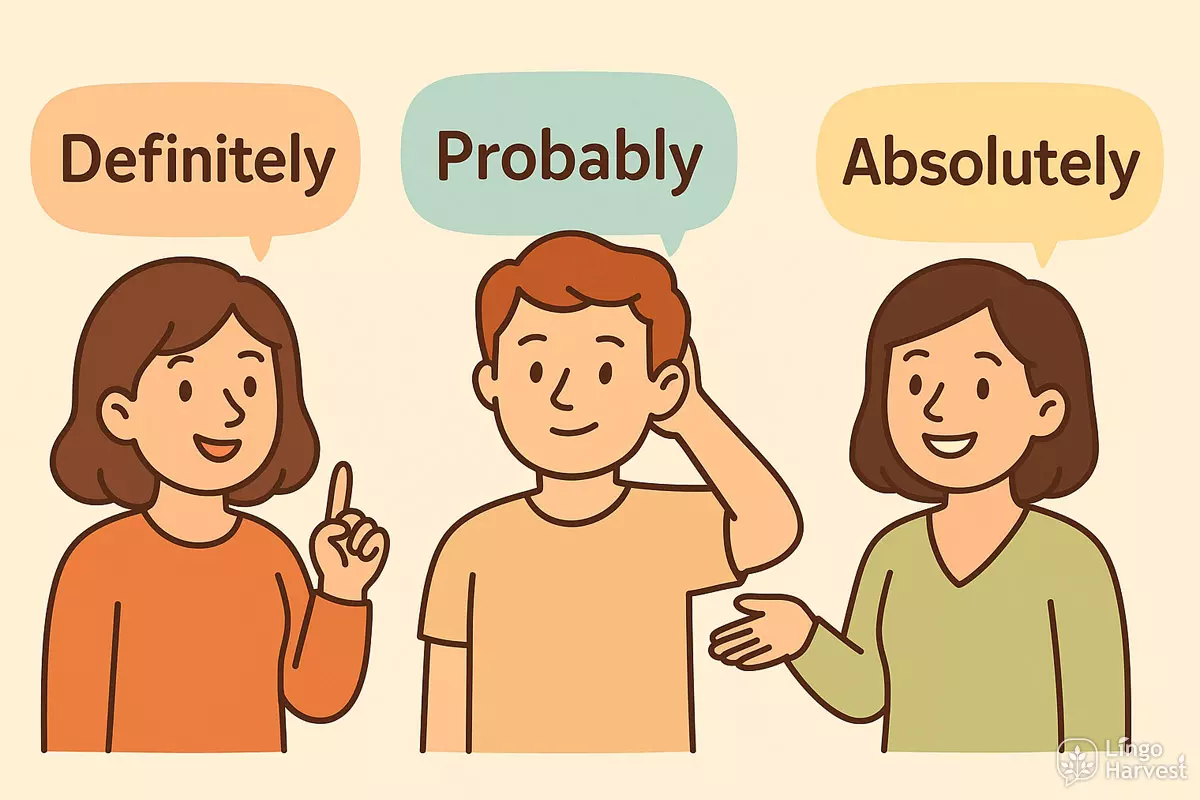
The selected adverbs are easy to remember and can be used in many contexts. Whether you’re agreeing, clarifying, or emphasizing, these words adapt well. Here are some ways they commonly appear in conversation:
- Definitely – “I’ll definitely call you.”
- Probably – “She’ll probably be late.”
- Absolutely – “That’s absolutely right.”
- Actually – “Actually, I don’t mind.”
- Quickly – “Can you do it quickly?”
- Just – “I just arrived.”
- Really – “It’s really good.”
- Usually – “I usually walk to work.”
- Probably – “He probably forgot.”
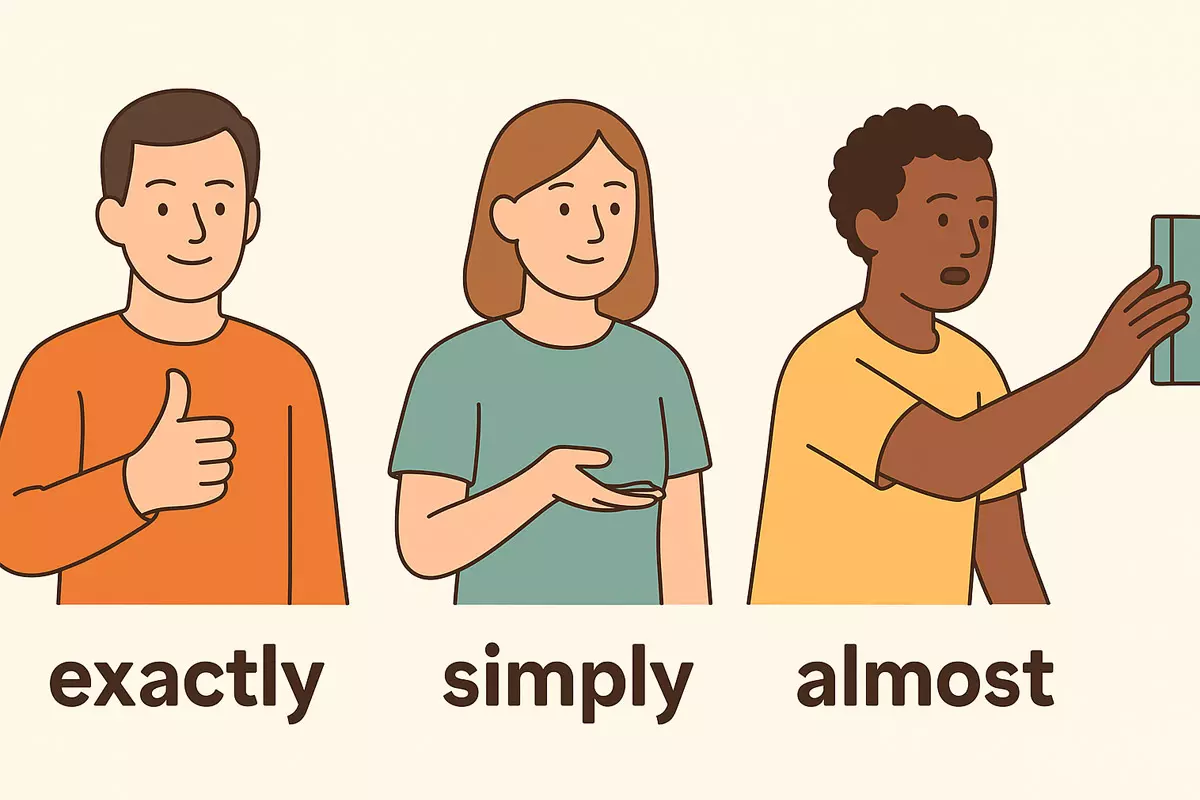
- Exactly – “That’s exactly what I meant.”
- Simply – “It’s simply amazing.”
- Almost – “I almost missed the bus.”
- Already – “I’ve already eaten.”
- Especially – “I like tea, especially green tea.”
- Clearly – “You can clearly see the difference.”
How These Adverbs Sound in Conversation
To illustrate how these adverbs enhance natural speech, here’s a quick comparison of sentences with and without them:
| Without Adverb | With Adverb |
|---|---|
| I like this idea. | I really like this idea. |
| I will help you. | I will definitely help you. |
| She is right. | She is absolutely right. |
| He finished the work. | He already finished the work. |
| We need to go. | We need to go quickly. |
Why These Choices Are Effective
What sets these adverbs apart is their frequency and flexibility. Native speakers rely on them for clear, concise communication. They help you sound more approachable and less robotic, while still conveying your message accurately. If you want your speech to feel easy and authentic, these words are a great place to start.
Quick Meanings and Usage Notes
Understanding how and when to use common adverbs can help your conversations sound smoother and more authentic. Each of the 15 adverbs in this article has its own shade of meaning and preferred context. Some are best for expressing frequency, while others show degree, certainty, or manner. Getting familiar with these subtle differences lets you pick the right word for the situation.
Core Ideas for Everyday Adverbs
Most of these adverbs are short, familiar, and flexible. You’ll often hear them in casual speech, emails, or friendly messages. Here’s a quick breakdown of how they typically function:
- Usually – expresses something that happens most of the time.
- Really – adds emphasis, similar to "very" or "truly."
- Simply – means "in a straightforward way" or "just."
- Actually – clarifies facts, sometimes used to gently correct.
- Absolutely – shows total agreement or certainty.
- Probably – suggests something is likely but not certain.
- Basically – simplifies a complex idea to its main point.
- Definitely – confirms something is sure.
- Clearly – signals something is obvious or easy to see.
- Especially – highlights something as more important than others.
- Seriously – can mean "in an honest way" or to show strong feeling.
- Hopefully – expresses a desire or wish for the future.
- Literally – means something is true in a real, exact sense (not figurative).
- Eventually – means "at some point in the future."
- Actually – often used to introduce surprising or clarifying information.
Tips for Natural-Sounding Usage
To avoid sounding robotic or overly formal, try mixing these adverbs into your speech and writing where they feel natural. It’s generally best to place them before the verb (e.g., "I really like this") or at the start of a sentence for emphasis ("Actually, I disagree"). Some, like "hopefully" or "eventually," work well at the beginning or end of a sentence.
Comparing Common Adverbs
Some words can seem similar but have distinct uses. Here’s a comparison of a few that are often confused:
| Adverb | Usage Note |
|---|---|
| Actually | Used for correcting, surprising, or emphasizing truth (e.g., "Actually, I’m not sure"). |
| Literally | Means "exactly as stated," not exaggeration (e.g., "He literally ran out the door"). |
| Basically | Summarizes or simplifies (e.g., "Basically, it means you can start now"). |
| Seriously | Shows earnestness or intensity (e.g., "Seriously, you should try this"). |
Common Pitfalls ❌ and Best Practices ✅
- Don’t overuse adverbs like "really" or "absolutely"—they lose impact if repeated too often.
- Be careful with "literally": only use it when you mean something is true in a non-figurative sense.
- Use "hopefully" for wishes, not certainty (e.g., "Hopefully, it won’t rain").
- Place adverbs naturally; forced placement can sound awkward.
Try experimenting with these adverbs in your daily conversations. Over time, you’ll notice which ones feel most comfortable and effective for your style.
Model Sentences and Pronunciation
When learning to use new adverbs, seeing them in everyday phrases is a practical way to understand their meaning and tone. Below, you’ll find clear example sentences that show how each adverb fits naturally into spoken English. Where relevant, pronunciation hints are provided to help you sound more authentic.
Example Sentences with Common Adverbs
- Actually: Actually, I’ve never been to Paris.
- Basically: Basically, it works like this.
- Definitely: I’ll definitely call you tomorrow.
- Probably: She’ll probably arrive late.
- Seriously: Are you seriously going to eat all that?
- Literally: I literally jumped out of my seat.
- Eventually: Eventually, we all agreed.
- Absolutely: That’s absolutely right.
- Especially: I love ice cream, especially chocolate.
- Usually: I usually wake up at 7am.
- Honestly: Honestly, I didn’t expect that.
- Clearly: It’s clearly not working.
- Simply: You simply add water and stir.
- Certainly: I will certainly help you.
- Exactly: That’s exactly what I meant.
Pronunciation Tips
- Many adverbs end in -ly. Make sure to pronounce the ‘lee’ ending clearly: /ˈæk.tʃu.ə.li/ (actually), /ˈjuː.ʒu.ə.li/ (usually).
- For words like definitely (/ˈdɛf.ɪ.nɪt.li/), stress the first syllable and keep the ending light.
- Literally is often pronounced /ˈlɪt.ər.əli/ in careful speech, but in casual English, you might hear /ˈlɪt.rəli/.
- Practice linking: In “She’ll probably arrive late,” say “prob-ly” instead of “prob-a-bly” for a more natural flow.
Quick Reference Table: Adverb Usage in Sentences
| Adverb | Sample Phrase |
|---|---|
| Honestly | Honestly, that’s not what I expected. |
| Basically | Basically, we need more time. |
| Absolutely | That’s absolutely true. |
| Eventually | Eventually, they found the answer. |
| Clearly | It’s clearly broken. |
| Usually | I usually go jogging in the evening. |
To sound more fluent, try reading these sentences aloud, focusing on the rhythm and stress patterns. Listen to native speakers and imitate the way they reduce or link sounds. With regular practice, these adverbs will become a natural part of your spoken English.
Soft vs Strong Tone Control
When you want your speech or writing to sound more natural, the way you use adverbs can make a big difference. Adverbs help you set the mood and adjust how forceful or gentle your message feels. Sometimes you need to soften your language to sound more polite or approachable; other times, you might want to express certainty or emphasis. Knowing how to select adverbs for either purpose can give you fine control over the impression you make.
Choosing Gentle or Firm Adverbs
Gentle adverbs can make statements less direct or more considerate, which is especially useful in sensitive discussions. On the other hand, firmer adverbs add strength, making your ideas or requests stand out with clarity and confidence. Here are some common adverbs, grouped by their effect:
- Gentle (Softening) Adverbs: perhaps, maybe, slightly, possibly, generally, somewhat, apparently, usually, fairly, often
- Firm (Strengthening) Adverbs: definitely, absolutely, certainly, always, completely, strongly, clearly, thoroughly, undoubtedly, never
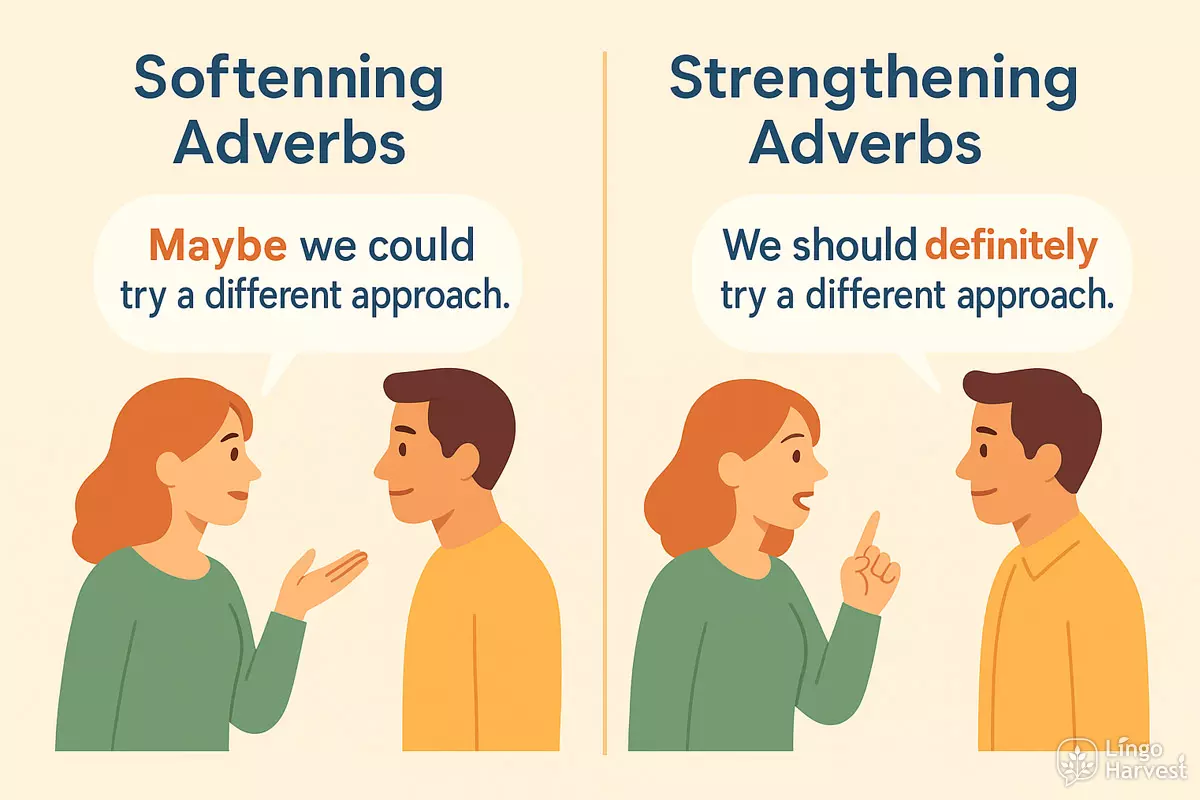
Quick Comparison: Soft vs Strong Adverb Usage
| Softening Adverbs | Strengthening Adverbs |
|---|---|
| Maybe we could try a different approach. | We should definitely try a different approach. |
| It's generally helpful to check your work. | It's always helpful to check your work. |
| She slightly disagreed with the decision. | She strongly disagreed with the decision. |
| I usually arrive on time. | I always arrive on time. |
| This might be the solution. | This is certainly the solution. |
Tips for Natural Tone with Adverbs
- Use softer adverbs when giving feedback, making suggestions, or showing uncertainty.
- Choose stronger adverbs to highlight certainty, express strong feelings, or clarify instructions.
- Mix both types in conversation for balance and authenticity.
- Avoid overusing any single adverb; variety keeps your language engaging.
Adapting your adverb choices helps your speech and writing sound more authentic and considerate. Whether you want to come across as diplomatic or decisive, knowing when and how to use these words is a skill worth practicing.
Mini Dialogues for Conversation Practice
Practicing short exchanges is one of the most effective ways to internalize new adverbs. Below, you’ll find a series of everyday dialogues that naturally incorporate some of the fifteen easy adverbs featured in this article. These sample conversations give you a sense of how native speakers use adverbs to sound more fluent and relaxed.
Sample Conversations Using Common Adverbs
- Actually
A: Did you finish the report?
B: Actually, I’m still working on it. - Obviously
A: Is she coming to the meeting?
B: Obviously, she’s the team leader. - Probably
A: Will it rain this afternoon?
B: Probably. The sky looks really dark. - Definitely
A: Are you joining us for dinner?
B: Definitely! I wouldn’t miss it. - Seriously
A: You’ve never tried sushi?
B: Seriously, never. I need to try it soon. - Literally
A: Was the movie good?
B: I literally laughed the whole time. - Usually
A: Do you drive to work?
B: Usually, but today I took the bus. - Nearly
A: Did you finish the book?
B: Nearly. I have just one chapter left. - Absolutely
A: Is this your final decision?
B: Absolutely. I’ve thought it through. - Actually
A: You look tired. Did you sleep well?
B: Actually, I hardly slept at all last night.
Practice Task: Fill in the Adverb
Choose the most natural adverb to complete each mini dialogue.
- A: Will you be at the party tonight?
B: __________! I already bought a gift. - A: Have you finished your homework?
B: __________, I forgot we had any. - A: Did you enjoy the concert?
B: I __________ loved every minute of it. - A: Are you coming to the meeting?
B: __________, I have another appointment.
Show answers
- Definitely
- Actually
- Absolutely (or Literally, depending on emphasis)
- Unfortunately (if included in your list), or Actually
Quick Reference: Dialogue Adverbs and Their Effects
| Adverb | Effect in Conversation |
|---|---|
| Actually | Corrects or clarifies information |
| Definitely | Shows strong agreement or certainty |
| Probably | Expresses likelihood but not certainty |
| Usually | Describes a regular habit or routine |
| Literally | Emphasizes that something is true in a real or exact sense |
| Nearly | Indicates something is almost but not quite complete |
| Seriously | Shows sincerity or surprise |
| Absolutely | Expresses complete agreement or certainty |
Try reading these dialogues aloud or role-playing with a partner. Focus on how each adverb changes the tone or meaning of your response. The more you use these simple adverbs in context, the more naturally they will become part of your everyday speech.
Short Self-Check Quiz
Ready to check your understanding of natural-sounding adverbs? Use the exercises below to see how well you can recognize and use these handy words in context. Try to answer each question before peeking at the solutions.
Choose the Best Adverb
For each sentence, pick the adverb that fits best from the following list: actually, especially, hardly, probably, simply, nearly, seriously, honestly, basically, definitely, obviously, generally, usually, clearly, absolutely.
- She ________ forgot her keys again—she does this almost every day!
- This cake is ________ delicious. You have to try it.
- I ________ can't believe how fast he ran the marathon.
- ________, I think this is the best solution to our problem.
- It's ________ raining, so bring your umbrella just in case.
Show answers
- usually
- absolutely
- seriously
- Honestly
- probably
Spot the More Natural Option
Choose which sentence sounds more like everyday English.
- A) I am very sure this is correct.
B) I am absolutely sure this is correct. - A) She is in a happy way.
B) She is obviously happy. - A) We will go to the park if it is not raining.
B) We will probably go to the park.
Show answers
- B
- B
- B
Match the Adverb to Its Meaning
See if you can link each adverb to its closest meaning:
| Adverb | Closest meaning |
|---|---|
| nearly | almost |
| simply | easily/just |
| clearly | obviously |
| generally | usually/most of the time |
| hardly | barely |
Show answers
- nearly → almost
- simply → easily/just
- clearly → obviously
- generally → usually/most of the time
- hardly → barely
Quick Practice: Rewrite the Sentences
Make these sentences sound more natural by replacing the underlined part with a suitable adverb from the list above:
- He in a very honest way admitted his mistake.
- I'm almost certain she's coming.
- The answer is very easy to see.
- They do this most of the time on weekends.
- It’s just not possible to finish today.
Show answers
- He honestly admitted his mistake.
- I'm probably sure she's coming. (Or: I'm definitely sure.)
- The answer is clearly visible.
- They generally do this on weekends.
- It’s simply not possible to finish today.
Practice: Replace Basic Words
Swapping out ordinary words for more natural-sounding adverbs can make your English flow better and feel less textbook. Let’s look at common “basic” words and see how adverbs can upgrade your sentences. Adverbs often show how, when, or how much, adding useful detail and style.
Upgrade These Sentences
Try replacing the underlined basic words with one of the easy adverbs from the article. This will help you sound more fluent and expressive.
- She really likes chocolate.
- I quickly finished my homework.
- They always go to the gym on Mondays.
- He just called you.
- The movie was very interesting.
- We often eat out on weekends.
- I almost missed the bus.
- The weather is quite nice today.
- She barely passed the exam.
- He usually wakes up early.
Show answers
- She absolutely likes chocolate.
- I instantly finished my homework.
- They regularly go to the gym on Mondays.
- He recently called you.
- The movie was extremely interesting.
- We frequently eat out on weekends.
- I nearly missed the bus.
- The weather is fairly nice today.
- She hardly passed the exam.
- He typically wakes up early.
Common Basic Words vs. Natural Adverbs
Here’s a quick guide to help you see the difference between simple words and their more natural adverb alternatives:
| Basic Word | Natural Adverb Alternative |
|---|---|
| Very | Extremely, incredibly, remarkably |
| Always | Constantly, consistently, regularly |
| Just | Recently, simply, barely |
| Usually | Typically, generally, commonly |
| Quickly | Rapidly, instantly, promptly |
| Almost | Nearly, practically, virtually |
| Often | Frequently, regularly, repeatedly |
| Really | Absolutely, genuinely, truly |
| Quite | Fairly, rather, relatively |
| Barely | Hardly, scarcely, narrowly |
Try It Yourself
Pick 3–5 sentences you use every day. Replace any simple adjectives or adverbs with one from the table above. Notice how your sentences sound more natural and expressive.
With practice, using these adverbs becomes second nature. Listen for them in conversations or media, and try to use them in your own speech and writing.