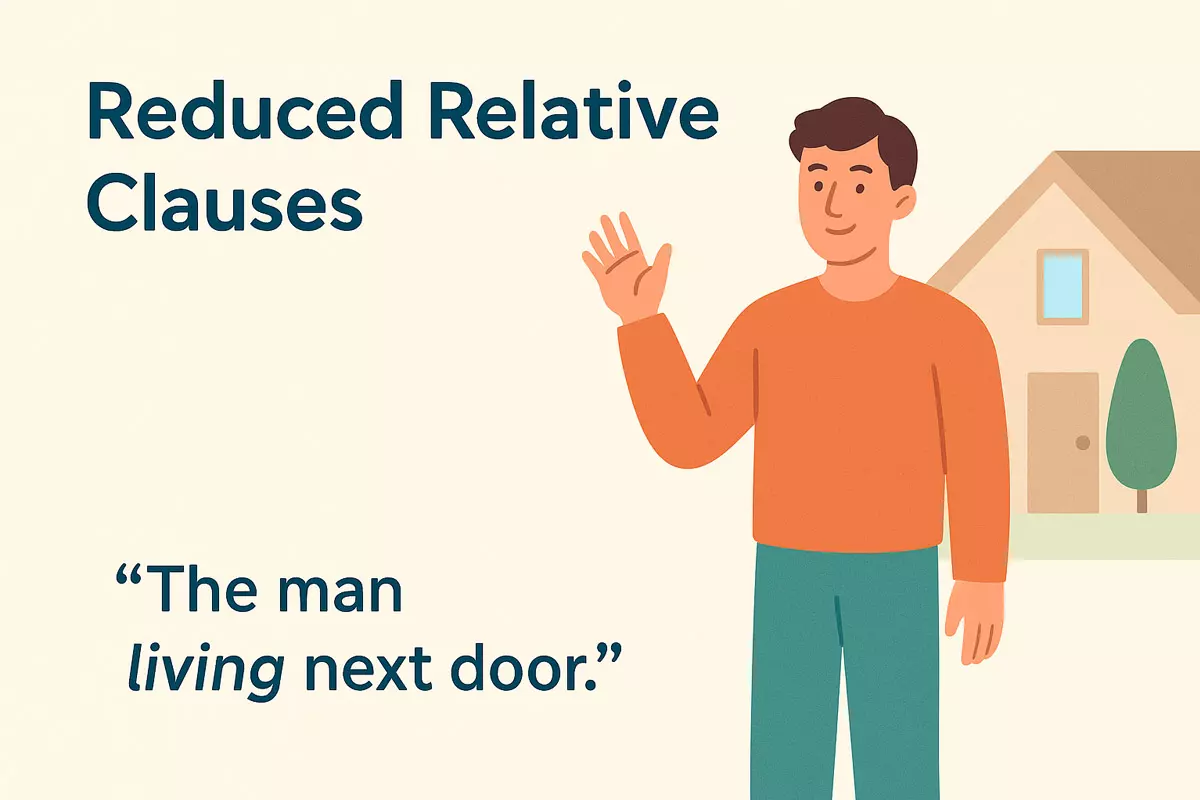
Reduced Relative Clauses: the man living next door

 This article explains reduced relative clauses, contrasts them with full clauses, and shows when reduction is possible. It covers present and past participle reductions, avoiding ambiguity, formal usage, and includes practice exercises.
English has a unique way of conveying additional information within a sentence without adding extra length, making it both efficient and expressive. For example, in the phrase the man living next door, the language uses a concise grammatical structure to include details about the subject without needing a separate sentence. This ability to layer meaning allows English speakers to communicate more precisely and vividly while keeping their sentences clear and succinct.
Definition of Reduced Relative Clauses
Reduced relative clauses are a more compact form of relative clauses, often used to make sentences smoother and less repetitive. Instead of using a full relative pronoun and verb, like “who is” or “that are,” these clauses condense the information, typically by removing the relative pronoun and sometimes the auxiliary verb. For example, “the man who lives next door” becomes “the man living next door.” This transformation can apply to both active and passive constructions, and is common in both written and spoken English.
How Reduced Relative Clauses Work
These clauses usually modify nouns, providing extra information without starting a new sentence or using a full relative clause. The main strategies for forming them are:
- Present participle (-ing form) for active meaning: “the students sitting in the back”
- Past participle for passive meaning: “the book published last year”
- Omitting “who/that/which” and sometimes auxiliary verbs, especially “be”
Examples of Full vs. Reduced Forms
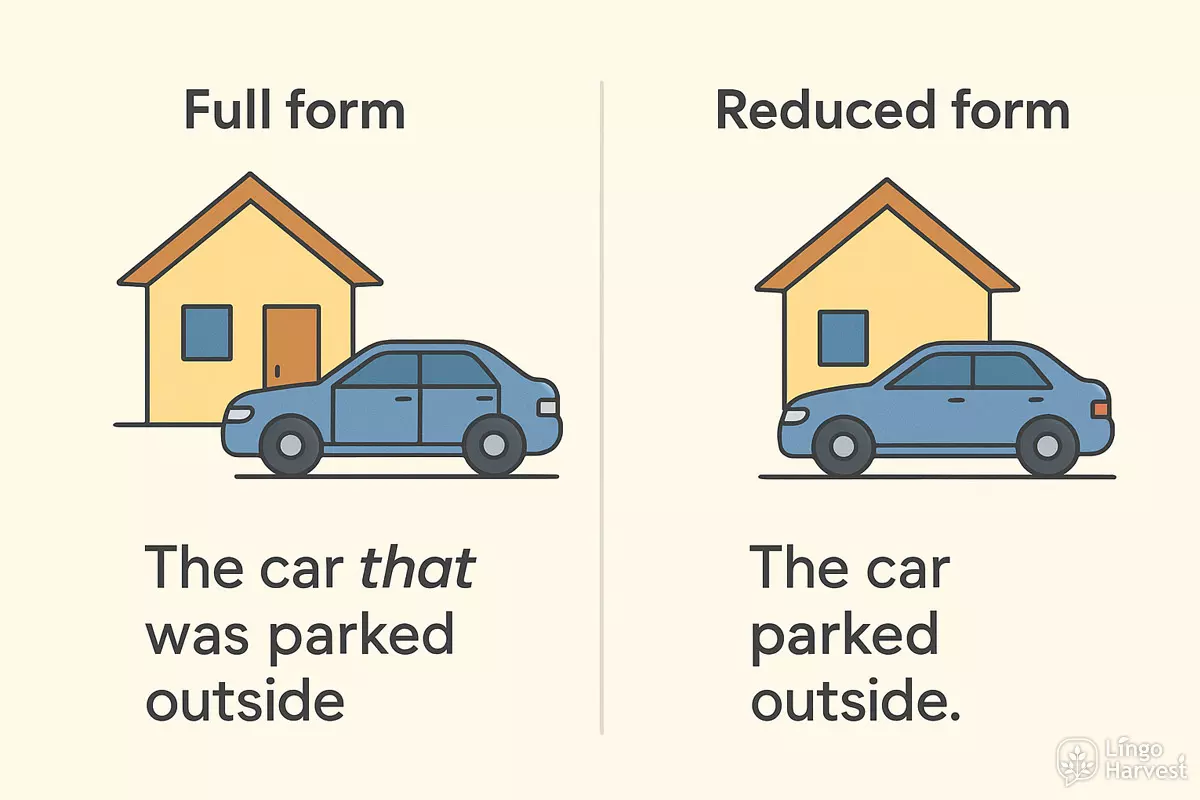
Compare these pairs to see how the structure changes:
- The woman who is talking to John → The woman talking to John
- The car that was parked outside → The car parked outside
- The students who study hard → The students studying hard
- The documents that were signed yesterday → The documents signed yesterday
Common Patterns and Usage
Reduced relatives are especially useful for making sentences less wordy. Here are some frequent structures:
- the man living next door
- the film directed by Spielberg
- the cake made by my mother
- the children playing outside
- the letter sent last week
- the dog barking loudly
- the houses built in 1990
- the workers repairing the road
- the ideas presented at the meeting
- the person responsible for the error
- the questions asked by reporters
- the students invited to the ceremony
- the train arriving at platform 2
- the food served at the event
- the man injured in the accident
Key Features
- Removes unnecessary words, making speech and writing more concise
- Common in both formal and informal contexts
- Requires the noun modified to be the subject of the reduced verb form
- Often uses present or past participles
Full vs Reduced Clause Comparison
Understanding the difference between full and reduced relative clauses can help you write and speak more naturally. Full relative clauses include a relative pronoun (like "who," "which," or "that") and sometimes an auxiliary verb, while reduced forms drop the pronoun and auxiliary, often using only the participle. This makes sentences more concise and is common in written English.
What Changes in the Reduced Form?
In reduced relative clauses, unnecessary words are omitted. The main noun is immediately followed by the participle phrase. The meaning usually stays the same, but the structure becomes simpler. This is especially useful when describing people or things in a more streamlined way.
Examples of Full and Reduced Relative Clauses
Let’s look at several pairs to see how the structure changes:
- the man who lives next door → the man living next door
- the book that was written by her → the book written by her
- students who are taking the test → students taking the test
- the car which was parked outside → the car parked outside
- the woman who is talking to John → the woman talking to John
- the house that was built last year → the house built last year
- the emails which were sent yesterday → the emails sent yesterday
- people who work here → people working here
- the letter that was delivered this morning → the letter delivered this morning
- the children who are playing outside → the children playing outside
Comparing Structure and Usage
For a clearer view, here’s how the two forms differ in several aspects:
| Feature | Full Relative Clause | Reduced Relative Clause |
|---|---|---|
| Relative Pronoun | Always present (who, which, that) | Omitted |
| Auxiliary Verb | Sometimes present (is, are, was, were) | Omitted |
| Verb Form | Finite verb (lives, was built) | Participle (living, built) |
| Sentence Length | Longer, more explicit | Shorter, more concise |
| Example | the man who lives next door | the man living next door |
When to Use Each Type
Full relative clauses are useful when clarity is essential or when the information is complex. Reduced forms work best in shorter, descriptive phrases—especially in written English, headlines, or formal writing. Practicing both can help you recognize and use them naturally in different contexts.
When Reduction Is Allowed
Reduced relative clauses are permitted in English under specific conditions that help maintain clarity and grammaticality. These reduced forms are most common with active participles (present or past), especially when the subject of the clause is the same as the noun being described. You’ll often see them in written English, where they help make sentences more concise and fluid.
Typical Situations for Using Reduced Relative Clauses
- The relative pronoun (who, which, that) is the subject of the full clause.
- The verb in the relative clause is in a participle form (present or past participle).
- The clause describes the noun immediately before it, with no ambiguity.
- There are no auxiliary verbs or modals in the relative clause (e.g., is, was, can, will).
- No prepositions are left stranded at the end of the clause after reduction.
- Reduction usually works with non-defining (non-essential) and defining (essential) relative clauses, though context matters.
Common Patterns and Examples
The following patterns illustrate where these shortened clauses are acceptable:
- Noun + present participle: The students sitting near the window (from "The students who are sitting near the window")
- Noun + past participle: The book written by my friend (from "The book that was written by my friend")
- Prepositional phrase after a reduced clause: The man living in Paris (from "The man who lives in Paris")
- Omitted relative pronoun with participle: The cake baked yesterday (from "The cake that was baked yesterday")
- Reduced clauses after indefinite pronouns: Anyone interested in the offer (from "Anyone who is interested in the offer")
- Describing objects or people: The cars parked outside (from "The cars that are parked outside")
- Using "having" for perfect meaning: The guests having finished dinner (from "The guests who have finished dinner")
- With "being" for passive meaning: The documents being reviewed (from "The documents that are being reviewed")
- With "seen," "found," "given," etc.: The keys found on the table (from "The keys that were found on the table")
- People or things with ongoing or completed action: The house built last year (from "The house that was built last year")
Where Reduction Doesn’t Work
Not every relative clause can be shortened. If the clause contains a modal verb, a different subject, or is otherwise essential for clarity, the full form should be used. For example, "The man who I met yesterday" cannot be reduced, because "who" is the object, not the subject.
Summary Table: Full vs. Reduced Relative Clauses
| Full Relative Clause | Reduced Relative Clause |
|---|---|
| The man who lives next door | The man living next door |
| The cake that was made by Anna | The cake made by Anna |
| The students who are waiting outside | The students waiting outside |
| The documents that are being printed | The documents being printed |
| The house that was built in 2020 | The house built in 2020 |
Key Takeaways
If the clause modifies the noun directly, uses a participle, and doesn’t risk confusion, it can usually be reduced. This approach streamlines sentences and is especially useful in formal writing.
Present and Past Participle Reductions
Understanding how participles create reduced relative clauses helps make sentences more concise. English often drops the relative pronoun ("who," "that," "which") and auxiliary verbs in these situations. The result? Shorter phrases that still convey essential information about nouns. For example, instead of "the man who is living next door," we say, "the man living next door."
How Participles Work in Reduced Clauses
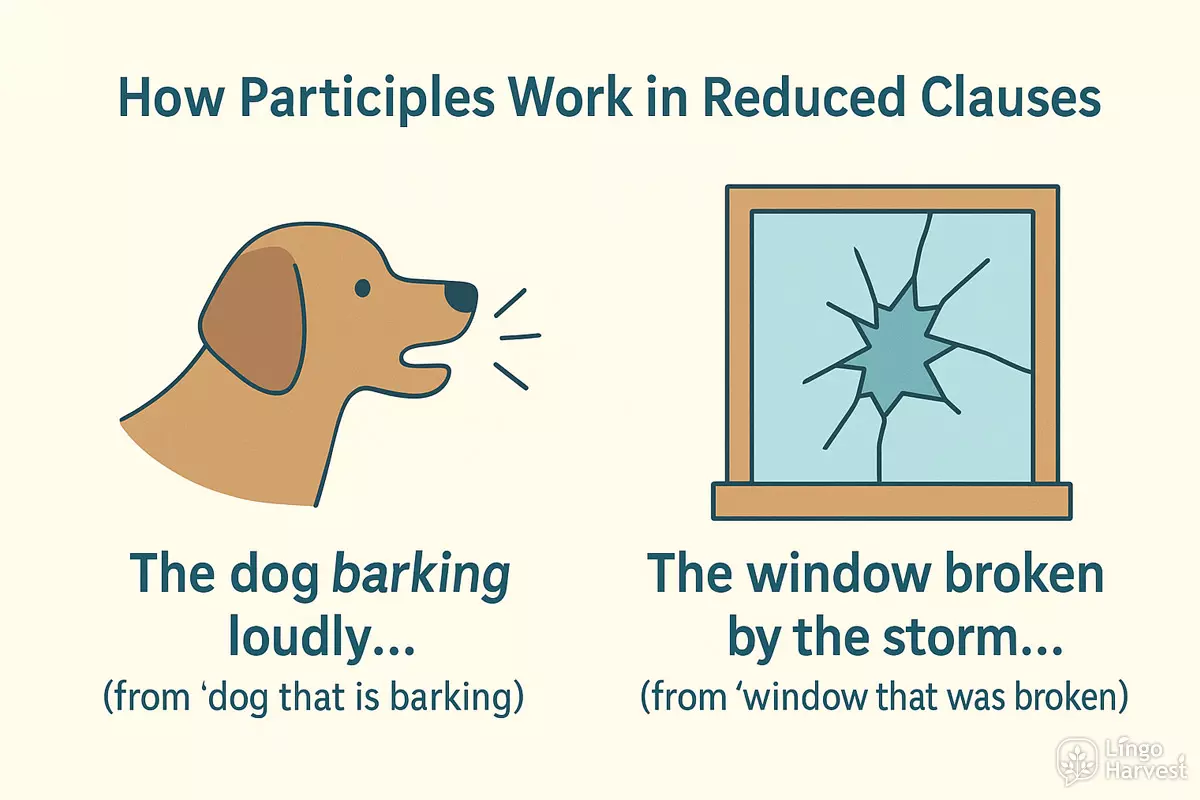
Present participles (-ing forms) typically reduce active clauses, while past participles (-ed or irregular forms) reduce passive or completed actions. This process is common in both spoken and written English, making descriptions more efficient.
- Active (present participle): "The students studying in the library..." (from "students who are studying")
- Passive (past participle): "The book published last year..." (from "book that was published")
- "The cake made by grandma..." (from "cake that was made")
- "The girl waiting outside..." (from "girl who is waiting")
- "The houses built in the 1800s..." (from "houses that were built")
- "The car parked near the entrance..." (from "car that is parked")
- "The man living next door..." (from "man who is living")
- "The letters sent yesterday..." (from "letters that were sent")
- "The dog barking loudly..." (from "dog that is barking")
- "The movie shown last week..." (from "movie that was shown")
- "The children playing outside..." (from "children who are playing")
- "The window broken by the storm..." (from "window that was broken")
When Reductions Are Possible
Reduced forms are only possible when the relative pronoun refers to the subject of the relative clause, not the object. For instance:
- ✅ "The man reading a book" (subject = man)
- ❌ "The book reading by the man" (incorrect)
This means the noun being described must do, or receive, the action in the participle phrase.
Comparison: Full vs. Reduced Clauses
| Full Relative Clause | Reduced Form |
|---|---|
| The man who is living next door | The man living next door |
| The cake that was made by grandma | The cake made by grandma |
| The students who are studying in the library | The students studying in the library |
| The book which was published last year | The book published last year |
| The children who are playing outside | The children playing outside |
| The window that was broken by the storm | The window broken by the storm |
Summary
Using participle phrases instead of full relative clauses can make your English more natural and efficient. The key is to recognize when the noun is the subject of the clause and to choose the right participle form for the meaning you want. This skill is especially useful for both formal and informal writing, as well as for clear, concise speech.
Avoiding Ambiguity in Reductions
Clear communication often depends on how easily listeners or readers can interpret a sentence. Reduced relative clauses—like “the man living next door”—can sometimes introduce confusion if not used thoughtfully. This usually happens when the reduced form could be mistaken for another grammatical structure or when the context doesn’t make the meaning obvious.
Common Sources of Ambiguity
Ambiguity typically arises when:
- The participial phrase directly follows a noun that could plausibly be the subject or object.
- The reduced clause omits necessary information, making it unclear who or what is being described.
- Word order allows for multiple interpretations.
Strategies for Clarity
Writers and speakers can take several steps to make their meaning unmistakable:
- Use full relative clauses when the reduced form might confuse: “the man who is living next door” instead of “the man living next door”.
- Place the reduced clause immediately after the noun it modifies, avoiding separation by other elements.
- Choose participles and modifiers carefully to prevent misreading.
- Provide additional context when necessary, especially in complex sentences.
- Avoid stacking multiple reduced clauses in a single noun phrase.
Ambiguous vs. Clear Examples
To illustrate, here are some examples showing how reduced relative clauses can cause confusion, and how to resolve it:
| Ambiguous Sentence | Clear Alternative |
|---|---|
| The man living next door heard the noise. | The man who is living next door heard the noise. |
| The students preparing for exams left early. | The students who were preparing for exams left early. |
| The dog chased by the cat ran away. | The dog that was chased by the cat ran away. |
| The letter sent yesterday was important. | The letter that was sent yesterday was important. |
| The girl reading a book smiled. | The girl who was reading a book smiled. |
Checklist for Reducing Ambiguity
Before using a shortened relative clause, consider these questions:
- Is the noun being described unmistakable in context?
- Could the participle be misread as part of the main verb?
- Would a full relative clause sound more natural or clear?
- Are there multiple nouns the reduced clause might modify?
By paying attention to these factors, you can use reduced relative clauses effectively—making your sentences both concise and easy to understand.
Usage in Formal and Academic Writing
Reduced relative clauses, such as in "the man living next door," are frequently used in scholarly texts to convey information efficiently and maintain sentence flow. They allow writers to include descriptive details without overloading sentences with conjunctions or full relative clauses, which helps keep academic prose concise and clear.
Why Use Reduced Relative Clauses?
Choosing a shortened clause form can improve readability and reduce redundancy. For instance, instead of writing "the man who is living next door," compressing it to "the man living next door" streamlines the sentence. This is particularly valuable in scientific articles, research papers, and formal reports, where clarity and brevity are prized.
Typical Contexts in Academic Writing
Writers often employ these structures when:
- Describing participants or subjects in research (e.g., "students enrolled in the program")
- Presenting data or findings (e.g., "the samples analyzed showed...")
- Defining terms or concepts (e.g., "variables affecting the outcome")
- Summarizing literature (e.g., "authors writing in the 19th century")
- Outlining methods (e.g., "tests performed by the team")
Common Patterns and Alternatives
Writers in academic settings may alternate between full and reduced forms depending on the desired emphasis or clarity. Below is a comparison of typical patterns:
| Full Relative Clause | Reduced Relative Clause |
|---|---|
| the method that was used | the method used |
| the students who are participating | the students participating |
| the data which were collected | the data collected |
| the article that was published recently | the article published recently |
| the researcher who conducted the experiment | the researcher conducting the experiment |
| the theory that is discussed | the theory discussed |
| the equipment which is required | the equipment required |
| the students who have completed the course | the students having completed the course |
Considerations and Cautions
While these shortened forms add efficiency, overuse can make sentences dense and harder to follow, especially for readers less familiar with academic English. It is also important to ensure that the reduced clause does not create ambiguity. For example, "the man living next door" is clear, but "the results shown" could be confusing if the context is not specific.
Summary
In sum, using reduced relative clauses in formal and academic contexts helps writers present information succinctly. They are especially useful for modifying nouns with essential details, provided clarity is maintained. Academic writers should balance conciseness with readability to ensure their arguments remain accessible.
Practice: Reduce Clauses in Context
Understanding how to shorten relative clauses is key to writing and speaking more naturally. Below, you'll find targeted exercises and examples that help you recognize and use reduced relative clauses effectively, especially with participles like "living" or "built."
Spot the Difference: Full vs. Reduced Clauses
The table below shows how full relative clauses transform into their reduced forms. Notice how unnecessary words are omitted, but the core meaning stays intact.
| Full Relative Clause | Reduced Relative Clause |
|---|---|
| The man who lives next door | The man living next door |
| The books that were written by her | The books written by her |
| The car which is parked outside | The car parked outside |
| The children who are playing in the park | The children playing in the park |
| The house that was built last year | The house built last year |
| The woman who is talking to John | The woman talking to John |
| The emails that were sent yesterday | The emails sent yesterday |
| The painting which was stolen last week | The painting stolen last week |
| The students who study hard | The students studying hard |
| The building that is being repaired | The building being repaired |
Try It Yourself: Rewrite the Sentences
Rewrite the sentences below by reducing the relative clauses. Focus on eliminating "who," "that," or "which," and changing the verb form if needed.
- The woman who is teaching the class is my aunt.
- The cake that was made by Tom was delicious.
- The students who are waiting in the hall look nervous.
- The letters that were delivered today are on your desk.
- The movie which is playing tonight is a comedy.
- The man who is standing near the door is the manager.
- The car that was parked outside has been towed.
- The children who were playing in the yard came inside.
- The book that is lying on the table belongs to me.
- The dog which was rescued last week is recovering well.
Show answers
- The woman teaching the class is my aunt.
- The cake made by Tom was delicious.
- The students waiting in the hall look nervous.
- The letters delivered today are on your desk.
- The movie playing tonight is a comedy.
- The man standing near the door is the manager.
- The car parked outside has been towed.
- The children playing in the yard came inside.
- The book lying on the table belongs to me.
- The dog rescued last week is recovering well.
Identify the Reduced Clause
In the sentences below, underline the reduced relative clause. Which noun does it describe?
- The artist painting by the river is famous.
- The report finished yesterday was excellent.
- The man standing at the door is our neighbor.
- The files sent last week are missing.
- The woman working late is my supervisor.
- The project completed last month won an award.
- The children playing in the garden seem happy.
- The letter written in French confused him.
- The car parked outside belongs to my cousin.
- The students preparing for exams look tired.
Show answers
- painting by the river describes "The artist"
- finished yesterday describes "The report"
- standing at the door describes "The man"
- sent last week describes "The files"
- working late describes "The woman"
- completed last month describes "The project"
- playing in the garden describes "The children"
- written in French describes "The letter"
- parked outside describes "The car"
- preparing for exams describes "The students"
Quick Tips for Reducing Clauses
- Use the present participle (-ing) for active meaning: The man living next door.
- Use the past participle (-ed or irregular) for passive meaning: The book published last year.
- Omit "who," "that," or "which" when reducing.
- Make sure the noun and participle logically match.
- Keep the sentence clear and concise.