Whiz-Deletion in Relative Clauses (B1-B2 intro)

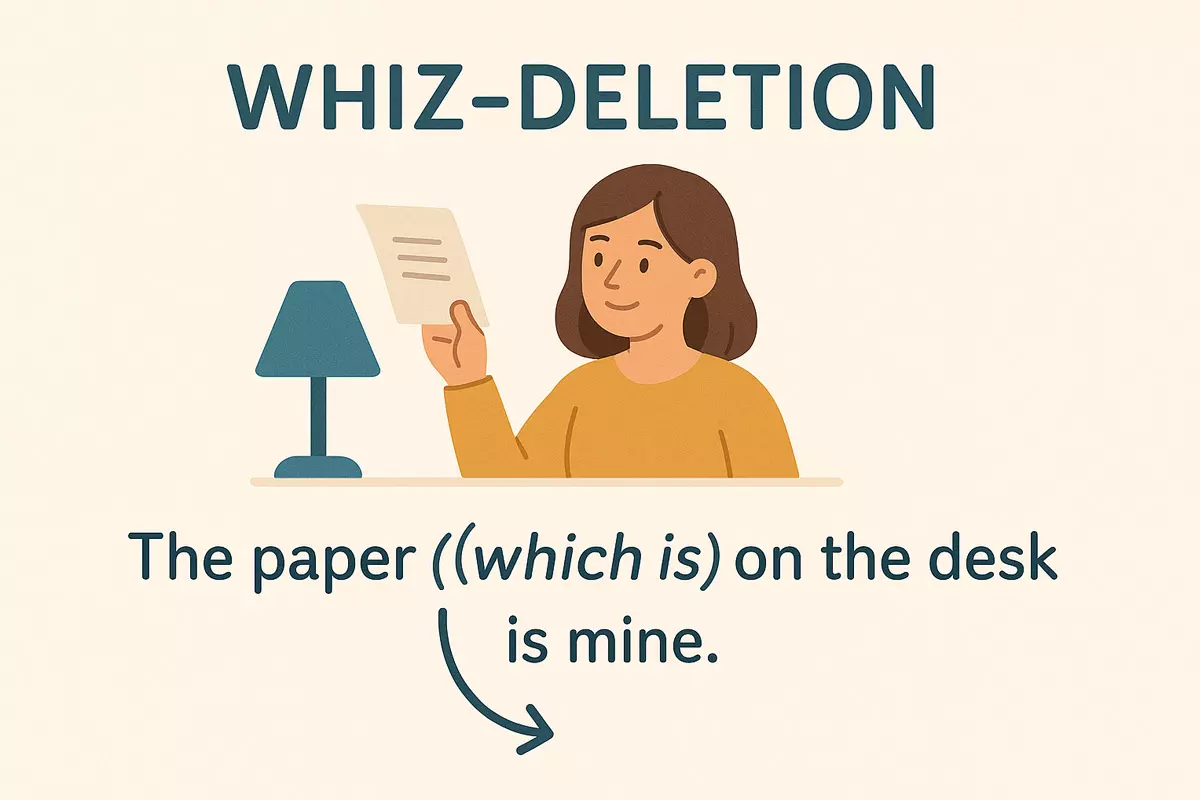 This article explains whiz-deletion, which is when a relative pronoun and be verb are omitted in English. It covers when deletion is possible, example sentences for B1–B2 learners, common mistakes, and provides practice exercises.
Have you ever noticed that some English sentences sound smoother when certain words are omitted? This article examines how leaving out specific pronouns in descriptive clauses can make your language more natural and fluid, particularly for intermediate learners. By understanding when and how to drop unnecessary pronouns, you can improve the flow of your sentences and communicate more effectively. We will look at common examples and provide practical tips to help you incorporate this technique into your everyday English writing and speaking.
What Whiz-Deletion Means
In English grammar, "whiz-deletion" describes a process in which certain words in relative clauses are left out to make sentences simpler and more natural. This typically involves omitting a relative pronoun (like who, which, or that) followed by the verb be (am, is, are, was, were) when these elements are not needed for clarity. The result is a shorter, smoother sentence that still expresses the same idea.
How the Process Works
This structure is common in spoken and written English, especially at the B1–B2 levels. The main idea is that if a clause starts with a relative word and the verb be, and the information that follows describes the noun, you can usually remove both the relative word and be.
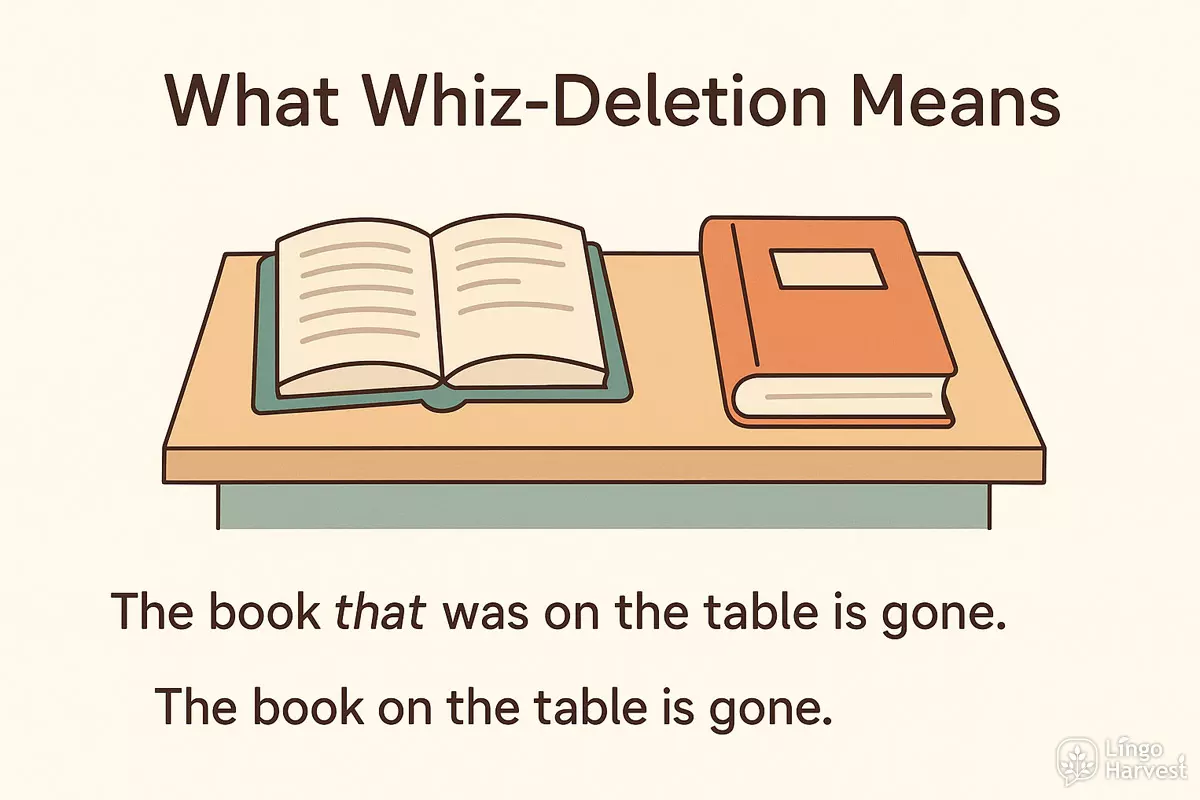
- The man who is talking to John is my uncle. → The man talking to John is my uncle.
- The book that was on the table is gone. → The book on the table is gone.
- Students who are interested should apply. → Students interested should apply.
- The cake which was made yesterday is delicious. → The cake made yesterday is delicious.
- The girl who is wearing a red dress is my sister. → The girl wearing a red dress is my sister.
- The car that is parked outside belongs to Anna. → The car parked outside belongs to Anna.
- The letter which was sent last week arrived today. → The letter sent last week arrived today.
- The people who are waiting outside look tired. → The people waiting outside look tired.
- The house that was built in 1920 needs repairs. → The house built in 1920 needs repairs.
- The students who are absent today will miss the test. → The students absent today will miss the test.
When to Use This Pattern
It's only possible to use this shortcut when the relative clause contains a form of be directly after the relative word. If the clause includes other verbs or extra information, you can't always delete the words.
| Full Relative Clause | After Whiz-Deletion |
|---|---|
| The movie that is showing now is popular. | The movie showing now is popular. |
| The boy who was chosen will speak. | The boy chosen will speak. |
| The car which is parked here is mine. | The car parked here is mine. |
| The food that was prepared is ready. | The food prepared is ready. |
| The people who are invited should come early. | The people invited should come early. |
Key Points to Remember
- Only omit the relative pronoun and be when they are directly followed by a phrase describing the noun.
- This pattern works with both active (doing something) and passive (having something done) forms.
- Not all relative clauses can be shortened this way; check if the meaning is clear.
- Using this structure makes sentences more concise and fluent.
When Relative Pronoun + Be Is Deleted
In English relative clauses, it’s common to omit both the relative pronoun (who, which, that) and the verb “be” in certain situations. This makes sentences shorter and more natural. The process, often called “whiz-deletion,” happens when the relative pronoun is the subject of the clause, and “be” is the main verb, usually followed by an adjective, noun, or prepositional phrase.
How It Works
You can drop the pronoun and “be” if the meaning stays clear. This typically occurs in defining (restrictive) relative clauses. The result is a more concise sentence, which is common in spoken and written English.
- The man who is responsible for this project is on vacation. → The man responsible for this project is on vacation.
- Here’s a cake that is made with almonds. → Here’s a cake made with almonds.
- Students who are interested should apply by Friday. → Students interested should apply by Friday.
- The book that is on the table is mine. → The book on the table is mine.
- Anyone who is over 18 can enter. → Anyone over 18 can enter.
- The car which is parked outside belongs to Sarah. → The car parked outside belongs to Sarah.
- People who are late will not be admitted. → People late will not be admitted.
- The rooms which are available have a sea view. → The rooms available have a sea view.
- Applicants who are qualified will be contacted. → Applicants qualified will be contacted.
- The documents that are needed are on the desk. → The documents needed are on the desk.
- The students who are absent must bring a note. → The students absent must bring a note.
- The issues which are discussed relate to safety. → The issues discussed relate to safety.
When You Can and Can’t Delete
You can only omit the pronoun and “be” when “be” is directly followed by:
- an adjective (tired, absent, available)
- a prepositional phrase (in the box, on the table)
- a past participle (made, written, designed)
- a noun phrase acting as a complement (a teacher, the manager)
But if “be” is followed by a verb (not a past participle), or if the clause gives extra (non-defining) information, you can’t use this shortcut. For example:
- The woman who is cooking dinner is my aunt. ❌ (Can’t delete, because “cooking” is a verb form, not an adjective or participle in passive.)
- My sister, who is very tall, plays basketball. ❌ (Non-defining clause; deletion not used.)
Quick Reference Table
| Full Relative Clause | After Deletion |
|---|---|
| The report that is attached | The report attached |
| The students who are absent | The students absent |
| The house which is on the corner | The house on the corner |
| Anyone who is interested | Anyone interested |
| The job that is available | The job available |
| Documents which are required | Documents required |
Summary
Leaving out the relative pronoun and “be” helps you sound more fluent and makes your English more natural. Practice spotting and using these patterns to improve both your understanding and your writing.
Structures That Allow Whiz-Deletion
Many English relative clauses can be shortened by omitting the relative pronoun (who, which, that) and sometimes the auxiliary verb is/are/was/were. This process, known as whiz-deletion, is especially common when the relative clause contains a subject pronoun followed by a form of "be." Understanding which sentence patterns permit this omission helps learners produce more natural and fluent English.
Typical Patterns Where Whiz-Deletion Applies
The most straightforward situations for omitting the pronoun and "be" are those where the relative clause describes a noun right before it. Here are core patterns that frequently allow this simplification:
- A noun + who/which/that + is/are + adjective
The man who is tired → The man tired - A noun + who/which/that + is/are + noun
The girl who is a doctor → The girl a doctor - A noun + who/which/that + is/are + prepositional phrase
The house which is on the hill → The house on the hill - A noun + who/which/that + was/were + adjective
The students who were late → The students late - A noun + who/which/that + was/were + prepositional phrase
The car that was in the garage → The car in the garage - A noun + who/which/that + is/are + present participle (-ing)
The people who are waiting → The people waiting - A noun + who/which/that + is/are + past participle (-ed/en)
The books that are written → The books written - A noun + who/which/that + was/were + present/past participle
The man who was injured → The man injured - A noun + who/which/that + is/are + to-infinitive
The team that is to play → The team to play - A noun + who/which/that + is/are + adverbial
The meeting which is tomorrow → The meeting tomorrow
Examples of Whiz-Deletion in Context
To see how these patterns work, compare full relative clauses with their reduced forms:
- The woman who is sitting near the window → The woman sitting near the window
- The cake that was made by Anna → The cake made by Anna
- The students who are preparing for exams → The students preparing for exams
- The letter which is on the table → The letter on the table
- The child who is to perform tonight → The child to perform tonight
- The car that was parked outside → The car parked outside
- The house which is for sale → The house for sale
- The people who are invited to the party → The people invited to the party
- The man who was injured in the accident → The man injured in the accident
- The story that is told by the teacher → The story told by the teacher
When Whiz-Deletion Is Not Possible
Not every relative clause can be reduced in this way. Whiz-deletion usually does not work if:
- The relative pronoun is the object, not the subject
- There is no form of "be" to delete
- The clause is essential for meaning or clarity
- The reduced form would be confusing or ambiguous
Useful Examples for B1–B2
Understanding whiz-deletion in relative clauses is easier with clear, practical examples. This grammatical feature often appears in sentences where the relative pronoun (“who,” “which,” “that”) and the verb “be” are omitted, making the sentence smoother and less formal. Here, you’ll see how sentences change when whiz-deletion is applied, along with patterns common at intermediate (B1–B2) level.
Typical Whiz-Deletion Patterns
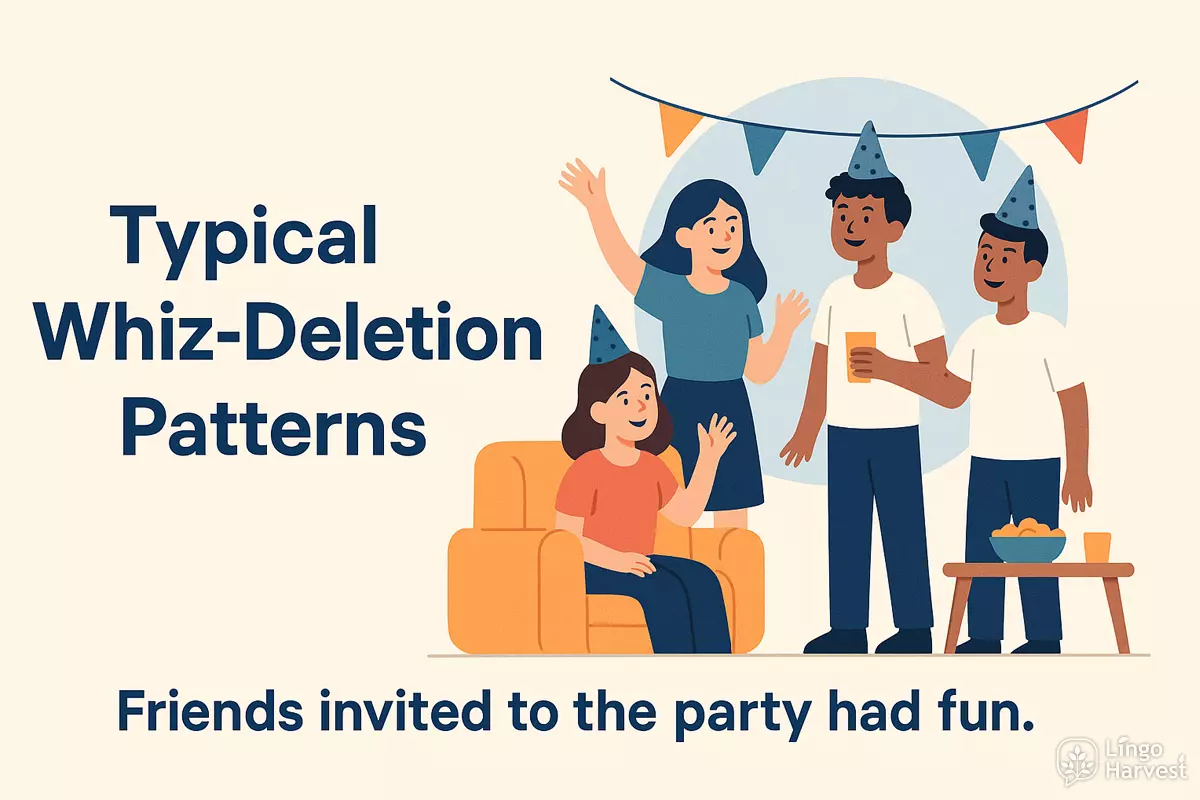
- The man standing by the door is my uncle. (from “The man who is standing by the door is my uncle.”)
- The cake made by Anna was delicious. (from “The cake that was made by Anna was delicious.”)
- People living in this city enjoy many parks. (from “People who are living in this city enjoy many parks.”)
- The book published last year won a prize. (from “The book that was published last year won a prize.”)
- Students invited to the event should RSVP. (from “Students who were invited to the event should RSVP.”)
- The girl wearing a blue jacket is my friend. (from “The girl who is wearing a blue jacket is my friend.”)
- The house built on the hill is expensive. (from “The house that was built on the hill is expensive.”)
- The car parked outside belongs to Tom. (from “The car that is parked outside belongs to Tom.”)
- The email sent yesterday was important. (from “The email that was sent yesterday was important.”)
- Children playing in the park are noisy. (from “Children who are playing in the park are noisy.”)
- The teacher helping us is very kind. (from “The teacher who is helping us is very kind.”)
- The film shown last night was excellent. (from “The film that was shown last night was excellent.”)
- Friends invited to the party had fun. (from “Friends who were invited to the party had fun.”)
Comparison: Full Relative Clause vs. Whiz-Deletion
| Full Relative Clause | With Whiz-Deletion |
|---|---|
| The students who are waiting outside are new. | The students waiting outside are new. |
| The bag that was found is mine. | The bag found is mine. |
| The woman who is talking to John is my boss. | The woman talking to John is my boss. |
| The documents which were sent yesterday are important. | The documents sent yesterday are important. |
Notice how the sentences become shorter and more natural with whiz-deletion. This structure is particularly useful in writing and speaking when you want to sound more fluent and avoid repetition.
Restrictions and Common Errors
When learning about whiz-deletion in relative clauses, it’s important to know where this structure can and cannot be used, as well as the typical mistakes learners make. Whiz-deletion (removing "who is/are," "which is/are," etc.) is only possible in certain situations, and using it incorrectly can lead to confusing or ungrammatical sentences.
Where Whiz-Deletion Is Not Allowed
Some relative clauses don’t permit whiz-deletion. Here are the main restrictions:
- Non-defining relative clauses: You cannot drop "who is" or "which is" in clauses set off by commas, e.g. My sister, who is a doctor, lives in Paris. ❌ My sister, a doctor, lives in Paris. (only possible as apposition, not as whiz-deletion)
- Clauses with verbs, not adjectives or nouns: Whiz-deletion generally works when the relative pronoun + "be" is followed by an adjective, noun, or prepositional phrase, not a verb. E.g. The man who is running → The man running, but The man who runs cannot be reduced.
- Past tense forms: You cannot delete "who was/which was" if the rest of the clause contains a verb, unless you use a perfect or passive participle: The cake which was eaten → The cake eaten.
- Subject clarity: If deleting makes the subject unclear, avoid it.
Frequent Learner Mistakes
Students at B1–B2 often make similar errors with whiz-deletion. Here are some to watch for:
- Dropping "who is" or "which is" in non-defining clauses (with commas)
- Trying to delete when the clause contains a main verb, not an adjective/noun/prepositional phrase
- Forgetting to change the verb form after deletion (e.g., leaving "is" or "are" in the reduced clause)
- Applying whiz-deletion to clauses in past tense without using the correct participle
- Creating ambiguous or confusing sentences by reducing too much
- Using whiz-deletion with "that" (not possible: "The book that is interesting" → "The book interesting" ❌)
- Trying to reduce clauses where the relative pronoun is the object, not the subject (e.g., The boy who I saw ❌)
- Overusing reduction in formal writing, where full clauses are often preferred
- Forgetting to adjust punctuation (no comma for reduced defining clauses)
- Using whiz-deletion with "whose" (not possible)
- Mixing up active and passive reductions (e.g., "The students who were given homework" → "The students given homework", but "The students giving homework" changes the meaning)
Comparing Whiz-Deletion: Allowed vs Not Allowed
| Original Clause | Whiz-Deletion (Reduced Form) |
|---|---|
| The girl who is sitting over there is my friend. ✅ | The girl sitting over there is my friend. |
| The cake which was made by Tom was delicious. ✅ | The cake made by Tom was delicious. |
| My uncle, who is an engineer, lives in Berlin. ❌ | My uncle, an engineer, lives in Berlin. (apposition, not whiz-deletion) |
| The people who work here are friendly. ❌ (verb after "who") | The people working here are friendly. (possible with present participle, not with "work") |
Key Takeaways
Understanding these limitations and common slip-ups helps you use reduced relative clauses more naturally and avoid confusion. Practice by checking whether the clause you want to reduce meets all the requirements. If in doubt, keep the full form.
Clarity Problems to Avoid
When using whiz-deletion in relative clauses, unclear sentences can easily confuse your reader. Whiz-deletion means omitting the relative pronoun and sometimes the verb “be” in clauses like “The man [who is] sitting there.” While this can make sentences shorter, it can also cause ambiguity if used incorrectly.
Common Pitfalls with Whiz-Deletion
- Confusing subject and object: When it’s not clear what the clause describes, readers may misunderstand who is doing the action.
- Omitting important information: If you delete more than just the relative pronoun and “be,” the meaning can change or become unclear.
- Overusing in complex sentences: Too many reduced clauses in one sentence can overload the reader and obscure the main idea.
- Unclear referents: If the noun and the reduced clause are far apart, it’s difficult to tell what is being described.
- Using with non-action verbs: Whiz-deletion works best with continuous forms of action verbs (“The girl [who is] running…”), not with stative verbs (“The man [who is] knows…” is incorrect).
- Mixing tenses: Whiz-deletion is not suitable for all tenses. It’s usually used for present or past continuous, not simple or perfect tenses.
- Pronoun confusion: Deleting the relative pronoun can sometimes make it unclear which noun the clause describes, especially in longer sentences.
- Ambiguous modifiers: Reduced clauses can sometimes be mistaken for regular adjectives or adverbs, changing the intended meaning.
- Awkward sounding phrases: Some reduced clauses sound unnatural and may distract the reader.
- Non-restrictive clauses: Whiz-deletion is only used with defining (restrictive) clauses, not with non-defining (extra information) clauses.
Examples: Clear vs. Unclear Usage
Below are some typical mistakes and how to avoid them:
- ❌ The book lying on the table is mine. (Clear if “lying” refers to the book, but unclear if multiple items are present.)
- ✅ The book that is lying on the table is mine. (Less ambiguity.)
- ❌ The students waiting will enter first. (Who is waiting?)
- ✅ The students who are waiting will enter first.
Table: When Whiz-Deletion Is (and Isn’t) Clear
| Use Whiz-Deletion | Avoid Whiz-Deletion |
|---|---|
| People standing outside are guests. | The man who knows the answer is absent. |
| The car parked in front is mine. | The students who will arrive later need tickets. |
| The woman talking to John is my teacher. | The book that I bought yesterday is great. |
| The child crying wants his mother. | The cat which has been fed is sleeping. |
Remember, reducing relative clauses works best with present or past participles and when the noun being described is clear and close by. Always check if your sentence remains easy to understand after whiz-deletion. If not, keep the full relative clause for clarity.
Practice: Rewrite Using Whiz-Deletion
Ready to apply what you’ve learned about streamlining relative clauses? In this section, you’ll work with sentences that can be shortened using Whiz-deletion. This process involves removing the relative pronoun and the form of "be" when possible, making your English more natural and fluent.
Instructions
For each sentence below, rewrite it by omitting the relative pronoun ("who," "which," or "that") and the verb "be," if possible. This technique is often used to create more concise noun phrases in English.
- The man who is standing by the door is my teacher.
- The book that is lying on the table belongs to Sarah.
- The students who are waiting outside will come in soon.
- The film which is playing tonight is a comedy.
- The cake that is decorated with strawberries looks delicious.
- The woman who is talking to John is his sister.
- The cars that are parked in front of the house are new.
- The painting which is hanging on the wall was made by my uncle.
- The bag that is made of leather is expensive.
- The children who are playing in the yard are my cousins.
Show answers
- The man standing by the door is my teacher.
- The book lying on the table belongs to Sarah.
- The students waiting outside will come in soon.
- The film playing tonight is a comedy.
- The cake decorated with strawberries looks delicious.
- The woman talking to John is his sister.
- The cars parked in front of the house are new.
- The painting hanging on the wall was made by my uncle.
- The bag made of leather is expensive.
- The children playing in the yard are my cousins.
Common Patterns for Whiz-Deletion
- Noun + who is → Noun + present participle (e.g., "the girl who is singing" → "the girl singing")
- Noun + that is/which is + adjective/past participle → Noun + adjective/past participle (e.g., "the car that is parked" → "the car parked")
- Noun + which is/that is + prepositional phrase → Noun + prepositional phrase (e.g., "the house which is on the hill" → "the house on the hill")
Practicing this structure helps you form more natural English phrases, especially in writing and formal contexts. Try making your own sentences and apply Whiz-deletion for extra practice!