Advanced Relative Clause Reduction: How to Compress Complex Sentences

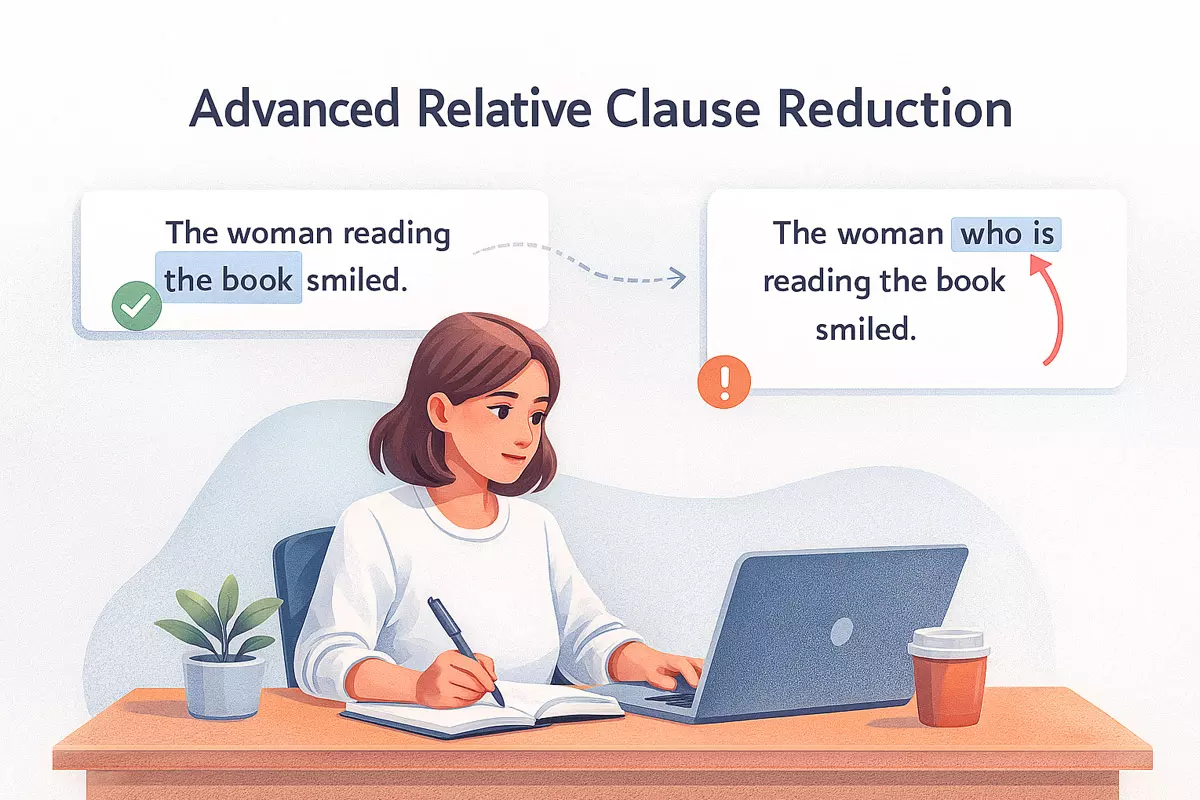 Here we what relative clause reduction is, the types that can be reduced, and how to reduce active, passive, and continuous forms. It also explains when reduction is inappropriate, its effects on writing, and offers practice with reduced clauses.
Condensing lengthy sentences into concise, clear statements improves your writing and makes it easier to read. By learning how to shorten clauses that describe nouns, you can create sophisticated prose while maintaining clarity and preserving the intended meaning. This approach not only sharpens your style but also ensures that your ideas are communicated more effectively, making your writing more engaging for readers and helping them grasp your message without unnecessary complexity or confusion.
What relative clause reduction is
Reducing relative clauses involves simplifying sentences by omitting certain elements, typically the relative pronoun (like "who," "which," or "that") and sometimes the auxiliary verb. This process transforms a full relative clause into a more concise phrase, making your writing less wordy and often more formal. For example, instead of saying "The book that is lying on the table is mine," you can say "The book lying on the table is mine."
This technique is especially handy in academic or professional contexts, where clarity and brevity are valued. It allows you to compress complex sentences, combining information efficiently without sacrificing meaning. The result is a streamlined sentence structure that still conveys all necessary details.
When and why to use clause reduction
- To make sentences shorter and more readable
- When the relative clause contains a form of "be" as the verb (e.g., "who is," "which are")
- To avoid repetition and redundancy
- In formal writing, where conciseness is preferred
- When the subject of the relative clause matches the noun it modifies
Common patterns and examples
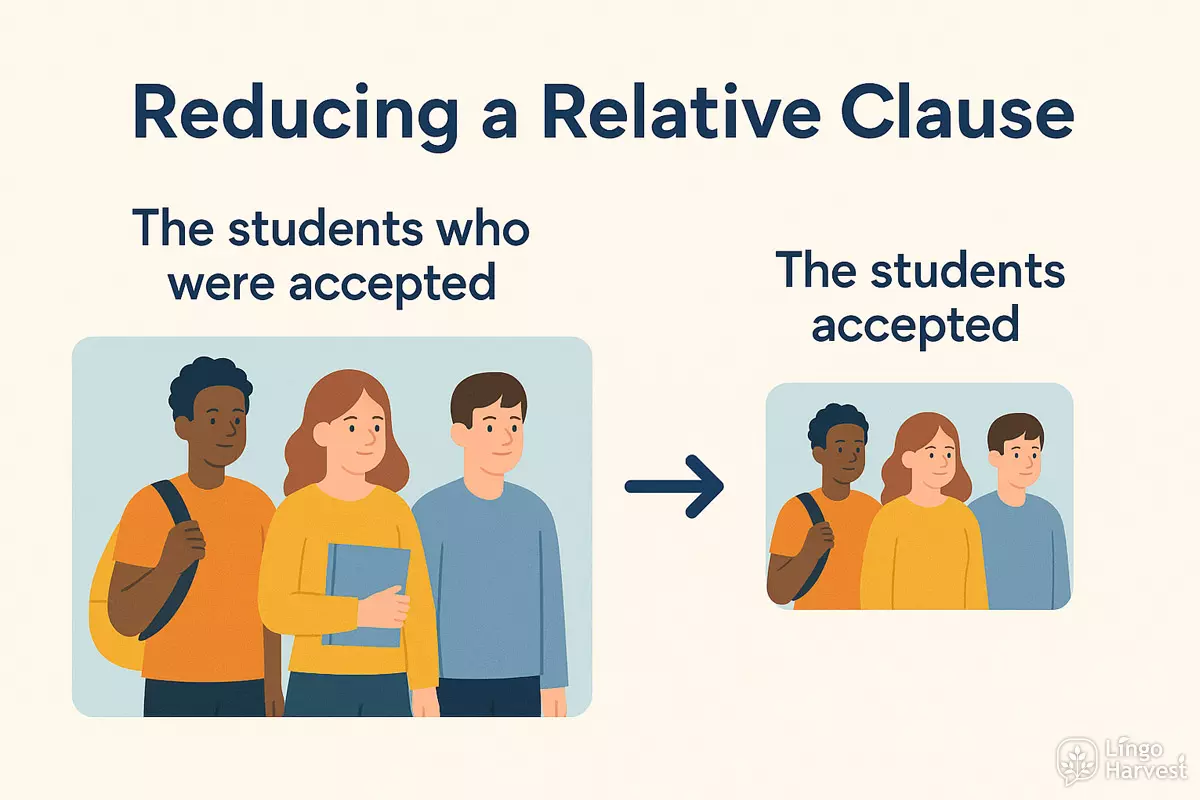
You can reduce relative clauses mainly in two ways: by removing the relative pronoun and auxiliary verb, or by using a present or past participle. Here are some typical transformations:
- The man who is talking → The man talking
- The students who were accepted → The students accepted
- The car that was stolen → The car stolen
- The ideas which are presented → The ideas presented
- The report which was submitted yesterday → The report submitted yesterday
- The woman who lives next door → The woman living next door
- The book that contains useful tips → The book containing useful tips
- The emails that were sent today → The emails sent today
- The children who play outside → The children playing outside
- The documents which are needed → The documents needed
Key points to remember
- Reduction is only possible when the relative pronoun refers to the subject of the clause.
- If the clause describes an ongoing action, use the present participle ("-ing" form).
- For passive meanings, use the past participle.
- Not all clauses can or should be reduced; clarity is the priority.
Types of reducible relative clauses
Understanding which relative clauses can be reduced is essential for streamlining sentences without losing meaning. Only certain patterns allow for safe compression, and recognizing these is crucial for advanced sentence manipulation.
Defining vs. Non-defining Clauses
Not every clause is eligible for reduction. Defining (restrictive) relative clauses often allow reduction, especially when the relative pronoun acts as the subject and the verb is in an appropriate form. Non-defining (non-restrictive) clauses, which provide extra information set off by commas, generally resist reduction.
Patterns That Allow Reduction
Most reducible clauses fall into a few predictable categories. The most common involve subject pronouns and verbs in the present or past participle forms. Here are key structures where reduction is possible:
- Subject + “who/that/which” + active verb → Present participle (e.g., “The man who works here” → “The man working here”)
- Subject + “who/that/which” + passive verb → Past participle (e.g., “The books that were written by her” → “The books written by her”)
- Omitting the relative pronoun when it is the object (e.g., “The film that I watched” → “The film I watched”)
Common Forms and Examples
The following examples illustrate the main patterns for reducing relative clauses. Each represents a core transformation used in advanced sentence compression:
- The students who are studying for exams → The students studying for exams
- The package that was delivered yesterday → The package delivered yesterday
- The car which is parked outside → The car parked outside
- The person who lives next door → The person living next door
- The cake that Mary baked → The cake Mary baked
- The documents which were signed by the manager → The documents signed by the manager
- People who speak French → People speaking French
- Projects that have been completed → Projects completed
- The animals that were rescued → The animals rescued
- The letter which was sent last week → The letter sent last week
- The man who was injured in the accident → The man injured in the accident
- The courses that are offered online → The courses offered online
- Children who play outside → Children playing outside
- The song that is played at weddings → The song played at weddings
- The house that Jack built → The house Jack built
Comparison of Reduction Types
Below is a comparison of main reduction strategies, showing their structure and the resulting compressed form.
| Original Clause | Reduced Form |
|---|---|
| The students who are waiting | The students waiting |
| The report that was published | The report published |
| The laptop which is used daily | The laptop used daily |
| The girl who lives next door | The girl living next door |
| The advice that he gave | The advice he gave |
Recognizing these constructions helps in identifying opportunities for clause reduction, leading to more concise and fluent academic or professional writing. Each pattern has its own rules, and understanding these distinctions is key for mastering complex sentence compression.
Reducing active, passive, and continuous forms
When working with complex sentences that include relative clauses, one effective way to condense information is to shorten verb forms. This process involves removing auxiliary verbs and relative pronouns, especially when the subject of the relative clause matches the noun it modifies. The result is a cleaner, more readable sentence that still conveys the essential meaning.
Active form reduction
For clauses in the active voice, you can often omit the relative pronoun and change the verb to its -ing form. This is especially useful when describing ongoing or habitual actions. For example:
- The man who drives the bus → The man driving the bus
- Students who study late often feel tired → Students studying late often feel tired
- Children who play outside are healthier → Children playing outside are healthier
- Anyone who wants to join must register → Anyone wanting to join must register
Passive form reduction
When the relative clause is in the passive, you can use the past participle to reduce the clause. This makes the sentence more concise and often more formal. For instance:
- The books that were written by her → The books written by her
- The house that was built last year → The house built last year
- Documents that are required must be submitted → Documents required must be submitted
- The results that were expected did not appear → The results expected did not appear
Continuous and perfect forms
Ongoing actions in relative clauses can be shortened by using the -ing form, while completed actions may use the past participle. For perfect aspect, the reduction is less common but possible in very formal or technical writing. Here are some examples:
- The workers who are repairing the road → The workers repairing the road
- The cake that has been baked today → The cake baked today
- The people who have completed the survey → The people having completed the survey (formal)
| Full Relative Clause | Reduced Form |
|---|---|
| The cars that are parked outside | The cars parked outside |
| The woman who is talking to John | The woman talking to John |
| The report that was completed yesterday | The report completed yesterday |
| People who live in cities | People living in cities |
| The students who were chosen for the award | The students chosen for the award |
Key points for effective reduction
- Ensure the reduced clause clearly modifies the correct noun.
- Avoid ambiguity by keeping the sentence logical and easy to follow.
- Remember that only defining (restrictive) relative clauses can usually be reduced.
- Use -ing for active, ongoing actions; past participle for passive or completed actions.
- Check that the subject of the main clause and the reduced clause match to avoid confusion.
By mastering these reduction strategies, your writing will become more concise and sophisticated, helping you convey complex ideas with clarity.
When reduction is not possible or safe
Sometimes, transforming a relative clause into a reduced form can lead to ambiguity, ungrammatical results, or even a loss of crucial information. Not every clause is a candidate for reduction—specific structures, meanings, or contexts require the full, explicit form to preserve clarity and grammaticality.
Cases Where Reduction Should Be Avoided
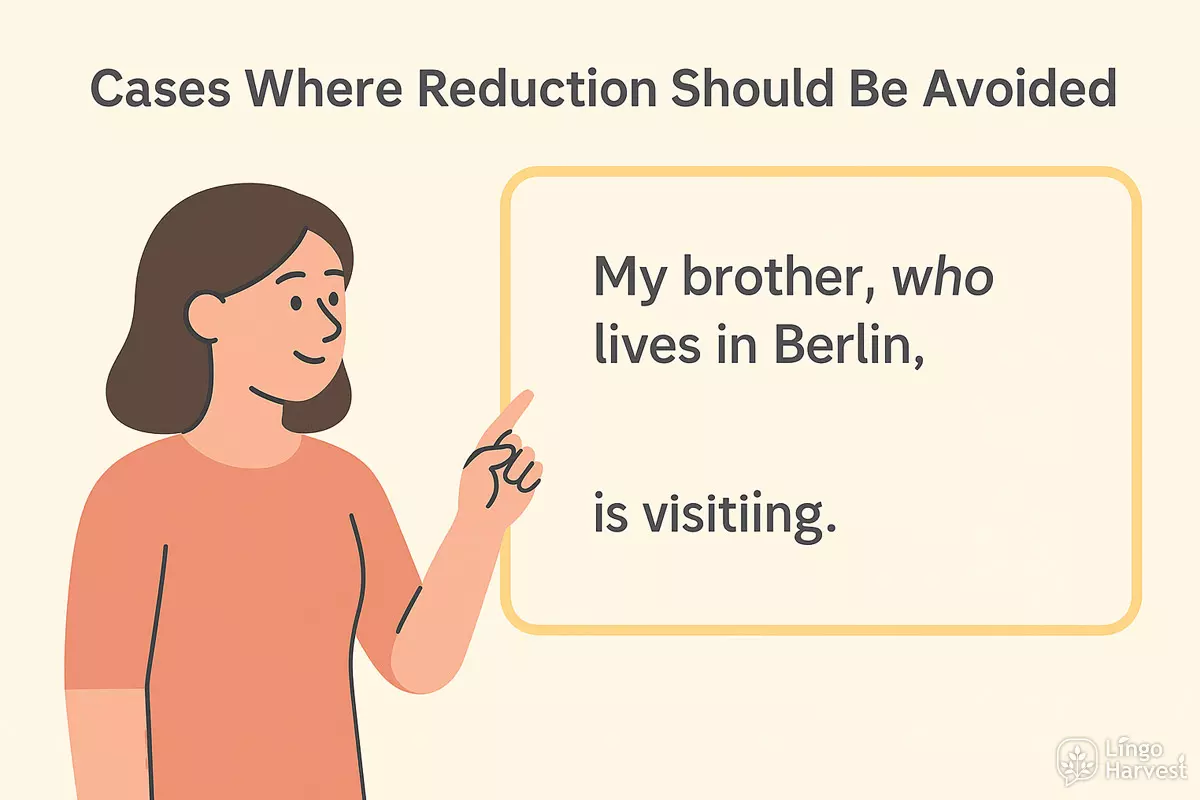
- Non-defining (non-restrictive) clauses: Clauses set off by commas, such as “My brother, who lives in Berlin, is visiting,” cannot be reduced. The information is additional, not essential, and reduction would cause confusion.
- Clauses with explicit subjects: If the relative clause has its own subject (not the noun being modified), reduction is ungrammatical. For example, “The book that she recommended…” cannot be reduced because “she” is not the subject of “book.”
- Clauses using “where,” “when,” or “why”: Reduction is generally not possible with these relative pronouns, as in “the year when I graduated.”
- Clauses expressing contrast, reason, or condition: Relative clauses that serve functions beyond simple description often require full forms for clarity.
- Passive constructions with ambiguity: Sometimes, reducing a passive relative clause can produce unclear or awkward sentences, especially if the agent is omitted.
- Clauses containing modal verbs: Phrases like “that can be seen” typically cannot be reduced to “can be seen.”
- Clauses with prepositions at the end: If a preposition is stranded (e.g., “the house that I lived in”), reduction may lead to unnatural phrasing.
- Clauses modifying abstract nouns: Reduction often sounds odd when the antecedent is an abstract concept (e.g., “the fact that she arrived late”).
- Clauses with negation: Sentences like “the only student who didn’t finish” are usually not reduced, as the negation is lost or distorted.
- Clauses modifying pronouns: Relative clauses after pronouns (e.g., “something that annoys me”) rarely undergo reduction.
Potential Pitfalls of Over-Reduction
Attempting to reduce a clause in the wrong context can result in sentences that are difficult to understand or even grammatically incorrect. For example, reducing “The manager who was responsible for the error…” to “The manager responsible for the error…” works, but reducing “The manager who he fired…” to “The manager he fired…” changes the meaning entirely.
Summary Table: Common Reduction Barriers
| Situation | Why Reduction Fails |
|---|---|
| Non-defining relative clauses | Reduction causes loss of non-essential information |
| Clauses with their own subject | Subject mismatch makes reduction ungrammatical |
| Relative clauses with “where/when/why” | Reduction disrupts meaning or structure |
| Negative or modal constructions | Reduction leads to loss of nuance or clarity |
Key Takeaways
When deciding whether to compress a relative clause, always check for ambiguity, essential details, and grammatical fit. If reduction risks altering the sentence’s meaning or readability, it’s better to keep the full clause.
Effects on style, clarity, and formality
Reducing relative clauses can reshape how sentences feel and function. By condensing complex structures, writers can make prose more succinct and energetic, but the process also influences the overall tone and precision of the text.
Impact on Writing Style
Shortening relative clauses often results in a brisker, more modern style. For example, "The book that was recommended by my professor" becomes "The book recommended by my professor." This approach can lend writing a more direct and professional tone, which is especially valued in academic and technical contexts. However, overuse may create a choppy or abrupt rhythm, so variety remains important.
Clarity and Reader Understanding
Simplifying sentences via clause reduction can enhance clarity by stripping away redundancy. However, omitting too much detail or context may lead to ambiguity. For instance, "Students who complete the assignment early" is clearer than "Students completing the assignment early" if the timing or conditions are crucial. Always assess whether the reduced form preserves the intended meaning.
Formality and Tone
Relative clause reduction generally increases formality. It removes conversational fillers, yielding more polished and impersonal language. In formal reports, academic papers, and business communication, this is usually desirable. On the other hand, in narrative or dialog, full clauses may sound friendlier and more natural.
Comparison of Full and Reduced Relative Clauses
Below is a comparison illustrating how different forms affect sentence characteristics:
| Full Relative Clause | Reduced Relative Clause | Effect on Sentence |
|---|---|---|
| The employee who was promoted last year | The employee promoted last year | More concise; slightly more formal |
| The data that are collected annually | The data collected annually | Streamlined; potential for ambiguity if context is lost |
| The report which was submitted yesterday | The report submitted yesterday | Sharper focus on the noun; formal |
| The students who are studying abroad | The students studying abroad | More direct; suitable for summaries and headlines |
Common Patterns and Considerations
- Omitting "who/that/which + be" when followed by a participle or adjective
- Ensuring reduced forms do not introduce ambiguity
- Maintaining subject-verb agreement after reduction
- Preserving essential information by avoiding over-reduction
- Balancing sentence variety for readability
- Adapting reductions to match the required tone (e.g., formal vs. informal)
- Checking for misplaced modifiers after reduction
- Using reductions in headlines and abstracts for brevity
- Revising reduced clauses when clarity is compromised
- Being mindful of audience expectations and genre conventions
In summary, advanced relative clause reduction is a powerful tool for refining prose, but it requires careful judgment to maintain clarity, appropriate tone, and the desired level of formality.
Practice: rewrite sentences using reduced clauses
Reducing relative clauses is a powerful way to make your writing more concise and sophisticated. In this exercise section, you’ll work with sentences that can be compressed by omitting relative pronouns and auxiliary verbs, or by changing clauses into participle phrases.
Instructions
Below, you’ll find sentences containing full relative clauses. Try to rewrite each one using a reduced clause. This often means removing words like “who,” “that,” or “which,” and changing the verb form when possible. Focus on accuracy as well as clarity.
Examples of Reduction Patterns
- Active clauses: Replace “who/that/which + verb” with a present participle (“-ing” form).
- Passive clauses: Replace “who/that/which + is/are + past participle” with a past participle phrase.
- Be + adjective/prepositional phrase: Remove the relative pronoun and “be” verb.
Practice Sentences
- The students who live in this dormitory are from various countries.
- The book that was written by the professor became a bestseller.
- We saw a film which was directed by a famous artist.
- Anyone who wants to join the club must fill out an application.
- The documents that are required for registration should be submitted by Friday.
- People who speak several languages have more job opportunities.
- The results that were published yesterday surprised the experts.
- The car which is parked outside belongs to my neighbor.
- The emails that are sent daily contain important updates.
- Employees who have completed the training can apply for promotion.
Show answers
- The students living in this dormitory are from various countries.
- The book written by the professor became a bestseller.
- We saw a film directed by a famous artist.
- Anyone wanting to join the club must fill out an application.
- The documents required for registration should be submitted by Friday.
- People speaking several languages have more job opportunities.
- The results published yesterday surprised the experts.
- The car parked outside belongs to my neighbor.
- The emails sent daily contain important updates.
- Employees having completed the training can apply for promotion.
Quick Reference: Full vs. Reduced Relative Clauses
| Full Relative Clause | Reduced Clause |
|---|---|
| The woman who is talking to the manager is my supervisor. | The woman talking to the manager is my supervisor. |
| The report that was completed last week is on your desk. | The report completed last week is on your desk. |
| The children who play in the park are my neighbors. | The children playing in the park are my neighbors. |
| The letters that are delivered every morning are important. | The letters delivered every morning are important. |
As you practice, remember that not every relative clause can or should be reduced. When in doubt, check if the meaning remains clear and unambiguous after reduction.