Fully Omitted Relative Clauses: When You Can Drop “Who / Which / That”

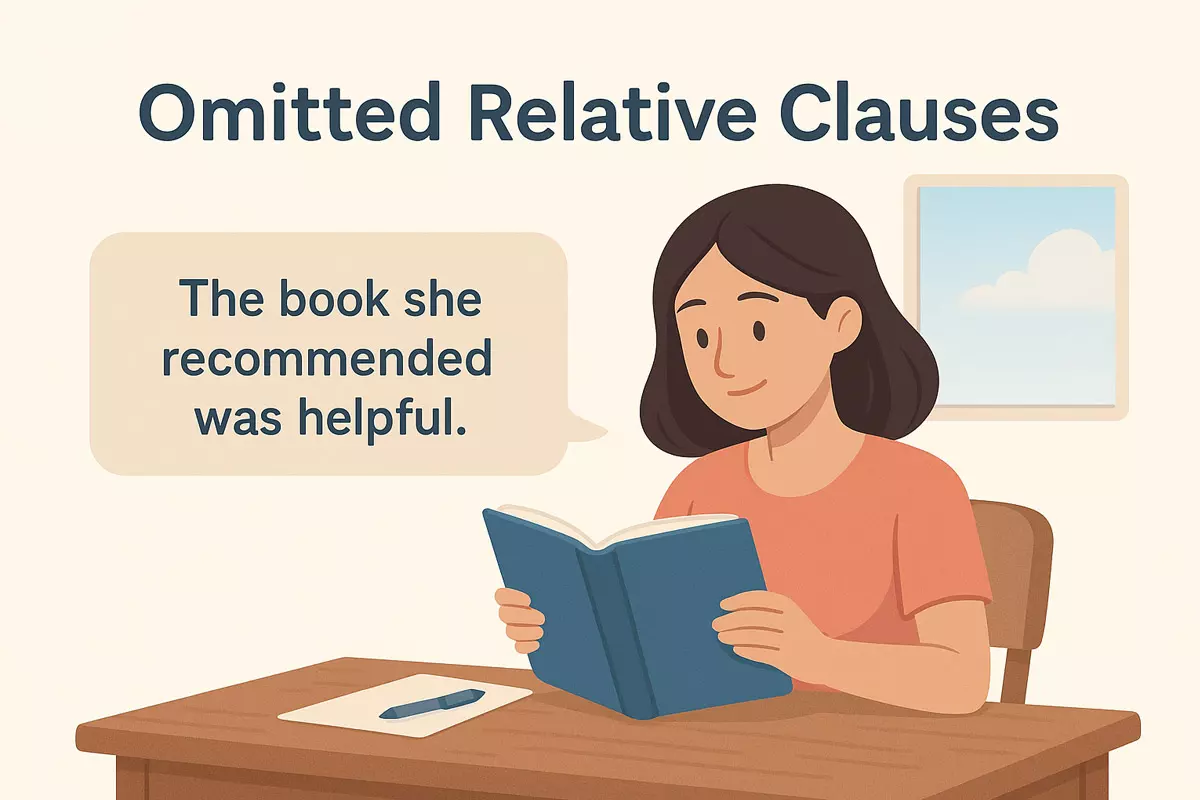 Here we the difference between reduced and omitted clauses, when you can omit relative pronouns, and how this differs for subject and object clauses.
Have you ever noticed that some English sentences omit certain connecting words but still remain clear and effective? Knowing when it is appropriate to leave out these small connectors can help make your writing flow better and sound more natural. By mastering this aspect of English, you can create sentences that are concise without sacrificing meaning, ultimately improving the readability and impact of your communication.
Difference between reduced and omitted clauses
When working with relative clauses, English offers two main shortcuts: reduction and omission. These approaches often look similar but serve different purposes and follow different rules. Understanding how they work can help you make your writing clearer and more concise.
What is a reduced relative clause?
A reduced relative clause shortens the original clause by removing the relative pronoun and sometimes the verb “be.” This is only possible when the relative clause is non-defining and the meaning remains clear. Typically, reduced forms use participles:
- The man driving the car is my uncle. (from “The man who is driving the car…”)
- Students invited to the conference should register early. (from “Students who were invited to the conference…”)
The information is still present, but it’s condensed into a more streamlined expression. Reduced clauses usually keep the descriptive function but drop some words.
What is an omitted relative clause?
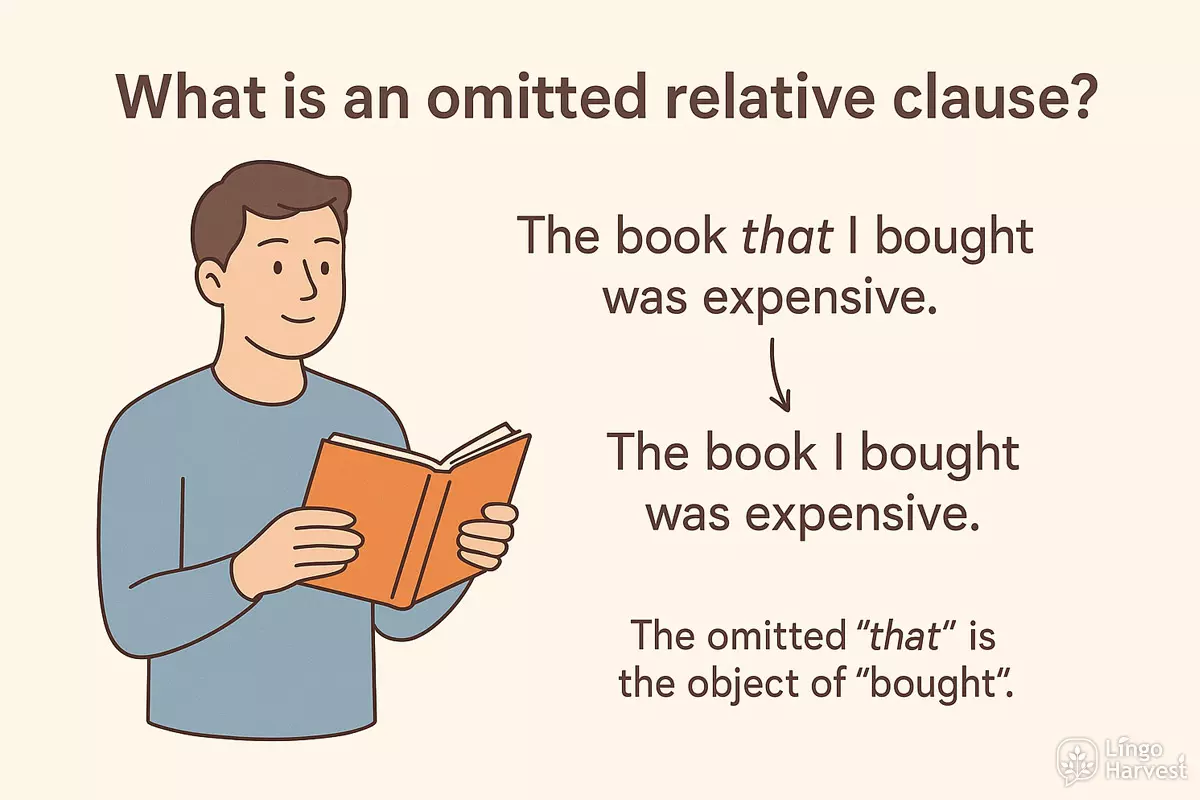
Omission, on the other hand, means leaving out the relative pronoun entirely—most often “who,” “which,” or “that.” This is only possible when the pronoun would function as the object of the clause, not the subject. The verb and the rest of the clause remain:
- The book (that) I bought was expensive. (The omitted “that” is the object of “bought.”)
- Here’s the cake (which) she made.
If the pronoun is the subject, omission isn’t possible: The boy who lives next door… (You can’t omit “who” here.)
Key differences at a glance
| Feature | Reduced Clause | Omitted Clause |
|---|---|---|
| What’s removed? | Relative pronoun + sometimes “be” verb | Only the relative pronoun (object position) |
| Clause structure | Often uses participles (verb forms) | Full clause remains, minus the pronoun |
| Allowed with | Subject or object relative clauses | Only object relative clauses |
| Examples | “People living in London…” “The car parked outside…” |
“The movie (that) I watched…” “The gift (which) she sent…” |
| Usage focus | Condenses information, more formal/written | Streamlines sentences, common in speech |
Quick reference: when to use each
- Reduce the clause if you can rephrase with a participle and the meaning stays clear.
- Omit the pronoun only when it’s the object, never the subject.
- Check if the reduced or omitted form fits naturally in your sentence; not all clauses can be shortened or dropped.
Understanding these distinctions helps you choose the right structure for clarity and flow—whether you’re writing formally or speaking casually.
Contexts where the relative pronoun can disappear
In English, certain situations allow you to drop the relative pronoun (“who,” “which,” or “that”) from a relative clause without causing confusion or grammatical errors. This omission isn’t always possible—there are some clear rules and patterns that guide when it's acceptable.
When omission is possible
The relative pronoun can be left out when it is not the subject of the relative clause. In other words, if the pronoun acts as the object, you can usually omit it. You’ll notice this most in informal spoken and written English, especially with restrictive (defining) clauses.
- The book you gave me was fascinating. (instead of “that you gave me”)
- The cake she baked was delicious. (instead of “which she baked”)
- The movie we watched was long. (instead of “that we watched”)
- The person I met yesterday is my neighbor. (instead of “who I met”)
- The letter he wrote made me smile. (instead of “that he wrote”)
- The shoes you bought are on sale. (instead of “that you bought”)
- The song we heard is stuck in my head. (instead of “that we heard”)
- The car they rented broke down. (instead of “which they rented”)
- The advice she gave was helpful. (instead of “that she gave”)
- The friend he invited didn’t come. (instead of “who he invited”)
When omission is NOT possible
You cannot drop the relative pronoun if it is the subject of the clause. For instance:
- The student who won the prize is absent. ❌ (cannot omit “who”)
- The car that broke down was new. ❌ (cannot omit “that”)
Summary: Subject vs. Object Position
The main deciding factor is whether the relative pronoun is functioning as the subject or the object in the clause. Here’s a quick comparison:
| Relative Pronoun as Subject | Relative Pronoun as Object |
|---|---|
| The man who called you is waiting. ❌ Cannot omit “who” |
The man you called is waiting. ✅ Can omit “who” |
| The book that inspired me is famous. ❌ Cannot omit “that” |
The book I read is famous. ✅ Can omit “that” |
| The cat which lives next door is friendly. ❌ Cannot omit “which” |
The cat we adopted is friendly. ✅ Can omit “which” |
| The woman who teaches us is kind. ❌ Cannot omit “who” |
The woman we respect is kind. ✅ Can omit “who” |
Other relevant patterns
Omission is generally not possible in non-defining (non-restrictive) relative clauses—those set off by commas. It’s also not allowed when the pronoun is followed by a preposition at the start of the clause (“the person to whom I spoke”). In informal English, you might sometimes find prepositions at the end, which can allow omission (“the person I spoke to”). Understanding these patterns will help you decide when you can safely leave out the relative pronoun, making your sentences more concise and natural.
Object vs subject relative clause omission
In English, dropping the relative pronoun—like “who,” “which,” or “that”—is possible in some sentences, but not always. The option to omit these words depends on their grammatical role in the relative clause. Specifically, omission is allowed when the pronoun acts as the object, but not when it’s the subject.
When can you leave out the relative pronoun?
You can usually skip the pronoun if it would be the object of the verb in the relative clause. For example:
- This is the book (that) I read yesterday. ✅
- She’s the person (who) I met at the conference. ✅
- Here’s a movie (which) we watched together. ✅
In each case, the omitted word is not the subject of the clause, but the object.
When do you need to keep the relative pronoun?
If the pronoun is the subject in the clause, you must keep it. Omitting it would make the sentence ungrammatical:
- This is the book that inspired me. ❌ (Can’t omit “that” here)
- The man who called you is waiting. ❌
- The dog which barked all night kept us awake. ❌
Here, the relative pronoun is essential because it serves as the subject for the verb in the clause.
Side-by-side comparison
To make the difference clearer, here’s a structured comparison of object and subject roles and whether omission is possible:
| Example Sentence | Role of Pronoun | Can Omit? | Grammatical? |
|---|---|---|---|
| This is the cake (that) I baked. | Object | Yes | ✅ Correct |
| This is the cake that won the prize. | Subject | No | ❌ Incorrect if omitted |
| The person (who) you called is here. | Object | Yes | ✅ Correct |
| The person who called you is here. | Subject | No | ❌ Incorrect if omitted |
| That’s the movie (which) I love. | Object | Yes | ✅ Correct |
| That’s the movie which changed everything. | Subject | No | ❌ Incorrect if omitted |
Quick reference: Omission rules
- Object pronouns in relative clauses: omission allowed, especially in informal speech and writing.
- Subject pronouns in relative clauses: must be kept for the sentence to be correct.
- Prepositional objects: omission is possible, but the preposition usually moves to the end (“the person (who) I spoke to”).
- Possessives (“whose”): never omitted.
Understanding whether the relative pronoun is acting as the subject or object helps you decide if dropping it is possible. This distinction is key for writing clear and fluent English.
Spoken vs written preferences
How we use omitted relative pronouns often depends on whether we’re speaking or writing. In casual speech, it’s common to drop “who,” “which,” or “that” when the meaning is clear. Written language, especially in formal contexts, tends to keep these words for clarity and precision.
Everyday speech: dropping relative pronouns
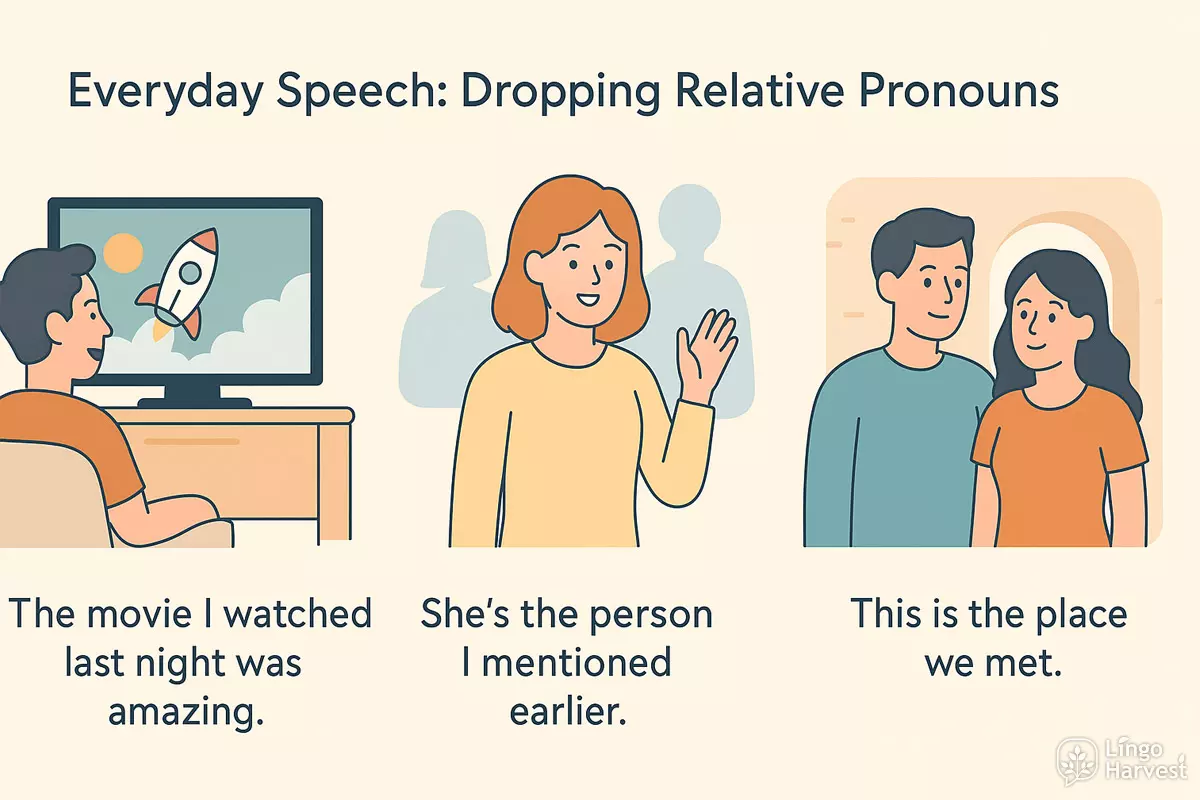
In conversation, listeners can infer missing words from context and intonation, so sentences like “That’s the book I told you about” sound natural. Speakers rely on shared understanding and rarely notice the absence of “that” or “which.”
- The movie I watched last night was amazing.
- She’s the person I mentioned earlier.
- This is the place we met.
- Here’s the cake you made.
- The job I applied for is still open.
- The friend you called is here.
- The song I love just played.
- The bag you lost was found.
- The answer I gave was correct.
- The advice you offered helped a lot.
Writing: retaining relative pronouns
In writing, especially in essays, reports, or formal emails, omitting relative pronouns can sometimes cause confusion or ambiguity. Readers lack the immediate feedback of conversation, so writers often include “who,” “which,” or “that” to ensure clarity. For example, “The report that you submitted was excellent” leaves no doubt about which report is meant.
| Spoken English (often omits) |
Written English (often retains) |
|---|---|
| The car I bought is blue. | The car that I bought is blue. |
| The teacher I like is leaving. | The teacher who I like is leaving. |
| This is the book you wanted. | This is the book which you wanted. |
| The project we discussed is starting. | The project that we discussed is starting. |
| The shoes you ordered arrived. | The shoes that you ordered arrived. |
| The friend I met yesterday called me. | The friend whom I met yesterday called me. |
Summary: context shapes usage
Generally, omitting relative pronouns is more acceptable and frequent in casual conversation, where brevity and speed matter. In contrast, formal writing favors including them to avoid ambiguity. Knowing your audience and the context will help you decide whether to drop or keep these words for smooth, clear communication.
Risks of ambiguity after omission
Leaving out relative pronouns like “who,” “which,” or “that” can make sentences feel more natural and concise, but it also opens the door to potential confusion. When the connector is missing, readers sometimes struggle to figure out which word or phrase is being described, or even misinterpret the sentence entirely. This is especially true in more complex sentences, where context alone may not be enough to clarify the intended meaning.
Common sources of confusion
- Unclear antecedents: Without an explicit connector, it’s harder to know which noun is being modified.
- Multiple possible referents: If there are several nouns in a sentence, omitting the relative pronoun can create ambiguity about which one is meant.
- Reduced clauses: Dropping the relative pronoun and auxiliary verb can make the clause look like a standalone phrase, blurring sentence boundaries.
- Misleading word order: Rearranged sentences may cause the modifier to attach to the wrong noun.
- Passive constructions: Omissions in passive voice can make it unclear who is performing the action.
- Nonrestrictive vs. restrictive confusion: Omitting the relative pronoun can sometimes make it unclear whether a clause is essential or extra information.
Examples of ambiguous sentences after omission
- “The students saw the man walking” (Who is walking—the students or the man?)
- “She found the book lost last week” (Was the book lost, or did she lose it?)
- “He met the artist painted the mural” (Did he meet the artist, or did he paint the mural?)
- “The cake baked yesterday was delicious” (Did someone bake the cake, or did the cake bake itself?)
- “I spoke to the manager recommended by my friend” (Who recommended whom?)
- “We discussed the project finished early” (Which project? The one finished early, or was it finished early?)
- “Children playing outside can be noisy” (Are the children noisy, or is playing outside noisy?)
- “The girl wearing a red hat smiled” (Is it clear which girl?)
- “People living in the city often commute” (Is it about people in general or a specific group?)
- “The car parked outside belongs to me” (Is it clear which car?)
Strategies to avoid misinterpretation
- Reintroduce the relative pronoun when the sentence structure is complex.
- Restructure the sentence to make the relationship between nouns and modifiers clearer.
- Use punctuation, such as commas, to signal nonrestrictive clauses.
- Limit omission to contexts where there is only one possible antecedent.
- Read sentences aloud to check for possible double meanings.
Omitting relative pronouns is a useful tool for making language more direct, but it requires careful attention to clarity. When in doubt, err on the side of explicitness to avoid confusion for your readers.
Practice: decide when to omit or keep the pronoun
Understanding when you can leave out the relative pronoun (“who”, “which”, or “that”) is crucial for writing clear, natural English. The key is to know the function of the pronoun in the relative clause: sometimes it’s essential, while other times it can be dropped without changing the meaning.
Identifying When to Drop the Pronoun
When the relative pronoun acts as the object of the clause, it can usually be omitted. If it is the subject, it must be kept. Let’s practice by looking at various sentences—decide if the pronoun can be left out or not.
- The book that I read was fascinating.
- The man who called you is waiting.
- Here’s the cake which she made yesterday.
- The student who won the prize is absent.
- This is the movie that we watched last week.
- The woman who lives next door is a doctor.
- They found the keys that I lost.
- The letter which arrived today is from my friend.
- She’s the person who everyone admires.
- The song that you recommended is great.
- The team which won the match is celebrating.
- This is the artist who painted the mural.
Quick Reference: Subject vs. Object Relative Clauses
Use the table below to compare when the pronoun is necessary and when it can be left out.
| Function of Pronoun | Omission Possible? | Example (with/without pronoun) |
|---|---|---|
| Subject | No | The man who called is here. Cannot omit “who” |
| Object | Yes | The book that I read is new. The book I read is new. |
| Preposition + Object | Yes (in informal English) | The house that I live in is old. The house I live in is old. |
| Possessive (“whose”) | No | The boy whose bike was stolen is upset. Cannot omit “whose” |
Try It Yourself: Omit or Keep?
For each sentence below, decide if the relative pronoun can be omitted. Write Omit or Keep.
- The movie that we saw was amazing.
- The girl who lives next door is friendly.
- The email which you sent arrived late.
- The teacher who helped me was kind.
- The chair that is broken needs fixing.
- The dog which barked all night kept me awake.
- The book that I ordered arrived today.
- The student who answered first was correct.
- The package which they delivered was damaged.
- The friend who called earlier wants to meet.
Show answers
- Omit (“that” is object: The movie we saw…)
- Keep (“who” is subject: The girl who lives…)
- Omit (“which” is object: The email you sent…)
- Keep (“who” is subject: The teacher who helped…)
- Keep (“that” is subject: The chair that is broken…)
- Keep (“which” is subject: The dog which barked…)
- Omit (“that” is object: The book I ordered…)
- Keep (“who” is subject: The student who answered…)
- Omit (“which” is object: The package they delivered…)
- Keep (“who” is subject: The friend who called…)
Extra Challenge: Fix the Sentences
Some of the sentences below are incorrect because the relative pronoun was omitted when it shouldn’t be. Identify and correct them.
- The man called is my uncle.
- The book you lent me was interesting.
- The students finished early went home.
- This is the cake she baked.
- The woman arrived late apologized.
- The movie we watched yesterday was fantastic.
- The car broke down caused a long delay.
- The letter you sent arrived this morning.
- The teacher explained the rule was patient.
- The gift he gave me was thoughtful.
Show answers
- The man who called is my uncle. (Add “who” – subject)
- Correct as is. (“you lent me” – object, omission OK)
- The students who finished early went home. (Add “who” – subject)
- Correct as is. (“she baked” – object, omission OK)
- The woman who arrived late apologized. (Add “who” – subject)
- Correct as is. (“we watched” – object, omission OK)
- The car that broke down caused a long delay. (Add “that” – subject)
- Correct as is. (“you sent” – object, omission OK)
- The teacher who explained the rule was patient. (Add “who” – subject)
- Correct as is. (“he gave me” – object, omission OK)
With practice, you’ll get a feel for when dropping the relative pronoun is natural and when it’s not. Focus on whether the pronoun is the subject or object of its clause—this is the key to mastering fully omitted relative clauses.