Complex Appositive Clauses for Academic Precision in Writing

 This article explains what appositive clauses are, how they differ from relative clauses, and when to use that-clauses in apposition. It covers punctuation rules, their role in academic writing, and provides practice exercises.
Mastering nuanced grammatical constructions, especially complex noun modifiers, can greatly improve the clarity and precision of academic writing. By skillfully employing these structures, writers are able to present detailed and layered information in a concise manner, which not only strengthens the depth of their arguments but also ensures that their ideas are communicated accurately. Such proficiency in grammar helps scholars avoid ambiguity and makes their research more accessible and compelling to readers, ultimately contributing to higher standards in scholarly discourse.
What appositive clauses are
Academic writing often uses specific sentence structures to clarify, define, and add detail. One such structure is the appositive clause, which provides additional information about a noun or noun phrase. Unlike simple appositives, which are typically single nouns or noun phrases, these clauses are more complex and contain a subject and a verb. They serve to explain, specify, or elaborate on the noun they follow, making writing more precise and nuanced.
Defining Features
- Always function as noun modifiers, giving extra information about another noun.
- Usually introduced by conjunctions such as that, whether, or how.
- Contain a subject and a predicate, unlike simple appositives.
- Can be restrictive (essential to meaning) or non-restrictive (additional but not essential).
Common Patterns and Examples

Here are some typical ways these clauses appear in academic texts:
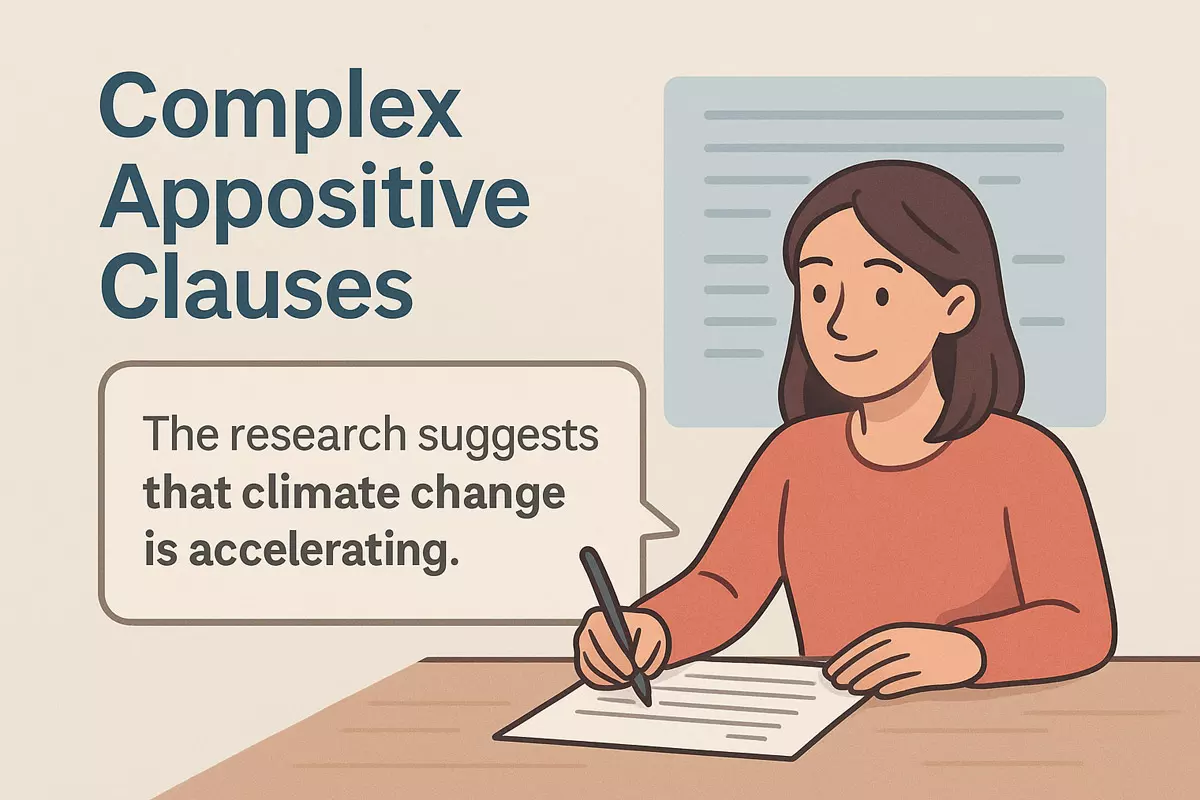
- The idea that climate change is accelerating has gained widespread acceptance.
- Her belief that hard work leads to success motivates her students.
- The question whether these results are valid remains unresolved.
- There is a possibility that the experiment will fail.
- His suggestion that we postpone the meeting was accepted.
- The fact that many participants dropped out affected the results.
- The assumption that all variables are controlled is often incorrect.
- Her claim that the data is incomplete requires verification.
- The theory that language shapes thought is widely discussed.
- The conclusion that further research is needed was inevitable.
- The proposal that new methods be adopted sparked debate.
- Our knowledge that the universe is expanding has revolutionized physics.
- The observation that errors increased over time is significant.
Appositive Clauses vs. Relative Clauses
Writers sometimes confuse appositive clauses with relative clauses because both add information about nouns. However, their roles and forms differ. The table below outlines the main distinctions:
| Type | Function & Example |
|---|---|
| Appositive Clause | Explains or defines the noun phrase as a whole. The claim that the results are conclusive is disputed. |
| Relative Clause | Identifies or adds information about a specific noun. The claim which was published last year is disputed. |
Mastering these clauses enables writers to express complex ideas with clarity and accuracy, which is especially important for scholarly communication.
Difference between apposition and relative clauses
Understanding how appositive clauses contrast with relative clauses is essential for academic writing, especially when clarity and precision are priorities. Both structures provide extra information about a noun, but they do so in distinct ways and serve different grammatical functions.
Core Functions and Structure
Appositive clauses act as noun modifiers, typically renaming or clarifying the noun they follow. They are often set off by commas and can be omitted without making the sentence ungrammatical, though some meaning may be lost. In contrast, relative clauses describe or specify a noun, using relative pronouns like "who," "which," or "that." These clauses can be restrictive (essential to the meaning) or non-restrictive (additional information only).
Key Contrasts
- Appositive clauses often begin with "that" (in academic English) and do not function as adjectives but rather as noun equivalents.
- Relative clauses always modify a noun and use relative pronouns, functioning adjectivally.
- Appositives can clarify or define, while relatives typically describe or identify.
- Omitting an appositive rarely affects grammaticality; omitting a restrictive relative clause can make a sentence ambiguous or incomplete.
Comparison Table
| Feature | Appositive Clauses | Relative Clauses |
|---|---|---|
| Introducers | Usually "that" (sometimes "whether," "if") | "who," "which," "that," "whom," "whose," etc. |
| Function | Rename or clarify a noun phrase (noun-like) | Modify a noun (adjective-like) |
| Commas | Common with non-restrictive appositives | Used only with non-restrictive relatives |
| Omission Impact | Sentence remains grammatical (may lose detail) | Restrictive: changes meaning; Non-restrictive: sentence remains grammatical |
| Academic Examples | The theory that all matter is energy… | The theory which Einstein proposed… |
Examples for Clarity
- The idea that language shapes thought is widely discussed. (appositive clause)
- The idea which has gained popularity is controversial. (relative clause)
- The hypothesis that water exists on Mars was confirmed. (appositive clause)
- The hypothesis that scientists tested was flawed. (relative clause)
- The fact that the Earth orbits the Sun is well-known. (appositive clause)
- The book that changed my mind was recommended by a friend. (relative clause)
- The statement that the results were inconclusive surprised many. (appositive clause)
- The student who won the prize gave a speech. (relative clause)
- The belief that education is key to progress is shared by many. (appositive clause)
- The city where I was born has changed a lot. (relative clause)
In summary, while both structures enrich academic writing, choosing the right clause type ensures greater accuracy and nuance in conveying complex information.
Using that-clauses in apposition
Appositive that-clauses allow writers to clarify or specify the content of a preceding noun, especially abstract ones like “idea,” “fact,” or “assumption.” This construction is common in academic and formal writing, where precise definition is essential. By embedding information directly after a noun, these clauses help avoid ambiguity and keep arguments tightly focused.
Common contexts for appositive that-clauses
Writers often use this technique to expand on or explain nouns that refer to statements, concepts, or beliefs. Some typical nouns followed by a that-clause include:
- belief
- fact
- claim
- assumption
- notion
- argument
- suggestion
- statement
- idea
- theory
- observation
- evidence
- indication
- proposal
- hypothesis
- realization
- requirement
- possibility
Form and punctuation
The structure typically involves a noun followed by a “that” clause without a comma. For example:
- The assumption that all variables are independent is rarely accurate.
- The fact that the experiment failed was unexpected.
Notice that no comma separates the noun from the clause, as the clause is essential to the meaning.
Comparing restrictive and non-restrictive usage
To distinguish appositive that-clauses from relative clauses or non-restrictive information, note the following:
- Appositive that-clauses provide content or definition, not mere description.
- Relative clauses often use “which” or “who,” and may be separated by commas.
- Appositive clauses are rarely optional; omitting them changes the meaning.
Extended examples in academic contexts
Here are several ways this construction enhances clarity:
- The claim that climate change is accelerating has been widely debated.
- The evidence that supports this theory is compelling.
- The realization that resources are limited led to policy changes.
- The assumption that children learn best by doing is widely held.
- The proposal that tuition fees be reduced was met with approval.
- The suggestion that further research is needed was well received.
- The statement that the results are inconclusive is accurate.
- The argument that technology improves productivity is persuasive.
- The hypothesis that sleep affects memory was tested thoroughly.
- The observation that the data trends upward is notable.
- The indication that demand is rising prompted new investments.
- The belief that exercise benefits mental health is widespread.
- The requirement that all participants sign a consent form was enforced.
- The notion that language shapes thought is central to the discussion.
- The realization that deadlines are approaching spurred action.
- The fact that the sample size was small limits the findings.
- The idea that collaboration fosters innovation is gaining traction.
- The evidence that supports the claim is robust.
- The proposal that classes start later was considered by the board.
- The assumption that results can be generalized is questionable.
Summary table: Appositive that-clauses vs. other clause types
| Clause Type | Function & Example | Comma Usage |
|---|---|---|
| Appositive that-clause | Defines or specifies a noun’s content The claim that he cheated was unfounded. |
None |
| Restrictive relative clause | Identifies which noun is meant The book that you lent me is excellent. |
None |
| Non-restrictive relative clause | Adds extra information The book, which you lent me, is excellent. |
Comma(s) |
| Reported speech | Conveys what someone said She said that she was tired. |
None |
Punctuation and comma use
Understanding where to place commas and other punctuation marks is essential when working with complex appositive clauses in academic writing. Proper punctuation not only clarifies meaning but also ensures precision in conveying nuanced information. Misplaced or omitted commas can cause ambiguity, especially in longer, information-rich sentences typical of scholarly work.
Commas with Non-Restrictive vs. Restrictive Appositive Clauses
Non-restrictive (non-essential) appositives provide extra information that can be omitted without changing the basic meaning of the sentence. These are set off with commas. Restrictive (essential) appositives, however, are integral to the sentence and do not require commas.
- My advisor, Dr. Smith, who chairs the ethics committee, reviewed my proposal. ✅ (non-restrictive, commas needed)
- The researcher who developed the new method presented her findings. ✅ (restrictive, no commas)
Common Patterns and Placement
Writers often struggle with where to insert punctuation in sentences with multi-part or nested appositive clauses. Consider the following patterns and guidelines:
- Set off non-essential clauses with commas both before and after the clause.
- Do not use commas for essential clauses that define or narrow the noun.
- If the appositive comes at the beginning or end of a sentence, only one comma is needed.
- Nested appositive clauses require careful placement of commas to avoid confusion.
- Semicolons may be necessary when appositive clauses themselves contain commas.
- Colons can introduce lengthy or complex appositive clauses for emphasis or clarification.
- Hyphens and dashes are not used to set off appositive clauses; use commas instead.
- Parentheses can be used for supplementary appositive information that is less central to the sentence.
- Capitalize proper nouns within appositive clauses, but not common nouns.
- Check the clause: if removing it changes the core meaning, omit the commas.
- Use a single comma after introductory appositive clauses.
- Do not separate short, single-word appositives with commas unless for clarity or contrast.
- In a list of appositives, separate each with commas or semicolons for clarity.
- Ensure subject-verb agreement is not disrupted by intervening appositive clauses.
- Do not confuse restrictive clauses with relative clauses; their punctuation rules differ.
Illustrative Examples
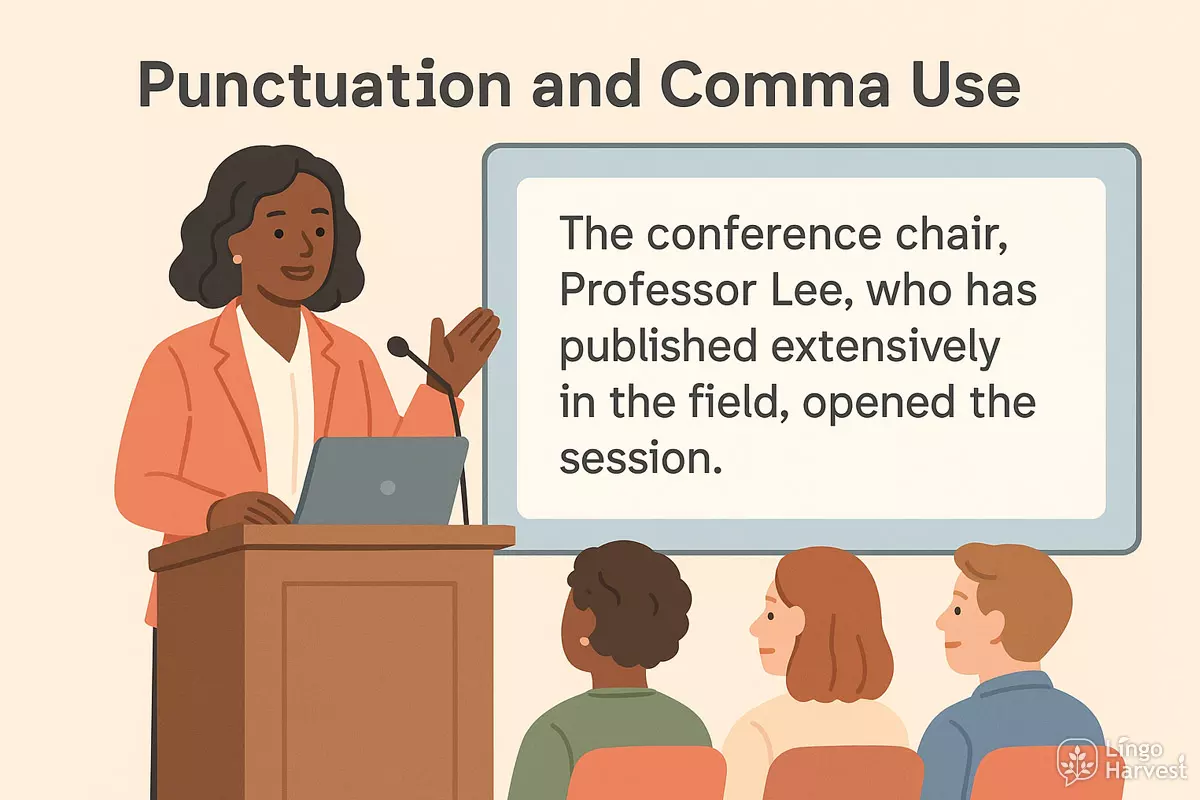
Clear examples help solidify these guidelines. See the following correct and incorrect usages:
- Correct: The conference chair, Professor Lee, who has published extensively in the field, opened the session.
- Incorrect: The conference chair Professor Lee, who has published extensively in the field opened the session. ❌
- Correct: The student who scored highest on the exam received a scholarship. (No commas; clause is essential.)
- Correct: The new policy, which was enacted last year, affects all faculty members. (Commas set off non-essential information.)
Quick Reference: Comma Placement with Appositive Clauses
| Clause Type | Comma Usage | Example |
|---|---|---|
| Non-restrictive | Commas before and after | The author, who won the award, thanked her team. |
| Restrictive | No commas | The book that I borrowed is overdue. |
| Introductory Appositive | Comma after clause | An expert in linguistics, Dr. Patel led the seminar. |
| Nested Appositive with Internal Commas | Use commas or semicolons for clarity | The team—composed of Jane, a statistician; Mark, an analyst; and Priya, a biologist—won the grant. |
By mastering these punctuation practices, academic writers can ensure their appositive clauses enhance, rather than obscure, the intended meaning. Consistent, careful comma use is a hallmark of precise, professional writing.
Role in academic definitions and explanations
Complex appositive clauses are frequently used by scholars to clarify technical terms, specify nuanced distinctions, and embed precise explanations directly within a sentence. This embedded structure allows for richer, more concise communication of definitions without breaking the flow of academic writing. Rather than relying on lengthy footnotes or additional sentences, writers can incorporate essential clarifications inline, which helps readers follow arguments with minimal disruption.
Enhancing Clarity and Precision
Academic texts often require precision when introducing or discussing central concepts. By integrating complex appositives, writers can define a term and immediately expand on its meaning or scope. For example:
- The concept of "liminality," which refers to the ambiguous transitional phase in a process or ritual, is essential in anthropology.
- Critical realism, which is a philosophical approach that combines a general philosophy of science with a philosophy of social science, offers a distinct perspective on causality.
In these examples, the clause after the comma provides a concise, authoritative definition or explanation, making the main idea clearer for the reader.
Common Patterns in Academic Usage
Writers often use certain patterns when constructing complex appositive clauses for definitions and explanations. Here are some of the most common:
- Term → a term which is defined as a key concept in the field
- Concept → a concept which can be understood as a mental model
- Theory → a theory which posits that behavior is influenced by context
- Method → a method which involves collecting data systematically
- Process → a process which consists of several sequential stages
- Model → a model which explains how variables interact
- Variable → a variable which measures student performance
- Approach → an approach which seeks to improve efficiency
- Framework → a framework which integrates multiple perspectives
- Principle → a principle which states that demand affects price
- Phenomenon → a phenomenon which is characterized by rapid change
- Instrument → an instrument which assesses language ability
- Construct → a construct which represents motivation
- Paradigm → a paradigm which shifts the way research is conducted
- Discipline → a discipline which focuses on human behavior
- Perspective → a perspective which views learning as a social activity
- Strategy → a strategy which aims to reduce costs
- Policy → a policy which regulates data protection
Comparison: Simple vs. Complex Appositive Clauses
To illustrate how complex appositive clauses function in academic writing, consider the following comparison:
| Simple Appositive | Complex Appositive Clause |
|---|---|
| The variable "anxiety," a psychological factor, affects performance. | The variable "anxiety," which is defined as a state of heightened nervousness or worry that can influence cognitive and physical outcomes, affects performance. |
| Newton's First Law, an important principle, describes inertia. | Newton's First Law, which states that an object in motion stays in motion unless acted upon by a force, describes inertia. |
| The model, a widely used framework, guides analysis. | The model, which integrates qualitative and quantitative data for comprehensive analysis, guides research in the field. |
| The theory, a central concept, underpins the study. | The theory, which posits that social structures influence individual behavior through established norms, underpins the study. |
Why Use Complex Appositive Clauses?
Scholarly writing benefits from these structures because they:
- Allow for on-the-spot clarification without interrupting the narrative
- Enhance reader comprehension by providing context immediately
- Support the logical flow by embedding definitions or scope within the argument
- Help avoid ambiguity and misinterpretation of specialized terms
In sum, complex appositive clauses are a powerful tool for academic writers seeking both precision and readability.
Practice: build appositive clauses from base sentences
Constructing complex appositive clauses sharpens academic writing by providing precise, layered information. This section will help you develop this skill by guiding you through rewriting basic statements to include appositive clauses, which often clarify, define, or expand on a noun within a sentence. The focus here is on transforming simple sentences into more nuanced ones, ideal for scholarly contexts.
How to Form Complex Appositive Clauses
Begin by identifying a noun that could benefit from additional explanation or detail. The appositive clause, usually introduced by "that," "which," or "who," then follows this noun and supplies extra information. These clauses are often set off by commas when the information is non-restrictive (not essential to the meaning).
- Add a definition: "The theory, which was developed in the 20th century, revolutionized the field."
- Clarify a term: "Genetics, a branch of biology that studies heredity, has advanced rapidly."
- Provide context: "Dr. Lee, who won the Nobel Prize, lectures at the university."
- Offer examples: "Two countries, namely Japan and South Korea, have implemented this policy."
- Specify relationships: "The experiment, which involved over one thousand participants, lasted a year."
Practice Tasks: Transform Base Sentences
Try rewriting these simple statements by adding a complex appositive clause for clarity or detail.
- Marie Curie discovered radium.
- Photosynthesis is essential for plants.
- Shakespeare wrote Hamlet.
- The conference was attended by leading scientists.
- Oxygen is necessary for respiration.
- The Amazon rainforest is vast.
- Albert Einstein developed the theory of relativity.
- The Mona Lisa was painted by Leonardo da Vinci.
- The Great Wall of China attracts tourists.
- Climate change affects weather patterns.
Show answers
- Marie Curie, who was a pioneering scientist, discovered radium.
- Photosynthesis, the process by which plants convert sunlight into energy, is essential for plants.
- Shakespeare, the renowned English playwright, wrote Hamlet.
- The conference, which was held in Geneva, was attended by leading scientists.
- Oxygen, a vital element for cellular respiration, is necessary for respiration.
- The Amazon rainforest, which covers much of South America, is vast.
- Albert Einstein, the physicist famous for his contributions to modern science, developed the theory of relativity.
- The Mona Lisa, a masterpiece of Renaissance art, was painted by Leonardo da Vinci.
- The Great Wall of China, one of the world’s most iconic structures, attracts tourists.
- Climate change, a phenomenon driven by human activities, affects weather patterns.
Common Patterns for Appositive Clauses
Below are common structures and connectors used in academic writing when constructing appositive clauses. Use these as templates for your own sentences:
- Noun, which/who/that + verb + rest of clause, main clause.
- Noun, such as + examples, main clause.
- Noun, a term that means…, main clause.
- Noun, namely + specific details, main clause.
- Noun, the process by which…, main clause.
Practice revising your own academic sentences by adding precise, relevant appositive clauses to enhance clarity and depth. This technique not only improves readability but also demonstrates critical engagement with your subject matter.