Extraposition with “It”: Moving Information for Better Flow

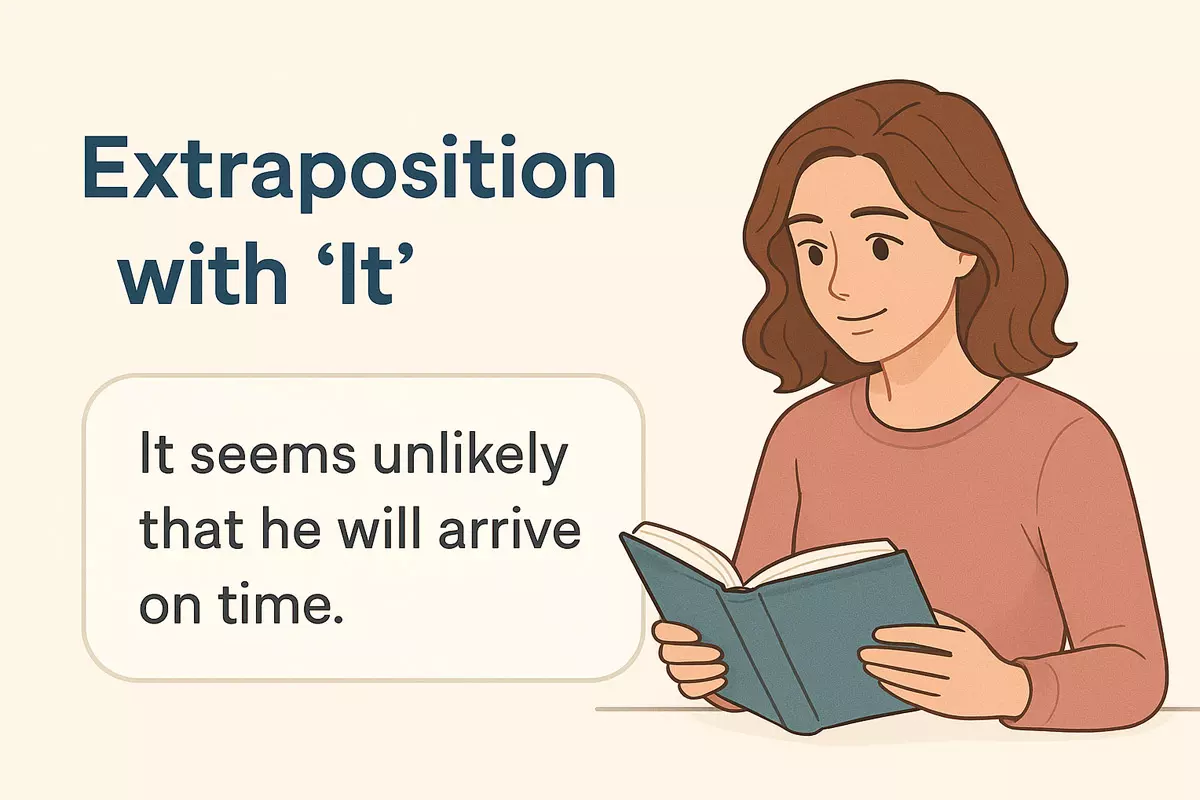 Here we the basic pattern of extraposition with it, shows how to move long clauses to the end for clarity, presents common academic structures, discusses formal tone, explains when extraposition is unsuitable, and includes practice exercises.
Shifting parts of a sentence by using structures like “it” can greatly improve the flow and clarity of your writing. This technique, known as extraposition, allows you to move complex or lengthy information to the end of a sentence, making it easier for readers to follow your ideas. For example, instead of saying “That you completed the project on time is impressive,” you can write “It is impressive that you completed the project on time.” By repositioning information in this way, you create sentences that are not only smoother but also more engaging and accessible.
Basic pattern of extraposition with it
Extraposition with “it” is a syntactic structure used to shift a long or complex subject to the end of a sentence and replace it with the pronoun “it” at the beginning. This approach helps sentences flow more naturally, especially when the original subject is a lengthy clause or phrase. The construction is particularly common in both spoken and written English for clarity and ease of processing.
How extraposition works
Instead of starting with a heavy subject, English often introduces the sentence with “it” and postpones the real subject to the end. For example, rather than saying “That you arrived on time surprised everyone,” we say “It surprised everyone that you arrived on time.” This pattern is especially useful when the subject is a clause (like “that you arrived on time”) or an infinitive phrase.
Typical structure
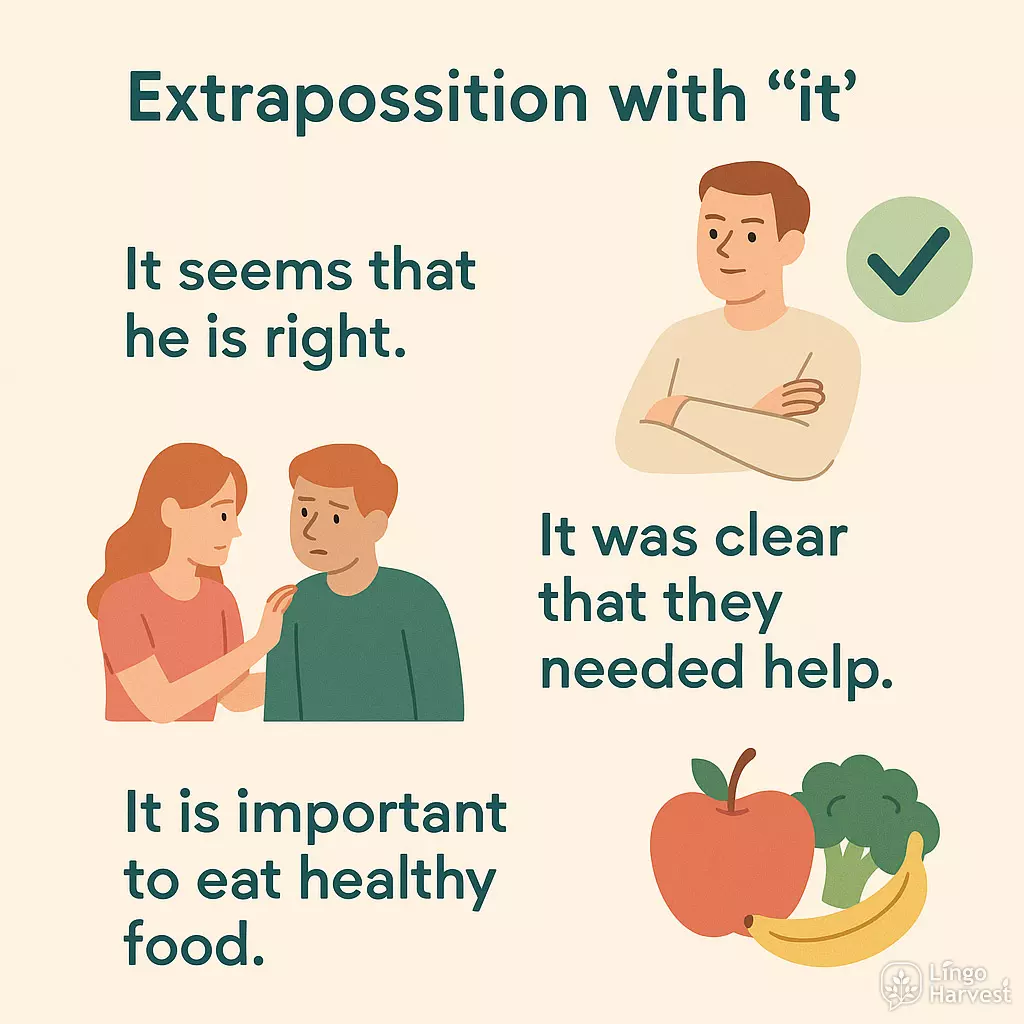
The most common formula looks like this:
- It + verb + complement + real subject (clause/phrase)
Examples:
- It seems that he is right.
- It was clear that they needed help.
- It is important to eat healthy food.
- It surprised me that the package arrived early.
Common verbs and adjectives used in extraposition
A variety of verbs and adjectives work well with this structure. Here are some typical choices:
- appear → It appears that he misunderstood the instructions.
- seem → It seems that the results are accurate.
- happen → It happened that we arrived at the same time.
- turn out → It turned out that the theory was correct.
- surprise → It surprised me that she agreed so quickly.
- shock → It shocked everyone that the project was canceled.
- amaze → It amazed us that he solved the problem so fast.
- be clear → It is clear that more research is needed.
- be possible → It is possible that the data were misinterpreted.
- be likely → It is likely that the trend will continue.
- be obvious → It is obvious that they made a mistake.
- be important → It is important that we review the results.
- be necessary → It is necessary that the report be updated.
- be interesting → It is interesting that the pattern repeats itself.
- be certain → It is certain that the policy will change.
- be strange → It is strange that no one noticed the error.
- be unfortunate → It is unfortunate that the meeting was postponed.
- be true → It is true that the data support the hypothesis.
- be likely → It is likely that the outcome will improve.
- be lucky → It is lucky that we arrived before the storm.
Comparing normal and extraposed sentences
To make the difference clear, here’s a side-by-side comparison of sentences with and without extraposition:
| Without extraposition | With extraposition (“it”) |
|---|---|
| That he won surprised us. | It surprised us that he won. |
| To finish on time is difficult. | It is difficult to finish on time. |
| That she left early was unexpected. | It was unexpected that she left early. |
| For him to apologize was rare. | It was rare for him to apologize. |
When to use this construction
You’ll often see “it” extraposition in formal writing, technical explanations, and anywhere clarity is important. It’s especially helpful when the original subject is wordy or might confuse the reader if placed at the front of the sentence. This structure improves readability and allows emphasis on the main information at the sentence’s end.
Shifting long clauses to the end position
Moving lengthy or complex information toward the end of a sentence often makes communication clearer and more natural. In English, this is frequently achieved by using “it” as a placeholder at the beginning, then shifting the real subject—a long clause or phrase—to the final position. This strategy helps readers and listeners process the sentence more easily, especially when the subject is complicated or introduces new information.
Why put long clauses at the end?
Placing extended or detailed content at the sentence’s conclusion allows for a smoother reading experience. Starting with “it” prepares the audience for important information, which arrives after the main verb. This structure is preferred because English typically favors short, familiar subjects and places heavier, new content later.
- Improves readability by reducing cognitive load
- Makes sentences sound less awkward or overloaded
- Highlights new or complex ideas where they’re most noticeable
- Helps maintain a natural rhythm, especially in spoken English
- Supports focus on the main action before the detailed explanation
Common patterns using “it” as a dummy subject
Writers and speakers often use “it” to introduce sentences where the real subject is a long clause. Here are some typical patterns:
- It is adjective + to + verb phrase
(It is important to finish the project on time.) - It is adjective + that + clause
(It is surprising that he declined the invitation.) - It seems/appears/happens + that + clause
(It appears that the results have improved.) - It takes + time/effort + to + verb
(It takes a lot of patience to teach young children.) - It is possible/necessary + to + verb
(It is possible to solve this problem.) - It was agreed/decided + that + clause
(It was agreed that everyone would contribute.) - It makes sense + to + verb
(It makes sense to review the data again.) - It turns out + that + clause
(It turns out that the meeting was canceled.) - It is unclear/obvious + whether/if + clause
(It is unclear whether she will attend.) - It helps + to + verb
(It helps to write things down.) - It is no surprise + that + clause
(It is no surprise that traffic was heavy.) - It became clear + that + clause
(It became clear that changes were needed.) - It is worth + noting/mentioning + that + clause
(It is worth noting that the deadline has changed.) - It seems likely + that + clause
(It seems likely that they will succeed.)
Comparing original vs. shifted structures
To see how this works in practice, compare the following sentences. The first version keeps the long clause at the front, while the second uses “it” to move the information to the end.
| Original (Long Clause First) | With Extraposition (“It” Structure) |
|---|---|
| That the company will relocate surprised everyone. | It surprised everyone that the company will relocate. |
| To understand this theory is difficult for most students. | It is difficult for most students to understand this theory. |
| Whether the plan will work remains to be seen. | It remains to be seen whether the plan will work. |
| That she finished so quickly impressed the judges. | It impressed the judges that she finished so quickly. |
| For the team to win is unlikely without practice. | It is unlikely for the team to win without practice. |
When should you use this technique?
Opt for extraposition with “it” when dealing with sentences where the real subject is a detailed clause or phrase. This is especially helpful in academic, professional, or formal writing, where clarity and sentence flow are crucial. However, if the subject is short or already familiar, sticking with the standard order is usually fine. In summary, moving complex elements to the sentence’s final position with “it” at the start helps ensure your message is both clear and easy to follow.
Common structures: it is clear that…, it seems that…
Using “it” as a placeholder at the start of a sentence is a common way to introduce extraposition in English. This structure helps shift lengthy or complicated subjects to the end of the sentence, making the statement easier to process. Phrases like “it is clear that…” and “it seems that…” are typical introductory patterns, allowing speakers and writers to present opinions or observations in a neutral, objective tone.
How these structures function
Sentences using this framework often state an evaluation or inference, with the real subject appearing later. This not only improves sentence flow but also lets the speaker foreground their attitude or certainty.
- It appears that the results were inconclusive.
- It is likely that she will join us tomorrow.
- It is unfortunate that we missed the opportunity.
- It has been suggested that changes are needed.
- It is possible that the meeting will be postponed.
- It is evident that more research is required.
- It is rumored that the company will expand soon.
- It turns out that the solution was simpler than expected.
- It is interesting that he chose a different approach.
- It is assumed that everyone has read the document.
- It is surprising that the results were so positive.
- It is doubtful that we can finish on time.
- It is hoped that the weather will improve.
- It can be argued that this method is more efficient.
- It is agreed that transparency is important.
- It is reported that traffic will be heavier tomorrow.
- It is feared that the project may be delayed.
- It turns out that the answer was right in front of us.
Why use these patterns?
Prefacing statements with “it is clear that…” or “it seems that…” provides a way to make generalizations or express uncertainty without directly attributing the opinion. This is especially useful in formal writing and academic contexts, where maintaining objectivity is important. Additionally, these structures can soften statements, making them less direct or confrontational.
Comparing direct and extraposed forms
Sometimes, the same idea can be presented with or without extraposition. Here’s a comparison:
| Direct Subject | Extraposed with “It” |
|---|---|
| That she will join us is likely. | It is likely that she will join us. |
| More research is required is evident. | It is evident that more research is required. |
| Whether we can finish on time is doubtful. | It is doubtful that we can finish on time. |
| Transparency is important is agreed. | It is agreed that transparency is important. |
Formal tone and academic style effects
Extraposition with “it” is especially prevalent in scholarly and professional writing, where clarity and objectivity are valued. By shifting complex clauses or heavy subjects to the end of the sentence, writers can create a more readable, measured tone that aligns with academic expectations. This syntactic strategy allows authors to emphasize new or important information, making their arguments easier to follow and ensuring that readers are not overwhelmed by convoluted sentence openings.
How extraposition shapes academic writing
Writers in formal contexts often rely on “it” extraposition to maintain an impersonal style. This approach helps minimize personal bias and centers attention on ideas rather than individuals. For instance, sentences such as “It is widely accepted that…” or “It appears that…” sound more detached and authoritative than their unextraposed counterparts.
- Enhances objectivity by avoiding direct personal reference
- Improves coherence and flow, especially in complex arguments
- Allows for smoother integration of long or technical information
- Reduces cognitive load by presenting the main subject after a familiar structure
- Supports hedging and cautious claims, e.g., “It seems that,” “It is possible that”
- Facilitates transitions between ideas in multi-clause sentences
- Emphasizes new findings or conclusions by placing them at the end
- Enables writers to meet reader expectations for formality and clarity
- Adapts easily to passive constructions, further distancing the author
- Allows for variation in sentence structure, preventing monotony
Frequent patterns in formal texts
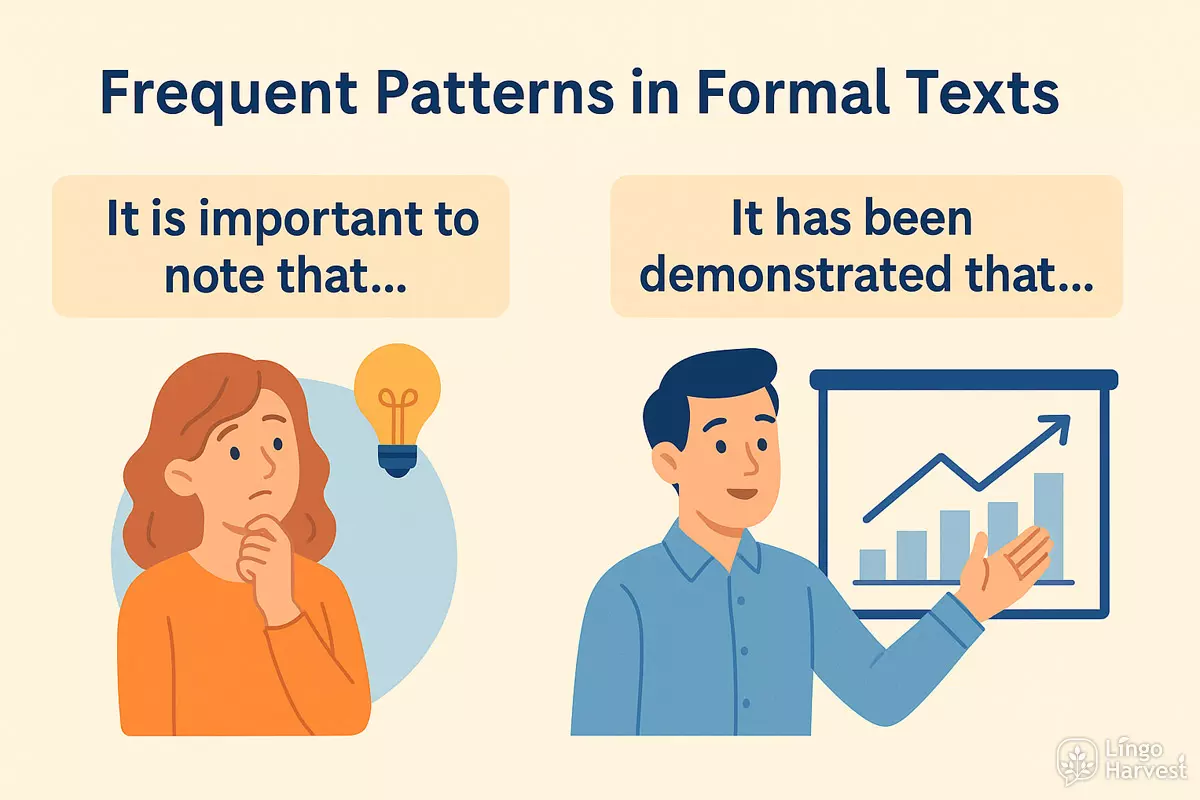
Certain introductory phrases with “it” are staples of academic prose. These patterns project a formal tone and help writers generalize or introduce evidence. Common examples include:
- It is important to note that…
- It has been demonstrated that…
- It is generally believed that…
- It is assumed that…
- It remains unclear whether…
- It is necessary to consider…
- It is evident that…
- It is worth mentioning that…
- It can be argued that…
- It is likely that…
- It appears that…
- It is suggested that…
- It is possible that…
- It is estimated that…
- It should be emphasized that…
- It is recommended that…
These templates help maintain a polished, academic register and guide readers through complex reasoning. Using extraposition thoughtfully can thus enhance both the tone and communicative effectiveness of scholarly writing.
When extraposition is not appropriate
Some sentences simply don’t benefit from shifting information to the end with “it.” In fact, rearranging certain clauses can make your writing sound awkward, forced, or even ungrammatical. Recognizing these situations helps maintain natural flow and clarity.
Cases where extraposition should be avoided
- Short or simple subjects: If the subject is already brief and clear, using “it” adds unnecessary complexity.
Example: “That she left surprised me.” (No need for “It surprised me that she left.”) - Emphatic or contrastive subjects: When you want to highlight or contrast the subject, keep it in its original position.
Example: “What matters is honesty.” (Not: “It is honesty that matters.”) - Questions and imperatives: Extraposition rarely works in interrogative or command forms.
Example: “Is it true that you’re leaving?” is correct, but “Is that you’re leaving true?” is not. - Stylistic or formal writing: Sometimes, especially in academic or legal contexts, the original subject is preferred for precision.
- Idiomatic expressions: Many fixed phrases lose their meaning if restructured with “it.”
Example: “That goes without saying.” (Not: “It goes without saying that that.”)
Examples of sentences where extraposition sounds unnatural or is incorrect
- “That he won was unexpected.” (Natural as written; “It was unexpected that he won” is possible, but less direct.)
- “Whoever arrives first gets the prize.” (Extraposition would be odd here.)
- “What you said surprised everyone.” (Already clear and focused.)
- “Whether we go depends on the weather.” (Moving the clause to the end is awkward.)
- “If you need help is not clear.” (Better: “It is not clear if you need help.” but the original is sometimes preferable for emphasis.)
- “That the meeting was canceled, everyone already knew.” (Extraposition not needed.)
- “How she did it remains a mystery.”
- “Why he left is unknown.”
- “Where we go is up to you.”
- “When you arrive matters.”
Summary table: Appropriate vs. inappropriate uses
| ❌ Not recommended | ✅ Good for extraposition |
|---|---|
| That she resigned surprised me. | It surprised me that she resigned. |
| To read the instructions is important. | It is important to read the instructions. |
| Whoever gets there first wins. (No extraposition) | It seems that they forgot. |
| What you said shocked them. (No extraposition) | It’s clear that you care. |
Key takeaways
Extraposition with “it” is a useful tool, but not a universal fix. Use it to clarify lengthy or complex subjects, but avoid it with short, focused, or idiomatic phrases. When in doubt, read your sentence aloud—if it feels forced, it’s probably best to keep the original word order.
Practice: rewrite sentences using extraposition
Understanding how to shift heavy information to the end of a sentence using “it” can help your writing sound more fluent and natural. Below, you’ll find a series of practice tasks. Start by identifying the original sentence, then rewrite it by moving the subject clause to the end and introducing “it” as the grammatical subject. This structure is especially common in formal and academic English.
Exercise: Transform These Sentences
Rewrite each sentence to improve flow by using “it” as the subject and moving the original subject to the end.
- That she passed the exam surprised everyone.
- To finish this project on time will require a lot of effort.
- That you arrived early made things easier for us.
- For John to win the race would be unexpected.
- Whether we can solve the problem remains to be seen.
- That the team lost shocked the fans.
- To understand quantum mechanics is challenging.
- That you didn’t call worried me.
- For the meeting to be cancelled was disappointing.
- That she speaks five languages impressed the committee.
- Whether he will attend is unknown.
- To balance work and life can be difficult.
- That the results were announced early surprised the participants.
- For the machine to break down now is inconvenient.
- That the application was rejected upset him.
Show answers
- It surprised everyone that she passed the exam.
- It will require a lot of effort to finish this project on time.
- It made things easier for us that you arrived early.
- It would be unexpected for John to win the race.
- It remains to be seen whether we can solve the problem.
- It shocked the fans that the team lost.
- It is challenging to understand quantum mechanics.
- It worried me that you didn’t call.
- It was disappointing for the meeting to be cancelled.
- It impressed the committee that she speaks five languages.
- It is unknown whether he will attend.
- It can be difficult to balance work and life.
- It surprised the participants that the results were announced early.
- It is inconvenient for the machine to break down now.
- It upset him that the application was rejected.
Tips for Recognizing and Using Extraposition
- Look for sentences starting with “That…”, “To…”, “For…to…”, or “Whether…” as the subject.
- Check if the subject is long or makes the sentence awkward. If so, consider using “it” extraposition.
- Extraposition is most common in formal writing, reports, and academic contexts.
- When in doubt, read your sentence aloud to check for natural flow.
Practicing these transformations will help you spot opportunities to use “it” for better sentence structure, making your English sound more sophisticated and clear.