Nominalizations in Advanced Writing: Turning Verbs into Nouns

 Here we what nominalization means in grammar, shows how verbs and adjectives become nouns, explains its benefits and drawbacks in academic writing, and provides practice in changing clauses to nominalized forms while maintaining clear style.
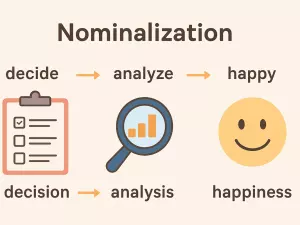
Transforming actions into abstract entities is an effective technique in advanced writing, enabling authors to express complex concepts more clearly and succinctly. By turning verbs into nouns, such as changing "decide" to "decision" or "analyze" to "analysis," writers can highlight the importance or result of actions rather than just the actions themselves. This approach not only streamlines sentences but also adds a level of professionalism and depth to your writing, making your arguments more persuasive and your ideas more impactful overall.
What nominalization is in grammar
Nominalization refers to the process of transforming verbs, adjectives, or even entire clauses into nouns. This change allows abstract concepts, actions, or qualities to be discussed as concrete entities within a sentence. In advanced writing, this grammatical shift is often used to create more formal, dense, or objective prose by focusing on ideas rather than actions or agents.
How nominalization works
Writers typically form nominalizations by adding suffixes to verbs or adjectives. For instance, “decide” becomes “decision,” and “happy” becomes “happiness.” This conversion enables sentences to emphasize results, concepts, or states over the actions themselves.
Common suffixes used for nominalization
Most nominalized forms in English are created by attaching specific endings to base words. Here are some of the most frequent suffixes:
- -tion (e.g., inform → information)
- -ment (e.g., develop → development)
- -ance / -ence (e.g., attend → attendance; exist → existence)
- -ity (e.g., able → ability)
- -ness (e.g., happy → happiness)
- -al (e.g., arrive → arrival)
- -ing (sometimes, e.g., read → reading as a noun)
- -ure (e.g., fail → failure)
- -sion (e.g., expand → expansion)
- -cy (e.g., vacant → vacancy)
Examples of nominalization in context

Consider how the meaning or tone of a sentence changes when verbs are transformed into nouns:
- “The committee decided to postpone the event.” → “The committee’s decision was to postpone the event.”
- “She analyzed the data carefully.” → “Her analysis of the data was careful.”
- “They failed to comply with the rules.” → “Their failure to comply with the rules was noted.”
- “We improved the process.” → “There was an improvement in the process.”
- “He arrived late.” → “His arrival was late.”
Why writers use nominalization
There are several reasons for converting verbs or adjectives into nouns in academic or professional writing:
- To make the text more formal or impersonal
- To condense complex actions into single concepts
- To focus on results or abstract ideas, not just agents or actions
- To connect ideas more smoothly in longer sentences
Verb to noun nominalization patterns
The following table shows common patterns for turning verbs into nouns, along with examples and their resulting abstract forms:
| Verb | Noun (Nominalization) | Example Sentence |
|---|---|---|
| analyze | analysis | The analysis was thorough. |
| decide | decision | Her decision surprised everyone. |
| fail | failure | Failure to act quickly caused problems. |
| develop | development | The development of new technology is rapid. |
| arrive | arrival | His arrival was unexpected. |
| expand | expansion | The expansion of the business was successful. |
| inform | information | We need more information. |
| apply | application | The application was approved. |
| promote | promotion | Her promotion was well-earned. |
| perform | performance | His performance impressed the judges. |
In summary, nominalization is a useful grammatical tool for reshaping sentences, allowing writers to highlight concepts or outcomes rather than just actions. This process, common in advanced and academic writing, brings precision and abstraction to language, but should be balanced to avoid overly dense or impersonal prose.
Common noun forms from verbs and adjectives
Writers frequently create nouns from verbs and adjectives to make their writing more formal, concise, or abstract. This process, known as nominalization, helps to encapsulate actions or qualities into a single concept, often making sentences denser and more information-rich. Understanding typical patterns can help you both recognize and use these forms effectively in advanced writing.
Typical endings and examples
Many nouns are formed by adding specific suffixes to verbs or adjectives. Here are some common patterns you’ll encounter:
- -tion / -sion: inform → information, decide → decision
- -ment: develop → development, argue → argument
- -ance / -ence: perform → performance, differ → difference
- -ity: possible → possibility, active → activity
- -ness: happy → happiness, dark → darkness
- -al: approve → approval, arrive → arrival
- -ure: expose → exposure, fail → failure
- -cy: private → privacy, urgent → urgency
- -dom: free → freedom, king → kingdom
- -ship: friend → friendship, leader → leadership
Structured patterns: Verb and adjective to noun
| Root Word | Nominalized Form | Suffix/Pattern |
|---|---|---|
| decide (verb) | decision | -sion |
| happy (adjective) | happiness | -ness |
| develop (verb) | development | -ment |
| active (adjective) | activity | -ity |
| arrive (verb) | arrival | -al |
| fail (verb) | failure | -ure |
| urgent (adjective) | urgency | -cy |
| free (adjective) | freedom | -dom |
Why use nominalizations?
Transforming verbs or adjectives into nouns allows for greater abstraction and can help condense complex actions or qualities into a single term. For example, “The committee decided” becomes “The committee’s decision,” which can make your writing more succinct and formal. However, overuse can lead to overly dense or impersonal prose, so balance is key.
Tips for using nominalizations effectively
- Use them to summarize actions or qualities when you need to be concise
- Prefer the noun form in academic or technical contexts for formality
- Be cautious: too many nominalizations can make your writing less direct or harder to read
By mastering these patterns, you can vary your sentence structures and achieve a more sophisticated writing style.
Advantages in academic and formal writing
Nominalization—the process of turning verbs or adjectives into nouns—serves several practical purposes in scholarly and professional contexts. Using this technique, writers can present information more abstractly, add a sense of objectivity, and condense complex ideas efficiently. This approach is particularly valued when discussing processes, concepts, or phenomena rather than focusing on individual actions or agents.
Conciseness and Density
Transforming verbs into nouns allows for more compact sentences, often reducing repetition and making dense material more manageable. For example, "analyze" becomes "analysis," which can then be used to summarize a body of work or findings in a single word. This helps writers fit more information into each sentence, a necessity in research papers and formal reports.
Impersonal and Objective Tone
Nominalizations help writers focus on ideas rather than actors, which supports an impersonal style prized in academic communication. By minimizing references to the writer or reader, texts appear more neutral and objective. For instance, "We decided to implement the policy" can become "The implementation of the policy was decided," shifting focus from people to processes.
Facilitating Cohesion and Thematic Progression
Noun forms allow for smoother transitions between sentences and paragraphs. When key concepts are nominalized, writers can refer back to them efficiently, supporting coherence throughout the text. This technique enables the chaining of ideas, as the noun forms often act as subjects or objects that link different parts of the discussion.
Common Nominalizations in Academic Writing
- development (from develop)
- assessment (from assess)
- implementation (from implement)
- investigation (from investigate)
- evaluation (from evaluate)
- identification (from identify)
- recommendation (from recommend)
- interpretation (from interpret)
- conclusion (from conclude)
- observation (from observe)
- comparison (from compare)
- expansion (from expand)
- recognition (from recognize)
- application (from apply)
- creation (from create)
- modification (from modify)
- participation (from participate)
- demonstration (from demonstrate)
Summary Table: Verb to Noun Transformations
| Verb | Nominalization |
|---|---|
| analyze | analysis |
| evaluate | evaluation |
| implement | implementation |
| recommend | recommendation |
| observe | observation |
| participate | participation |
| conclude | conclusion |
| modify | modification |
Risks: over-nominalization and dense style
Writers often use nominalizations—turning verbs into nouns—to sound more formal or academic. However, excessive use of this technique can make sentences unnecessarily complex and difficult to follow. When too many nouns pile up, the writing loses energy and clarity, resulting in dense, abstract prose that may alienate readers or obscure the main message.
Common Problems Caused by Excessive Nominalization
- Loss of immediacy: Actions become buried in nouns, making writing less dynamic.
- Ambiguity: Overpacked sentences can obscure who is doing what.
- Reader fatigue: Dense wording slows comprehension and can frustrate audiences.
- Wordiness: Nominalized constructions often require extra prepositions or modifiers.
- Impersonal tone: The subject may disappear, making the writing feel detached.
Examples of Dense vs. Clear Style

| Dense (Nominalized) | Clear (Active) |
|---|---|
| The implementation of the policy was a success. | They implemented the policy successfully. |
| There was an investigation of the problem by the team. | The team investigated the problem. |
| Completion of the project occurred last week. | They completed the project last week. |
| His explanation of the process was confusing. | He explained the process confusingly. |
| Decisions regarding the allocation of resources were made. | They decided how to allocate resources. |
Signals of Overuse
Writers can spot problematic density if sentences contain:
- Long strings of nouns stacked together (e.g., "The development of strategies for implementation")
- Frequent use of "of" or "by" phrases following nouns
- Abstract nouns ending in -tion, -ment, -ance, -ity, -ness, or -ence
- Missing or unclear agents (the "doer" of the action)
When to Avoid Nominalizations
- When clarity and directness are essential
- In instructions or technical documentation
- When describing actions or processes step-by-step
- To emphasize responsibility or agency
- For engaging general audiences or non-experts
Overusing noun-based constructions can undermine the effectiveness of advanced writing. Striking a balance between sophistication and accessibility helps ensure your message remains both precise and readable.
Balancing nominal and verbal structures
Achieving clarity and cohesion in advanced writing often depends on how writers alternate between noun-based (nominal) and verb-based (verbal) forms. Overusing one at the expense of the other can lead to either overly dense or overly simplistic prose. Striking the right mix allows for both precision and readability, especially in academic or technical contexts.
When to use nominalizations
Nominalizations—turning verbs into nouns—are useful for conveying complex ideas, summarizing processes, or introducing topics in a formal register. However, excessive reliance on them can make writing abstract or impersonal.
- Summarizing previous discussion: the implementation of the policy
- Expressing general concepts: analysis, development, observation
- Highlighting results or phenomena: increase, reduction, failure
- Creating cohesion between sentences
When to favor verbal forms
Active verbs lend energy and directness to writing. They clarify agency and sequence, making arguments more engaging and transparent.
- Describing actions: The committee implemented the policy.
- Clarifying who is responsible: Researchers observed a trend.
- Reducing wordiness and ambiguity
- Maintaining narrative flow
Comparing effects: Examples in context
| Nominal Structure | Verbal Structure |
|---|---|
| The assessment of risks was completed. | They assessed the risks. |
| There was a reduction in costs. | Costs decreased. |
| The implementation of new measures improved safety. | New measures improved safety. |
| The observation of changes revealed trends. | Researchers observed changes and revealed trends. |
| The development of the project continued. | The project developed further. |
Tips for effective variation
Writers can achieve a dynamic and precise style by alternating between noun-based and verb-based forms. Consider the following strategies:
- Use nominalizations to introduce or summarize ideas, then clarify with active sentences.
- Check for unnecessary abstract nouns and replace them with verbs where possible.
- Maintain a balance: too many nouns can obscure meaning; too many verbs can oversimplify.
- Read drafts aloud to catch monotony or awkwardness in sentence structure.
- Vary sentence length and structure to keep your writing engaging.
By thoughtfully combining noun and verb forms, advanced writers can tailor their style to suit the purpose, audience, and genre, ensuring their message is both clear and compelling.
Practice: transform clauses into nominalized forms
Understanding how to convert full clauses into their nominalized equivalents is a key skill in advanced writing. Nominalization allows you to condense information, add formality, and shift the focus within a sentence. Below, you’ll find practice activities and examples to help you master this technique.
Recognizing Opportunities for Nominalization
Before you begin transforming sentences, it’s important to spot verbs or entire clauses that could be replaced with a noun phrase. This often involves turning actions or processes into concepts or events. Consider the following list of common transformations:
- People discuss the proposal. → The discussion of the proposal
- They decided to postpone the meeting. → The decision to postpone the meeting
- She investigated the problem. → Her investigation of the problem
- Students complete assignments on time. → Timely completion of assignments
- The committee approved the plan. → The committee’s approval of the plan
- We observed that errors occurred frequently. → The frequent occurrence of errors
- They failed to reach an agreement. → Their failure to reach an agreement
- Managers analyze the data carefully. → Careful analysis of the data by managers
- The team implemented the new system. → The implementation of the new system by the team
- Researchers found that pollution increased. → The increase in pollution found by researchers
Task: Convert Clauses to Nominalizations
Try transforming these sentences into more concise, nominalized forms. Focus on replacing the main verb or action with an appropriate noun form.
- They investigated the cause of the failure.
- She explained the process to the team.
- We observed that productivity improved.
- They agreed to change the schedule.
- The company announced that prices would rise.
- Researchers measured the temperature changes.
- The committee evaluated the proposals.
- He described the problem in detail.
- The team reviewed the results carefully.
- Managers identified several risks.
Show answers
- The investigation of the cause of the failure
- Her explanation of the process to the team
- The improvement in productivity observed by us
- The agreement to change the schedule
- The company’s announcement of the price increase
- The measurement of the temperature changes by researchers
- The committee’s evaluation of the proposals
- His detailed description of the problem
- The careful review of the results by the team
- The identification of several risks by managers
Common Patterns in Nominalization
Certain verbs frequently lend themselves to nominalization. Here are some patterns and their typical noun forms:
| Verb or Clause | Nominalized Form |
|---|---|
| decide | decision |
| analyze | analysis |
| approve | approval |
| fail | failure |
| improve | improvement |
| explain | explanation |
| implement | implementation |
| occur | occurrence |
| investigate | investigation |
| announce | announcement |
Being able to shift from active verbs to their nominalized forms will make your academic and professional writing more concise and sophisticated. Practice regularly to develop an instinct for when and how to use this strategy effectively.