Nominalization: Turning Words into Nouns

 Here we what nominalization is, how verbs and adjectives are turned into nouns, common suffixes used, its effects on sentence style and academic writing, when it can be problematic, and includes practice rewriting sentences using nominalizations.
Have you ever considered how transforming verbs and adjectives into nouns can add depth and complexity to your writing? This process, known as nominalization, enables you to reshape sentences and express ideas in a more precise, formal, or abstract manner. By converting actions or descriptions into nouns, you can focus attention on concepts or results rather than just actions themselves, which can make your language clearer and more sophisticated, especially in academic or professional contexts.
What Is Nominalization?
Nominalization is the process of converting other parts of speech—such as verbs, adjectives, or even whole phrases—into nouns. This transformation allows abstract ideas, actions, or qualities to be discussed as things or concepts, rather than as actions or descriptions. For example, turning the verb “decide” into the noun “decision” is a typical case of this process in English. Using noun forms in sentences can make writing more formal or abstract, and is common in academic, legal, and scientific writing. However, overuse can also make text harder to read, so understanding how and when to use this linguistic tool is important.
How Does It Work?
Words are often transformed into nouns by adding specific suffixes, such as -ion, -ment, -ness, or -ity. This modification shifts the focus from the action or quality to the concept itself. Here are some common transformations:
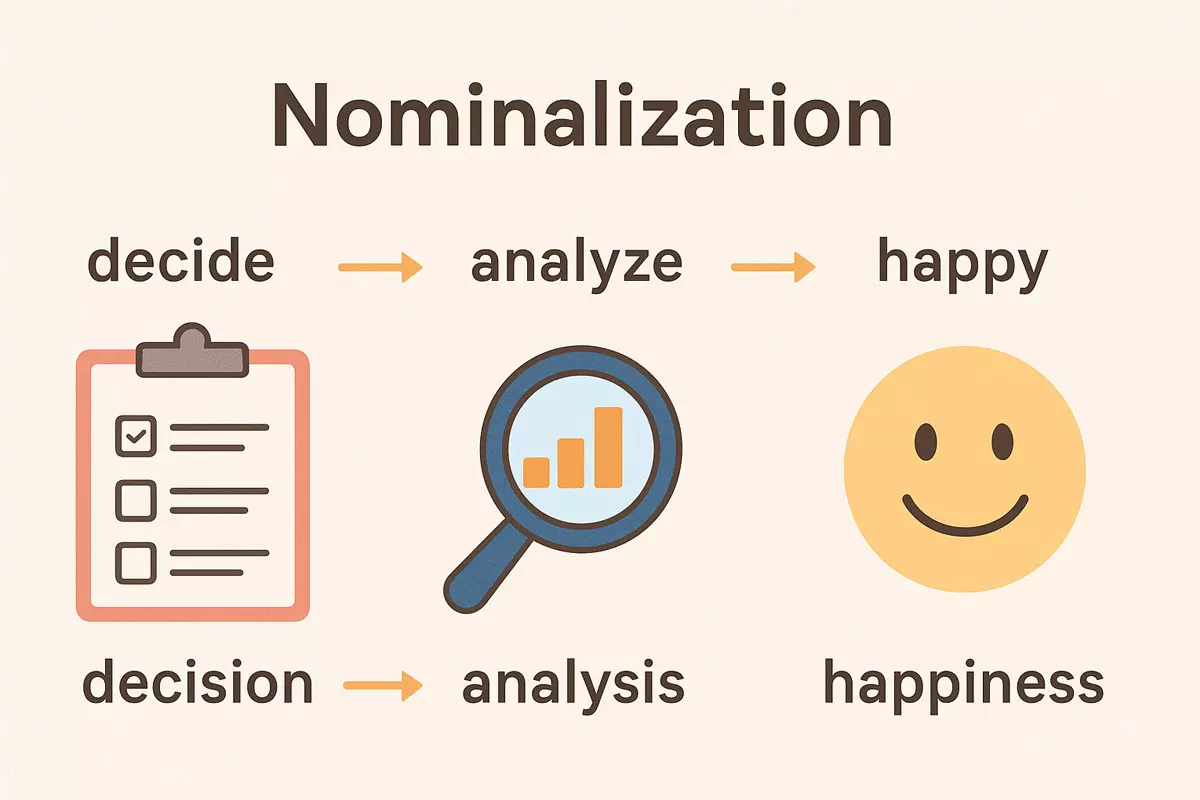
- decide → decision
- analyze → analysis
- happy → happiness
- move → movement
- possible → possibility
- inform → information
- react → reaction
- create → creation
- approve → approval
- fail → failure
- grow → growth
- arrange → arrangement
- strong → strength
- choose → choice
- judge → judgment
- appear → appearance
- think → thought
- discover → discovery
- develop → development
- relate → relation
Why Do Writers Use This Technique?
Turning verbs or adjectives into nouns helps writers discuss subjects at a more general, abstract, or objective level. For example, “The negotiation was successful” focuses on the result, while “They negotiated successfully” draws attention to the action. This shift can be useful for summarizing complex processes, expressing ideas efficiently, or creating a formal tone.
Types of Nominalization
There are two main types:
- Derivational nominalization: Adding suffixes to a base word to form a noun (e.g., “perform” becomes “performance”).
- Zero derivation (conversion): Using a word as a noun without changing its form (e.g., “run” as in “a morning run”).
Forming Nouns: Common Suffixes
The English language uses several suffixes to create nouns from other words. Here are some of the most frequent:
- -ion (action, condition)
- -ment (state, result)
- -ness (quality, state)
- -ity (quality, state)
- -ance / -ence (state, quality)
- -al (action, process)
- -ure (action, result)
- -ship (state, condition)
- -dom (state, domain)
- -ing (used for gerunds)
Understanding how to transform verbs and adjectives into nouns can help you recognize more abstract or formal language in reading and use it purposefully in your own writing.
Verbs Becoming Nouns
Turning action words into objects or concepts is a common process in English. This transformation, known as nominalization, allows us to refer to activities, states, or results as things rather than actions. For example, "decide" (an action) becomes "decision" (a thing or event). This shift is especially useful in academic, legal, and technical writing, where abstract ideas often need to be discussed as entities.
How It Works

The process usually involves adding certain suffixes to the base form of a verb. Common endings include -tion, -ment, -ance, and -ing. The choice of suffix depends on the verb and historical patterns in English.
- achieve → achievement
- inform → information
- move → movement
- perform → performance
- decide → decision
- create → creation
- arrive → arrival
- describe → description
- approve → approval
- choose → choice
- respond → response
- explain → explanation
- develop → development
- compete → competition
- analyze → analysis
- react → reaction
- improve → improvement
- refer → reference
Why Use Nominalization?
Transforming an action into a noun can make sentences more concise or formal. For instance, instead of saying "The company decided to expand," you might write "The company's decision to expand." This lets you focus on the result or the concept, rather than the process.
Common Patterns
Some verbs can produce more than one noun, each with a slightly different meaning. Others may not follow predictable rules. Here's a look at some typical endings and their uses:
| Verb | Nominalized Form | Suffix Used |
|---|---|---|
| inform | information | -ation |
| achieve | achievement | -ment |
| perform | performance | -ance |
| arrive | arrival | -al |
| choose | choice | -ice |
| analyze | analysis | -is |
| explain | explanation | -ation |
| develop | development | -ment |
Understanding how to shift verbs into nouns helps you recognize patterns in English and can improve both your writing and comprehension, especially in more formal or technical contexts.
Adjectives Becoming Nouns
Turning descriptive words into things or concepts is a common process in English and many other languages. This shift, often called nominalization, allows adjectives to function as nouns. For example, "the rich" refers to people who are wealthy, and "the unknown" describes things that are not known. These transformations help speakers express groups, ideas, or qualities in a compact way.
How It Works
When an adjective is used as a noun, it usually refers to a group or abstract concept. In English, this is often signaled by adding "the" before the adjective. The meaning is understood from context, and the adjective takes on a new grammatical role.
- the poor → people who are poor
- the elderly → older people
- the unknown → things not known
- the brave → brave people
- the disabled → people with disabilities
- the accused → person or people accused of something
- the unemployed → people without jobs
- the injured → people who are hurt
- the French → people from France
- the oppressed → people who are oppressed
- the absurd → things that are absurd
- the living → people who are alive
- the supernatural → things beyond the natural world
- the invisible → things that cannot be seen
Patterns and Nuances
This construction is especially common for describing groups of people, nationalities, or abstract qualities. Not all adjectives can be used this way; it typically works with words that describe people, states, or collective ideas. Sometimes, the plural sense is implied even though the adjective itself does not change form.
Comparing Languages
Some languages, like Russian or German, also turn adjectives into nouns, but the rules and endings may differ. In English, the process is very flexible, especially for social categories and philosophical concepts.
Summary Table: Examples of Transformation
| Adjective | Meaning as Noun |
|---|---|
| rich | wealthy people |
| unknown | things not known |
| young | young people |
| dead | those who have died |
| innocent | people who are innocent |
| blind | people without sight |
| guilty | those who are guilty |
Using this grammatical tool enriches expression and allows for more nuanced discussion of groups, qualities, and ideas. Understanding when and how adjectives can become nouns is a practical skill for both learners and advanced users of English.
Common Suffixes Used in Nominalization
Understanding how words transform into nouns often comes down to recognizing which endings signal this shift. In English, certain suffixes frequently indicate a word has been nominalized, allowing verbs or adjectives to function as nouns in sentences. These endings not only change the word’s grammatical role but sometimes subtly alter its meaning or scope.
Popular Endings for Creating Nouns
Many noun-forming suffixes are easy to spot once you know what to look for. Here are some of the most widely used ones, with examples to illustrate their application:
- -tion / -sion: creation, discussion, decision, expansion
- -ment: development, achievement, movement, agreement
- -ness: happiness, darkness, effectiveness, awareness
- -ity: ability, activity, responsibility, creativity
- -ance / -ence: resistance, importance, difference, existence
- -al: arrival, approval, refusal, proposal
- -ing: building, painting, understanding, meeting
- -ure: closure, failure, exposure, pressure
- -cy: accuracy, efficiency, urgency, transparency
- -ship: friendship, leadership, partnership, membership
- -dom: freedom, kingdom, wisdom, boredom
- -hood: childhood, neighborhood, likelihood, adulthood
- -er / -or: worker, actor, inventor, teacher
Comparing Suffixes: Patterns and Origins
Some endings come from Latin or Greek, while others are native to English. Their origins can influence both meaning and formality. The table below shows a comparison of select suffixes, their typical sources, and notes on usage:
| Suffix | Origin / Notes | Example Nouns |
|---|---|---|
| -tion / -sion | Latin; abstract nouns | invention, conclusion |
| -ment | Latin/French; action/result | enjoyment, statement |
| -ness | Old English; states/qualities | kindness, weakness |
| -ity | Latin; quality/state | curiosity, stability |
| -ance / -ence | Latin; process/state | performance, audience |
| -al | Latin; act/process | arrival, recital |
| -ing | Germanic; gerunds | writing, training |
Tips for Spotting Nominalization
Look for these endings when reading or writing, especially in formal or academic texts. Some suffixes, like -tion and -ment, are particularly common in scholarly writing, while others, such as -ness or -ing, appear in both spoken and written English. Recognizing these patterns can help you vary your sentence structure and express ideas more precisely.
Effects on Sentence Style
When verbs and adjectives are transformed into nouns, the flow and clarity of written language can shift noticeably. This process, often called nominalization, can make sentences sound more formal or abstract. While this technique is common in academic and bureaucratic writing, it can also lead to sentences that feel heavy or impersonal.
Clarity and Directness
Using too many noun forms in place of active verbs often results in less direct sentences. For example, instead of saying "The committee decided," a nominalized version might be "The decision of the committee..." This extra layer can obscure who is doing what, making statements harder to follow.
Impact on Tone and Formality
Turning actions and descriptions into nouns generally raises the formality of your prose. This can be useful in scientific articles or legal documents, but it might not suit informal contexts. Readers may find such sentences distant or detached.
- Can obscure agency (who is acting)
- Tends to increase sentence length
- May introduce vagueness
- Boosts perceived objectivity
- Often used to sound more authoritative
- Can slow down reading pace
- Helps condense complex ideas
- Reduces repetition of verbs
- Enables more complex sentence structures
- May hinder reader engagement
- Useful for summarizing processes or results
- Can be overused, leading to dense text
Comparison: Direct vs. Nominalized Sentences
| Direct (Verb-Focused) | Nominalized (Noun-Focused) |
|---|---|
| The manager approved the plan. | The approval of the plan was given by the manager. |
| We analyzed the data. | An analysis of the data was conducted. |
| They decided to postpone the meeting. | The decision to postpone the meeting was made. |
| Researchers discovered a new method. | A new method was discovered by researchers. |
When to Use Nominalization
Writers might choose this structure to emphasize results over actions, condense information, or maintain an objective tone. However, excessive use can make your text harder to read and less engaging. Striking a balance between active verbs and noun forms helps ensure both clarity and professionalism.
Nominalization in Academic Writing
Academic texts frequently transform verbs and adjectives into nouns, allowing writers to build more formal, compact sentences. This process often helps convey complex ideas with precision and objectivity, making it a staple of scholarly style. By focusing on concepts rather than actions, writers can emphasize theories, processes, and relationships.
Why Scholars Use Noun Forms
Turning actions and qualities into nouns enables greater abstraction. This technique supports a tone of impartiality and distance, which is often valued in research papers, reports, and academic articles. It also allows information to be condensed, making arguments clearer and more logically connected.
Common Patterns and Examples
Writers often rely on certain suffixes to create nominal forms. Here are frequent patterns and sample words:
- -tion: creation (from create), evaluation (from evaluate)
- -ment: development (from develop), agreement (from agree)
- -ance/-ence: performance (from perform), existence (from exist)
- -ity: activity (from active), possibility (from possible)
- -ness: effectiveness (from effective), awareness (from aware)
- -al: approval (from approve), arrival (from arrive)
- -ing: understanding (from understand), writing (from write)
- -sion: decision (from decide), expansion (from expand)
- -ure: failure (from fail), closure (from close)
- -cy: fluency (from fluent), consistency (from consistent)
Effects on Academic Style
Using noun-based constructions can make sentences more concise but sometimes less direct. For example:
- Direct: "Researchers analyzed the data."
- Nominalized: "The analysis of the data was conducted by researchers."
This shift often moves the focus from the doer to the process or result, which can be useful for highlighting findings rather than actions.
Comparing Verb-Based and Noun-Based Structures

| Verb-Based Structure | Noun-Based (Nominalized) Structure |
|---|---|
| They discussed the results. | The discussion of the results occurred. |
| We decided to continue. | The decision to continue was made. |
| She improved the method. | There was an improvement in the method. |
| Scientists observed the phenomenon. | The observation of the phenomenon was made by scientists. |
Considerations and Pitfalls
While nominal forms add formality, overusing them can make writing dense or impersonal. Striking a balance between clarity and formality is key. Writers should consider their audience and purpose before choosing between action-focused or concept-focused phrasing.
When Nominalization Causes Problems
Turning verbs and adjectives into nouns can sometimes create issues in writing. While these noun forms can lend formality or abstraction, overusing them may make sentences harder to read and less direct. Readers often have to work harder to understand the main action or idea, leading to confusion or disengagement.
Why Excessive Noun Forms Weaken Writing
When writers rely too much on noun-based constructions, sentences can become bloated and passive. This often obscures the subject and action, making the message less clear. For example, instead of saying "The committee decided," a nominalized version might read "The decision of the committee was made," which feels less immediate and more cumbersome.
Common Pitfalls Associated with Overusing Noun Derivations
- Reduced clarity
- Longer, more complex sentences
- Buried subjects and actions
- Unnecessary abstraction
- Increased passive voice usage
- Stilted or formal tone
- Reader fatigue
- Difficulty identifying the agent
- Loss of energy or immediacy
- Ambiguity in meaning
- Lower engagement
- Obscured relationships between ideas
Before and After: Direct vs. Nominalized Sentences
| Direct Version | Nominalized Version |
|---|---|
| We analyzed the data. | The analysis of the data was conducted. |
| The manager approved the plan. | The approval of the plan was given by the manager. |
| They failed to deliver the package. | The failure in the delivery of the package occurred. |
| The team improved the process. | The improvement of the process was achieved by the team. |
| She explained the method. | The explanation of the method was provided by her. |
Tips for Avoiding Unnecessary Noun Conversions
- Favor verbs over noun phrases for actions.
- Identify the main subject and action in each sentence.
- Revise lengthy noun phrases into more direct statements.
- Read your writing aloud to spot awkward constructions.
- Ask yourself if the sentence could be shorter or clearer.
In summary, while noun-based forms have their place, using them carelessly can cloud your message. Striking a balance between conciseness and formality leads to clearer, more engaging communication.
Practice: Rewrite Using Nominalizations
Working with nominalizations helps writers transform verbs and adjectives into nouns, giving their sentences a more formal and concise tone. This practice section offers opportunities to convert sentences by replacing action words with their noun forms. Doing so can improve academic or technical writing and introduce variety into everyday communication.
Instructions
Below, you will find a set of sentences written in a straightforward, active style. Your task is to rewrite each sentence by turning the main verb or adjective into a noun, creating a nominalized version. This often means restructuring the sentence to accommodate the new noun form. Consider how the change affects the tone and clarity.
- The committee decided to investigate the issue.
- We analyzed the data carefully.
- She explained the process clearly.
- The scientist observed how the substance changed.
- They failed to comply with the new regulations.
- The team improved their performance significantly.
- The manager approved the proposal quickly.
- The teacher encouraged students to participate.
- The company expanded its operations internationally.
- The judge considered all the evidence.
Common Nominalizations
- decide → decision
- analyze → analysis
- explain → explanation
- observe → observation
- comply → compliance
- improve → improvement
- approve → approval
- encourage → encouragement
- expand → expansion
- consider → consideration
- fail → failure
- perform → performance
- regulate → regulation
- participate → participation
- propose → proposal
Why Use Nominalizations?
Nominalized constructions can make writing more formal and abstract, which is often preferred in academic, legal, and scientific contexts. However, overuse may make text feel heavy or less direct. Practicing with these transformations helps you recognize when and how to use nominal forms effectively.
Show answers
- The committee made a decision to investigate the issue.
- A careful analysis of the data was conducted.
- Her explanation of the process was clear.
- The scientist made an observation of the substance's change.
- There was a failure to comply with the new regulations.
- The team achieved significant improvement in their performance.
- The proposal received quick approval from the manager.
- The teacher gave encouragement for student participation.
- The company underwent international expansion of its operations.
- The judge gave careful consideration to all the evidence.