Verb to Noun Conversion for Formal Writing (analyze → analysis)

 This article explains verb to noun conversion, key suffixes like -tion and -ment, how meanings shift, and when to use these nouns in reports and essays. It warns against overuse and offers practice for balancing verb and noun forms.
- What verb → noun conversion is (nominalization)
- Key suffixes for verb-based nouns: -tion, -ment, -al, -ance, -ing
- Meaning shifts between verb and noun forms (decide vs decision)
- Where verb-based nouns are useful in reports and essays
- Risks of heavy nominalization for clarity and readability
- Balancing verb forms and noun forms in one paragraph
- Practice: rewrite sentences using analysis, improvement, increase, etc.
Changing verbs into their noun forms is a subtle yet effective way to enhance the tone and clarity of your academic or professional writing. By mastering this skill, you can produce writing that is more concise, polished, and objective. This approach allows you to present ideas with greater precision and formality, which is especially valuable in settings where clear communication is essential. Developing the ability to use noun forms appropriately can significantly improve the overall quality and impact of your work.
What verb → noun conversion is (nominalization)
Turning a verb into a noun—a process called nominalization—is a common feature of formal writing. This linguistic transformation allows writers to describe actions, processes, or states as things or concepts. For example, instead of saying "They analyze the data," you might write "Their analysis of the data..." Nominalization often makes sentences sound more objective or abstract, which is why it appears so often in academic and professional texts.
How Nominalization Works
Usually, verbs are converted into nouns by adding specific suffixes like -tion, -ment, -ance, or -ing. The resulting noun form can refer to the action itself, the result of the action, or sometimes the process. This shift can help condense information, link ideas, and maintain a formal tone.
Examples of Verb to Noun Conversion
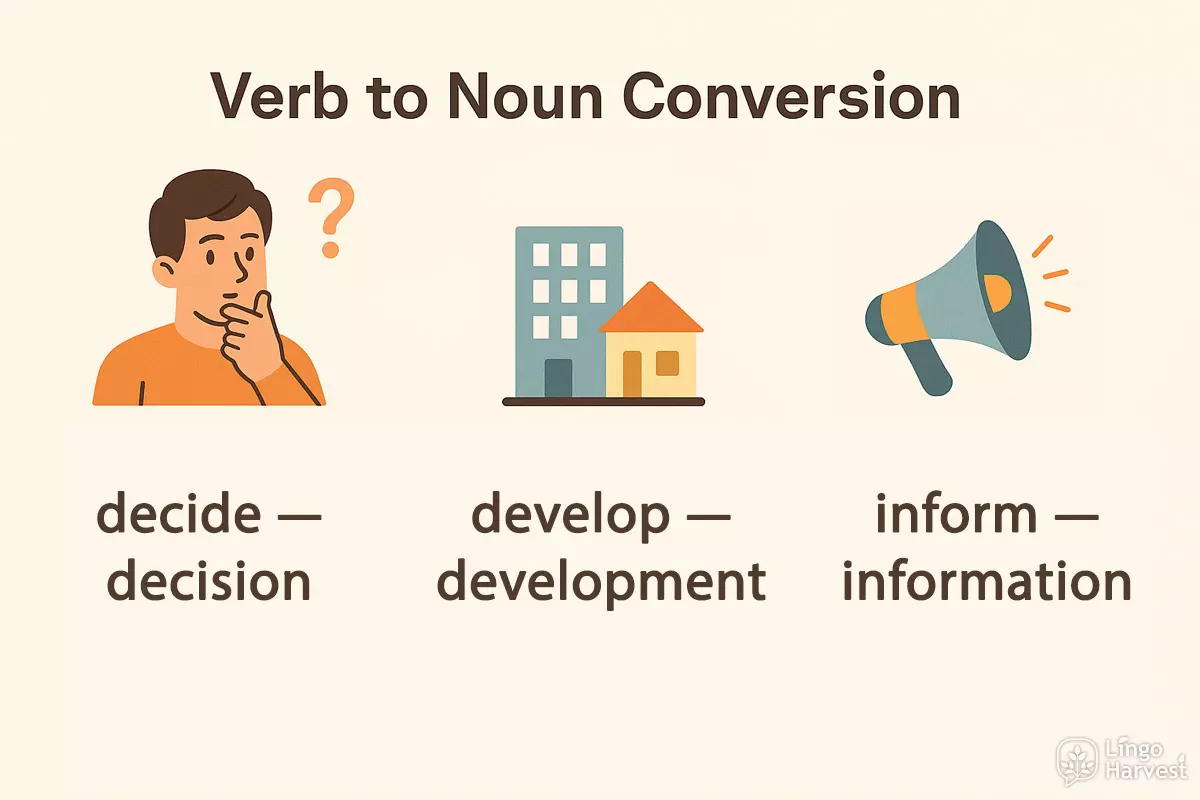
- analyze → analysis
- decide → decision
- develop → development
- inform → information
- respond → response
- move → movement
- approve → approval
- describe → description
- perform → performance
- explain → explanation
- investigate → investigation
- arrange → arrangement
- apply → application
- assist → assistance
- choose → choice
- fail → failure
- prefer → preference
- appear → appearance
Why Use Nominalization?
Using noun forms of verbs can help you:
- Emphasize the result or concept rather than the action
- Make your writing more concise and formal
- Link ideas smoothly within and between sentences
- Reduce repetition of verbs
| Verb | Noun (Nominalized Form) |
|---|---|
| analyze | analysis |
| decide | decision |
| develop | development |
| investigate | investigation |
| perform | performance |
| respond | response |
| describe | description |
| explain | explanation |
| move | movement |
| apply | application |
Mastering this aspect of English grammar can elevate your academic or professional writing by making it more precise and formal. However, overusing nominalizations may make your text heavy or less engaging, so it's best to use them thoughtfully.
Key suffixes for verb-based nouns: -tion, -ment, -al, -ance, -ing
Understanding how to transform verbs into more formal nouns can significantly improve academic and professional writing. Certain suffixes are commonly added to verb stems to create nouns that express actions, processes, or results. These noun forms are often preferred in essays, research, and reports for their precision and formality.
Overview of Common Suffixes
Several endings are frequently used to convert verbs into nouns. Each suffix has its own typical usage and may change the spelling of the original verb. Here’s a breakdown of these endings and what they generally convey:
- -tion: Indicates the act, process, or result of an action (e.g., "create" → "creation").
- -ment: Often forms nouns that refer to the action or result of the verb (e.g., "develop" → "development").
- -al: Used for nouns that denote an action or process, sometimes more abstract (e.g., "arrive" → "arrival").
- -ance: Typically forms nouns expressing a state or quality (e.g., "perform" → "performance").
- -ing: The gerund form, which can function as a noun (e.g., "run" → "running").
Examples of Verb-to-Noun Transformations
To illustrate the variety and patterns, here are several verbs paired with their noun forms using these suffixes:
- inform → information
- move → movement
- approve → approval
- attend → attendance
- analyze → analysis (irregular, but related to the pattern)
- organize → organization
- achieve → achievement
- survive → survival
- perform → performance
- train → training
- develop → development
- explain → explanation
- arrive → arrival
- apply → application
- choose → choice (irregular, but often grouped in noun formation studies)
- lead → leading
- decide → decision (irregular, but a common noun form from a verb)
- combine → combination
Suffix Patterns and Spelling Changes
Adding these suffixes sometimes involves spelling adjustments. For example, verbs ending in -e often drop the -e before adding -ing or -ion (e.g., "create" → "creation", "move" → "moving"). Verbs ending in -y may change to -i (e.g., "apply" → "application").
| Verb | Noun Form | Suffix |
|---|---|---|
| inform | information | -tion |
| develop | development | -ment |
| arrive | arrival | -al |
| perform | performance | -ance |
| train | training | -ing |
| explain | explanation | -tion |
| achieve | achievement | -ment |
| organize | organization | -tion |
| apply | application | -tion |
| move | movement | -ment |
Usage in Formal Writing
In formal contexts, using noun forms built from these suffixes helps to convey ideas with clarity and academic tone. For example, "the analysis of data" is typically preferred over "analyzing data" in scholarly texts. Being comfortable with these transformations allows for greater flexibility and sophistication in your writing.
Meaning shifts between verb and noun forms (decide vs decision)
When converting verbs to nouns in formal writing, the meaning often changes in subtle but important ways. The action-oriented sense of a verb like "decide" shifts to an abstract or result-oriented concept in the noun "decision." This transformation affects how information is conveyed and interpreted within academic and professional contexts.
How meaning changes from action to concept
Verbs typically describe an action, process, or occurrence. When the corresponding noun form is used, the focus moves to the outcome, event, or state. For example, "analyze" refers to the process of examining something, while "analysis" refers to the result or product of that process. This change can make sentences sound more objective and detached, which is preferred in formal writing.
- Verb (action/process): to choose, to discuss, to respond
- Noun (result/concept): a choice, a discussion, a response
Common pairs and their nuanced differences
Writers often need to select between a verb and its noun form depending on the desired formality and focus. For instance, "decide" emphasizes the act of making a choice, while "decision" highlights the outcome or the fact that a choice was made. Using noun forms can also help vary sentence structure and avoid repetitive verbs.
| Verb (Action/Process) | Noun (Result/Concept) |
|---|---|
| analyze | analysis |
| decide | decision |
| choose | choice |
| explain | explanation |
| describe | description |
| conclude | conclusion |
| inform | information |
| apply | application |
| approve | approval |
| propose | proposal |
| oppose | opposition |
| investigate | investigation |
| observe | observation |
| recommend | recommendation |
| organize | organization |
| assess | assessment |
| develop | development |
| instruct | instruction |
| describe | description |
Implications for formal writing
Switching from verb to noun form can make your writing sound more formal, objective, and concise. For example, "The committee decided..." becomes "The committee’s decision..."—shifting emphasis from the act to the outcome. This approach is especially useful in reports, research papers, and other academic documents, where clarity and precision are valued. Using noun forms thoughtfully helps structure arguments, highlight results, and maintain an appropriate tone.
Where verb-based nouns are useful in reports and essays
Choosing noun forms derived from verbs—such as "discussion" instead of "discuss"—can clarify structure and add precision in academic and professional writing. These noun forms, often called nominalizations, help convey complex ideas efficiently and make your writing sound more objective and formal. For example, using "analysis" rather than "analyze" enables you to focus on the process or result itself, not just the action.
Enhancing Clarity and Formal Tone
Nominalized verbs allow writers to describe actions, processes, or concepts as distinct entities. This approach is especially helpful in formal documents, where it's important to separate the act from its outcome or to generalize findings. For instance, "evaluation of results" is more precise and concise than "we evaluated the results," especially in abstracts, introductions, and conclusions.
Common Contexts for Verb-Based Nouns

Writers turn verbs into nouns in several situations to improve readability and coherence:
- Stating aims: "The aim of this investigation..."
- Describing methods: "The measurement of temperature..."
- Presenting results: "The observation revealed..."
- Summarizing findings: "After analysis,..."
- Discussing implications: "The implication of these findings..."
- Making recommendations: "Recommendation for future research..."
- Expressing cause and effect: "The increase in temperature caused..."
- Structuring arguments: "This argument supports the hypothesis."
- Justifying procedures: "Justification for the approach..."
- Reporting conclusions: "The conclusion of the study..."
Examples of Verb-to-Noun Conversions
Using the right form can improve the flow and professionalism of your writing. Here are some common verb-based nouns and their corresponding verbs:
| Verb | Noun Form |
|---|---|
| analyze | analysis |
| investigate | investigation |
| measure | measurement |
| discuss | discussion |
| observe | observation |
| recommend | recommendation |
| conclude | conclusion |
| justify | justification |
| explain | explanation |
| describe | description |
| imply | implication |
| compare | comparison |
| assess | assessment |
| evaluate | evaluation |
| define | definition |
| apply | application |
| identify | identification |
| predict | prediction |
| select | selection |
Summary
Opting for noun forms based on verbs helps structure arguments, clarify methodology, and express results more succinctly. This technique is especially valuable for producing clear, organized, and professional academic writing.
Risks of heavy nominalization for clarity and readability
Turning verbs into nouns—such as changing "analyze" to "analysis"—is a common strategy in academic and formal writing. However, overusing this technique can make text more difficult to read and understand. When sentences rely too heavily on abstract nouns instead of dynamic verbs, readers may struggle to follow the meaning or identify who is performing which action.
How excessive noun usage affects comprehension
Dense passages packed with nominalizations can obscure agency and make prose feel impersonal or vague. Instead of clearly showing actions and actors, sentences become cluttered with abstract concepts, leading to confusion or disengagement. For example:
- "The implementation of the proposal led to the improvement of the process." (Who implemented? How did it improve?)
- "Analysis of the data resulted in the conclusion that changes were necessary." (Who analyzed? Who concluded?)
Common pitfalls of overusing noun forms
Writers aiming for formality sometimes overcorrect, stacking multiple nominalizations in a single sentence. This can result in:
- Long, unwieldy sentence structures
- Loss of narrative energy and immediacy
- Ambiguity about responsibility or causation
- Reduced reader engagement and retention
- Increased cognitive load for the audience
Comparison: Verb-based vs. Nominalized Sentences
Below is a side-by-side comparison showing how excessive noun usage can cloud meaning, while verb-based phrasing tends to be clearer:
| Nominalized Sentence | Verb-Based Revision |
|---|---|
| There was an evaluation of the project by the team. | The team evaluated the project. |
| The implementation of the strategy resulted in improvement. | The team implemented the strategy and improved the results. |
| A decision was made regarding the policy update. | The committee decided to update the policy. |
| The identification of errors was accomplished through analysis. | We identified errors by analyzing the data. |
| Completion of the assignment was achieved by the students. | The students completed the assignment. |
When to avoid excessive abstraction
Nominalizations are sometimes useful for summarizing complex ideas or maintaining an objective tone. However, clarity should take precedence. When possible, prefer active verbs and specify actors to keep your writing direct and reader-friendly. If your text starts to feel dense or detached, review it for clusters of abstract nouns and consider revising for simplicity and precision.
Balancing verb forms and noun forms in one paragraph
Achieving a clear, formal tone in academic or professional writing often depends on the effective use of both action words and their corresponding noun forms. While verbs drive sentences and clarify what happens, noun forms (also called nominalizations) can help condense complex ideas, express abstract concepts, or create a more objective style. Overusing either can make writing seem either too direct and informal, or overly dense and abstract. Striking a balance allows for variety and precision, making arguments both readable and convincing. One technique is to use action verbs when describing processes or actions, then shift to noun forms when summarizing findings or discussing concepts. For instance, when presenting research, you might first describe what you did (“We analyzed the data”) and then state the result using a noun form (“the analysis revealed…”). This approach helps readers follow both the activity and its outcome.
Common verb-to-noun conversions for formal writing
Writers often encounter situations where switching between forms is beneficial. Here are some frequent conversions:
- analyze → analysis
- investigate → investigation
- demonstrate → demonstration
- explore → exploration
- assess → assessment
- develop → development
- measure → measurement
- observe → observation
- decide → decision
- respond → response
- perform → performance
- describe → description
- explain → explanation
- propose → proposal
- recommend → recommendation
- evaluate → evaluation
- participate → participation
- apply → application
- solve → solution
- compare → comparison
Examples of effective mixing
When drafting a paragraph, try alternating forms for clarity and flow. For example: “We conducted an analysis of the results, which allowed us to identify patterns. Based on this assessment, we recommend further investigation.” This structure uses both nominalizations (“analysis,” “assessment,” “investigation”) and action verbs (“conducted,” “identify,” “recommend”) to keep the writing both precise and dynamic. Writers should also be aware of the context. In methods sections, verbs often dominate to describe procedures. In discussions or conclusions, noun forms can succinctly summarize complex findings or concepts. Finding this equilibrium is key to producing professional, readable text without unnecessary repetition or abstraction.
Practice: rewrite sentences using analysis, improvement, increase, etc.
Transforming verbs into nouns can make your writing more formal and concise. In this exercise, you'll practice converting sentences by replacing verb phrases with their noun forms, such as changing "analyze" to "analysis" or "improve" to "improvement." This is especially useful in academic or professional contexts, where noun-based structures often sound more objective and polished.
Rewrite the following sentences using noun forms
Read each sentence and replace the verb (in bold) with a suitable noun. Adjust the sentence as needed to maintain correct grammar and meaning.
- The scientists analyzed the data carefully.
- We need to improve our results next year.
- Sales increased rapidly in March.
- The manager decided to change the policy.
- They will discuss the proposal tomorrow.
- Students participated in the survey.
- The team achieved its goals.
- We measured the temperature every hour.
- The company developed a new strategy.
- She presented her findings at the conference.
Useful noun forms for formal writing
- analyze → analysis
- improve → improvement
- increase → increase
- decide → decision
- discuss → discussion
- participate → participation
- achieve → achievement
- measure → measurement
- develop → development
- present → presentation
When making these changes, you may also need to adjust other parts of the sentence for clarity and flow. This process is fundamental for producing clear, formal English in essays, reports, and academic writing.
Show answers
- The scientists conducted an analysis of the data.
- An improvement in our results is needed next year.
- There was a rapid increase in sales in March.
- The manager made a decision to change the policy.
- A discussion of the proposal will take place tomorrow.
- There was active participation by students in the survey.
- The team reached its achievement of goals.
- Measurement of the temperature was done every hour.
- The company focused on the development of a new strategy.
- She gave a presentation of her findings at the conference.