Ellipsis in Complex Sentences: What You Can Safely Leave Out

 The article defines ellipsis and its types, details how it appears in coordinate, comparative, and conditional clauses, examines differences in spoken and written use, discusses how to avoid ambiguity, and provides practice with applying and restoring ellipsis.
When crafting complex sentences, writers may feel tempted to leave out words that appear obvious from the context. However, deciding which details can be omitted without losing clarity requires careful judgment. Striking the right balance between brevity and completeness is a valuable skill that enhances the effectiveness of your writing. By thoughtfully choosing which words to include or exclude, you can ensure your sentences remain concise while still communicating your intended message clearly and effectively to readers.
Definition and types of ellipsis
Ellipsis is the deliberate omission of words or phrases from a sentence when their meaning can be inferred from context. In complex sentences, this linguistic shortcut helps avoid unnecessary repetition, making communication more efficient and natural. The omitted elements are often verbs, subjects, or clauses that have already been mentioned or are easily understood by the listener or reader.
What is left out and why?
In many cases, speakers drop repeated verbs or subjects to streamline their sentences. For example, in "She can play the piano, and he can too," the verb "can" is implied in the second clause. This practice is common in both written and spoken language, especially when two or more clauses share similar structure or content.
Main types of ellipsis in complex sentences
- Verb phrase ellipsis: Omitting a verb phrase that has already appeared (e.g., "I will go, and you will too").
- Gapping: Leaving out repeated verbs or predicates in coordinated clauses (e.g., "John likes apples, and Mary likes oranges").
- Stripping: Omitting everything except one element, often with "too" or "either" (e.g., "He can sing, and she can too").
- Null complement anaphora: Skipping repeated objects or complements (e.g., "She wanted to go, but I didn't want to go").
- Comparative ellipsis: Omitting parts after "than" or "as" in comparisons (e.g., "She is taller than I am").
- Relative clause ellipsis: Leaving out parts of a relative clause (e.g., "This is the book I told you about").
- Subject ellipsis: Omitting the subject when it is clear from context, often in informal speech ("Going to the store, want anything?").
- Coordination ellipsis: Omitting repeated elements in coordinated structures ("She likes tea, he coffee").
- Infinitival ellipsis: Leaving out "to" and the verb when it is understood ("I'd like to help, but I can't help").
- Sentential ellipsis: Omitting entire clauses when context fills the gap ("If possible, yes").
Comparison of common ellipsis patterns
| Type | Example with Ellipsis | Full Form |
|---|---|---|
| Verb phrase ellipsis | I will go, and you too. | I will go, and you will go too. |
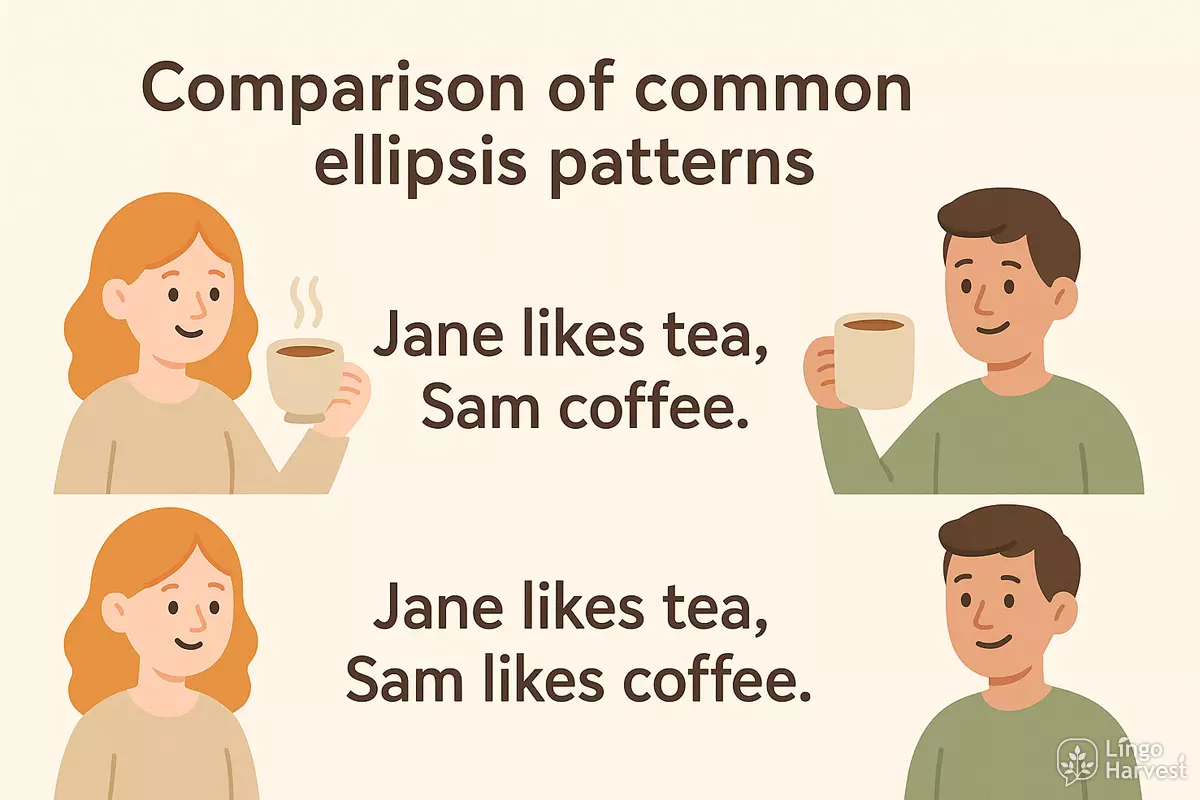
| Gapping | Jane likes tea, Sam coffee. | Jane likes tea, Sam likes coffee. |
| Comparative ellipsis | She runs faster than I do. | She runs faster than I run. |
| Stripping | He ate the cake, and she too. | He ate the cake, and she ate the cake too. |
| Coordination ellipsis | We ordered soup, they salad. | We ordered soup, they ordered salad. |
These various forms allow speakers to avoid redundancy and maintain clarity, provided the context makes the omitted material clear. Understanding the different types can help both writers and readers navigate complex sentences more effectively.
Ellipsis in coordinate clauses
When two or more clauses are joined by coordinating conjunctions such as and, but, or or, speakers often omit repeated words or phrases for efficiency. This type of omission is common in both spoken and written language, helping to avoid unnecessary repetition and keep sentences concise. The omitted material is usually recoverable from the context, which prevents ambiguity.
Common patterns and examples
In coordinated structures, ellipsis can affect various sentence elements, including subjects, verbs, objects, and even auxiliary verbs. Here are some frequent cases:
- She likes apples and (she likes) oranges.
- They finished the project, but (they) didn’t celebrate.
- You can stay here or (you can) leave.
- He has read the book and (he has) watched the movie.
- We should call them, or (we should) send an email.
- Anna wanted pizza and (Anna wanted) pasta.
- He will go to Paris, and (he will go) to Rome.
- Tom can’t swim but (Tom can) run fast.
- Mary cooks and (Mary) cleans every day.
- I could sing, or (I could) dance if you prefer.
- She works hard but (she) plays harder.
- We might travel in June or (we might travel) in July.
- He must study or (he must) fail the exam.
- They were tired but (they were) happy.
- Jack bought apples, and (Jack bought) oranges, too.
- We’ll meet at noon or (we’ll meet) at one.
- She could come early or (she could come) late.
- He knows French and (he knows) Spanish.
- I will write the report and (I will) send it tomorrow.
- They planned a trip but (they) canceled it.
How much can you leave out?
The amount of material that can be omitted depends on clarity and the parallel structure of the clauses. If removing a word or phrase leads to confusion or changes the sentence's meaning, it's best to retain it. The omitted parts must be easily inferable from earlier in the sentence.
| Full Form | With Ellipsis |
|---|---|
| She likes tea and she likes coffee. | She likes tea and coffee. |
| He will call you or he will email you. | He will call or email you. |
| They can stay here or they can leave. | They can stay or leave. |
| Mary is reading and Mary is writing. | Mary is reading and writing. |
When to avoid ellipsis
Omitting too much can make sentences ambiguous or awkward. If the two clauses are not parallel or if the omitted information is essential for understanding, it's safer to include the full form. Always consider whether your reader can easily reconstruct the missing parts from context. In summary, using ellipsis in joined clauses can make your writing more natural and less repetitive, as long as clarity is maintained.
Ellipsis in comparative and conditional structures
Ellipsis often plays a crucial role when dealing with comparisons and conditions in complex sentences. By omitting repeated words or phrases, English speakers make their language more efficient and less redundant. However, it’s important to know what can safely be left out and what must remain for clarity.
Comparative Constructions
When making comparisons using words like "than" or "as," it’s common to leave out parts of the sentence that are understood from context. This streamlines communication without causing confusion.
- She is taller than I am (am omitted).
- He speaks French better than he speaks German.
- This book is more interesting than that book is.
- My car is as fast as your car is.
- She has more experience than her coworkers have.
- They know more than we know.
- I did the job as quickly as I could.
- She’s more patient than anyone else is.
- He can run farther than he could last year.
- The task was easier than we expected it to be.
Conditional Sentences
Ellipsis is also common in conditional sentences, especially in informal speech and writing. Often, the main clause or parts of it are omitted when the meaning is clear.
- If you need help, let me know (main clause implied).
- If necessary, call me.
- If not, we’ll try something else.
- Should you require assistance, just ask.
- Had I known, I would have acted differently.
- If possible, arrive early.
- If so, we can proceed.
- If in doubt, consult the manual.
- Were I you, I’d reconsider.
- If all else fails, restart the system.
Patterns of Omission
The table below shows typical ellipsis patterns in both comparative and conditional structures, illustrating what is left out and what is implied for clarity:
| Full Structure | Elliptical Version (Omitted Elements) |
|---|---|
| She is taller than I am tall. | She is taller than I am. |
| If you are ready, you can start. | If you are ready, (you can start). |
| He has more books than she has books. | He has more books than she has. |
| If it rains, we will stay inside. | If it rains, (we will stay inside). |
| This exam is harder than the last exam was hard. | This exam is harder than the last was. |
| If you wish to join, you may join. | If you wish to join, (you may). |
Understanding how and when to omit words in these structures not only makes your writing smoother but also helps prevent awkward or repetitive phrasing. Just be sure the omitted element is truly clear from context—otherwise, the sentence may become ambiguous.
Register: spoken vs written ellipsis
In everyday conversation, sentences are often shortened by leaving out words that listeners can easily infer. This is especially common in speech, where context and shared understanding allow speakers to omit repeated subjects, verbs, or even whole clauses. By contrast, formal writing tends to require more explicitness, making ellipsis less frequent and usually more controlled.
Common Patterns in Speech
Spoken language is full of omitted elements, especially when the meaning remains clear. Here are some typical ways ellipsis appears in everyday talk:
- Answering questions with fragments: "Coming tonight?" → "Probably."
- Leaving out repeated verbs: "You going to the party?" → "Might."
- Omitting subjects: "Need help?" instead of "Do you need help?"
- Skipping auxiliary verbs: "Seen her?" instead of "Have you seen her?"
- Dropping objects: "Want some?" instead of "Do you want some?"
- Leaving out conjunctions: "Home now. Tired."
- Short imperatives: "Coming?" or "Ready?"
- Tag questions with minimal form: "Nice weather, huh?"
- Abbreviated conditionals: "If hungry, there's food."
- Contrastive ellipsis: "I can. She can't."
Ellipsis in Written Registers
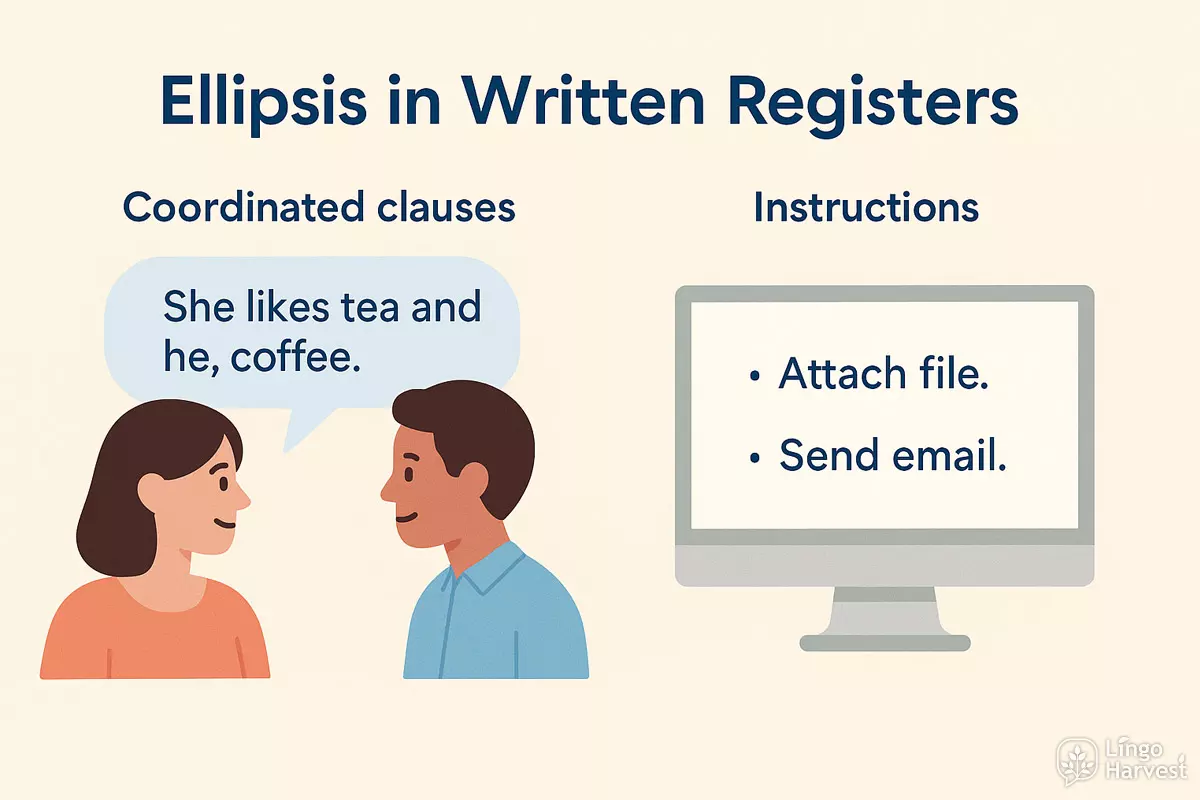
Written texts, especially academic or business documents, avoid excessive omission to ensure clarity. However, ellipsis still appears, though more selectively. Typical cases include:
- Coordinated clauses: "She likes tea and he, coffee."
- Instructions: "Attach file. Send email."
- Notes and headlines: "Meeting postponed."
- Brevity in correspondence: "Will do."
Writers must judge whether the omitted information is easily recoverable by the reader. Overusing ellipsis in formal texts can lead to ambiguity or misunderstandings.
Comparing Spoken and Written Ellipsis
| Spoken (Informal) | Written (Formal) |
|---|---|
| Omission of subjects/auxiliaries: "Finished?" | Complete sentences: "Have you finished?" |
| Fragmented replies: "Could be." | Full replies: "It could be possible." |
| Short questions: "Coming with?" | Explicit questions: "Are you coming with me?" |
| Elliptical imperatives: "Hands washed!" | Polite requests: "Please wash your hands." |
| Context-driven: Relies on shared knowledge | Self-contained: Less reliance on context |
When Ellipsis Works—and When It Doesn’t
In spoken language, leaving out words rarely causes confusion if the context is clear. In writing, though, omitting too much can make your meaning vague or even misleading. As a rule of thumb, the more formal or distant your audience, the less you can safely leave out. Always consider your reader and the potential for ambiguity before relying on ellipsis in complex sentences.
Avoiding ambiguity and misunderstanding
When using ellipsis in complex sentences, clarity should always be the priority. Omitting words can make your writing more concise, but it also increases the risk of confusing readers if the sentence structure leaves multiple interpretations. To minimize confusion, it’s essential to ensure that the meaning remains clear even when certain elements are left out.
Common pitfalls when omitting elements
Writers often drop repeated words or phrases, assuming the reader will fill in the gaps. However, if the omitted material could refer to more than one thing, the result might puzzle your audience. Some typical issues include:
- Unclear referents: When the subject or object is missing and the reader cannot easily determine what is being discussed.
- Parallel structure breakdown: When ellipsis is used in a list or series but the underlying grammatical pattern isn’t maintained.
- Ambiguous conjunctions: When 'and', 'or', or 'but' join clauses and the omitted words could logically fit in more than one place.
Strategies for clear ellipsis
To keep your sentences both concise and comprehensible:
- Check if the omitted information is recoverable from context without guesswork.
- Read the sentence aloud; if it sounds incomplete or odd, reconsider the omission.
- Maintain parallelism in lists and compound structures so the reader can easily “fill in” the missing parts.
- Use pronouns carefully—make sure their antecedents are obvious even after omission.
- Avoid ellipsis in highly technical or formal writing unless the meaning is unmistakable.
- When in doubt, err on the side of explicitness rather than brevity.
Examples: Ambiguous vs. clear ellipsis
| Ambiguous Version | Clear Version |
|---|---|
| She likes her brother more than me. | She likes her brother more than she likes me. |
| He said he would call, and left. | He said he would call, and he left. |
| Sam gave Alex his book because he was finished. | Sam gave Alex his book because Sam was finished. |
| Tom speaks French better than John. | Tom speaks French better than John does. |
Quick checklist for safe ellipsis
- Is the omitted information recoverable and unambiguous?
- Does the sentence maintain grammatical balance?
- Would a reader unfamiliar with the context understand the intended meaning?
- Are you avoiding unnecessary repetition without sacrificing clarity?
By reviewing these points and examples, you can confidently use ellipsis in complex sentences while ensuring your message remains easy to follow.
Practice: apply ellipsis and then restore full forms
Understanding ellipsis in complex sentences is best achieved by working through real examples. Below, you'll find a series of practice tasks where parts of sentences have been omitted. Your goal is to identify what’s missing (the elided material) and then rewrite the sentences in their full, explicit form. This process helps you internalize how and when ellipsis is used, and how to restore omitted elements for clarity or formal writing.
Task 1: Identify and Expand Ellipsis
Read each sentence and decide what information has been left out. Then, rewrite each sentence, restoring all implied words or phrases.
- Jane went to the store, and Tom to the library.
- If you want to join, let me know; if not, that’s fine.
- She can play the piano better than I can.
- He likes coffee; she, tea.
- We finished the project, but they didn’t.
- Although tired, he continued working.
- I’ll help if you need me to.
- Some students passed, others failed.
- She speaks French as well as her brother.
- They could have arrived earlier, but didn’t.
Show answers
- Jane went to the store, and Tom went to the library.
- If you want to join, let me know; if not, that’s fine with me.
- She can play the piano better than I can play the piano.
- He likes coffee; she likes tea.
- We finished the project, but they didn’t finish the project.
- Although he was tired, he continued working.
- I’ll help if you need me to help.
- Some students passed, while others failed.
- She speaks French as well as her brother speaks French.
- They could have arrived earlier, but they didn’t arrive earlier.
Task 2: Apply Ellipsis Yourself
Take these fully written sentences and shorten them by omitting repeated or obvious information, without making the meaning unclear.
- Maria likes chocolate, and Peter likes chocolate too.
- We will go to the cinema if you will go to the cinema.
- He is taller than his brother is tall.
- I have never been to Paris, but she has been to Paris.
- She can play the guitar, and he can play the guitar too.
- They finished the project, and we finished the project as well.
- I will read the book if you will read the book.
- She speaks Spanish better than I speak Spanish.
- He didn't see the movie, but I saw the movie.
- We were tired after the trip, and they were tired after the trip too.
Show answers
- Maria likes chocolate, and Peter too.
- We will go to the cinema if you will.
- He is taller than his brother is.
- I have never been to Paris, but she has.
- She can play the guitar, and he can too.
- They finished the project, and we did as well.
- I will read the book if you will.
- She speaks Spanish better than I do.
- He didn't see the movie, but I did.
- We were tired after the trip, and they were too.
Common Patterns of Ellipsis in Complex Sentences
Here are some frequent structures where ellipsis naturally occurs. Recognizing these will help you both spot and use ellipsis confidently:
- Coordinated clauses: “I called, but nobody answered.”
- Comparisons: “He’s older than I am.”
- Conditional sentences: “If necessary, call me.”
- After auxiliary verbs: “She can swim, and so can I.”
- Reduced relative clauses: “The man (who is) sitting over there is my uncle.”
- Conjunctions with omitted subjects/verbs: “Some ate pizza, others pasta.”
- After ‘to’ in infinitive structures: “She wanted to go, but I didn’t want to.”
- Ellipsis after ‘but’: “He tried, but failed.”
- Fronted adverbials: “When finished, press the button.”
- Short answers: “Will you come?” “I will.”
- Tag questions: “You’re coming, aren’t you?”
- Omission in reported speech: “She said (that) she was tired.”
Compare Elliptical and Full Sentences
The table below demonstrates how ellipsis operates in various sentence types, with both the shortened and complete versions side by side for clarity.
| Elliptical Sentence | Full Form |
|---|---|
| She likes apples, and he bananas. | She likes apples, and he likes bananas. |
| Jack can play the guitar, and Jill the piano. | Jack can play the guitar, and Jill can play the piano. |
| If hungry, help yourself. | If you are hungry, help yourself. |
| Some people left early, others stayed late. | Some people left early, while others stayed late. |
| He did more than was expected. | He did more than was expected of him. |
| She can swim, and so can I. | She can swim, and so can I swim. |
| They could have helped, but didn’t. | They could have helped, but they didn’t help. |
| When finished, submit your work. | When you are finished, submit your work. |
| He is smarter than I am. | He is smarter than I am smart. |
| We saw the movie, and they the play. | We saw the movie, and they saw the play. |
Practicing both reducing and expanding sentences with ellipsis will sharpen your grammatical awareness and make your writing more flexible and precise.