Substitution in Advanced Grammar: Using “One”, “Do”, “So”, and “Not”

 Here we the difference between substitution and ellipsis, explains how to use words like one, ones, do, so, and not to avoid repetition, discusses their impact on politeness and economy, points out frequent mistakes, and provides practice exercises.
Mastering complex English involves learning to avoid unnecessary repetition by using clever substitutes such as "one," "do," "so," and "not." These words allow us to replace previously mentioned ideas or phrases, resulting in sentences that flow more smoothly and sound more natural. By employing these alternatives appropriately, we can make our communication clearer and more concise, which is especially important in both written and spoken English. Developing this skill not only improves your language proficiency but also enhances your ability to express ideas effectively.
How substitution differs from ellipsis
Understanding the distinction between substitution and ellipsis is essential for mastering advanced grammar. Both are cohesive devices used to avoid unnecessary repetition, but they function in different ways. Substitution replaces a word or phrase with another, such as “one,” “do,” or “so,” while ellipsis omits the repeated element entirely, leaving it understood from context.
Key differences in use
Substitution involves inserting a specific word to stand in for something mentioned earlier. For example, “I need a pen. Do you have one?” Here, “one” substitutes for “a pen.” In contrast, ellipsis removes the repeated item: “I need a pen. Do you?” The object “a pen” is omitted but implied. Ellipsis is often more economical, relying on the listener’s or reader’s ability to infer the missing information. Substitution, on the other hand, makes the sentence more explicit by providing a stand-in word.
Common patterns and markers
- Substitution: uses words like “one/ones,” “do/does/did,” “so,” “not.”
- Ellipsis: omits verbs, subjects, or objects that are clear from the previous clause or sentence.
- Substitution is more common in formal or written English; ellipsis is frequent in spoken and informal contexts.
- Ellipsis can involve larger stretches of text, while substitution typically replaces a single word or short phrase.
Examples comparing both strategies
| Substitution Example | Ellipsis Example |
|---|---|
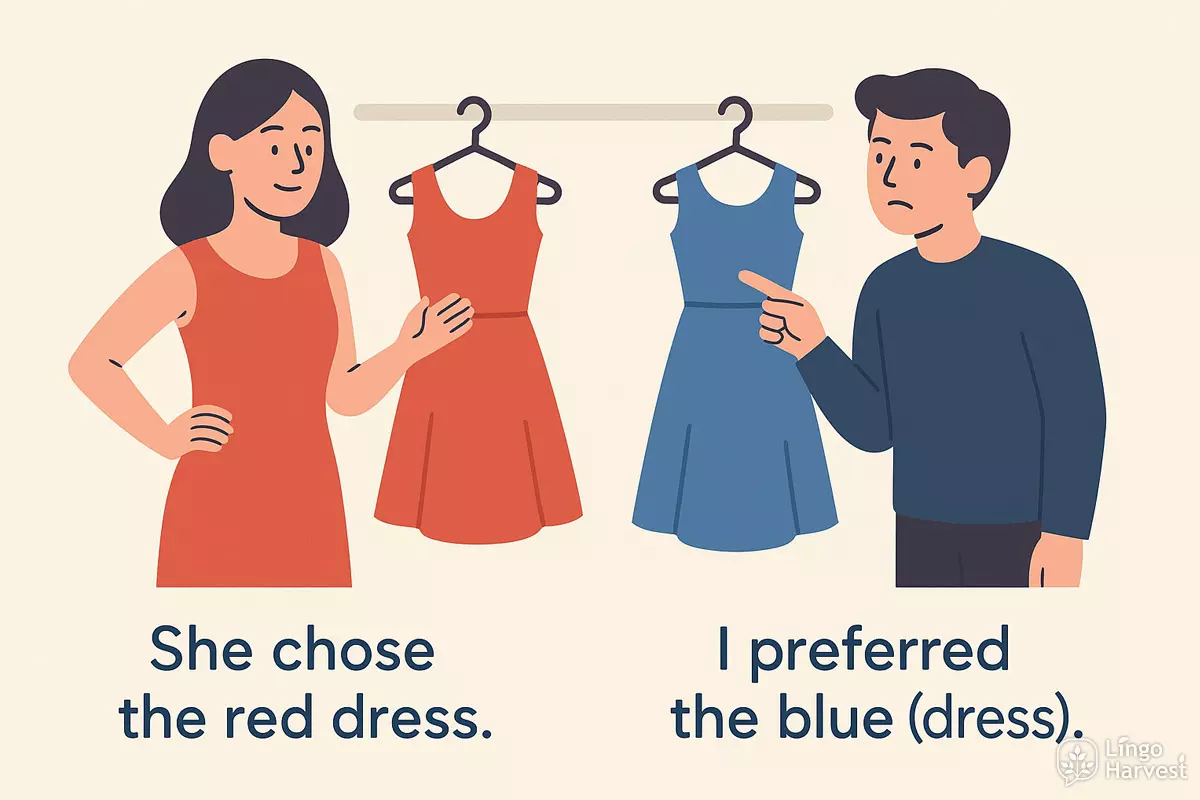
| She chose the red dress. I preferred the blue one. | She chose the red dress. I preferred the blue → (dress). |
| Tom finished first. Sarah did so as well. | Tom finished first. Sarah → (finished first) as well. |
| He said he would help, but I think not so. | He said he would help, but I think → (he won’t). |
| She likes coffee; I do not. | She likes coffee; I → (don’t like coffee). |
Summary of main contrasts
- Substitution uses a “placeholder” word; ellipsis relies on omission.
- Ellipsis often creates shorter, snappier sentences, especially in conversation.
- Substitution can clarify what is being referred to, reducing ambiguity.
- Both strategies help avoid repetition, but they suit different contexts and styles.
By recognizing when to use each, writers and speakers can make their language more fluent and precise.
Using one and ones to avoid noun repetition
When speaking or writing in English, repeating the same noun multiple times can sound awkward and redundant. To make sentences smoother and more natural, we often substitute the noun with "one" (for singular, countable nouns) or "ones" (for plural, countable nouns). This substitution helps to avoid unnecessary repetition and keeps communication concise.
How "one" and "ones" work
"One" is used when referring back to a singular noun already mentioned, while "ones" replaces a plural noun. These forms cannot be used with uncountable nouns or in situations where the noun is not clear from context.
- I like the red shirt, but I’ll buy the blue one. (Not repeating "shirt")
- These apples are sour; I prefer the sweet ones. (Not repeating "apples")
- She lost her pen, so I gave her my one.
- Which cookies do you want? The chocolate ones, please.
- My phone is old. I need a new one.
- Do you want this chair or that one?
- Some students passed, but the lazy ones failed.
- He had many ideas, but the best one was about recycling.
- We need more cups. There aren’t enough ones for everyone. ❌ (Incorrect: "cups" is plural, but "ones" is rarely used for objects like cups; usually, we omit the noun or use "some more")
- This is my favorite book. I haven’t read the other one yet.
Common patterns and tips
- Adjectives usually come before "one" or "ones": "the big one", "the old ones".
- We don’t use "one" or "ones" for uncountable nouns: Not "I need some more sugar ones."
- These substitutes require a clear reference. If it’s not obvious, repeat the noun for clarity.
- Articles and possessives can be used: "a new one", "my old ones".
| Original Sentence | With "one" or "ones" |
|---|---|
| Is this your umbrella? | No, mine is the red one. |
| I like these shoes. | I prefer the black ones. |
| Which jacket did you buy? | I bought the cheaper one. |
| Do you want this apple? | No, I’d like a bigger one. |
| These pencils are dull. | Let’s use the sharp ones. |
| That computer is slow. | I want a faster one. |
| Those bags are heavy. | The small ones are lighter. |
Mastering the use of "one" and "ones" is a valuable skill for making your English sound more fluent and avoiding awkward repetition in both conversation and writing.
Using do, so, and not to replace clauses
Replacing whole clauses with single words like “do,” “so,” and “not” helps avoid repetition and keeps sentences clear. These substitutes act as stand-ins for longer verb phrases or clauses, allowing speakers and writers to communicate efficiently without restating information everyone already knows.
How “do” works as a substitute
“Do” (and forms like “does” or “did”) often replace a verb phrase when the action is repeated or already mentioned. This is common in short answers, tag questions, and when agreeing or disagreeing.
- She plays the piano, and I do too. (replaces “play the piano”)
- He didn’t finish the project, but I did. (replaces “finish the project”)
- They like jazz, don’t they? Yes, they do.
- Does she know the answer? She does.
Using “so” to refer back to clauses
“So” can stand in for an entire clause, usually in agreement or confirmation. It’s common after reporting verbs or when confirming expectations.
- “She’s coming to the party.” “I hope so.” (so = she’s coming)
- “Will it rain tomorrow?” “I think so.” (so = it will rain)
- “Are they ready?” “I believe so.” (so = they are ready)
- “Did you hear the news?” “I guess so.”
Replacing negatives with “not”
“Not” can substitute for an entire negative clause, particularly after verbs like “think,” “believe,” or “hope.”
- “Will she join us?” “I hope not.” (not = she will not join us)
- “Is it true?” “I’m afraid not.” (not = it isn’t true)
- “Are you coming?” “Probably not.”
- “Will he call?” “I don’t think so.”
Substitution patterns at a glance
| Form | Example Substitution | Full Clause Replaced |
|---|---|---|
| do/does/did | She enjoys it, and I do too. | and I enjoy it too |
| so | I hope so. | I hope she will come |
| not | I hope not. | I hope she will not come |
| so (agreement) | So do I. | I do as well |
| do not / does not | She doesn’t like it, and neither do I. | and I don’t like it either |
Common mistakes and tips
- ❌ Incorrect: “I hope yes.” (Say “I hope so.”)
- ✅ Correct: “Will she pass?” “I think so.”
- ❌ Incorrect: “Me too do.” (Say “So do I.”)
- ✅ Correct: “She didn’t go, and neither did I.”
Mastering these substitutes makes both spoken and written English more natural and avoids clumsy repetition. Practice recognizing when a clause can be replaced with “do,” “so,” or “not” for smoother communication.
Pragmatic effects: politeness and economy
Substitution with words like “one”, “do”, “so”, and “not” serves more than just grammatical neatness—it also shapes how speakers manage politeness and efficiency in conversation. These forms let us avoid awkward repetition, gently soften statements, or sidestep sensitive topics, making exchanges smoother and more considerate.
Politeness through substitution
Using substitutes can help speakers avoid being too direct or repetitive, both of which can seem impolite or blunt. For example, saying “I’d like the chocolate one” instead of repeating the full noun phrase (“chocolate cake”) sounds less robotic and more natural. In questions, “Would you like some tea?” followed by “I’d love some, thank you” (leaving out “tea”) is tactful and succinct.
- “I prefer the spicy one.” (avoids repeating “dish”)
- “I hope so.” (instead of “I hope that happens”)
- “She might not.” (instead of “She might not come”)
- “They do.” (instead of “They like it too”)
- “He didn’t, but I did.” (avoids repeating the verb phrase)
Economy and conversation flow
Substitution also keeps conversations uncluttered and efficient. By replacing longer phrases with shorter stand-ins, speakers maintain a natural rhythm and avoid unnecessary repetition. This is especially useful in quick exchanges or when the context is clear.
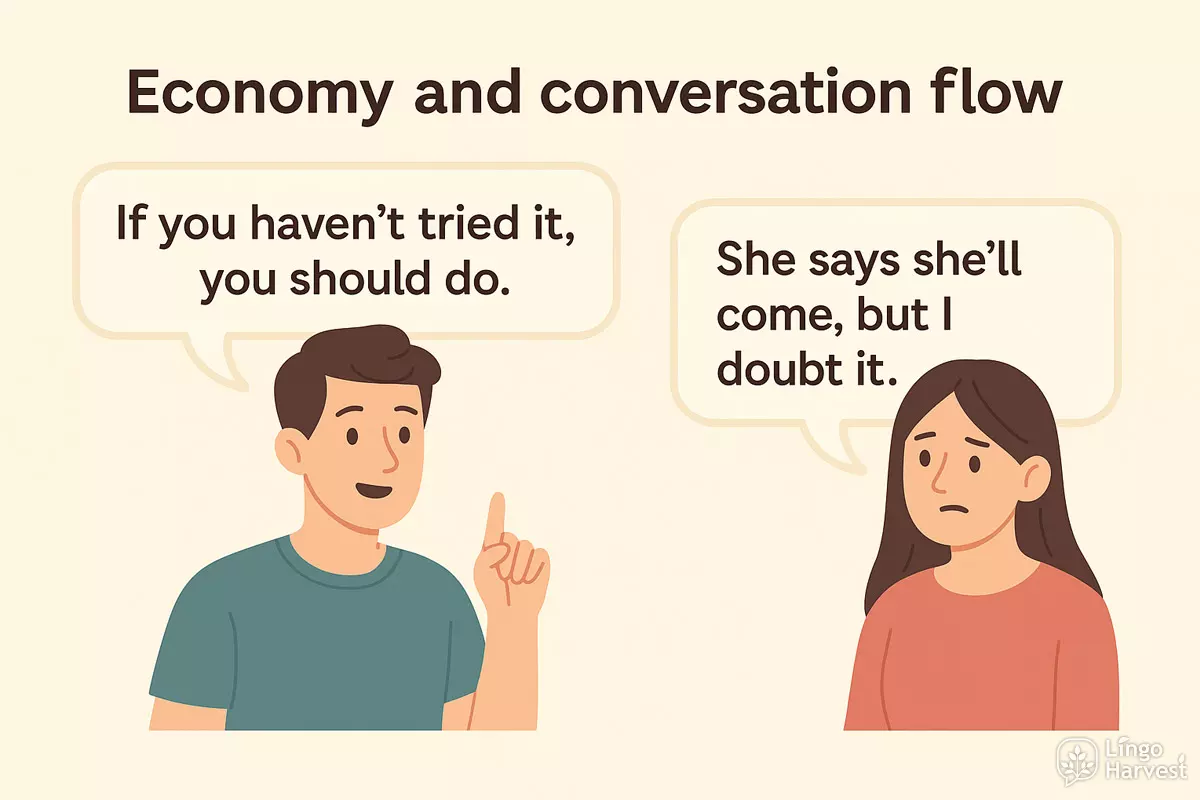
- “If you haven’t tried it, you should do.”
- “She says she’ll come, but I doubt it.”
- “You can have the red one or the blue one.”
- “I think so.”
- “I haven’t, but John has.”
- “Will you help? I hope so.”
- “Some people like jazz, others not.”
- “She promised to call, but she didn’t.”
- “He could join us, if he wants to.”
- “They might go, but I doubt it.”
Comparing functions in context
| Substitute | Pragmatic Use | Example |
|---|---|---|
| one | Avoids repeating a noun; maintains politeness | “Do you want the chocolate or the vanilla one?” |
| do | Substitutes for a verb phrase; keeps responses brief | “I didn’t finish, but she did.” |
| so | Replaces clauses; softens or affirms statements | “I hope so.” |
| not | Negates a repeated phrase; signals contrast politely | “Some people enjoy it, others not.” |
In summary, these substitution forms are tools for making speech smoother, less repetitive, and more attuned to social nuances. They allow speakers to be both tactful and concise, supporting natural, polite interaction.
Common substitution mistakes at higher levels
Learners advancing in English often encounter subtle pitfalls with substitution words like “one,” “do,” “so,” and “not.” These forms seem straightforward but can lead to errors that affect clarity or naturalness, especially in more complex sentences. Mastery requires attention to nuance, register, and the specific grammar rules that govern their use.
Overusing or Misplacing “One/Ones”
A frequent issue is using “one” or “ones” when an article or pronoun would be more idiomatic, or omitting them when needed. For instance, “I prefer the blue shirt to the red” (correct) versus “I prefer the blue one to the red one” (acceptable, but redundant if context is clear). Problems also arise when “one” is incorrectly left out, causing ambiguity.
- Repeating “one” unnecessarily: “These apples are fresher than those ones ❌” (should be “those”).
- Omitting when needed: “Which cake do you want? – I’ll take the chocolate. ❌” (should be “the chocolate one”).
- Plural confusion: “I need two clean ones, not dirty.”
Confusing “Do/Does/Did” in Substitution
Advanced learners sometimes struggle with tense and subject agreement in substitution with “do.” This can result in sentences that sound awkward or ungrammatical.
| Incorrect Use ❌ | Corrected Version ✅ |
|---|---|
| She speaks French and I do too. | She speaks French, and so do I. |
| He didn’t finish, but I do. | He didn’t finish, but I did. |
| They will come, and so I do. | They will come, and so will I. |
| She likes jazz, and I does too. | She likes jazz, and so do I. |
| I’m happy, and so she is. | I’m happy, and so is she. |
| They were tired, and so we do. | They were tired, and so were we. |
| He enjoys reading, and so I am. | He enjoys reading, and so do I. |
| She can play the piano, and so I do. | She can play the piano, and so can I. |
| They haven’t seen the film, and neither do we. | They haven’t seen the film, and neither have we. |
| I wouldn’t go, and neither I would. | I wouldn’t go, and neither would I. |
Misapplying “So” and “Not” in Ellipsis
“So” and “not” can stand in for clauses, but errors often occur with register or when the wrong form is chosen for the intended meaning.
- ✔️ “I think so” / “I hope so” — correct ❌ “I want so” — incorrect
- ✔️ “I think not.” — correct (formal) ✔️ “I don’t think so.” — correct (common) ❌ “I don’t think not.” — incorrect
- ✔️ “If so, let me know.” — correct ❌ “If yes, let me know.” — incorrect
- ✔️ “She may come, but I don’t think so.” — correct ❌ “She may come, but I think not so.” — incorrect
Register and Redundancy Issues
Advanced users sometimes default to forms that are technically correct but sound stilted or repetitive, especially with “one,” “so,” or “do.” Choosing the most natural substitute depends on context and familiarity with idiomatic patterns.
- Unnecessary repetition: “If you do so, so do I.”
- Over-formality: “He believes so, and so do I.” (correct, but could often just say “Me too.” in conversation)
- Mixing registers: “She is going to the party, and I do so as well.” ❌ (should be “and so am I”)
Summary of Typical Mistakes
- Incorrect tense with “do/did/does” substitutions
- Redundant use of “one/ones”
- Inappropriate register with “so/not”
- Forgetting agreement between subject and auxiliary
- Omitting necessary substitutes, leading to ambiguity
- Mixing forms (“so do I” vs. “I do so”)
- Using substitutes in contexts where a full clause is clearer
- Confusing plural and singular forms
- Transferring patterns from other languages
- Overusing literal translations instead of idiomatic phrases
Paying attention to these nuanced issues helps advanced learners sound more natural and precise in both spoken and written English.
Practice: replace repeated elements with substitution
Understanding how to avoid unnecessary repetition in sentences is crucial for advanced English. Substitution with words like “one,” “do,” “so,” and “not” streamlines communication and improves clarity. Let’s focus on how to use these substitutes in realistic contexts.
Identifying When to Substitute
Repeated elements can make sentences sound awkward or overly formal. Consider these examples:
- “I liked your idea, and I think Sarah liked your idea too.”
- “He said he would attend, but I don’t think he will attend.”
In both cases, repeating the same phrase is unnecessary. Substitution makes the sentences smoother.
Common Substitution Patterns
Here are typical ways to replace repeated nouns, verbs, verb phrases, clauses, or entire sentences:
- “One/ones” – replaces countable nouns: “I prefer the red apples to the green ones.”
- “Do/does/did” – replaces verbs or verb phrases: “She plays tennis better than I do.”
- “So” – substitutes for clauses or statements: “He is coming, and so am I.”
- “Not” – replaces negative verbs or clauses: “She will pass the exam; I hope so, but I’m not sure.”
Practice: Substitute in Context
Try replacing the repeated part in each sentence using the appropriate substitution word. Rewrite each sentence.
- Mike wants to buy a new laptop, and Sarah wants to buy a new laptop too.
- Julia didn’t finish her assignment, but Mark finished his assignment.
- Will you attend the meeting? I hope you will attend the meeting.
- These shoes are too small. Do you have shoes in a bigger size?
- He thought it would rain, and it did rain.
- I don’t like horror movies, but my brother likes horror movies.
- She promised to help, but she didn’t help.
- Are you hungry? If so, let’s eat.
- Some students passed the test, and some students didn’t pass the test.
- I haven’t tried the soup. Have you tried the soup?
Show answers
- Mike wants to buy a new laptop, and Sarah wants to buy one too.
- Julia didn’t finish her assignment, but Mark did.
- Will you attend the meeting? I hope so.
- These shoes are too small. Do you have any in a bigger size?
- He thought it would rain, and it did.
- I don’t like horror movies, but my brother does.
- She promised to help, but she didn’t.
- Are you hungry? If so, let’s eat.
- Some students passed the test, and some didn’t.
- I haven’t tried the soup. Have you?
Substitution Overview Table
Below is a summary of how each substitute functions in context:
| Substitution word | Typical use |
|---|---|
| one / ones | Replaces countable nouns: “I like the blue shirt, but I prefer the red one.” |
| do / does / did | Replaces verbs or verb phrases: “He plays the guitar, and so do I.” |
| so | Substitutes for clauses/statements: “She said it would be easy, and I think so too.” |
| not | Negates verbs/clauses: “He will succeed; I hope so, but I’m not sure.” |
Tips for Effective Substitution
- Always check if the meaning remains clear after substitution.
- Remember that “one” is only for countable nouns; use “it” for uncountable or singular.
- Be careful with tense and agreement, especially with “do/does/did.”
- Use “so” to avoid repeating whole ideas or clauses.
- Practice by rewriting sentences from articles, dialogues, or your own writing.