Concessive Clauses with “Much as”, “Although”, and “While”

 This article explains concessive clauses, compares much as, although, and while, and shows their placement and punctuation in complex sentences. It highlights subtle differences in tone and common mistakes, with practice on expressing contrast.
Expressing contrast in English is important for showing surprising or unexpected relationships between ideas, and mastering this skill can make your writing more nuanced and effective. Words and phrases such as much as, although, and while are commonly used to introduce contrasting information, helping to highlight differences or unexpected connections between statements. By learning how to use these expressions correctly, you can bring more clarity, subtlety, and sophistication to your communication, making your arguments or descriptions more compelling and precise.
Meaning and function of concessive clauses
Concessive clauses introduce a contrast or unexpected result in a sentence. They are used to acknowledge a fact or situation, while highlighting that it does not prevent the main action or conclusion from occurring. This structure helps speakers and writers show complexity, admit exceptions, or soften statements. In English, words like “much as”, “although”, and “while” commonly introduce these subordinate clauses.
Purpose and effect in communication
By using contrastive clauses, speakers can present two opposing ideas within the same sentence. This allows for greater nuance. For example, one can admit a limitation or an opposing fact, but still emphasize the main point or outcome. This is especially useful in arguments, discussions, and formal writing, where balance and fairness are valued.
- They express opposition or contrast between two ideas.
- They admit a fact, yet show it doesn’t alter the main message.
- They help create a more nuanced and diplomatic tone.
- They allow the writer to anticipate counterarguments or exceptions.
- They signal to the reader or listener that a surprising or non-obvious result follows.
Common connectors and their nuances
Different conjunctions introduce concessive clauses, each with subtle distinctions:
- Although — straightforward, often used for general contrast.
- While — can indicate contrast or simultaneous actions, depending on context.
- Much as — slightly formal, emphasizes the strength of the admitted fact.
| Connector | Typical Usage | Example |
|---|---|---|
| Although | Direct contrast between facts | Although it was raining, we went for a walk. |
| While | Contrast or simultaneous events | While I like coffee, I rarely drink it in the evening. |
| Much as | Strongly concedes a point, often formal | Much as I admire his work, I can’t agree with his methods. |
Typical patterns and examples
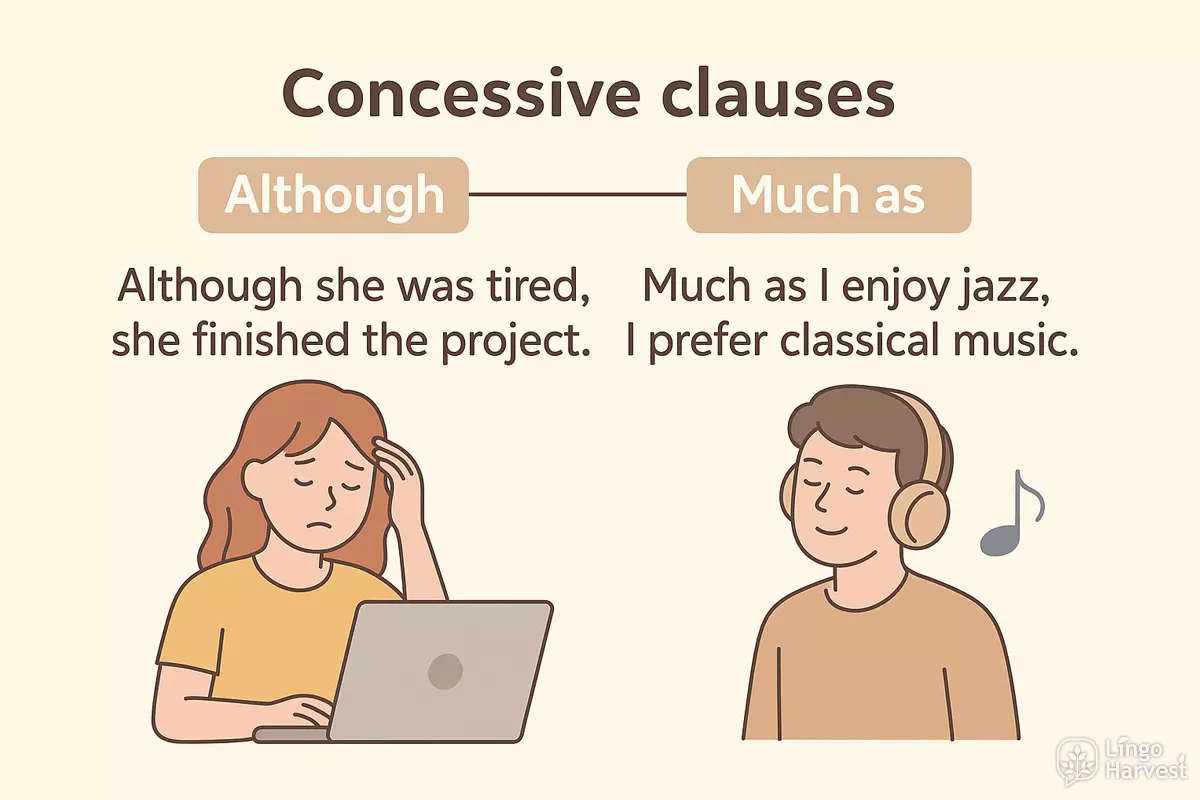
These clauses usually begin with the connector, followed by the concessive information and then the main clause. Here are some patterns and sample sentences:
- Although she was tired, she finished the project.
- Much as I enjoy jazz, I prefer classical music.
- While the offer is generous, I have to decline.
- Although the weather was bad, the event continued.
- Much as we tried, we couldn’t solve the problem.
- While he’s talented, he lacks experience.
- Although it seems risky, the plan could succeed.
- Much as they wanted to stay, they had to leave.
- While it’s expensive, the quality is excellent.
- Although I disagree, I respect your opinion.
- Much as you argue, the decision is final.
- While I understand your concerns, we must proceed.
In summary, using these clauses helps express balance, acknowledgment of contrary facts, and adds sophistication to both spoken and written communication.
Comparing much as, although, and while
When expressing contrast or concession in English, “much as,” “although,” and “while” each play a distinct role. Understanding how these conjunctions function helps you add nuance and subtlety to your sentences.
Key Differences in Usage
- Much as is typically used in more formal or written English. It introduces a strong contrast, often acknowledging an emotion or fact before presenting the opposing idea. It usually starts the sentence.
- Although is the most common concessive conjunction. It can be used at the beginning or in the middle of a sentence to show contrast between two clauses.
- While can indicate contrast or simultaneous actions. In concessive clauses, it’s more formal and often used to introduce a statement that is surprising given the main clause.
Formality and Emphasis
“Much as” tends to sound more formal or literary, and is less frequent in everyday conversation. “Although” is neutral and widely used in both spoken and written English. “While” in the concessive sense is also somewhat formal, but less so than “much as.”
Typical Sentence Patterns
Below is a structured comparison of how each is used, with examples and notes on style:
| Conjunction | Typical Pattern | Example Sentence |
|---|---|---|
| Much as | Much as + [clause], [contrasting clause] | Much as I like chocolate, I try to avoid eating it every day. |
| Although | Although + [clause], [contrasting clause] [Contrasting clause] although + [clause] |
Although it was raining, we went for a walk. We went for a walk although it was raining. |
| While | While + [clause], [contrasting clause] | While I appreciate your help, I prefer to do it myself. |
When to Use Each
- Use much as to highlight a strong personal feeling or fact that makes the contrast particularly striking.
- Choose although for most general contrasts; it’s flexible in position and tone.
- Pick while when you want a formal contrast, especially if the two ideas are happening at the same time or are directly opposed.
Expanded Examples
- Much as I respect your opinion, I must disagree.
- Much as he tried, he couldn’t finish the task on time.
- Although she was tired, she finished her homework.
- Although the offer was tempting, he refused.
- We enjoyed the trip, although the weather wasn’t perfect.
- While I admire his dedication, I don’t agree with his methods.
- While the movie was entertaining, it was too long.
- While they live nearby, we rarely see them.
- Much as I’d love to join you, I have to work late.
- Although it sounds easy, this task is actually quite challenging.
- While I understand your concerns, the decision is final.
- Much as we hoped for sunshine, it rained all weekend.
- Although he’s young, he’s very responsible.
- While I enjoy classical music, jazz is my favorite.
Position and punctuation in complex sentences
Understanding where to place concessive clauses and how to punctuate them is key to writing clear and natural English. Clauses introduced by “much as,” “although,” and “while” can appear at the beginning or in the middle of a sentence, but their position affects both style and punctuation.
Sentence placement of concessive clauses
Often, these clauses come at the start to emphasize contrast, but they may also follow the main clause. When used initially, they set up an expectation that the main clause will contradict or contrast with the first idea.
- At the beginning:
Much as I like chocolate, I try not to eat it every day.
Although it was raining, we decided to go hiking.
While he is talented, he lacks experience. - After the main clause:
I try not to eat chocolate every day, much as I like it.
We decided to go hiking, although it was raining.
He lacks experience, while he is talented.
Punctuation rules for concessive clauses
When these subordinate clauses come before the main clause, use a comma after the concessive clause. If the subordinate clause follows the main clause, a comma is usually required only with “although” and “while,” but this can be omitted for short, simple sentences. “Much as” almost always requires a comma due to its contrastive nature.
Comparison of clause placement and punctuation
| Clause Position & Example | Punctuation Rule |
|---|---|
| Initial: Although it was late, she kept working. | Comma after concessive clause |
| Final: She kept working, although it was late. | Comma before concessive clause |
| Initial: Much as I admire him, I can't agree. | Comma after concessive clause |
| Final: I can't agree, much as I admire him. | Comma before concessive clause |
| Initial: While he apologized, he did not seem sincere. | Comma after concessive clause |
| Final: He did not seem sincere, while he apologized. | Comma before concessive clause (optional if clause is short) |
Common pitfalls to avoid
- ❌ Omitting necessary commas, which can cause confusion.
- ❌ Placing “much as” in the middle of a clause (it should introduce a whole clause, not just a phrase).
- ❌ Using “although” and “while” interchangeably—“while” can sometimes mean “at the same time,” not contrast.
Mastering these structural and punctuation conventions will help your concessive sentences flow naturally and be easily understood.
Subtle differences in tone and emphasis
The choice between “much as,” “although,” and “while” can influence the nuance of your sentence and the way your message is received. Each introduces contrast, but they differ in formality, strength of contrast, and the order in which information is presented.
Emphasis and Formality
“Much as” tends to sound more formal and is often used in written or careful speech to highlight a surprising or significant contrast. “Although” is neutral and flexible, suitable for most contexts. “While” can sound slightly softer and sometimes suggests a simultaneous situation in addition to contrast.
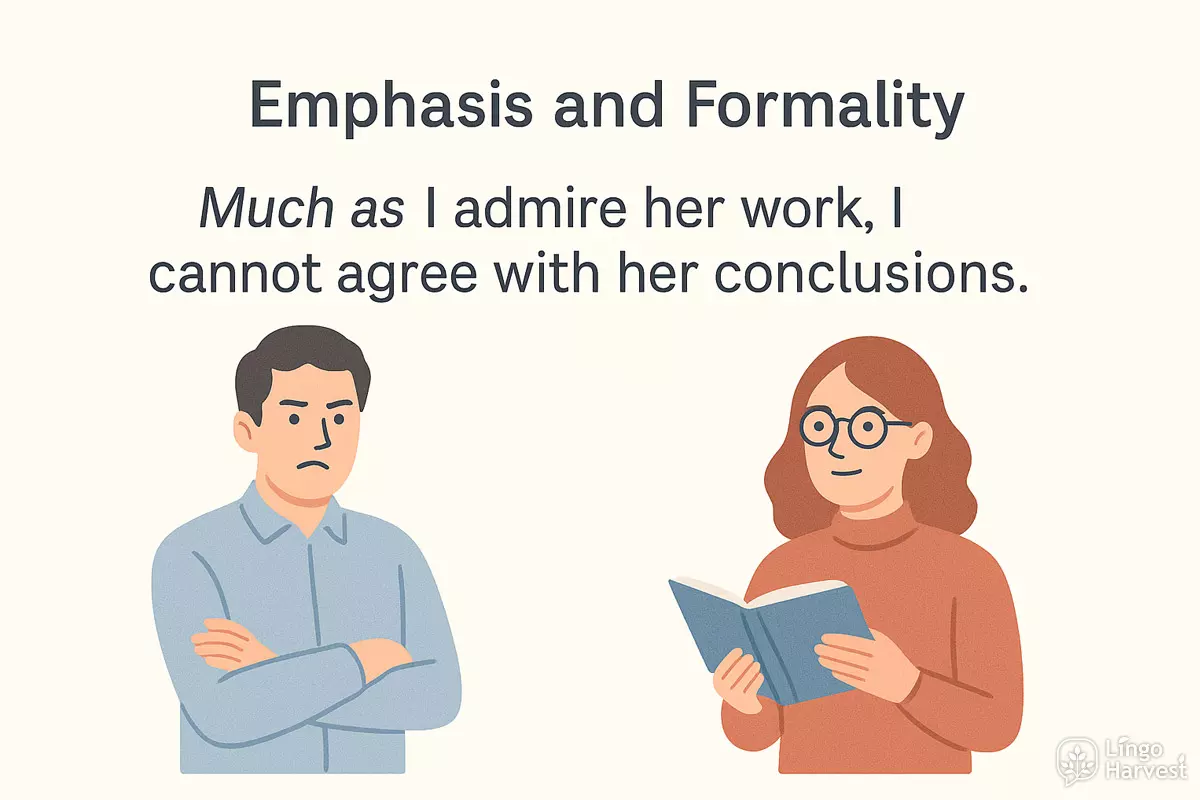
- Much as I admire her work, I cannot agree with her conclusions. (strong contrast, formal)
- Although I admire her work, I cannot agree with her conclusions. (neutral, everyday use)
- While I admire her work, I cannot agree with her conclusions. (softer contrast, possibly implying ongoing admiration)
Order and Focus
The position of the concessive clause can subtly shift the focus. “Much as” almost always starts the sentence, placing extra weight on the concession. “Although” and “while” allow more flexibility, appearing at the beginning or in the middle.
Comparison Table
| Connector | Typical Use | Tone/Emphasis |
|---|---|---|
| Much as | Usually at sentence start; strong contrast | Formal, emphatic, highlights surprise or contradiction |
| Although | Flexible position; general contrast | Neutral, clear, suitable for most contexts |
| While | Flexible position; contrast or simultaneity | Milder, sometimes suggests parallel actions or qualities |
Expanded Examples
To illustrate these distinctions, consider the following variations:
- Much as I wanted to stay, I had to leave early.
- Although it was raining, they went for a walk.
- While I understand your concerns, I believe the plan is sound.
- Much as he tried, he couldn’t finish on time.
- Although she was tired, she continued working.
- While the movie was interesting, it was too long.
- Much as I respect you, I must disagree.
- Although we planned carefully, things went wrong.
- While I agree with your point, I see other issues.
- Much as they practiced, the team did not win.
In summary, choosing between these connectors lets you fine-tune the level of emphasis and the tone of your contrast, allowing for more precise and effective communication.
Frequent learner errors with concessive linkers
Many learners run into trouble when using concessive connectors like “much as”, “although”, and “while”. These difficulties usually involve word order, register, and subtle differences in meaning. Mastering these linkers is crucial for expressing contrast in more natural and sophisticated ways.
Common pitfalls with concessive clauses
- Mixing up linkers: Learners often use “much as” when “although” or “while” would be more natural, and vice versa.
- Incorrect sentence structure: It’s common to see errors in word order, especially with “much as”, which must introduce the clause.
- Misunderstanding formality: Some students use “much as” in informal situations, not realizing it is typically reserved for written or formal contexts.
- Confusing contrast and time: “While” can signal both contrast and time, leading to ambiguous sentences.
- Omitting commas: Punctuation mistakes can make concessive clauses hard to follow.
- Using double concessive markers: Phrases like “Although but” or “Much as yet” are incorrect but surprisingly common.
- Misplacing main and subordinate clauses: Learners sometimes put the main idea in the concessive clause, making the sentence awkward.
- Incorrect tense usage: Changing tenses improperly can create confusion about the sequence or relationship of events.
- Overusing certain linkers: Some students rely almost exclusively on “although”, missing the nuance offered by “much as” or “while”.
- Literal translations: Translating directly from their native language often produces unnatural or incorrect structures.
Comparison of concessive linker usage
| Linker | Typical Error Example | Correct Usage |
|---|---|---|
| Much as | Much as I like pizza, but I try not to eat it often. ❌ | Much as I like pizza, I try not to eat it often. ✅ |
| Although | Although he was tired, but he kept working. ❌ | Although he was tired, he kept working. ✅ |
| While | While I was hungry, I ate. (ambiguous: time or contrast?) | While I was hungry, I waited for dinner. (clear contrast) |
| All linkers | Although he is rich, yet he is not happy. ❌ | Although he is rich, he is not happy. ✅ |
Tips to avoid mistakes
To use concessive clauses accurately, focus on matching the linker to both context and register. Always check word order, avoid double conjunctions, and pay attention to punctuation. Practice rewriting sentences that use only “although” by substituting “much as” or “while” where appropriate, and notice how the meaning or tone shifts.
Practice: write sentences contrasting expectations and reality
Exploring concessive clauses is most effective when you try out your own sentences that highlight the contrast between what you expected and what actually happened. This not only reinforces the structures of “much as,” “although,” and “while,” but also helps you communicate subtle differences in attitude or feeling.
Task: Create Your Own Sentences
Try to complete or invent sentences that show a clear contrast. Use “much as,” “although,” or “while” to join the two ideas. Focus on situations where reality turns out differently from what was expected.
- Much as I enjoy classical music, I rarely go to concerts.
- Although he studied all night, he did not pass the exam.
- While I hoped for sunshine, it rained the entire weekend.
- Much as she tried to stay awake, she fell asleep during the movie.
- Although the instructions seemed simple, assembling the furniture was challenging.
- While the restaurant looked fancy, the food was disappointing.
- Much as we planned ahead, there were still unexpected problems.
- Although I wanted to help, I didn’t know what to say.
- While everyone expected an easy win, the match was very close.
- Much as he loves spicy food, he couldn’t handle that dish.
- Although the weather forecast promised snow, it stayed dry all day.
- While she appears confident, she often feels nervous inside.
- Much as we practiced, the performance didn’t go smoothly.
- Although tickets were expensive, the concert hall was full.
- While I believed the rumor, it turned out to be false.
- Much as he wanted to win, he congratulated the other team graciously.
- Although they promised to call, I never heard from them.
- While the movie received great reviews, I didn’t enjoy it.
Contrast Patterns: Expectations vs. Reality
Below, see how concessive clauses set up a contrast between what was anticipated and what actually occurred:
| Expectation | Reality (with concessive clause) |
|---|---|
| I thought she would arrive on time. | Although she promised to be punctual, she was late. |
| We expected the hike to be easy. | Much as we trained, the trail was more difficult than we imagined. |
| Everyone predicted a quick recovery. | While it seemed he would get better soon, his illness lasted weeks. |
| I believed I could finish the book in a day. | Although I started early, I didn’t finish until much later. |
| The team hoped for a victory. | Much as they played hard, they lost the final match. |
| We assumed the plan would work flawlessly. | While the plan looked perfect on paper, it failed in practice. |
| She expected to enjoy her new job. | Although the job sounded exciting, she found it stressful. |
| I thought the meal would be delicious. | Much as the chef tried, the dish was bland. |
| They believed the movie would be boring. | While they expected to be bored, they actually loved it. |
| He hoped to get a promotion quickly. | Although he worked hard, it took years to advance. |
Quick Practice: Fill in the Blanks
Complete the sentences below using “much as,” “although,” or “while.”
- _________ I wanted to join the party, I had to stay home and finish my work.
- _________ the weather was perfect, few people went to the beach.
- _________ he apologized, she remained upset.
- _________ they hoped to win the prize, they didn’t make it to the finals.
- _________ she tried her best, she couldn’t solve the problem.
- _________ I like the idea, it may be difficult to implement.
- _________ the movie received great reviews, I didn’t enjoy it.
- _________ he knew the answer, he didn’t speak up in class.
- _________ they practiced for weeks, their performance was disappointing.
- _________ the task seemed simple, it turned out to be quite challenging.
Show answers
- Much as I wanted to join the party, I had to stay home and finish my work.
- Although the weather was perfect, few people went to the beach.
- While he apologized, she remained upset.
- Much as they hoped to win the prize, they didn’t make it to the finals.
- Much as she tried her best, she couldn’t solve the problem.
- Although I like the idea, it may be difficult to implement.
- Although the movie received great reviews, I didn’t enjoy it.
- Although he knew the answer, he didn’t speak up in class.
- Much as they practiced for weeks, their performance was disappointing.
- Although the task seemed simple, it turned out to be quite challenging.
Try inventing your own examples using these patterns to improve your understanding of concessive clauses. Notice how the contrast between what is expected and what actually happens can be expressed in subtle and varied ways.