Concessive Participial Clauses: Despite Being…, Though Knowing…

 Here we how to form concessive participial clauses, use patterns like despite, in spite of, and though, connect non-finite forms to the right subject, choose formal or informal uses, avoid dangling participles, and practice transforming clauses.
English provides concise ways to express contrasts, even when information appears to contradict expectations, by using special participial phrases. Understanding how these constructions function can enhance writing, allowing for greater nuance and sophistication. By mastering participial phrases, writers can clearly and efficiently highlight exceptions or surprising elements within their sentences, making their ideas more engaging and precise. This skill is valuable for anyone aiming to communicate complex or unexpected relationships in English.
Form and meaning of concessive participial clauses
Concessive participial clauses express contrast or unexpected outcomes, usually indicating that something happened despite a particular circumstance. These structures often rely on participles (typically present or past) combined with markers like "though," "although," or "despite." The participle clause can come before or after the main clause, and the subject of the participle usually matches the subject of the main clause.
Structural patterns
English concessive participial clauses frequently use the following forms:
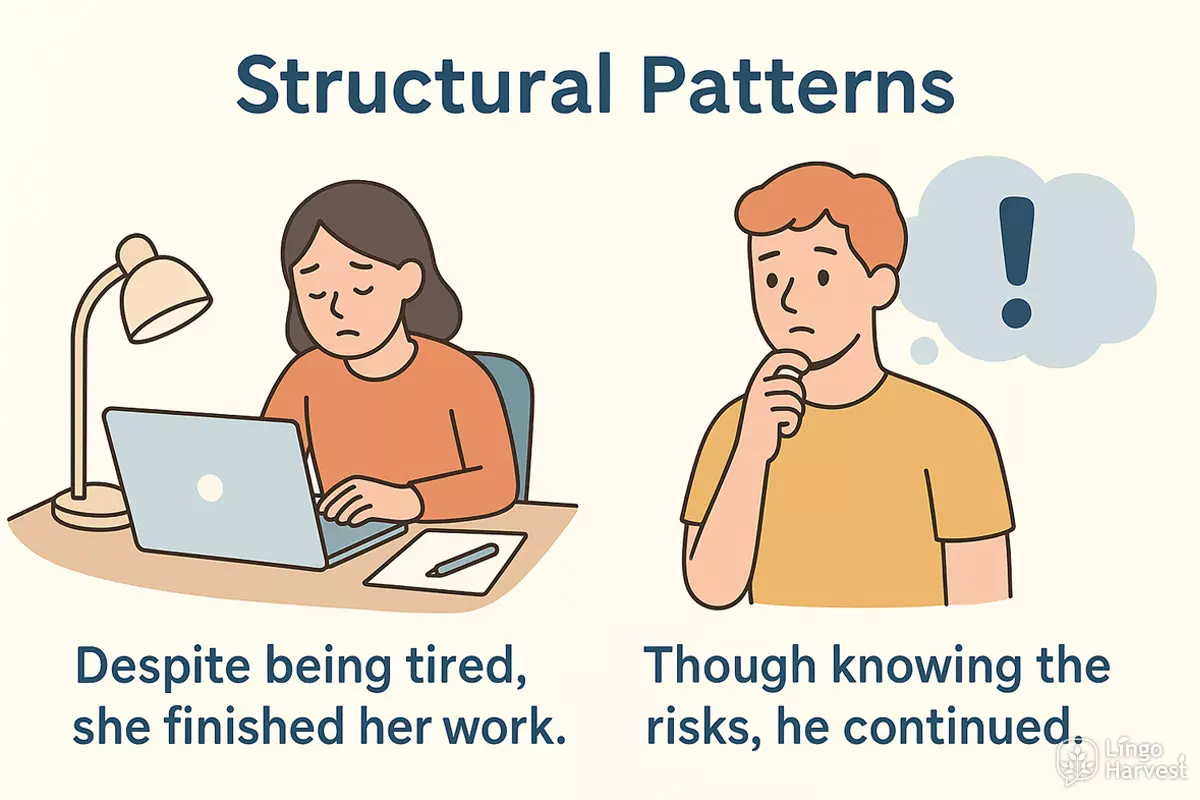
- Despite + present participle: Despite being tired, she finished her work.
- Though + present/past participle: Though knowing the risks, he continued.
- Although + present/past participle: Although warned, they proceeded.
- In spite of + present participle: In spite of feeling ill, he attended the meeting.
- Without + present participle: Without having studied, she passed the exam.
- Even with + noun/gerund: Even with having little time, he managed it.
- Despite having + past participle: Despite having failed before, she tried again.
- Though not + present participle: Though not expecting a reply, he emailed her.
- Even though + present/past participle: Even though discouraged, he applied.
- Despite not + present participle: Despite not knowing anyone, she joined the group.
- While + present/past participle: While being inexperienced, he performed well.
- Although having + past participle: Although having seen the movie, she watched it again.
- Despite his/her/their + noun/gerund: Despite her protesting, the plan went ahead.
- Despite there being + noun: Despite there being no evidence, the rumor spread.
- Though having + past participle: Though having lost, he congratulated his opponent.
- Despite never + present participle: Despite never having met, they worked well together.
- Though rarely + present participle: Though rarely speaking, he made an impact.
- Despite always + present participle: Despite always arriving late, she was promoted.
- Even with not + gerund: Even with not knowing the language, he traveled alone.
- Despite only + present participle: Despite only working part-time, she earned enough.
Meaning and use
These constructions emphasize a contradiction between two actions or states. The participial clause sets up an expectation, while the main clause describes something that happens anyway, defying that expectation. For example, “Despite being late, he caught the train” highlights the unexpected outcome.
Comparison with standard concessive clauses
Below is a comparison between traditional concessive clauses and participial alternatives. Notice how the participial form is more concise and often more formal or literary.
| Standard Concessive Clause | Participial Clause |
|---|---|
| Although he was tired, he finished his work. | Despite being tired, he finished his work. |
| Even though she had not studied, she passed the exam. | Without having studied, she passed the exam. |
| Though he knew the risks, he continued. | Though knowing the risks, he continued. |
| Although they were warned, they proceeded. | Although warned, they proceeded. |
Notes on usage
- The subject of the participial clause should be the same as the main clause for clarity. - These clauses are more common in written, especially formal or academic, English. - Some forms (e.g., "though knowing") may sound literary or archaic in everyday speech. Understanding how to use these structures allows for more nuanced and sophisticated expression, helping to convey subtle contrasts and unexpected results in a compact form.
Patterns with despite, in spite of, though
When expressing contrast or unexpected results in English, several structures are commonly used. Among these, "despite," "in spite of," and "though" allow speakers to link ideas in ways that highlight exceptions, surprises, or contradictions. Understanding how to use each one, especially with participial clauses, makes your writing and speech more nuanced.
Using "despite" and "in spite of" with participles
Both "despite" and "in spite of" are prepositions, so they are followed by a noun, pronoun, or a gerund/participle (-ing form). These forms allow you to pack complex information into a single phrase. Here are some common patterns:
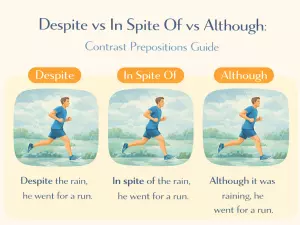
- Despite/in spite of + noun: Despite the rain, we went out.
- Despite/in spite of + gerund: In spite of feeling tired, she finished the race.
- Despite/in spite of + being + adjective: Despite being late, he didn’t rush.
- Despite/in spite of + not + -ing: Despite not knowing anyone, she enjoyed the party.
- Despite/in spite of + past participle: In spite of having finished early, they waited.
Using "though" with participial clauses
"Though" acts as a conjunction. It introduces a subordinate clause and is often followed by a subject and verb, but it can also precede a participial clause for conciseness:
- Though + subject + verb: Though he was tired, he kept working.
- Though + past participle: Though warned, he ignored the advice.
- Though + present participle: Though knowing the risks, she went ahead.
- Though + being + adjective: Though being inexperienced, he succeeded.
Comparing patterns: prepositions vs. conjunctions
The choice between these forms depends on sentence structure and the desired emphasis. Here’s a side-by-side look:
| Prepositional Pattern (Despite/In spite of) | Conjunction Pattern (Though) |
|---|---|
| Despite being busy, she called. | Though busy, she called. |
| In spite of not knowing French, he traveled to Paris. | Though not knowing French, he traveled to Paris. |
| Despite having little money, they were happy. | Though having little money, they were happy. |
| In spite of feeling nervous, he spoke clearly. | Though feeling nervous, he spoke clearly. |
Key points to remember
- "Despite" and "in spite of" are always followed by a noun, pronoun, or -ing form—not a full clause with a subject and verb.
- "Though" can introduce a full clause or a participial phrase for brevity and style.
- Participial clauses often make sentences more concise and formal.
Mastering these contrasting patterns will help you express subtle differences and unexpected outcomes more effectively in both spoken and written English.
Linking non-finite forms to the correct subject
Understanding how participial clauses attach to the right subject is essential for clarity in English sentences. In concessive participial constructions—such as "Despite being tired, she finished the report"—the non-finite verb form ("being tired") must clearly refer to the intended agent, usually the subject of the main clause. Ambiguity or misalignment can easily cause confusion for the reader.
How reference works with participial clauses
Typically, the implied subject of a participial phrase is the same as the subject of the main clause. For example, in "Though knowing the risks, he proceeded," "knowing" refers to "he." However, if the participle points to a different agent, the sentence can become unclear or ungrammatical.
- After working all night, she felt exhausted. ✅
- Though being warned, the hikers continued. ✅
- While walking in the park, a dog barked at us. ❌ (ambiguous: who was walking?)
- Despite being late, the meeting started on time. ❌ (meetings can't be late; subjects clash)
Common pitfalls and how to avoid them
Writers sometimes unintentionally create "dangling participles," where the participial clause seems to modify the wrong noun. To prevent this, always ensure the implied actor in the participial phrase matches the main clause subject.
- Check that the participial phrase logically describes the main clause subject.
- If another agent is intended, restate it explicitly: "Though knowing the risks, the workers proceeded."
- Reword or break up sentences if ambiguity remains.
Patterns for clear subject-participle connections
Writers can use these structures to maintain clarity and coherence:
- Despite being adjective, subject + verb...
- Though verb-ing, subject + verb...
- Even though verb-ed, subject + verb...
- While verb-ing, subject + verb...
- In spite of noun/gerund, subject + verb...
- Notwithstanding noun/gerund, subject + verb...
- Regardless of noun/gerund, subject + verb...
- After verb-ing, subject + verb...
- Without verb-ing, subject + verb...
- Having verb-ed, subject + verb...
Summary table: Correct vs. ambiguous participial clause links
| Participial Clause Example | Interpretation |
|---|---|
| Despite being tired, she continued working. | Clear: "she" is tired and continues working. ✅ |
| While reading the book, the phone rang. | Ambiguous: Who was reading? The phone? ❌ |
| Though warned about the danger, the hikers proceeded. | Clear: "the hikers" were warned. ✅ |
| After finishing the project, the results were announced. | Ambiguous: Who finished the project? Who announced? ❌ |
Clarity in concessive participial clauses depends on matching the non-finite form to the correct agent. Careful sentence structure and attention to reference help avoid confusion in both writing and comprehension.
Formal vs informal uses in writing
Concessive participial clauses—such as "despite being late" or "though knowing the risks"—appear in both academic and everyday texts, but their frequency and tone can differ greatly depending on the context. Writers often select these structures to add nuance or contrast, yet some settings favor more explicit or traditional forms.
Where and how these clauses are used
In academic or professional documents, participial clauses offer a concise way to express contrast without lengthy subordinate clauses. For instance, "Despite being inexperienced, she excelled at the task" is more streamlined than "Although she was inexperienced, she excelled at the task." In contrast, casual conversation and informal writing—like emails or blogs—may use these clauses for brevity or style, but sometimes avoid them altogether in favor of more direct constructs.
Patterns and preferences
Writers should be aware of audience expectations. Overuse of participial clauses in relaxed contexts can sound stilted or overly formal, while avoiding them in scholarly writing might make the text less efficient or precise. Certain phrases are more common in specific registers:
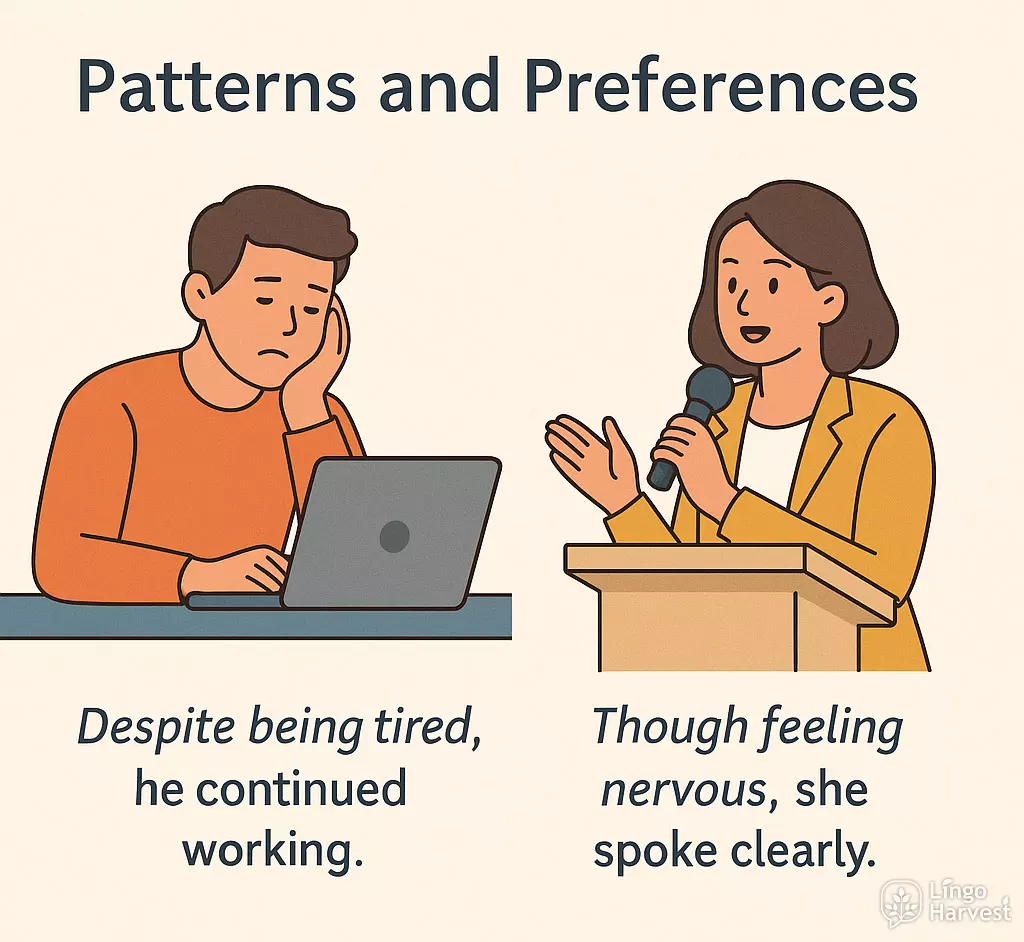
- Despite being tired, he continued working. (neutral/formal)
- Though feeling nervous, she spoke clearly. (neutral/formal)
- While knowing the answer, he hesitated. (formal/academic)
- Even knowing the risks, they proceeded. (neutral/creative)
- Despite having little time, she finished the project. (neutral/formal)
- Though lacking experience, he succeeded. (neutral/formal)
- While being new, he fit in quickly. (formal)
- Despite feeling unwell, she attended the meeting. (neutral/formal)
- Though not expecting much, he was impressed. (neutral/informal)
- Even after hearing the news, she remained calm. (neutral/informal)
- Despite knowing the outcome, they tried. (formal/neutral)
- Though being late, he was admitted. (neutral/formal)
Comparison of formal and informal usage
| Context | Typical Use |
|---|---|
| Academic papers, reports | Frequent; adds conciseness and sophistication; e.g., "Despite being complex, the theory is widely accepted." |
| Business emails, formal letters | Used for clarity and brevity; e.g., "Though knowing the deadline, the team requested an extension." |
| Creative writing, journalism | Employed for stylistic effect or to vary sentence structure. |
| Casual conversation, informal messages | Less common; often replaced by full clauses or simpler connectors ("although," "but"). |
Tips for effective use
- Consider your audience: formal readers expect precision and conciseness; informal readers prefer clarity and directness.
- Avoid stacking multiple participial clauses in one sentence; this can confuse readers.
- When in doubt, opt for a full clause ("Although she was tired...") in informal contexts.
- Check for subject clarity—ensure the participial phrase clearly refers to the sentence subject.
In summary, participial concessive clauses bring flexibility and nuance to English writing, but their appropriateness depends on the level of formality and the expectations of your readers.
Avoiding dangling participles in concessions
When using concessive participial clauses—like those starting with “Despite being…” or “Though knowing…”—it’s easy to accidentally create ambiguity if the participle doesn’t clearly refer to the intended subject. This is known as a dangling participle, and it can confuse readers or even change the meaning of your sentence. To steer clear of this common pitfall, always make sure the noun or pronoun that the participial phrase describes is present and clearly connected to the main clause.
What is a dangling participle?
A dangling participle occurs when the participial phrase doesn’t logically or grammatically modify any word in the main clause. For example:
- “Though being tired, the meeting continued.” ❌ (Who was tired?)
- “Despite running late, the documents were finished.” ❌ (Who was running late?)
In both examples, the participial phrase is left “dangling,” since it doesn’t clearly refer to a subject.
How to fix unclear participial clauses
To make your concessive clauses clear, rephrase so that the participle matches the subject of the main clause, or introduce the subject explicitly. Here are some effective strategies:
- Ensure the subject of the main clause is the doer of the participle.
- Rewrite the sentence to include the correct subject after the participial phrase.
- Use a full subordinate clause if necessary for clarity.
Common patterns and solutions
Below is a table with typical concessive participial constructions, examples of ambiguous usage, and clear alternatives. This helps illustrate how to avoid confusion and keep your sentences precise.
| Ambiguous Sentence | Clear Revision |
|---|---|
| Though being late, the report was submitted. | Though I was late, I submitted the report. |
| Despite knowing the answer, the question was left blank. | Despite knowing the answer, she left the question blank. |
| While feeling sick, the assignment was finished. | While he was feeling sick, he finished the assignment. |
| Though having little experience, the job was completed well. | Though she had little experience, she completed the job well. |
| Despite being warned, the mistake was repeated. | Despite being warned, he repeated the mistake. |
| Though studying hard, the results were disappointing. | Though she studied hard, her results were disappointing. |
| Despite not liking crowds, the concert was attended. | Despite not liking crowds, he attended the concert. |
| While knowing the risks, the investment was made. | While knowing the risks, they made the investment. |
| Though being nervous, the speech was delivered well. | Though nervous, she delivered the speech well. |
| Despite being hungry, the meal was skipped. | Despite being hungry, he skipped the meal. |
Key reminders for clarity
- Check that the participial phrase logically modifies the subject of the main clause.
- Avoid starting sentences with participial clauses if the subject changes between clauses.
- If the subject isn’t the same, use a full clause: “Although he was tired, the meeting continued.”
- Read your sentence aloud—if it feels confusing, clarify who’s performing the action.
By paying attention to these details, your concessive participial constructions will be clear, precise, and easy to understand.
Practice: transform full clauses into participial concessions
Converting full concessive clauses into participial phrases is a valuable skill for producing more concise and sophisticated English sentences. Below you’ll find guidance, examples, and targeted practice to help you become comfortable with these transformations.
How to Transform Full Concessive Clauses
Start by identifying a subordinate clause that expresses concession (usually beginning with “although,” “though,” or “even though”). The subject of the main and subordinate clauses should be the same to allow for a participial phrase. Replace the conjunction and verb with a participial form, usually the present participle (-ing) or past participle, depending on the verb and context.
Examples: From Full Clauses to Participial Concessions
- Although she was tired, she finished her homework. → Being tired, she finished her homework.
- Even though he knew the answer, he remained silent. → Knowing the answer, he remained silent.
- Though it was raining, they went for a walk. → Despite it raining, they went for a walk. / Raining, they went for a walk.
- Although he had little experience, he got the job. → Having little experience, he got the job.
- Even though she was unwell, she attended the meeting. → Being unwell, she attended the meeting.
- Though John disagreed, he accepted the decision. → Disagreeing, John accepted the decision.
- Although they arrived late, they were admitted. → Arriving late, they were admitted.
- Even though he was warned, he took the risk. → Being warned, he took the risk.
- Though she had no money, she bought a gift. → Having no money, she bought a gift.
- Although it was dangerous, they continued. → Being dangerous, they continued.
- Even though she disliked parties, she went. → Disliking parties, she went.
- Though the evidence was weak, the jury convicted him. → The evidence being weak, the jury convicted him.
Try It Yourself: Practice Tasks
Transform these full concessive clauses into participial concessions. Write your answers before checking the suggested versions.
- Although Mark forgot the time, he made it to the meeting.
- Even though the weather was terrible, they played the match.
- Though she had finished her work, she stayed late.
- Although the instructions were unclear, he completed the task.
- Even though they disagreed, they worked together.
- Though he felt nervous, he gave a great speech.
- Although the road was closed, she found another way.
- Even though the deadline was tight, the team succeeded.
Show answers
- Forgetting the time, Mark made it to the meeting.
- The weather being terrible, they played the match.
- Having finished her work, she stayed late.
- The instructions being unclear, he completed the task.
- Disagreeing, they worked together.
- Feeling nervous, he gave a great speech.
- The road being closed, she found another way.
- The deadline being tight, the team succeeded.
Tips for Successful Transformation
- Ensure the subject of the participial phrase matches the main clause subject.
- Use “being” for states or adjectives (e.g., being tired, being late).
- Use the present participle (-ing) for active actions (e.g., knowing, disagreeing).
- For perfect or completed actions, use “having + past participle” (e.g., having finished).
Practicing these transformations will help you develop a more concise and advanced writing style, especially in formal or academic contexts.