Despite vs In Spite Of vs Although: Contrast Prepositions Guide

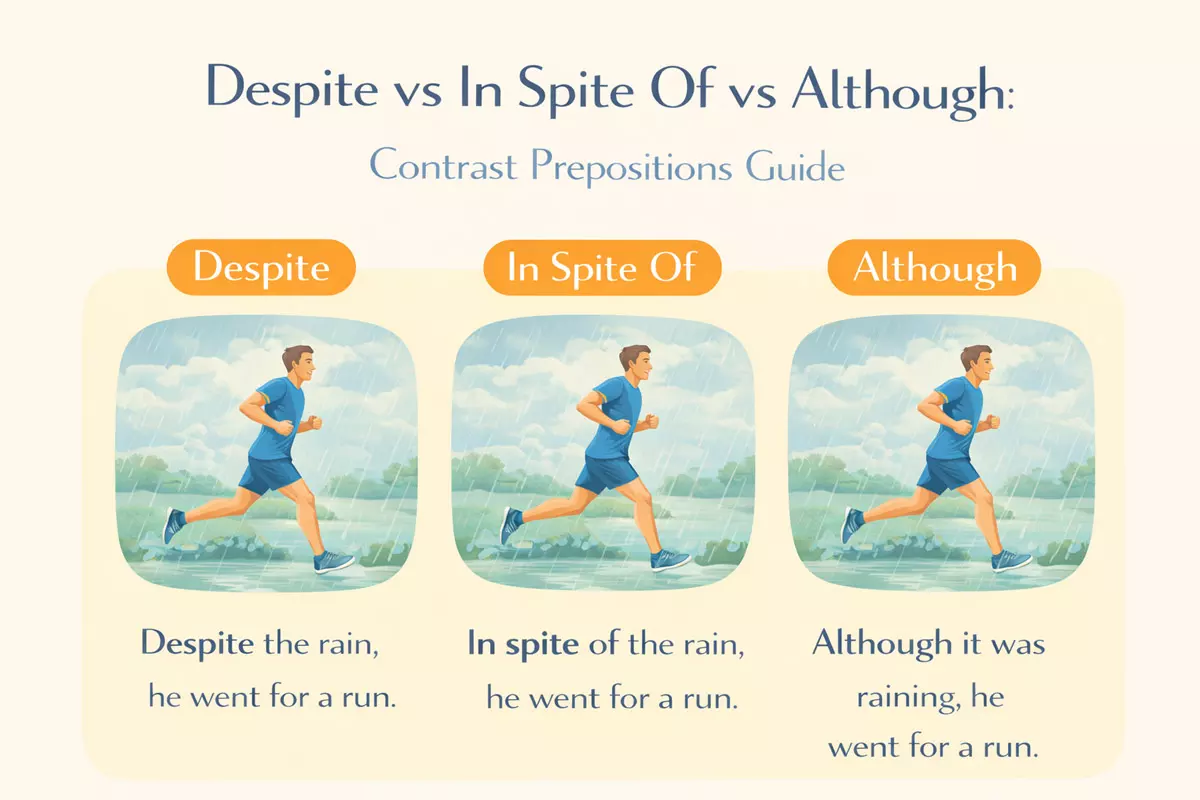 This article distinguishes clauses and phrases with although and despite, explains noun and gerund use after in spite of, shows when to use notwithstanding in formal writing, clarifies even though vs. despite the fact that, and corrects common errors like despite of.
- The Clause vs. Phrase distinction: Mapping 'Although' (conjunction) against 'Despite' (preposition)
- Syntactic constraints: Using nouns, pronouns, and gerunds (-ing) after 'In spite of'
- Register analysis: When to use 'Notwithstanding' as a high-level academic alternative
- Concessive logic: Building 'Even though' vs. 'Despite the fact that' structures for emphasis
- Common Error Correction: Eliminating the 'Despite of' mistake and managing 'of' in 'In spite of'
- Punctuation and Flow: Sentence-initial placement vs. mid-sentence contrast markers
- Practice: Reconfiguring complex arguments by switching between clausal and prepositional contrast
Navigating the subtle differences between words that express contrast can be tricky, especially with terms like despite, in spite of, and although. Each of these expressions is used to introduce contrasting ideas, but they differ in structure. Despite and in spite of are followed by a noun, pronoun, or gerund, while although is followed by a full clause. Mastering their correct usage will help you write clearer, more natural sentences and avoid common mistakes in English writing.
The Clause vs. Phrase distinction: Mapping 'Although' (conjunction) against 'Despite' (preposition)
Understanding how “although” and “despite” function in sentences comes down to the difference between clauses and phrases. “Although” is a conjunction, which means it connects two clauses—each with its own subject and verb. “Despite,” on the other hand, acts as a preposition and is followed by a noun, pronoun, or gerund, not a full clause. This grammatical difference shapes how we use each word to express contrast.
How “although” works: Linking clauses
“Although” introduces a subordinate clause, which can go at the start or in the middle of a sentence. Each side of “although” is a complete thought (with a subject and verb). This flexibility allows for more complex contrasts, especially in formal or written English.
- Although it was raining, we went for a walk.
- We went for a walk although it was raining.
- Although she studied hard, she failed the test.
- Although I don’t like spinach, I ate the salad.
- He finished the race although he was tired.
How “despite” works: Introducing phrases
“Despite” is always followed by a noun, pronoun, or gerund (verb+ing form acting as a noun), never a full clause. You can’t use a subject and verb directly after “despite.” This makes “despite” a bit more restrictive, but also concise.
- Despite the rain, we went for a walk.
- Despite her hard work, she failed the test.
- Despite not liking spinach, I ate the salad.
- Despite being tired, he finished the race.
- Despite my warning, they went ahead.
Direct comparison: Structure and usage
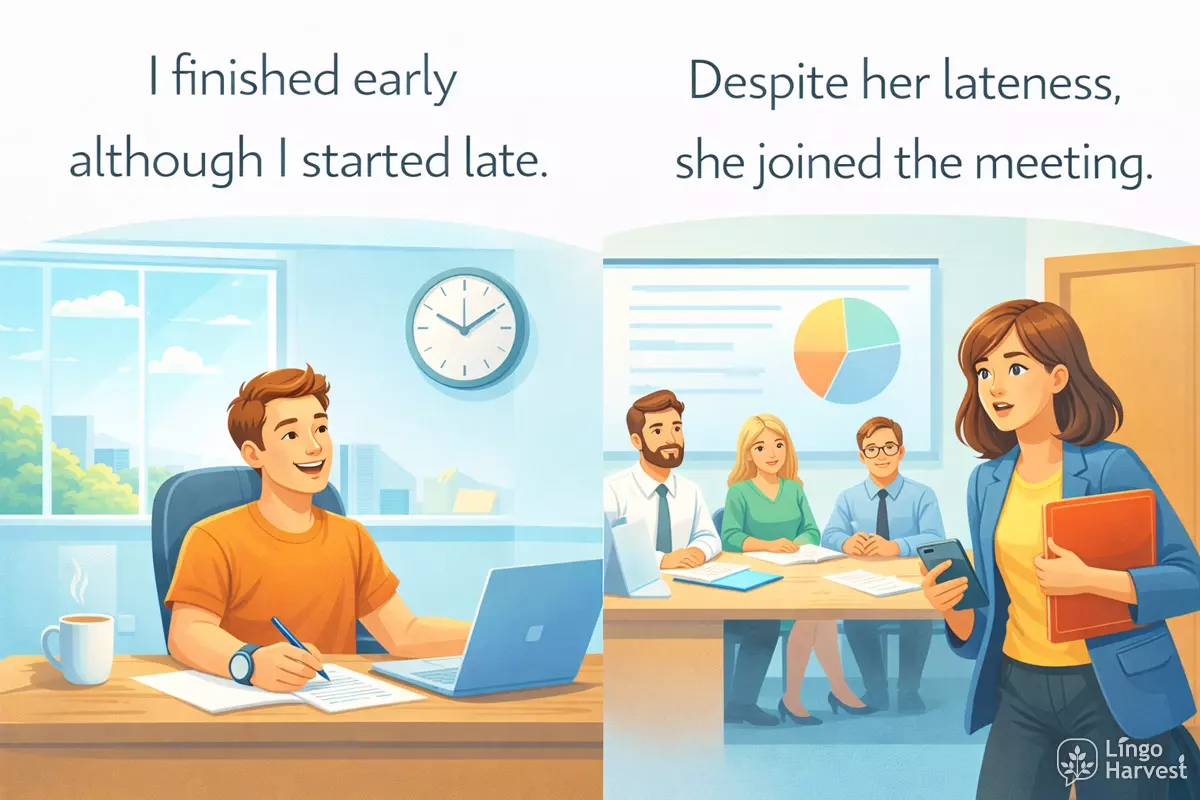
Here’s a structured look at how each form works and what follows them:
| Connector | What Follows / Example |
|---|---|
| Although (conjunction) |
|
| Despite (preposition) |
|
Common mistakes to avoid
It’s easy to mix up these forms. For example, “Despite she was late, she joined the meeting” is incorrect (should be “Despite her lateness…” or “Although she was late…”). Remember: use “although” with clauses, “despite” with phrases or gerunds.
- ❌ Despite she was tired, she kept working. → Despite being tired, she kept working.
- ✅ Although she was tired, she kept working.
- ✅ Despite her tiredness, she kept working.
Being clear about these structural differences will help you avoid common errors and sound more natural in English conversations and writing.
Syntactic constraints: Using nouns, pronouns, and gerunds (-ing) after 'In spite of'
To use “in spite of” correctly, it’s important to know what grammatical forms can follow this expression. Unlike conjunctions such as “although,” “in spite of” is a preposition, so it must be followed by a noun, pronoun, or gerund (the -ing form of a verb acting as a noun). This means you cannot place a full clause (subject + verb) directly after “in spite of.”
Acceptable structures after “in spite of”
You can use the following types of words or phrases after “in spite of”:
- Nouns: “In spite of the rain, they played outside.”
- Pronouns: “In spite of everything, she stayed calm.”
- Gerunds (-ing forms): “In spite of feeling tired, he finished the race.”
- Noun phrases: “In spite of his best efforts, he missed the bus.”
- Possessive + gerund: “In spite of her complaining, we enjoyed the trip.”
- Demonstratives (this/that): “In spite of that, we succeeded.”
- Quantifiers: “In spite of all the problems, they managed well.”
- Names: “In spite of John’s warning, they went ahead.”
- Abstract nouns: “In spite of danger, he acted bravely.”
- Pronoun + gerund: “In spite of him being late, the meeting started on time.”
Common mistakes to avoid
Placing a full clause (like “he was sick”) after “in spite of” is incorrect. Instead, use a gerund or noun phrase. For example, say “in spite of being sick” rather than “in spite of he was sick.”
Comparison: “in spite of” vs. “although”
The difference in what follows “in spite of” and “although” is a common source of confusion. Here’s a quick comparison:
| Form after | Example with “in spite of” | Example with “although” |
|---|---|---|
| Noun | In spite of the noise, she slept. | Although there was noise, she slept. |
| Gerund (-ing) | In spite of being late, he was calm. | Although he was late, he was calm. |
| Clause (subject + verb) | ❌ In spite of he was tired... | ✅ Although he was tired, he finished. |
| Pronoun | In spite of this, we continued. | Although this happened, we continued. |
Quick reference: what works after “in spite of”
Use “in spite of” with:
- single nouns (the weather, the delay)
- noun phrases (her advice, their mistakes)
- pronouns (everything, that, this)
- gerunds (being late, feeling sick)
- possessive + gerund (his arriving, their leaving)
Avoid using a full clause after “in spite of.” If you want to use a complete idea (subject + verb), use “although” instead. This distinction is key for clear, accurate English.
Register analysis: When to use 'Notwithstanding' as a high-level academic alternative
Academic and formal writing often requires precise markers of contrast or concession. While "despite," "in spite of," and "although" are common, "notwithstanding" stands out as a sophisticated alternative, typically reserved for high-register or scholarly contexts. Its usage signals both a formal tone and nuanced logical relationship, making it especially useful in legal, policy, and advanced research writing.
Key contexts for using 'notwithstanding'
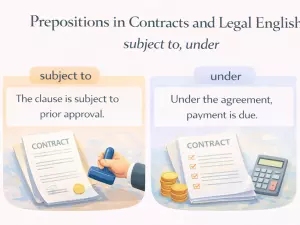
- Legal documents: Frequently appears in statutes, contracts, and policy texts to override or limit the effect of preceding clauses.
- Research articles: Used to highlight exceptions to general findings or to introduce counter-evidence.
- Academic argumentation: Effective for signaling a concession while maintaining a formal, objective stance.
- Formal reports: Suitable for executive summaries or policy briefs where clarity and authority are paramount.
- Complex sentence structures: Useful when the contrast needs to be tightly linked to a specific clause rather than the whole sentence.
Comparing 'notwithstanding' with other contrast markers
| Expression | Register & Typical Use | Example Sentence |
|---|---|---|
| Notwithstanding | Very formal, academic, legal | Notwithstanding significant opposition, the policy was enacted. |
| Despite | Neutral, academic or everyday | Despite the rain, the event continued as planned. |
| In spite of | Neutral, slightly less formal than "despite" | In spite of limited funding, the study achieved its goals. |
| Although | Neutral to formal, both spoken and written | Although results were mixed, the hypothesis was supported. |
Effective patterns and placement
"Notwithstanding" is flexible in sentence positioning, but its placement can affect emphasis and clarity. It may appear at the beginning, middle, or end of a sentence. In high-level writing, it often introduces an exception or counterpoint concisely.
- Notwithstanding noun phrase, main clause.
- Main clause, notwithstanding noun phrase.
- Main clause notwithstanding, secondary clause.
Expanded examples for academic writing
- Notwithstanding recent advances, certain challenges remain unresolved.
- Notwithstanding the evidence presented, the conclusion remains tentative.
- The results, notwithstanding some inconsistencies, support the main hypothesis.
- Notwithstanding these limitations, the study contributes valuable insights.
- Notwithstanding the risks, the intervention was approved.
- Notwithstanding its popularity, the method has notable drawbacks.
- The findings are significant, notwithstanding the small sample size.
- Notwithstanding their objections, the proposal moved forward.
- Notwithstanding the apparent contradictions, the data align with previous research.
- Notwithstanding this, further investigation is warranted.
- Notwithstanding the lack of consensus, the authors recommend adoption.
- Notwithstanding external pressures, the committee maintained its position.
In summary, "notwithstanding" elevates the formality and precision of contrast in academic prose. It is best reserved for contexts where clarity, authority, and register are paramount, and should be used judiciously to avoid unnecessary complexity in more conversational or general writing.
Concessive logic: Building 'Even though' vs. 'Despite the fact that' structures for emphasis
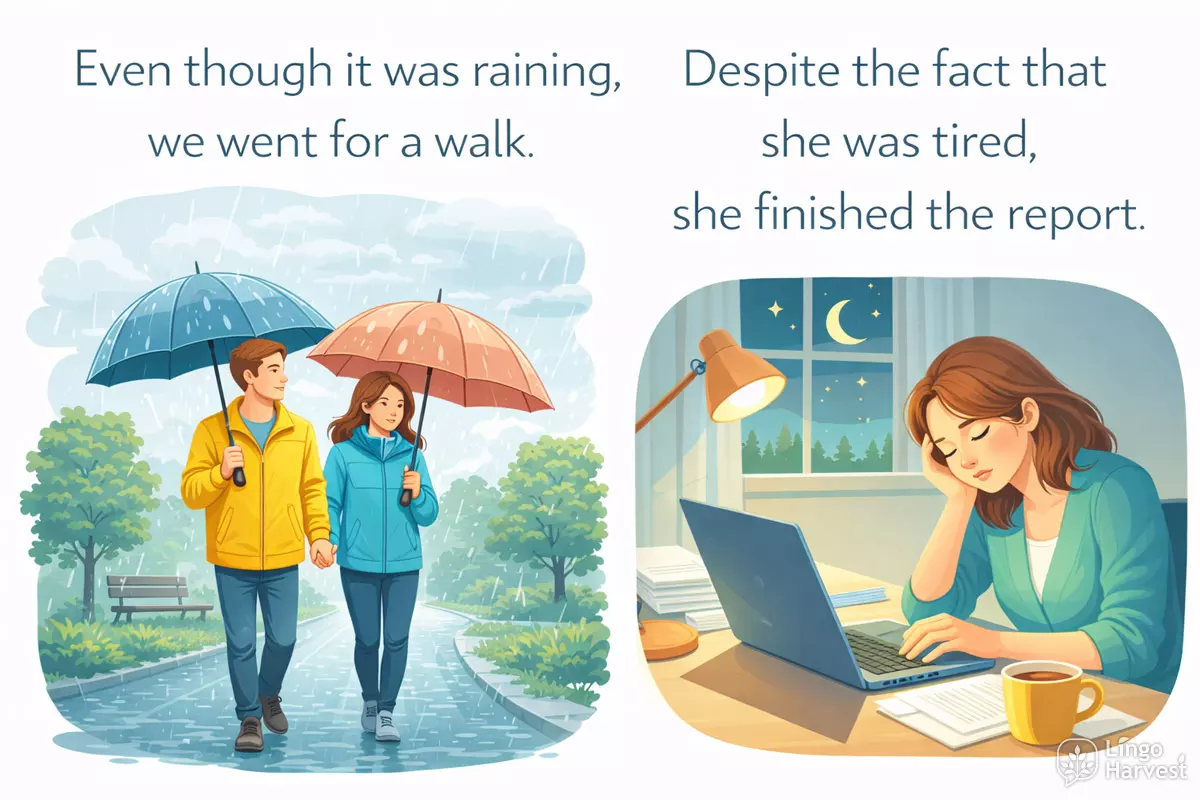
When you want to show contrast or unexpected results in English, two powerful tools are “even though” and “despite the fact that.” Both introduce surprising or opposing information, but they differ in structure, tone, and emphasis. Understanding when to use each can help your writing or speech sound more deliberate and nuanced.
“Even though”: Direct and Conversational
“Even though” acts as a subordinating conjunction, introducing a clause with a full subject and verb. It’s often used in both spoken and written English for a straightforward, natural-sounding contrast. This phrase is especially common when you want to make the contrast feel immediate or personal.
- Even though it was raining, we went for a walk.
- Even though she was tired, she finished the report.
- Even though Mark studied hard, he didn’t pass the test.
- Even though the traffic was heavy, they arrived on time.
- Even though he apologized, she remained upset.
- Even though I set an alarm, I overslept.
- Even though the food looked strange, it tasted delicious.
- Even though it was expensive, he bought the watch.
- Even though we disagreed, we stayed friends.
- Even though the instructions were clear, mistakes happened.
“Despite the fact that”: Formal and Emphatic
“Despite the fact that” is longer, more formal, and often used in written English or when you want to emphasize the surprising nature of the contrast. It introduces a full clause, similar to “even though,” but its length adds gravity and weight to your statement.
- Despite the fact that it was raining, we went for a walk.
- Despite the fact that she was tired, she finished the report.
- Despite the fact that Mark studied hard, he didn’t pass the test.
- Despite the fact that the traffic was heavy, they arrived on time.
- Despite the fact that he apologized, she remained upset.
- Despite the fact that I set an alarm, I overslept.
- Despite the fact that the food looked strange, it tasted delicious.
- Despite the fact that it was expensive, he bought the watch.
- Despite the fact that we disagreed, we stayed friends.
- Despite the fact that the instructions were clear, mistakes happened.
Comparing Structure and Emphasis
Choosing between these forms depends on your audience and the level of emphasis you need. Here’s a side-by-side look at the main differences:
| Expression | Features & Usage |
|---|---|
| Even though |
|
| Despite the fact that |
|
Tips for Emphatic Contrast
- Use even though for a conversational, concise effect, especially in speech or informal writing.
- Reserve despite the fact that for situations where you need to stress the contrast or maintain a formal tone.
- Avoid overusing despite the fact that in everyday conversation — its length can sound stiff or overly dramatic.
- Both structures require a full clause (subject + verb) after them; do not use a noun or gerund directly after these phrases.
- Understanding the subtle differences between these expressions helps you control the tone and emphasis in your sentences, making your contrasts clearer and more impactful.
Common Error Correction: Eliminating the 'Despite of' mistake and managing 'of' in 'In spite of'
Many English learners mix up how to use “despite” and “in spite of,” especially when it comes to the little word “of.” The confusion is understandable, but the rules are straightforward once you see them clearly.
Why "despite of" is always wrong
“Despite” stands alone and never takes “of” after it. The phrase “despite of” is incorrect, even though it might sound logical if you’re thinking of “in spite of.” Native speakers never use “despite of.”
- ❌ Incorrect: Despite of the rain, we went out.
- ✅ Correct: Despite the rain, we went out.
How "in spite of" should always include "of"
“In spite of” is a fixed phrase. The word “of” is essential—leaving it out is a common error. You cannot say “in spite the rain”; it must be “in spite of the rain.”
- ❌ Incorrect: In spite the cold, she wore a dress.
- ✅ Correct: In spite of the cold, she wore a dress.
Quick Reference: Correct Usage Patterns
Use this table to compare the forms at a glance:
| Expression | Correct Pattern | Example |
|---|---|---|
| Despite | despite + noun/gerund | Despite feeling tired, he finished the project. |
| In spite of | in spite of + noun/gerund | In spite of the delay, they arrived on time. |
| Despite of | Never correct | ❌ (Do not use) |
| In spite | Incomplete (missing "of") | ❌ (Do not use) |
Common Mistakes and How to Fix Them
Spotting and correcting these errors is easier with practice. Here are typical mistakes with the right forms:
- “Despite of his efforts, he failed.” → “Despite his efforts, he failed.”
- “In spite the weather, we went hiking.” → “In spite of the weather, we went hiking.”
- “Despite of being tired, she kept running.” → “Despite being tired, she kept running.”
- “In spite missing the bus, he was early.” → “In spite of missing the bus, he was early.”
- “Despite of the noise, I slept well.” → “Despite the noise, I slept well.”
- “In spite the rain, the match continued.” → “In spite of the rain, the match continued.”
- “Despite of her age, she is very active.” → “Despite her age, she is very active.”
- “In spite the difficulties, he succeeded.” → “In spite of the difficulties, he succeeded.”
- “Despite of what he said, we left.” → “Despite what he said, we left.”
- “In spite being tired, she worked late.” → “In spite of being tired, she worked late.”
Summary Tips
Remember: “despite” never needs “of,” and “in spite of” always includes it. When in doubt, check the structure. With practice, these usage patterns will become second nature.
Punctuation and Flow: Sentence-initial placement vs. mid-sentence contrast markers
Understanding where and how to position contrast expressions like "despite," "in spite of," and "although" is key for natural, clear English. The placement of these markers—whether at the start of a sentence or within it—affects not just punctuation, but also the rhythm and emphasis of what you’re saying.
Starting Sentences for Emphasis
When you put contrast words at the beginning, the contrast gets highlighted. For example, "Although it was raining, we went outside." Here, the reader is prepared for a contrast right away. Commas are typically used after "although" clauses, while "despite" and "in spite of" require a comma only if the introductory phrase is long or needs extra clarity.
- Although she was tired, she finished her work.
- Despite the late hour, they continued the meeting.
- In spite of the noise, he managed to concentrate.
Mid-sentence Contrast Markers
Placing these expressions in the middle can create a more subtle shift in tone. The main clause comes first, and the contrast is introduced after a comma. This is common in both formal and informal writing.
- She finished her work, although she was tired.
- They continued the meeting, despite the late hour.
- He managed to concentrate, in spite of the noise.
Punctuation Patterns and Flow
"Although" introduces a clause (with subject + verb) and is always followed by a comma when the clause comes first. "Despite" and "in spite of" are prepositions, so they take a noun, pronoun, or gerund, not a full clause. Commas are less rigid here, but clarity should guide your choice.
| Marker | Sentence-initial Example | Mid-sentence Example |
|---|---|---|
| Although | Although it was cold, we went swimming. | We went swimming, although it was cold. |
| Despite | Despite her fear, she spoke up. | She spoke up, despite her fear. |
| In spite of | In spite of the traffic, we arrived on time. | We arrived on time, in spite of the traffic. |
Quick Tips for Natural Flow
- Use a comma after an introductory "although" clause.
- No comma is needed after "despite" or "in spite of" unless the phrase is long or for clarity.
- Mid-sentence placement usually needs a comma before the contrast marker.
- Sentence-initial placement can create stronger emphasis on the contrast.
- Choose position based on what you want to highlight: the contrast or the main action.
Mastering these punctuation and flow patterns helps your writing sound both polished and easy to understand. Experiment with placement to see how it changes the impact of your sentences.
Practice: Reconfiguring complex arguments by switching between clausal and prepositional contrast
Understanding how to rephrase sentences by shifting between contrast clauses (using "although", "though", "even though") and prepositional phrases (using "despite", "in spite of") is essential for both clarity and stylistic variety in writing. This skill helps you express nuanced arguments, making your English more flexible and sophisticated.
Transforming Clauses into Prepositional Phrases
To switch from a clausal contrast to a prepositional one, identify the main verb and subject in the clause. Then, reduce the clause to a noun, noun phrase, or gerund (-ing form), and use "despite" or "in spite of" before it. Here are some examples for practice:
- Although it was raining, we went for a walk. → Despite the rain, we went for a walk.
- Although she was tired, she finished the project. → In spite of being tired, she finished the project.
- Although he had little experience, he got the job. → Despite his lack of experience, he got the job.
- Although the exam was difficult, everyone passed. → In spite of the difficult exam, everyone passed.
- Although they disagreed, they remained friends. → Despite their disagreement, they remained friends.
- Although we left early, we missed the train. → In spite of leaving early, we missed the train.
- Although she tried hard, she failed the test. → Despite trying hard, she failed the test.
- Although the weather was cold, they went swimming. → Despite the cold weather, they went swimming.
- Although he apologized, she was still angry. → In spite of his apology, she was still angry.
- Although the instructions were clear, he made mistakes. → Despite the clear instructions, he made mistakes.
Switching Prepositional Contrast to Clausal Contrast
Now, try reversing the process: rewrite sentences that use "despite" or "in spite of" into ones that use "although" or "even though". This often requires expanding the noun phrase or gerund into a full clause.
- Despite the noise, she fell asleep.
- In spite of his illness, he went to work.
- Despite being nervous, he spoke confidently.
- In spite of the rain, the match continued.
- Despite her efforts, the plan failed.
- In spite of their warnings, he went ahead.
- Despite the late hour, the café was busy.
- In spite of losing money, they stayed positive.
- Despite the traffic, we arrived on time.
- In spite of not studying, she passed the exam.
- Despite the heat, the workers continued outside.
- In spite of limited resources, the team succeeded.
- Despite his age, he runs marathons.
- In spite of the delay, the presentation started smoothly.
Show answers
- Although there was noise, she fell asleep.
- Even though he was ill, he went to work.
- Although he was nervous, he spoke confidently.
- Even though it was raining, the match continued.
- Although she tried hard, the plan failed.
- Even though they warned him, he went ahead.
- Although it was late, the café was busy.
- Even though they lost money, they stayed positive.
- Although there was traffic, we arrived on time.
- Even though she did not study, she passed the exam.
- Although it was hot, the workers continued outside.
- Even though resources were limited, the team succeeded.
- Although he is old, he runs marathons.
- Even though there was a delay, the presentation started smoothly.
Common Patterns and Pitfalls
It’s important to remember:
- Never use "despite" or "in spite of" directly before a full clause (with subject + verb).
- Use gerunds (-ing forms) or noun phrases after "despite" and "in spite of".
- After "although", "even though", or "though", use a subject + verb.
Comparison Table: Clausal vs. Prepositional Contrast
| Clausal Contrast (Although/Even though) | Prepositional Contrast (Despite/In spite of) |
|---|---|
| Although she was late, she finished the test. | Despite being late, she finished the test. |
| Even though he didn’t study, he passed. | In spite of not studying, he passed. |
| Although it was cold, they went outside. | Despite the cold, they went outside. |
| Although the team lost, they celebrated. | Despite losing, they celebrated. |
| Even though the answer was obvious, he hesitated. | In spite of the obvious answer, he hesitated. |
Quick Practice: Rewrite the Sentences
Transform each sentence using the other type of contrast structure:
- Although the food was cold, we ate it.
- Despite her fear, she tried skydiving.
- In spite of the difficulty, he solved the problem.
- Although they were tired, they finished the race.
- Despite not having experience, she was hired.
- Although it was raining, the event continued.
- Despite the late hour, he kept working.
- In spite of the noise, she stayed focused.
- Although he felt unwell, he attended the meeting.
- Despite the high cost, they bought the equipment.
Show answers
- Despite the cold food, we ate it.
- Although she was afraid, she tried skydiving.
- Although it was difficult, he solved the problem.
- Despite being tired, they finished the race.
- Although she didn’t have experience, she was hired.
- Despite the rain, the event continued.
- Although it was late, he kept working.
- Although there was noise, she stayed focused.
- Despite feeling unwell, he attended the meeting.
- Although the cost was high, they bought the equipment.