Result Clauses with “So… That”, “Such… That”, and Alternatives

 Here we the core structure of result clauses, highlights the differences between so… that and such… that, and presents alternative structures and linkers. It also discusses emphasis, common mistakes, and offers practice with creating result clauses.
If you want to make your English more vivid and precise, it helps to use expressions that link causes to strong or surprising effects. For example, instead of simply saying something was tasty, you could say it was so delicious that you couldn't stop eating. Similarly, rather than calling an event exciting, describe it as so thrilling that it left everyone speechless. By mastering these cause-and-effect phrases, you can express strong outcomes and add greater impact to your language in both speaking and writing.
Core structure of result clauses
Understanding how result clauses work is essential for expressing cause and effect in English. These constructions allow us to link an action or quality to its consequence, most often using “so… that” or “such… that.” Both forms have specific structures and slightly different uses, but their purpose is to show the result of a situation.
“So… That” Pattern
The “so… that” structure is commonly used with adjectives and adverbs. The basic form is:
- so + adjective/adverb + that + clause
For example:
- She was so tired that she fell asleep at her desk.
- The soup was so hot that I couldn’t eat it.
- He spoke so quickly that nobody understood him.
- The movie was so boring that half the audience left early.
- The room was so cold that everyone had to wear jackets.
- The lecture was so long that many students lost focus.
- The music was so loud that we couldn’t hear each other talk.
- The traffic was so heavy that we arrived an hour late.
This construction emphasizes the extent or degree of something, leading directly to a specific outcome.
“Such… That” Pattern
“Such… that” is typically used with nouns or noun phrases (sometimes with adjectives). The structure is:
- such + (adjective) + noun + that + clause
Examples include:
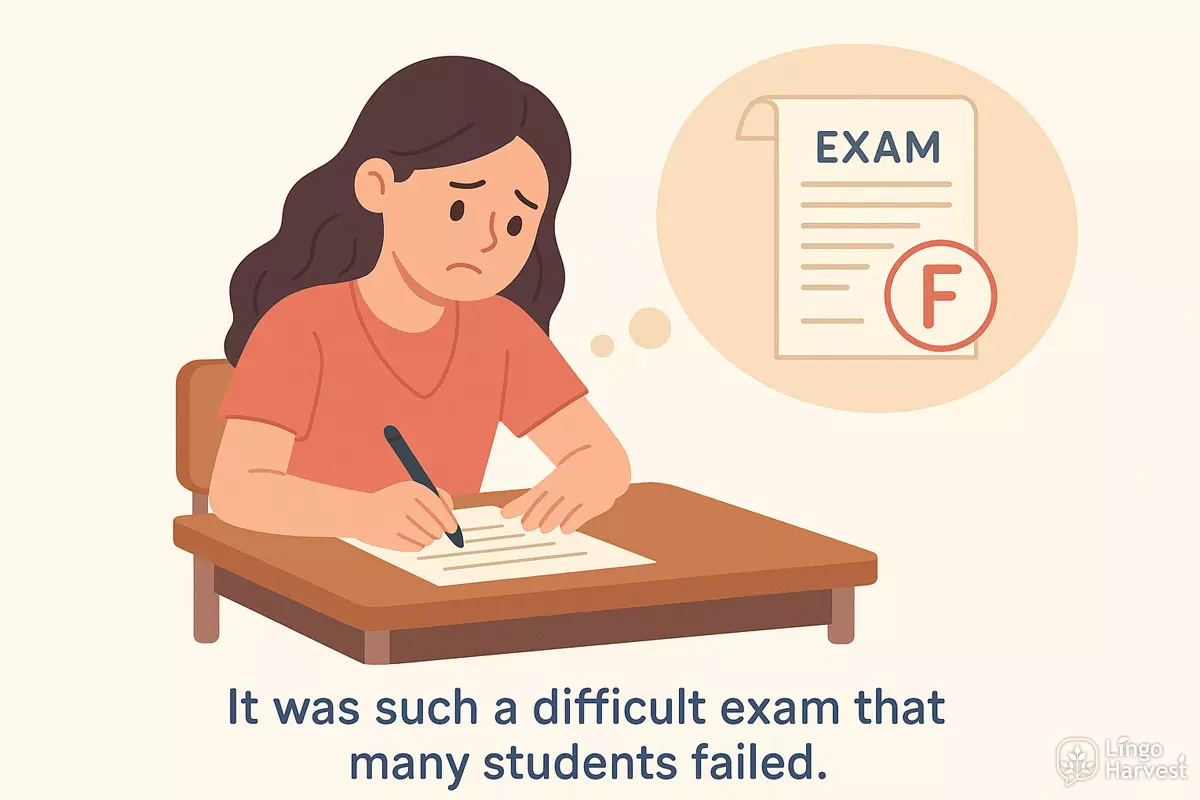
- It was such a difficult exam that many students failed.
- They are such good friends that they finish each other’s sentences.
- We had such terrible weather that the event was canceled.
- She told such an unbelievable story that nobody knew how to respond.
- He made such a big mistake that the project had to be restarted.
- It was such an interesting book that I read it in one day.
- They cooked such delicious food that everyone asked for the recipe.
- The team showed such strong determination that they won the competition.
This form focuses on the quality or nature of the noun, highlighting the cause of the result.
Comparing “So… That” and “Such… That”
The main difference lies in what comes after “so” (adjective/adverb) versus “such” (noun or noun phrase). Here’s a comparison of their structure and typical usage:
| Pattern | Example |
|---|---|
| so + adjective/adverb + that | The book was so interesting that I read it in one day. |
| such + (adjective) + noun + that | It was such an interesting book that I read it in one day. |
| so + much/many/few/little + noun + that | He had so many problems that he didn’t know what to do. |
| such + a lot of + noun + that | They made such a lot of noise that the neighbors complained. |
Alternatives and Variations
Other expressions can introduce result clauses, though they may sound more formal or less conversational. Some alternatives include:
- so much so that – e.g., “He was annoyed, so much so that he left.”
- to such an extent that – e.g., “She worked to such an extent that she became exhausted.”
- with the result that – e.g., “It rained all night, with the result that the match was postponed.”
- consequently – e.g., “The roads were icy; consequently, several accidents occurred.”
- as a result – e.g., “He forgot the meeting; as a result, he missed the announcement.”
- therefore – e.g., “She was unwell; therefore, she stayed home.”
- so that (purpose, not result) – e.g., “He spoke loudly so that everyone could hear.” (Note: different from result clauses!)
Summary of Key Points
- Use “so… that” with adjectives/adverbs to highlight degree or extent.
- Use “such… that” with nouns or noun phrases to describe qualities leading to a result.
- Alternatives exist, but “so… that” and “such… that” remain the most common for everyday use.
- Pay attention to the noun/adjective distinction to avoid common mistakes.
Understanding these patterns helps you clearly express causes and consequences in both written and spoken English.
Differences between so… that and such… that
Understanding when to use so… that and such… that is important for forming result clauses accurately in English. Both structures express cause and effect, but the grammar and usage patterns are not the same. The main distinction lies in the types of words or phrases each one works with and the sentence structure they require.
How “so… that” works
So… that is followed by an adjective or adverb. It describes the degree or intensity of a quality or action, leading to a result. Here are some typical patterns:
- so + adjective + that + result
She was so tired that she fell asleep instantly. - so + adverb + that + result
He spoke so quickly that I couldn’t understand him.
How “such… that” is used
Such… that is followed by a noun phrase (often with an adjective). It emphasizes the quality or type of something, not just the intensity. The most common patterns look like this:
- such + (adjective) + noun + that + result
It was such a difficult question that nobody could answer. - such + plural noun + that + result
They are such good friends that they never argue.
| Form | Example | Usage Notes |
|---|---|---|
| so + adjective/adverb + that | She was so tired that she left early. | Use for single adjectives or adverbs. |
| such + (adjective) + noun + that | It was such a cold day that the lake froze. | Use with noun phrases, often with an adjective. |
| so + much/many/little/few + noun + that | He had so much work that he stayed late. | For quantifying nouns, “so” is correct (not “such”). |
| such + plural noun + that | They are such talented musicians that everyone admires them. | Works with plural or uncountable nouns. |
Quick Reference: When to Choose Each Structure
- So… that for adjectives and adverbs: “The soup was so hot that I burned my tongue.”
- Such… that for noun phrases: “It was such a loud noise that everyone jumped.”
- “So” with quantifiers: “She has so many books that she needs a new shelf.”
- “Such” before adjectives + nouns: “He’s such a fast runner that he wins every race.”
In summary, use so… that with adjectives or adverbs, and such… that with nouns (often with adjectives). Mixing them up can make sentences sound unnatural. Practice with various structures to become comfortable choosing the right pattern for the result you want to express.
Alternative result structures and linkers
While “so… that” and “such… that” are common for expressing results, English offers a variety of other ways to connect cause and effect. These alternatives can add nuance, vary sentence rhythm, or suit more formal or informal contexts. Exploring other linking words and patterns helps make your language richer and more precise.
Common alternative linkers and structures
Several other conjunctions and expressions can introduce result clauses or show consequences. Some are more suitable for written English, while others fit naturally in conversation. Here are some widely used alternatives:
- Therefore: She was late; therefore, she missed the meeting.
- As a result: The project ran over budget. As a result, it was delayed.
- Consequently: He didn’t study. Consequently, he failed the test.
- So (as a simple connector): It was raining, so we stayed inside.
- Thus: Prices rose. Thus, demand dropped.
- Hence: He was the eldest, hence the leader.
- For this reason: The evidence was weak. For this reason, the case was dismissed.
- That’s why: I was tired. That’s why I left early.
- So that (purpose/result): She spoke clearly so that everyone could understand.
- Resulting in: The power went out, resulting in long delays.
- Leading to: He ignored the warnings, leading to an accident.
- With the result that: The road was icy, with the result that several cars skidded.
- Such that: The noise was such that no one could hear the speaker.
- To the extent that: He exaggerated to the extent that nobody believed him.
- To the point where: She worked to the point where she was exhausted.
Comparing patterns: formal and informal
Some alternatives are more formal, while others are preferred in spoken English. Here’s a comparison of a few commonly used result linkers:
| Pattern | Example | Typical Use |
|---|---|---|
| so | I was hungry, so I made a sandwich. | Neutral, spoken/written |
| therefore | He forgot his keys; therefore, he couldn’t enter. | Formal, written |
| as a result | She overslept. As a result, she missed the bus. | Neutral, often written |
| that’s why | The weather was bad. That’s why we stayed home. | Informal, spoken |
| thus | The plan failed. Thus, we had to start over. | Formal, written |
Other structures for expressing results
Besides conjunctions, English uses participle phrases, infinitive clauses, and prepositional phrases to show results:
- Participle phrase: The vase fell, breaking into pieces.
- Infinitive of result: He grew up to become a famous artist.
- Prepositional phrase: She was praised to such an extent that she blushed.
Choosing among these options depends on the tone, formality, and clarity you want. Exploring a range of result structures lets you tailor your message for different audiences and contexts.
Emphasis and exaggeration in result clauses
Writers and speakers often use result clauses to highlight the intensity or surprising nature of an outcome. By manipulating the structure or choice of words, you can make a result sound more dramatic, persuasive, or memorable. Expressions like “so… that” and “such… that” are especially useful for this, as they naturally lend themselves to amplifying statements.
Ways to intensify result clauses
Several strategies can make the outcome feel stronger or more exaggerated:
- Inserting intensifiers (e.g., so, such, incredibly, extremely) before adjectives or adverbs.
- Choosing adjectives or adverbs with a strong meaning (e.g., “devastating,” “unbelievably,” “utterly”).
- Repeating the intensifier for stylistic effect (e.g., “so, so tired that…”).
- Using alternative result phrases (e.g., “to the extent that,” “with the result that”).
- Combining result clauses with surprising outcomes.
Common patterns for emphasis
Here are some frequently used structures and variations:
- so + adjective/adverb + that: The test was so hard that nobody finished on time.
- such + (a/an) + adjective + noun + that: It was such a noisy room that I couldn’t concentrate.
- so many/much/few/little + noun + that: She had so much work that she stayed late.
- to such an extent that: He was exhausted to such an extent that he fell asleep immediately.
- with the result that: She forgot her umbrella, with the result that she got soaked.
- so + adjective + as to + verb: The soup was so hot as to burn my tongue.
Examples of exaggeration and emphasis
When you want to dramatize a situation or outcome, these examples show just how flexible and expressive result clauses can be:
- He was so tired that he fell asleep standing up.
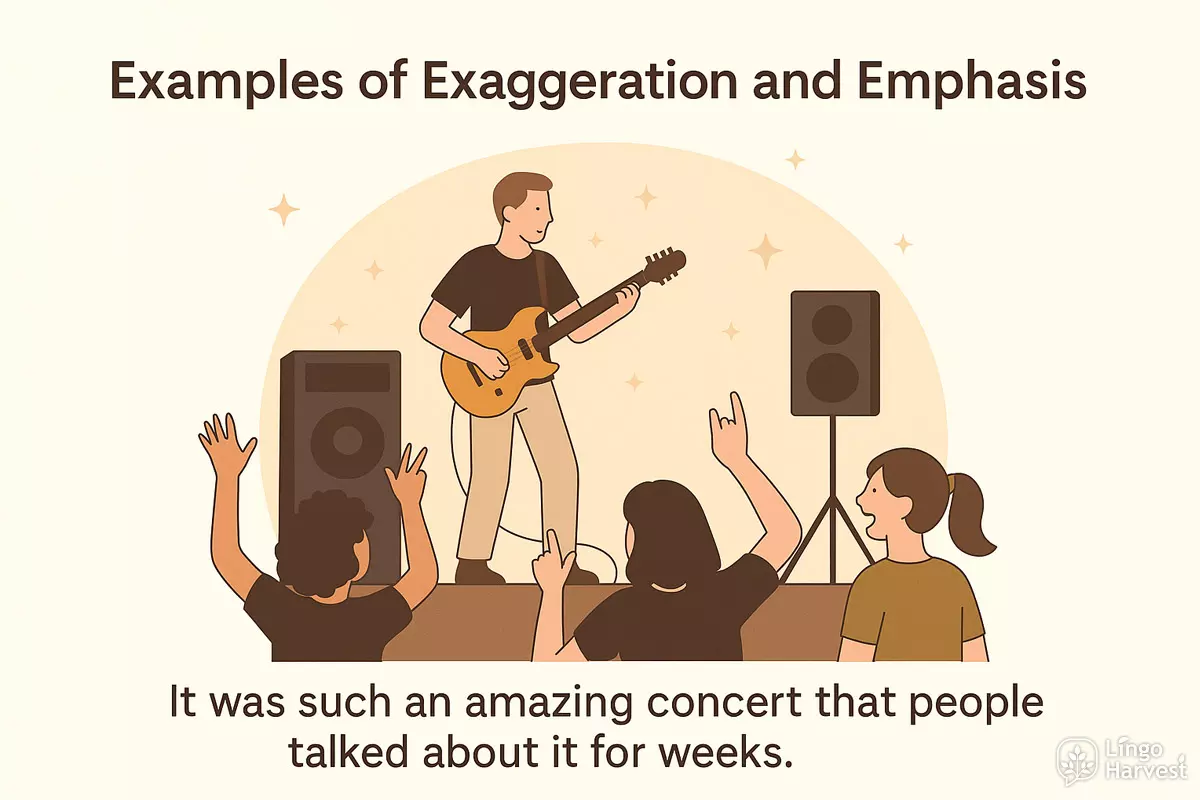
- It was such an amazing concert that people talked about it for weeks.
- They made so many mistakes that the project failed.
- The movie was so boring that half the audience left early.
- She spoke so quietly that nobody could hear her.
- He ran so fast that he broke the school record.
- The weather was so bad that flights were canceled.
- He was so shocked that he couldn’t speak.
- The book was so interesting that I finished it in one night.
- It was such a mess that we had to start over.
- She had so little time that she skipped lunch.
- The team was so confident that they didn’t practice.
- It was such a difficult exam that almost everyone failed.
- The news was so unexpected that nobody believed it at first.
- The soup was so salty that it was inedible.
- He was such a talented musician that he played by ear.
- The mountain was so high that it took days to climb.
- She was so happy that she cried.
- The cake was so delicious that everyone wanted seconds.
- It was such a long meeting that people got restless.
Comparing forms for emphasis
Sometimes, the choice between “so… that” and “such… that” depends on the sentence structure. Here’s a quick comparison of how these forms are used to heighten effect:
| Pattern | Example |
|---|---|
| so + adjective/adverb + that | The water was so cold that we couldn’t swim. |
| such + (a/an) + adjective + noun + that | It was such a cold day that everyone stayed inside. |
| so many/much/few/little + noun + that | They had so little food that they went hungry. |
| to such an extent that | He laughed to such an extent that he cried. |
| with the result that | He missed the deadline, with the result that the order was canceled. |
Using these frameworks, you can add nuance, drama, or humor to your descriptions, making your communication more vivid and engaging.
Common mistakes with word order and intensity
Learners often stumble when using result clauses like “so… that” and “such… that,” especially with the placement of words and the level of intensity expressed. These errors can make sentences sound unnatural or even change the meaning entirely. Understanding the typical pitfalls can help you avoid confusion and communicate more clearly.
Word Order Issues
The most frequent problem is mixing up the word arrangement in these structures. For example, “so” is followed by an adjective or adverb, while “such” is followed by a (sometimes modified) noun. Placing these elements incorrectly leads to awkward or incorrect phrases. Here are some common slips:
- ❌ She is so beautiful girl that everyone notices her. → Incorrect word order
- ✅ She is such a beautiful girl that everyone notices her.
- ✅ She is so beautiful that everyone notices her.
- ❌ It was such cold that we stayed inside. → Missing noun after "such"
- ✅ It was such cold weather that we stayed inside.
- ✅ It was so cold that we stayed inside.
Problems with Intensity
Another source of confusion is choosing the right degree of emphasis. Sometimes, “so” or “such” is used when a less intense word would be more appropriate, or the result clause is included when the cause isn’t strong enough. Overuse or misuse can make sentences sound exaggerated or odd.
- ❌ The test was so difficult that I almost failed. (Correct if the test was truly very hard; otherwise, “quite” or “rather” may be better)
- ❌ She is such a nice person that everyone likes her. (Acceptable, but “so nice” may sound more natural in some contexts)
- ❌ He ran so quickly that he won. (Fine, but often “so fast” is preferred in casual speech)
Confusing “So” and “Such” with Alternatives
Sometimes, “so” and “such” are swapped with other intensifiers or alternative result structures, leading to errors. Below is a comparison of the correct forms and common mistakes:
| Incorrect Example | Corrected Form |
|---|---|
| It was so a boring movie that I left. | It was such a boring movie that I left. |
| She has such beautiful that people stare. | She is so beautiful that people stare. She has such beauty that people stare. |
| They are so talented musicians that they won. | They are such talented musicians that they won. |
| He spoke such fast that I couldn’t understand. | He spoke so fast that I couldn’t understand. |
| This room is such hot in summer. | This room is so hot in summer. This is such a hot room in summer. |
Summary of Typical Errors
To avoid these mistakes, keep these tips in mind:
- Use “so” with adjectives or adverbs: so tall, so quickly
- Use “such” with (adjective +) noun: such a tall man, such kindness
- Don’t mix “so” with nouns or “such” with just adjectives
- Ensure the result (“that” clause) matches the intensity of the cause
- Check for missing articles or modifiers with “such”
- Avoid redundancy: don’t use both “so” and “such” together
- Don’t overuse these structures; sometimes a simple adjective or adverb is enough
- Review sentence flow to make sure it sounds natural
Careful attention to structure and degree of emphasis will make your result clauses much clearer and more idiomatic.
Practice: create and improve result clauses from prompts
Sharpen your skills with result clauses by working through these practical prompts. Below, you'll find sentence fragments and situations. Your task is to create complete sentences using result structures like “so...that”, “such...that”, or alternative forms. These exercises will help you make your writing and speaking more precise when expressing outcomes or consequences.
Transforming Prompts into Result Clauses
Rewrite each prompt by forming a clear result clause. Use “so...that”, “such...that”, or another appropriate structure (e.g., “as a result”, “consequently”, “therefore”). Try to vary your choice of connectors.
- The coffee was very hot. / She couldn't drink it.
- It rained heavily. / The streets flooded.
- He studied hard. / He passed the exam.
- The movie was boring. / Many people left early.
- The solution was simple. / Everyone understood it immediately.
- The team worked efficiently. / The project finished ahead of schedule.
- The mountain was steep. / Few hikers reached the top.
- The offer was generous. / She accepted without hesitation.
- The weather was perfect. / They decided to have a picnic.
- The child was tired. / He fell asleep on the bus.
- The explanation was unclear. / Students asked many questions.
- The box was heavy. / I couldn't lift it alone.
- The prize was valuable. / Everyone wanted to win.
- The food was spicy. / Some guests couldn't eat it.
- The instructions were detailed. / Assembly was easy.
- The performance was impressive. / The audience applauded loudly.
- The error was minor. / It didn't affect the results.
- The game was exciting. / Fans talked about it for days.
- The road was icy. / Driving became dangerous.
- The room was noisy. / I couldn't concentrate.
Show answers
- The coffee was so hot that she couldn't drink it.
- It rained so heavily that the streets flooded.
- He studied hard; as a result, he passed the exam.
- The movie was so boring that many people left early.
- The solution was so simple that everyone understood it immediately.
- The team worked efficiently, so the project finished ahead of schedule.
- The mountain was so steep that few hikers reached the top.
- The offer was so generous that she accepted without hesitation.
- The weather was so perfect that they decided to have a picnic.
- The child was so tired that he fell asleep on the bus.
- The explanation was so unclear that students asked many questions.
- The box was so heavy that I couldn't lift it alone.
- The prize was so valuable that everyone wanted to win.
- The food was so spicy that some guests couldn't eat it.
- The instructions were so detailed that assembly was easy.
- The performance was so impressive that the audience applauded loudly.
- The error was so minor that it didn't affect the results.
- The game was so exciting that fans talked about it for days.
- The road was so icy that driving became dangerous.
- The room was so noisy that I couldn't concentrate.
Upgrade Simple Sentences
Take these basic sentences and improve them by combining them into a more natural result clause. This will help you practice making your English sound more fluent and precise.
- He was very tired. He went to bed early.
- The cake was delicious. Everyone wanted another slice.
- The news was surprising. She didn’t know what to say.
- The lecture was informative. The students took many notes.
- The movie was exciting. People applauded at the end.
- The room was noisy. We couldn’t concentrate.
- The task was easy. They finished it in minutes.
- The weather was terrible. We decided to stay home.
- The book was interesting. I read it in one night.
- The athlete ran fast. He broke the school record.
Show answers
- He was so tired that he went to bed early.
- The cake was so delicious that everyone wanted another slice.
- The news was so surprising that she didn’t know what to say.
- The lecture was so informative that the students took many notes.
- The movie was so exciting that people applauded at the end.
- The room was so noisy that we couldn’t concentrate.
- The task was so easy that they finished it in minutes.
- The weather was so terrible that we decided to stay home.
- The book was so interesting that I read it in one night.
- The athlete ran so fast that he broke the school record.
Alternatives to "So...That" and "Such...That"
Sometimes, using alternatives can make your language less repetitive. Here are some structures you can use instead of the typical result clauses:
- Therefore (e.g., It was late; therefore, we went home.)
- As a result (e.g., She forgot her umbrella. As a result, she got wet.)
- Consequently (e.g., He missed the train. Consequently, he was late for work.)
- That’s why (e.g., The store was closed. That’s why we didn’t buy anything.)
- Thus (e.g., The evidence was clear. Thus, the jury reached a quick decision.)