Advanced Purpose Clauses: In Order To, So As To, So That

 Here we ways to express purpose in English, including basic and advanced forms, formality differences between to, in order to, and so as to, and using so that with or without modal verbs.
Clearly and precisely expressing the reason behind an action is an essential skill in English, particularly for those seeking to write with greater sophistication. By mastering advanced ways to show intent, writers can improve the flow of their sentences and communicate their messages more effectively. Using varied structures such as in order to, so that, or with the aim of not only adds variety but also helps clarify the purpose behind each action. Developing this skill enhances both academic and professional writing, making arguments and explanations more compelling and coherent for readers.
Basic vs advanced purpose expressions
When expressing why someone does something in English, we can use simple or more advanced structures. The simplest way is often with "to" + verb (the infinitive), while more complex sentences might use phrases like "in order to," "so as to," or "so that." Each has its own style, level of formality, and specific use cases.
Simple purpose expressions
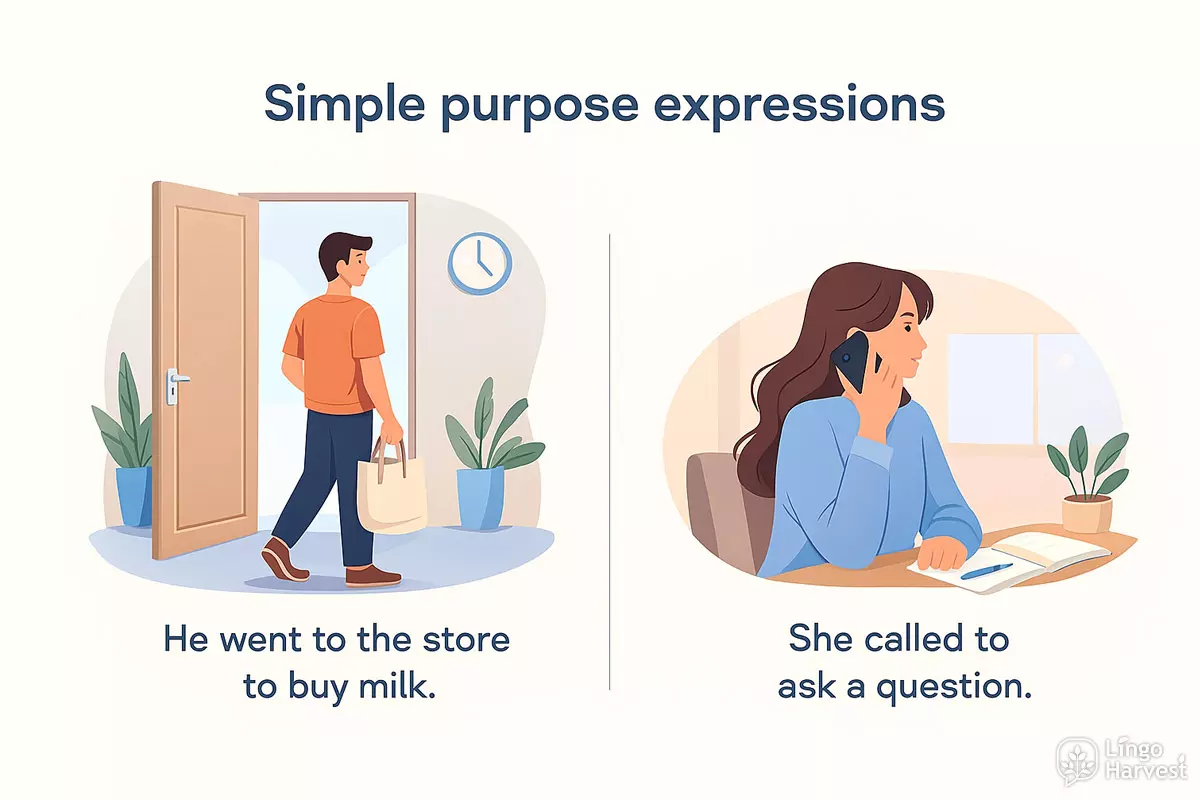
The most common way is to use the infinitive. This is direct and works in everyday conversation:
- He went to the store to buy milk.
- She called to ask a question.
- We exercise to stay healthy.
This form is clear and concise, but sometimes you need to be more precise or formal.
More advanced ways to express purpose
Advanced learners often use "in order to," "so as to," or "so that" for emphasis, clarity, or to fit a formal context. These forms can also help avoid ambiguity or awkward repetition.
| Form | Example | Usage & Notes |
|---|---|---|
| to + verb | He left early to catch the bus. | Most common, neutral/informal speech. |
| in order to + verb | She spoke quietly in order to not wake the baby. | More formal; used for clarity or emphasis. |
| so as to + verb | He whispered so as to avoid attention. | Formal or written English, less common in speech. |
| so that + clause | They left early so that they could find seats. | Allows different subjects; can use modal verbs. |
Key differences and tips
- Infinitive ("to" + verb): Use for most casual contexts. Good when the subject is the same in both parts of the sentence.
- "In order to" / "so as to": Both mean the same as "to," but add formality. "So as to" is especially formal.
- "So that": Use when the subject changes, or when you want to add a modal verb (can, will, may, could, etc.).
More examples for practice
- He saved money to buy a car.
- She studied late in order to pass the exam.
- He wore a hat so as to protect his head.
- We left early so that we would not be late.
- They whispered so as to not disturb the meeting.
- She took notes in order to remember the details.
- He ran to catch the train.
- He locked the door so that no one could enter.
- She brought an umbrella in order to stay dry.
- They spoke quietly so as to not wake the kids.
Choosing between these forms depends on context, tone, and clarity. Mastering advanced purpose clauses helps your English sound more natural and precise, especially in writing or formal situations.
Formality contrasts: to vs in order to vs so as to
When choosing between "to," "in order to," and "so as to," it’s important to understand how each one fits different levels of formality and style. The simplest option, "to," is by far the most common in everyday speech and writing, making it the go-to choice for most informal contexts. In contrast, "in order to" and "so as to" convey a more formal tone and are often preferred in academic, business, or official texts.
Comparing levels of formality
"To" is direct and efficient, which is why it dominates informal conversations and casual writing. "In order to" adds clarity and emphasis, especially when there’s potential for ambiguity, or when a sentence might otherwise sound abrupt. "So as to" is the most formal and sometimes sounds old-fashioned, but it appears in legal documents, instructions, and some formal correspondence.
Usage patterns and example contexts
The choice isn’t just about formality; it also depends on sentence structure and the need for emphasis or clarity. Here’s how these phrases typically function:
- To: Used for simple, direct statements of purpose. Example: "She left early to catch the bus."
- In order to: Preferred when extra clarity is needed, or to avoid confusion. Example: "He spoke slowly in order to be understood."
- So as to: Chosen for very formal writing or when echoing a particular style. Example: "Applicants must submit all documents so as to complete registration."
Structured comparison
Below is a summary of the main contrasts in style, tone, and context:
| Expression | Formality | Typical Contexts | Example Sentence |
|---|---|---|---|
| to | Informal ✅ | Everyday speech, emails, casual writing | I called to ask a question. |
| in order to | Neutral–Formal ✅ | Essays, reports, instructions, formal letters | She paused in order to collect her thoughts. |
| so as to | Formal ✅ | Legal documents, official policies, formal instructions | Arrive early so as to avoid delays. |
Quick reference: When to choose each
- Use "to" when you want to sound natural and straightforward.
- Use "in order to" if you need extra clarity, or when writing for a semi-formal or formal audience.
- Use "so as to" mainly in formal or traditional writing, or if you wish to match a specific style guide.
Understanding these nuances helps you match your language to your context and audience, making your purpose clauses clear and appropriate.
So that with and without modal verbs
Purpose clauses introduced by so that often include modal verbs, but not always. The choice depends on the intended meaning and the level of formality. When a modal is used, it typically expresses possibility, permission, ability, or necessity related to the purpose. Without a modal, the clause simply describes the result or reason in a more neutral way.
Using Modals in Purpose Clauses
Including a modal verb like can, could, will, or may makes the purpose explicit and often clearer. This is especially common in formal writing and speech. Here are some examples:
- She left early so that she could catch the train.
- Turn the volume down so that we can concentrate.
- I'll write it down so that I won't forget.
- He wears glasses so that he may see better.
No Modal: Direct Result or General Purpose
Sometimes, so that is used without a modal verb. This is more common in informal speech or when the outcome is certain and not dependent on ability or permission.
- She whispered so that nobody heard.
- He paused so that everyone had time to understand.
- We closed the door so that the cat stayed inside.
- I left a note so that you knew where I was.
Comparing Usage: With and Without Modals
The presence or absence of a modal verb changes the nuance. With modals, the focus is on ability, permission, or possibility; without modals, it’s a straightforward result. See the comparison below:
| With Modal Verb | Without Modal Verb |
|---|---|
| Leave early so that you can avoid traffic. | Leave early so that the roads are clear. |
| Speak up so that everyone will hear you. | Speak up so that everyone hears you. |
| Take notes so that you won’t forget. | Take notes so that you remember. |
| Wear a mask so that you may protect others. | Wear a mask so that others stay safe. |
Summary of Patterns
- Use so that + modal verb to highlight ability, permission, or possibility.
- Use so that + simple present/past for direct results or when the outcome is certain.
- Formality increases with modal verbs; informality often drops the modal.
- Context determines if a modal is needed for clarity or nuance.
Understanding how to structure purpose clauses with or without modals helps you convey intent or result clearly and appropriately for different situations.
Avoiding redundant purpose markers
When using advanced purpose clauses such as "in order to," "so as to," and "so that," it’s easy to accidentally double up on markers or use unnecessary words. This often happens when speakers try to emphasize intent, but end up creating awkward or overly complex sentences. Streamlining your sentences not only improves clarity but also makes your writing more natural and concise.
Common Redundancies to Watch Out For
Writers sometimes combine two purpose markers, thinking it adds emphasis. In practice, this results in redundancy. For example:
- Incorrect: He left early so that in order to avoid traffic.
- Incorrect: She called so as to for confirm the appointment.
The correct approach is to use only one marker that best fits the context.
Examples of Streamlining Purpose Clauses
Below is a list of purpose clause combinations that should be avoided, along with better alternatives:
- ❌ In order to so that — ✓ Use one: "in order to" or "so that"
- ❌ So as to for — ✓ Use only "so as to"
- ❌ To in order to — ✓ Use either "to" or "in order to"
- ❌ So that so — ✓ Use only "so that"
- ❌ In order to for to — ✓ Use "in order to"
- ❌ So as to so that — ✓ Pick one, not both
- ❌ To so that — ✓ Use one clear marker
- ❌ In order that so that — ✓ Choose "in order that" or "so that"
- ❌ For to — ✓ Use only "to" for purpose
- ❌ So as to to — ✓ Pick the most suitable one
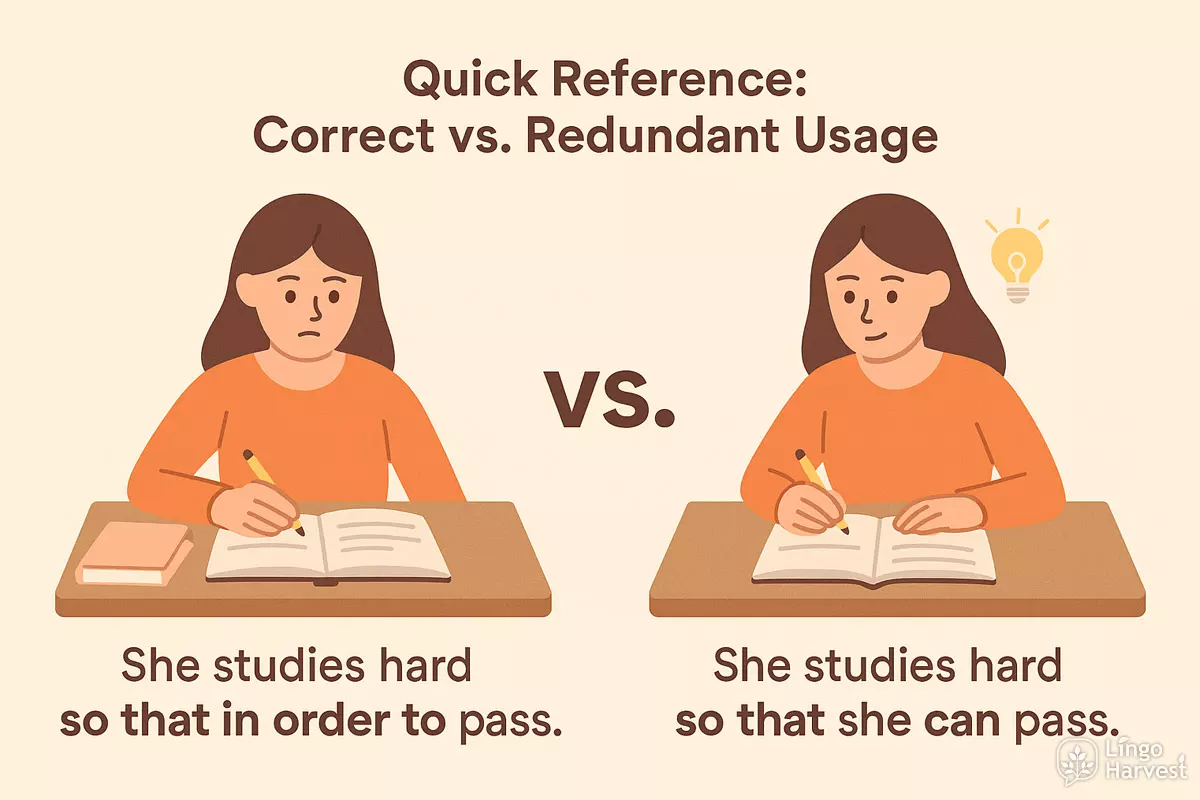
Quick Reference: Correct vs. Redundant Usage
| Redundant Example | Improved Version |
|---|---|
| She studies hard so that in order to pass. | She studies hard so that she can pass. |
| He went to the store in order to for buy milk. | He went to the store to buy milk. |
| They left early so as to so that avoid crowds. | They left early so as to avoid crowds. |
| We met so that to discuss the plan. | We met to discuss the plan. |
| I called for to confirm my reservation. | I called to confirm my reservation. |
| She trained in order that so that she could win. | She trained so that she could win. |
Tips for Natural Sentences
- Choose one clear purpose marker; more is not better.
- If in doubt, use the simplest marker ("to") for informal contexts.
- Reserve longer forms ("in order to," "so as to") for formality or emphasis.
- Re-read sentences for unnecessary repetition of intent.
- Remember, clarity improves with conciseness.
By focusing on one appropriate marker, you’ll keep your sentences effective and easy to understand.
Choosing the right structure for register and clarity
Selecting between in order to, so as to, and so that depends on both the formality of your context and the need for explicit meaning. Each serves a purpose clause, but their register and nuance differ. Understanding these differences helps your writing or speech sound natural and precise, whether you’re drafting an academic essay, a business report, or simply explaining intentions in conversation.
Register: Formality and Context
The choice of structure is often guided by the level of formality you wish to convey:
- In order to – Suitable for neutral to formal contexts; often used in written English and when clarity is crucial.
- So as to – More formal and less common in speech; typically used in academic or legal writing.
- So that – Flexible for both formal and informal situations; allows inclusion of a subject in the dependent clause.
Clarity: Expressing Purpose Precisely
While all three options signal purpose, their structure can affect how explicit or concise your sentence is. So that is particularly useful when you need to state who will benefit or act, while the other two typically use the same subject for both clauses.
| Structure | Typical Use & Example | Register |
|---|---|---|
| in order to + verb | He left early in order to catch the train. | Neutral/Formal |
| so as to + verb | She whispered so as to not wake the baby. | Formal |
| so that + subject + verb | They paused so that everyone could understand. | Any (context-dependent) |
Common Patterns and Usage Tips
- Use in order to for clear purpose, especially in instructions or formal writing.
- Prefer so as to when you want to sound particularly formal or avoid repetition of “in order to.”
- Opt for so that when you need to specify a different subject or result, or to emphasize consequence.
- Do not use so as to in very casual speech; it can sound stilted.
- When brevity is important and the subject is clear, to + verb alone is often acceptable.
- Avoid unnecessary repetition; choose the structure that best fits your sentence flow.
- If expressing possibility or ability, so that + can/could is preferred (e.g., so that she can join).
- For negative purpose, use in order not to or so as not to.
- Remember that so that introduces a finite clause, while the others use the infinitive.
- Match your structure to your audience: academic readers may expect more formal constructions.
- Check for ambiguity: if the subject could be unclear, use so that to specify it.
- In technical or scientific writing, in order to is commonly accepted for stating objectives.
- Use in order to for emphasis when a simple infinitive might seem abrupt.
- In legal or contract language, so as to is sometimes chosen for precision.
- For spoken English, so that or just to is usually most natural.
Ultimately, your choice should reflect both the clarity you need and the tone appropriate for your audience. Practicing these distinctions leads to more effective and versatile English.
Practice: refine purpose clauses in academic-style sentences
Sharpening your use of complex purpose clauses is essential for clear, sophisticated academic writing. In this section, you'll find targeted exercises and examples to help you distinguish between "in order to," "so as to," and "so that," as well as guidance for revising awkward or informal sentences. Each example reflects realistic academic contexts, such as research aims, methodology explanations, and argumentation.
Common Academic Patterns for Purpose Clauses
- Researchers designed the experiment in order to test the hypothesis.
- Controls were implemented so as to minimize bias.
- The survey was translated so that participants could respond in their native language.
- Data were anonymized in order to protect participant privacy.
- Instructions were clarified so as to ensure accurate completion.
- Measures were taken so that results would be reproducible.
- The sample size was increased in order to improve statistical power.
- Preliminary tests were conducted so as to identify potential errors.
- The wording was adjusted so that ambiguity could be avoided.
- Variables were controlled in order to isolate the effects of the intervention.
- Guidelines were established so as to standardize procedures.
- Training was provided so that staff would be familiar with the protocol.
- Questions were piloted in order to assess clarity.
- Extra time was allotted so as to accommodate slower readers.
- Diagrams were included so that complex concepts could be visualized.
Task: Improve Purpose Clauses in Academic Sentences
Rewrite each sentence, making the purpose clause more formal or precise using "in order to," "so as to," or "so that" as appropriate.
- We changed the schedule to help students participate more easily.
- They added more examples for readers to understand the theory.
- The software was updated for better compatibility.
- She repeated the experiment to check her results.
- The team met early to finish the report before the deadline.
- He revised the article to clarify the main argument.
- They organized a meeting to resolve the conflict.
- We adjusted the plan to reduce unnecessary costs.
- She slowed down the presentation to make it easier to follow.
- The school introduced a new rule to improve safety.
Show answers
- The schedule was changed in order to facilitate student participation.
- Additional examples were included so that readers could better understand the theory.
- The software was updated so as to improve compatibility.
- The experiment was repeated in order to verify the results.
- The team met early so as to complete the report before the deadline.
- The article was revised in order to clarify the main argument.
- A meeting was organized so that the conflict could be resolved.
- The plan was adjusted so as to reduce unnecessary costs.
- The presentation was slowed down so that it would be easier to follow.
- A new rule was introduced in order to improve safety.
Comparison Table: Purpose Clause Forms in Academic Contexts
| Expression | Typical Use in Academic Writing | Example |
|---|---|---|
| in order to + base verb | States the aim of an action, often formal | Data were collected in order to test the hypothesis. |
| so as to + base verb | Emphasizes method or means, slightly more formal/rare | Questions were revised so as to ensure clarity. |
| so that + subject + verb | Focuses on the outcome or result for a person/group | Instructions were provided so that all participants understood the process. |
| for + noun/gerund | Less precise; sometimes used for general aims | Methods for analyzing the data were discussed. |
Quick Check: Identify the Purpose Clause
For each sentence, underline the purpose clause and specify which structure is used.
- The study was replicated so as to confirm previous findings.
- Ethical approval was obtained so that the research could proceed legally.
- Additional training was provided in order to enhance staff competence.
- Special software was installed for processing large datasets.
- The survey was expanded so as to include more demographic groups.
- The guidelines were updated so that all staff members would follow the same procedure.
- The test was repeated in order to reduce measurement error.
- A new tool was introduced for improving workflow efficiency.
- The questionnaire was simplified so as to increase response rates.
- The system was redesigned so that users could navigate it more easily.
Show answers
- so as to confirm previous findings — "so as to" + base verb
- so that the research could proceed legally — "so that" + subject + verb
- in order to enhance staff competence — "in order to" + base verb
- for processing large datasets — "for" + gerund
- so as to include more demographic groups — "so as to" + base verb
- so that all staff members would follow the same procedure — "so that" + subject + verb
- in order to reduce measurement error — "in order to" + base verb
- for improving workflow efficiency — "for" + gerund
- so as to increase response rates — "so as to" + base verb
- so that users could navigate it more easily — "so that" + subject + verb