Stance Markers: Showing Certainty, Doubt, and Attitude in Text

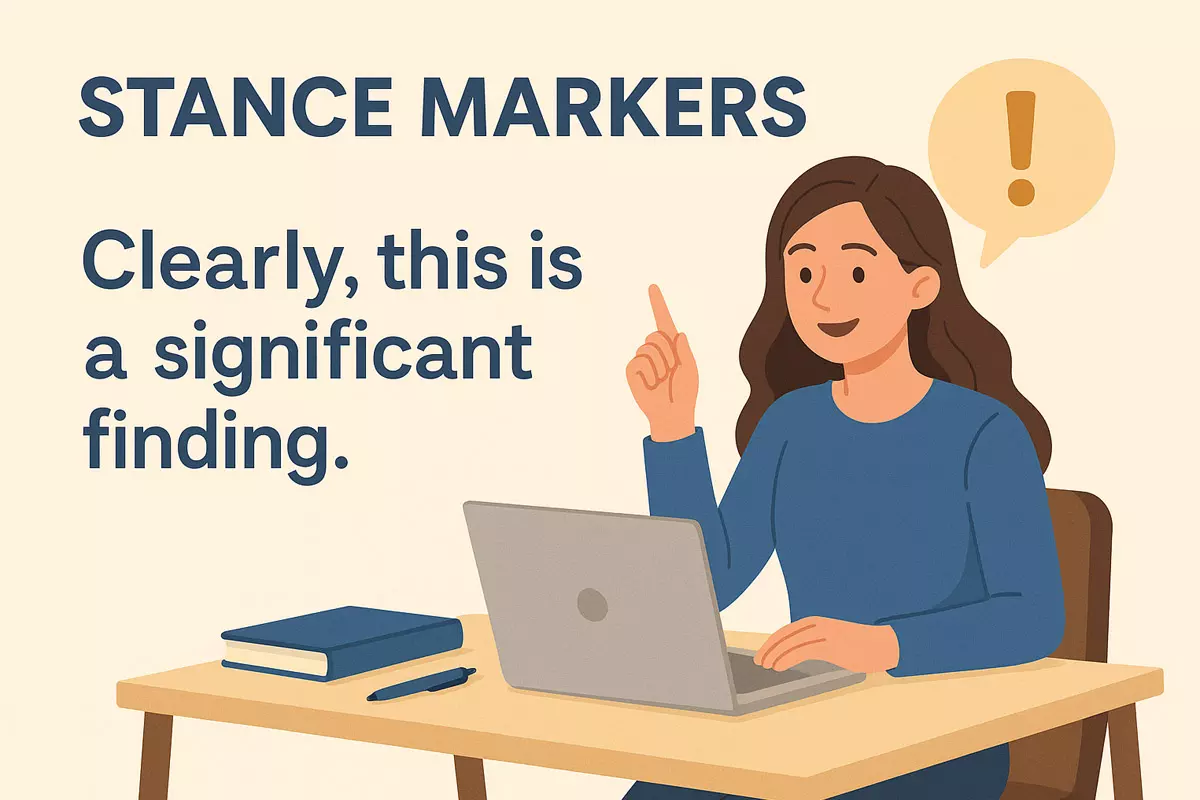 The article defines stance in writing, outlines lexical and grammatical stance markers, explains how to convey confidence, doubt, and evaluation, discusses clause positioning, compares spoken and written stance, and provides editing practice to clarify stance.
Writers frequently convey their confidence, doubt, or personal perspective through subtle language choices that influence how readers perceive a message. By recognizing the specific words and phrases that signal certainty or skepticism, readers and writers alike can better understand the underlying tone and intent of a text. Developing an awareness of these linguistic tools not only helps readers interpret meaning more accurately but also allows writers to communicate their ideas more effectively and persuasively in any context.
Definition of stance in writing
Writers constantly express their attitudes, judgments, and levels of certainty toward the information they present. This expression of viewpoint, known as stance, shapes the way readers interpret a text. Stance involves the linguistic choices authors make to signal confidence, doubt, agreement, disagreement, or emotional engagement with their material. It is not just about what is said, but how it is said, reflecting the writer’s position in relation to the content and the audience.
Key Aspects of Stance
- Certainty: Indicates how confident the writer is about a claim (e.g., “It is clear that...”).
- Doubt: Signals hesitancy or openness to other interpretations (e.g., “It seems that...”).
- Attitude: Shows approval, disapproval, or neutrality (e.g., “Unfortunately, the results were inconclusive.”).
- Distance: Marks how close the writer feels to the information or opinion (e.g., “According to experts...” vs. “I believe...”).
- Engagement: Involves inviting the reader to agree, disagree, or consider alternatives (e.g., “You might notice that...”).
Expressing stance is a subtle but powerful part of academic, scientific, journalistic, and even creative writing. It helps readers understand whether a statement is a fact, an interpretation, or a personal opinion. The language of stance includes modal verbs, adverbs, reporting verbs, and evaluative adjectives or phrases.
Common Linguistic Markers of Stance
- Modal verbs: may, might, must, should, can
- Adverbs: probably, certainly, possibly, clearly, evidently
- Verbs of reporting or thinking: suggest, claim, argue, believe, doubt
- Adjectives: likely, unlikely, possible, apparent, obvious
- Phrases: It appears that, There is no doubt that, In my view
- Hedges: somewhat, to a certain extent, in some cases
- Boosters: undoubtedly, always, never, absolutely
- Attitudinal markers: unfortunately, surprisingly, regrettably
- Self-mentions: I think, we argue, the author suggests
- Reference to evidence: According to data, The results indicate
Writers choose stance markers deliberately, depending on the purpose, audience, and genre. For instance, scientific articles often use cautious language to avoid overgeneralization, while opinion pieces may employ more direct and assertive forms.
Types of stance markers: lexical and grammatical
Writers and speakers use a range of expressions to indicate their attitudes, levels of certainty, or doubts about what they communicate. These stance expressions can be sorted into two main groups: those that rely on specific words (lexical) and those that involve grammatical structures. Understanding both categories helps in analyzing or crafting text with the right tone and level of confidence.
Lexical stance markers
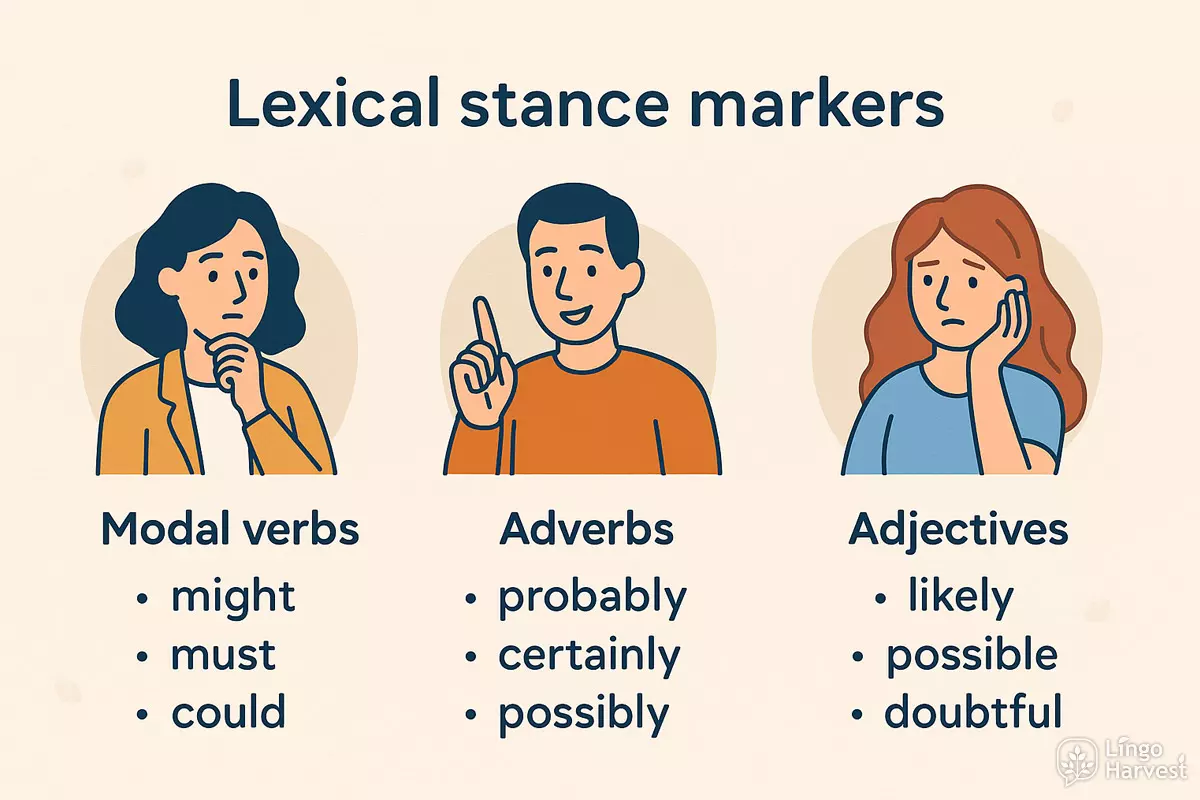
Lexical items directly convey attitude or certainty. These include single words or fixed expressions that explicitly show the author's position. Here are some common types:
- Modal verbs: might, must, could, should, will
- Adverbs: probably, certainly, possibly, clearly, obviously
- Adjectives: likely, possible, doubtful, certain, apparent
- Verbs of cognition: believe, think, assume, doubt, know, suggest
- Nouns expressing stance: possibility, certainty, assumption, doubt
- Set phrases: in my opinion, it seems that, it is clear that, as far as I know
- Reporting verbs: claim, argue, state, report, assert, maintain
- Discourse markers: frankly, admittedly, honestly, surprisingly
- Markers of evaluation: important, significant, trivial, relevant
- Hedges: sort of, kind of, more or less, somewhat
Grammatical stance markers
Grammatical tools allow writers to embed attitude within sentence structure, often in subtler ways than lexical markers. These include:
- Modal auxiliaries: may, might, must (as part of verb phrases)
- Passive voice: "It is believed that..." to distance the writer from the claim
- Conditional clauses: "If this is true, then..." to show uncertainty
- Interrogative structures: Using questions to express doubt or challenge, e.g., "Can we really say that...?"
- Extraposition: "It seems that..." or "It is possible that..."
- Nominalization: Turning verbs into nouns, e.g., "The assumption that..."
- Tag questions: "This is correct, isn't it?"
- Infinitive or gerund constructions: "To be honest," or "Being clear about..."
- Subordinate clauses: "Although it appears that..."
- Emphatic do: "I do think that..."
| Lexical Markers | Grammatical Markers |
|---|---|
| clearly, probably, apparently | modal auxiliaries (might, must) |
| believe, doubt, assume | passive constructions ("It is said that...") |
| in my opinion, as far as I know | conditional clauses ("If..., then...") |
| important, significant, doubtful | tag questions ("..., isn't it?") |
Choosing the right marker
Picking between these options depends on the level of certainty, politeness, or distance you want to convey. Lexical markers are often more direct, while grammatical ones can be subtle, allowing for nuanced shades of meaning. Recognizing and using both types effectively is key to expressing attitude, certainty, or doubt in any form of written or spoken text.
Showing confidence, doubt, and evaluation
Writers often communicate their level of certainty, skepticism, or judgment through specific language choices called stance markers. These expressions help readers interpret whether a statement is presented as a solid fact, an open possibility, or a personal viewpoint. By choosing the right phrases, authors can signal conviction, tentativeness, or critical assessment depending on their intent.
Expressing Confidence
To indicate strong belief or certainty, authors use assertive words and phrases. These can make arguments more persuasive and statements appear more authoritative. Typical markers of confidence include:
- Clearly
- Undoubtedly
- It is certain that
- There is no doubt
- Obviously
- It is evident that
- Certainly
- Without question
- Demonstrably
- It is well established
- Beyond any doubt
- It is undeniable that
- There is clear evidence that
- Unquestionably
- It is universally accepted that
- There is strong proof that
- It is a fact that
- Indisputably
- There can be no argument that
- The evidence plainly shows
Signaling Doubt or Uncertainty
Conversely, to soften a claim or express hesitation, writers select hedging expressions. These stance markers are useful in academic writing and critical discussion, where absolute statements may not be justified. Examples include:
- Possibly
- It seems that
- Perhaps
- It is likely that
- May
- Apparently
- It appears that
- Suggests
- Could
- Tentatively
- It is possible that
- Potentially
- There is a chance that
- Arguably
- In some cases
- Often
- It is not certain that
- Possibly indicates
- Somewhat
- It could be interpreted that
Evaluative Language: Showing Attitude
Writers also use stance markers to share their attitude toward information, showing approval, disapproval, or neutrality. This evaluative language helps readers understand the writer’s perspective and the weight given to evidence or ideas.
| Stance Marker | Effect/Typical Use |
|---|---|
| Unfortunately | Signals a negative evaluation or regret |
| Surprisingly | Indicates unexpectedness or mild disbelief |
| Importantly | Highlights significance or priority |
| Regrettably | Expresses disapproval or disappointment |
| Encouragingly | Shows a positive or hopeful attitude |
| Alarmingly | Conveys concern or urgency |
Mixing Stance Markers
Effective writing often combines these markers to balance claims, acknowledge limitations, or guide the reader’s interpretation. For instance, a researcher may first hedge a claim (“It appears that…”) and then add an evaluative comment (“Importantly, this trend continues in recent data”). This approach helps present nuanced arguments and fosters reader trust. Understanding and using a range of stance markers lets writers shape how their ideas are received, whether aiming for authority, caution, or critical reflection.
Positioning stance markers in clauses
Writers and speakers have several options for placing stance markers within sentences, and these choices can subtly affect meaning and emphasis. Stance expressions—such as adverbs, modal verbs, and reporting verbs—often appear at the start, in the middle, or at the end of a clause. Each position can highlight different aspects of the message, direct attention, or signal the writer’s attitude more or less strongly.
Common Positions for Stance Markers
- Initial position: Placing a marker at the beginning of a sentence or clause sets the tone early, signaling attitude or certainty right away.
Clearly, the results support the hypothesis. - Medial position: Inserting a marker after the subject or auxiliary can make the stance seem more integrated with the statement.
The results obviously support the hypothesis. - Final position: Adding a marker at the end provides a subtle, afterthought-like emphasis or softening.
The results support the hypothesis, apparently.
Examples of Stance Markers in Different Positions
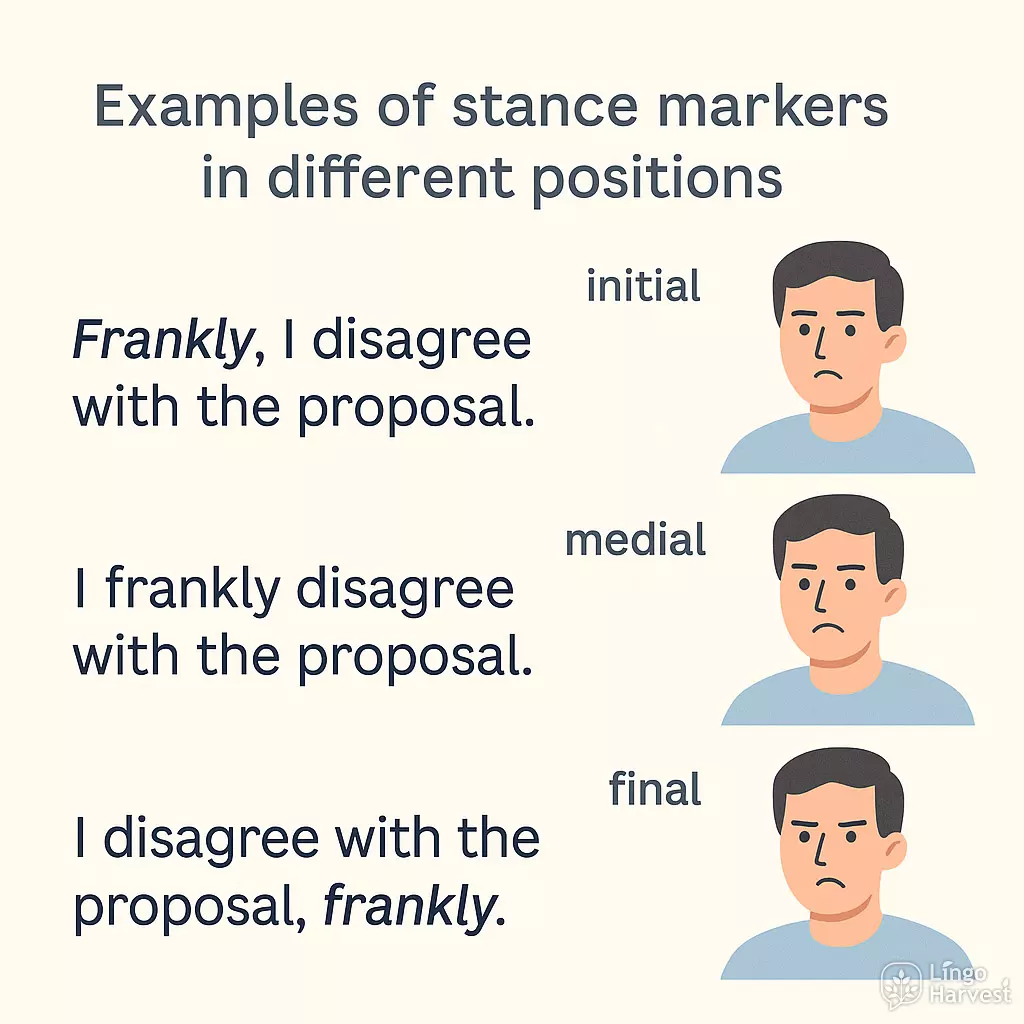
- Frankly (initial / medial / final)
- Frankly, I disagree with the proposal.
- I frankly disagree with the proposal.
- I disagree with the proposal, frankly.
- Undoubtedly (initial / medial / final)
- Undoubtedly, this is a significant discovery.
- This is undoubtedly a significant discovery.
- This is a significant discovery, undoubtedly.
- Honestly (initial / medial / final)
- Honestly, I didn’t expect such results.
- I honestly didn’t expect such results.
- I didn’t expect such results, honestly.
- Clearly (initial / medial / final)
- Clearly, the data needs further analysis.
- The data clearly needs further analysis.
- The data needs further analysis, clearly.
- Fortunately (initial / medial / final)
- Fortunately, no one was injured.
- No one was fortunately injured.
- No one was injured, fortunately.
- Possibly (initial / medial / final)
- Possibly, the system will need an update.
- The system possibly will need an update.
- The system will need an update, possibly.
Types of Stance Markers and Placement Patterns
Writers use a wide variety of words and phrases to express attitude, certainty, or doubt. Here are some common stance markers and where they frequently occur:
- Adverbs: certainly, perhaps, unfortunately, probably
- Modal verbs: might, must, should, can
- Reporting verbs: claim, suggest, argue, believe
- Adverbial phrases: in my opinion, without a doubt, to be honest
Impact of Placement on Emphasis
The position of a stance marker can change the nuance or focus of a statement. For example, starting with an adverb like "fortunately" signals positivity before any information is given. In contrast, ending with "fortunately" can soften the tone or make the comment sound more reflective.
| Position | Example Sentence |
|---|---|
| Initial | Probably, the experiment will succeed. |
| Medial | The experiment will probably succeed. |
| Final | The experiment will succeed, probably. |
| With reporting verbs | Smith argues that further research is needed. |
| With modal verbs | This might explain the unexpected results. |
When to Choose Each Position
Choosing where to place a stance marker depends on what you want to emphasize. Leading with a marker gives your attitude prominence, while placing it later can soften or qualify your statement. In academic writing, initial and medial positions are common, but final placement is sometimes used for a conversational or tentative effect. By becoming aware of these placement options, writers can better control tone and guide the reader’s interpretation of their claims and arguments.
Differences between spoken and written stance
When people express certainty, doubt, or attitude, their strategies often depend on whether they are speaking or writing. Spoken language tends to be more immediate and interactive, allowing for real-time clarification and adjustment. In contrast, written texts usually require more careful planning, with stance markers chosen deliberately to guide the reader’s interpretation.
Features of stance in speech
Spoken communication is typically informal and context-dependent. Speakers rely on intonation, stress, and body language to reinforce their perspective. Common features include:
- Hedges: “I guess,” “maybe,” “sort of”
- Boosters: “definitely,” “absolutely,” “for sure”
- Discourse markers: “well,” “you know,” “I mean”
- Personal pronouns: frequent use of “I” and “we”
- Repetition and reformulation: to clarify stance
- Immediate feedback: through listener response
- Pauses and fillers: “uh,” “um,” which can signal uncertainty
- Intonation: rising for questions, falling for certainty
- Ellipsis and incomplete sentences: context fills gaps
- Nonverbal cues: gestures, facial expressions
Features of stance in writing
In written texts, authors lack the support of voice and gesture. They depend more on lexical choices and grammatical constructions to convey viewpoint. Typical characteristics are:
- Modal verbs: “might,” “must,” “should”
- Adverbs: “probably,” “certainly,” “unquestionably”
- Reporting verbs: “suggests,” “claims,” “argues”
- Nominalizations: “possibility,” “doubt,” “certainty”
- Embedded stance: within complex sentences
- Impersonal style: less direct use of “I”
- Explicit markers: “in my opinion,” “it is likely that”
- Reference to evidence: “according to data,” “research shows”
- Careful hedging: to avoid overgeneralization
- Organizational signals: “however,” “therefore,” “in contrast”
| Spoken Stance | Written Stance |
|---|---|
| Relies on intonation and gestures | Depends on word choice and syntax |
| Frequent use of hedges and fillers | Uses modal verbs and adverbs for nuance |
| Interactive, with immediate feedback | One-way, reader interprets without author present |
| Personal and subjective (“I think”) | Often more formal and impersonal |
| Context fills gaps; incomplete sentences common | Sentences tend to be complete and explicit |
Summary
Spoken and written forms each have unique ways of signaling certainty, doubt, and attitude. While conversation allows for flexibility and interactive adjustment, writing relies on structure and explicit markers to communicate the author’s stance clearly. Understanding these contrasts can help you choose the most effective language for your context.
Practice: edit texts to clarify and control stance
Editing for stance involves more than just grammar or vocabulary; it’s about shaping how readers interpret your certainty, doubt, or attitude. Small changes in wording can shift a text from sounding unsure to confident, or from neutral to highly subjective. Try the following exercises to practice recognizing and refining stance in written language.
Task 1: Identify and Revise Stance Markers
Read each sentence and decide if the stance is too strong, too weak, or just right for an academic context. Then, rewrite the sentence to make it more appropriate if needed.
- It is obvious that climate change is the result of human activity.
- Perhaps the data suggests a correlation between exercise and mood.
- I think the author is completely wrong.
- The results definitely prove the hypothesis.
- Everyone knows that technology always improves learning outcomes.
- The study clearly shows that the treatment works for all patients.
- It is certain that remote work is the best solution for productivity.
- Maybe the conclusion is not accurate at all.
- I strongly believe the model is unreliable.
- The evidence proves without question that the policy is effective.
Show answers
- 1. Too strong for academic writing.
Revised: It is likely that climate change is influenced by human activity. - 2. Too weak/uncertain.
Revised: The data suggests a correlation between exercise and mood. - 3. Too subjective.
Revised: The author’s interpretation appears questionable. - 4. Too certain.
Revised: The results support the hypothesis. - 5. Overgeneralization.
Revised: Technology may improve learning outcomes in some contexts. - 6. Too absolute.
Revised: The study indicates that the treatment may be effective for many patients. - 7. Excessively strong claim.
Revised: Remote work appears to improve productivity in certain situations. - 8. Too vague and informal.
Revised: The conclusion may require further verification. - 9. Too personal and emotional.
Revised: The model’s reliability appears uncertain. - 10. Overconfident and absolute.
Revised: The evidence suggests that the policy may be effective.
Stance Marker Vocabulary: Alternatives for Clarity
Choosing the right words can help you express different levels of certainty or attitude. Here’s a list of common stance markers you can use or replace to adjust your tone:
- certainly
- probably
- possibly
- undoubtedly
- apparently
- clearly
- likely
- suggests
- seems
- may
- could
- arguably
- in my view
- according to
- reportedly
- evidently
- it is believed that
- it is possible that
- raises doubts
- demonstrates
Task 2: Edit for Purpose and Audience
Below are excerpts from student essays. Edit each one to better fit a formal academic style, focusing on how the stance is conveyed.
- Honestly, I think the experiment was a total failure.
- There’s no way this theory is correct.
- Maybe the results mean something, but I’m not sure.
- The evidence shows cats are the best pets ever.
- Obviously, this method works better than all the others.
- I’m certain the researcher made several mistakes.
- Perhaps this conclusion is completely wrong.
- It’s clear that the new policy solves every problem.
- I strongly believe the study proves nothing.
- Everyone knows this model is the only reliable one.
Show answers
- The experiment did not achieve its intended outcomes.
- This theory appears to lack sufficient supporting evidence.
- The results may indicate a trend, but further analysis is needed.
- The evidence suggests that cats may be preferable pets in certain contexts.
- This method appears to perform better in some situations.
- It seems that the researcher may have made several errors.
- This conclusion may require further validation.
- The new policy may address some issues effectively.
- The study’s findings remain inconclusive.
- This model appears reliable in certain applications.
Comparison: Weak, Neutral, and Strong Stance Markers
It can help to compare how different stance markers affect the tone of your writing. Here is a table of common phrases and their typical strength:
| Stance Strength | Example Phrases |
|---|---|
| Weak/Uncertain | might, could, it is possible that, seems, perhaps |
| Neutral/Moderate | suggests, indicates, likely, in general, appears |
| Strong/Certain | proves, clearly, undoubtedly, demonstrates, certainly |
Experiment by replacing words in your own writing with options from different columns to see how the perceived certainty or subjectivity changes.