Emphatic Pronouns and Structures: Using “THIS” and “THAT” for Impact

 Here we how demonstratives like this and that signal emphasis, their use in focusing discourse, combining them with clefts, referencing past or future information, and strategies to avoid vague or excessive demonstrative use.
Emphasizing specific words in conversation or writing can make our communication more effective, and demonstratives such as this and that are useful tools for adding impact. By choosing these emphatic forms carefully, we can highlight important points and guide our audience’s attention, making our statements clearer and more memorable. Subtle adjustments in language, like the strategic use of demonstratives, often determine how strongly our ideas are received and understood.
How demonstratives can signal emphasis
Demonstrative words like “this” and “that” often do more than just point to objects or ideas—they can also foreground information and inject strong feeling into speech or writing. By choosing a particular demonstrative, speakers and writers can highlight what matters most, draw attention to contrasts, or convey attitude and emotional coloring.
Ways demonstratives create emphasis
Effective use of “this,” “that,” and their plural forms can influence how your message is received. Here are some common strategies:
- Focusing attention: Using “this” draws listeners or readers to something immediate or newly introduced (“Listen to this story!”).
- Expressing evaluation: “That” can distance or even criticize (“That was a terrible idea”).
- Contrasting elements: Pairing “this” and “that” in comparison underlines differences (“This solution works; that one doesn’t”).
- Signaling importance: Demonstratives highlight what is crucial or noteworthy (“Remember this!”).
- Conveying emotion: A sharp “That’s enough!” or “This is amazing!” shifts tone instantly.
- Building narrative drama: Repetition or isolation of a demonstrative adds suspense (“And this is where everything changed…”).
- Clarifying reference: “This” makes abstract points concrete (“This proves my argument”).
- Stressing instructions: “Do this, not that.”
- Introducing examples: “Take this for instance…”
- Marking opinions: “I can’t stand that kind of behavior.”
Comparison of demonstrative emphasis
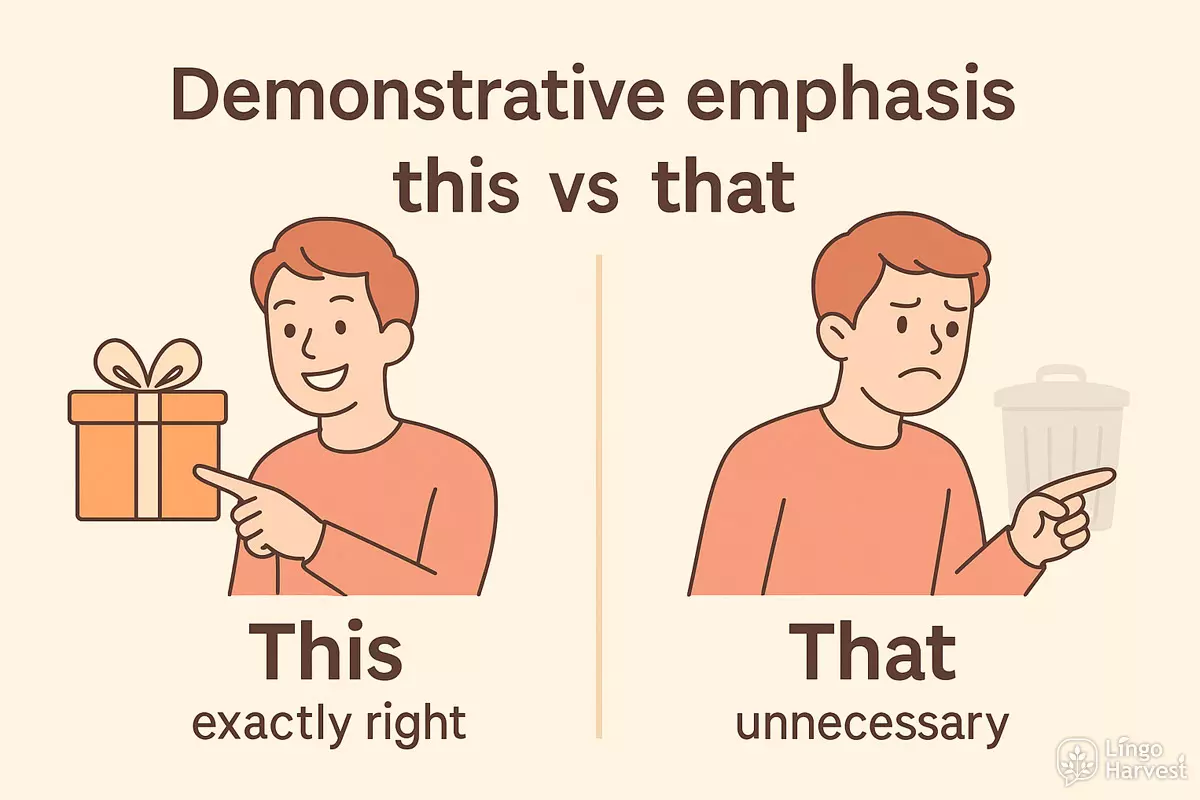
When choosing between “this” and “that,” the emotional and contextual nuance can shift. The table below illustrates some common distinctions:
| Usage Pattern | Effect on Emphasis |
|---|---|
| This (immediate, positive) | Brings the subject closer, often with positive or urgent emotion. Example: “This is exactly what I wanted!” |
| That (distanced, critical) | Signals separation, judgment, or criticism. Example: “That was unnecessary.” |
| This/That + noun (highlighting) | Draws focus to a specific item or idea. Example: “Look at this result.” |
| Repeated demonstratives | Creates rhythm, drama, or urgency. Example: “This, this, and this—all must be done!” |
Choosing the right demonstrative for impact
Selecting between “this” and “that” is more than a grammatical choice; it’s about controlling the spotlight in your sentence. “This” generally signals immediacy or approval, while “that” can introduce distance or disapproval. The deliberate use of these words can sharpen your statements, clarify your stance, and make your communication more vivid and memorable.
This vs that in discourse focus
Understanding how “this” and “that” work in emphasizing information is crucial for effective communication. Both words can highlight information, but they serve different purposes in discourse. “This” typically draws attention to something present, immediate, or newly introduced, while “that” often refers to something more distant, previously mentioned, or less connected to the speaker’s current perspective. The choice between them can subtly shift the focus or emotional impact of a statement.
How “this” shifts attention
Using “this” as an emphatic pronoun or structure brings a sense of immediacy and involvement. It can mark what’s about to be said as especially relevant or personal. For instance, in conversation, “Listen to this” prepares the listener for something important or surprising. In narratives, “this” can spotlight a key event or reaction.
- This is what I mean.
- Let me tell you this.
- This is exactly the issue we discussed.
- Try this approach next time.
- Oh, this! I almost forgot.
The role of “that” in highlighting distance or contrast
Conversely, “that” often points to something removed in time, space, or relevance. It can reference earlier points in a conversation, or underscore contrast between ideas. “That” might also be used to downplay or distance the speaker emotionally from the subject.
- Did you see that?
- That was unexpected.
- About that, I have questions.
- I can’t believe that happened.
- Is that really necessary?
Comparison of emphatic uses
| Function | Example & Discourse Effect |
|---|---|
| Immediate focus or new information | This is what matters now. ✅ Signals importance and present relevance. |
| Reference to something previously mentioned or remote | That was a surprise. → Links back to earlier content or emotional distance. |
| Personal involvement | This makes me proud. ✅ Expresses connection or ownership. |
| Contrast or evaluation | That isn’t what I meant. ❌ Highlights disagreement or correction. |
Quick tips for choosing “this” or “that”
- Use “this” for things you want to bring close—physically, emotionally, or in the flow of ideas.
- Use “that” for things you want to keep at a distance, refer back to, or contrast with current topics.
- Switch between them to subtly shift focus or signal perspective changes in conversation or writing.
Mastering these distinctions helps speakers and writers guide their audience’s attention, reinforce key points, and manage tone with nuance.
Using clefts and demonstratives together
Pairing cleft sentences with demonstrative pronouns like “this” and “that” can significantly amplify emphasis in spoken and written English. Clefts are already designed to spotlight a particular part of a sentence, but when combined with demonstratives, the result is even more striking. This approach is especially effective for clarifying, correcting, or highlighting information in conversation or argument.
How the combination works
Cleft structures (e.g., “It was John who called”) break a sentence to focus on one element. Adding a demonstrative (“That’s John who called”) draws attention and creates a pointed, immediate effect. This blend is common in both formal and informal contexts.
- That’s what I meant.
- This is where the problem starts.
- It was that movie that made me cry.
- That’s how you do it.
- It’s this part that confuses me.
- This is the reason I called.
- That’s the person I was talking about.
- It’s that decision that changed everything.
- This is what I’ve been looking for.
- That’s when I realized the truth.
- It was this song that cheered me up.
- That’s the way to solve it.
- This is who you need to speak to.
- It’s that moment that matters most.
- That’s the reason we’re here.
- This is the answer I needed.
- It was this idea that made the difference.
- That’s what you should remember.
Comparing emphasis: clefts alone vs. with demonstratives
When evaluating the strength of focus, pairing clefts with demonstratives almost always produces a sharper, more immediate effect. The table below illustrates this contrast:
| Cleft Only | Cleft + Demonstrative |
|---|---|
| It was Sarah who fixed the error. | That’s Sarah who fixed the error. |
| It is the timing that matters. | This is the timing that matters. |
| It was the food that impressed me. | That’s the food that impressed me. |
| It’s the explanation that’s confusing. | This is the explanation that’s confusing. |
| It was the rule that changed. | That’s the rule that changed. |
When to use this combination
Blending clefts and demonstratives is especially useful when you want to:
- Highlight a specific person, thing, or moment
- Clarify a previous statement
- Correct misunderstandings
- Stress cause and effect
- Draw attention during presentations or debates
Pointing to previous vs upcoming information
When we use “this” and “that” for emphasis, their job often depends on whether we’re referring back to something already mentioned, or introducing something that’s about to be explained. Recognizing which direction these words point helps clarify meaning and adds punch to your message.
Referring Back: Emphasizing What’s Already Stated
“THAT” is commonly used to highlight or reinforce something just discussed. It can sum up, judge, or add intensity to a previous statement. In emphatic structures, it draws a line under what’s come before.
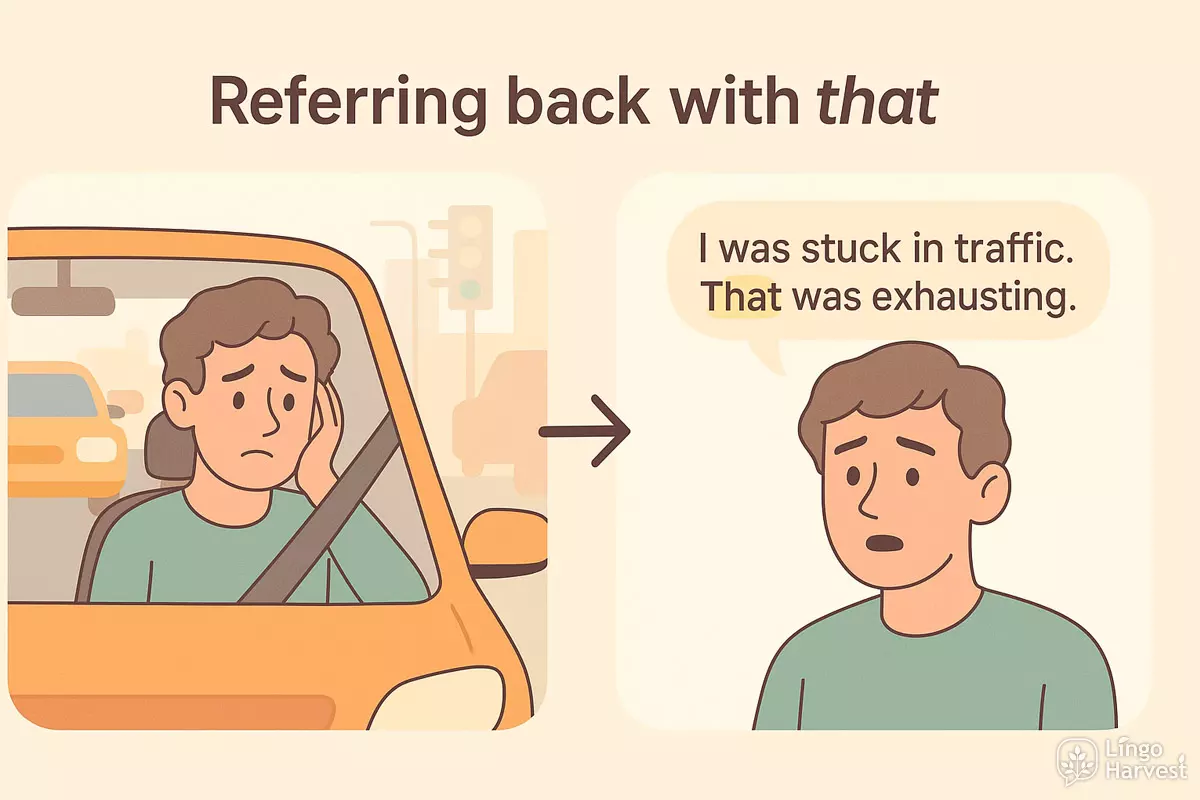
- I missed the last train home. That was frustrating!
- They canceled the project unexpectedly. That surprised everyone.
- We waited in line for three hours. That was unbelievable.
- She solved the problem in seconds. That impressed me.
- He didn’t reply to any of my messages. That worried me.
- Our flight was delayed five times. That drove people crazy.
- The presentation crashed right before the meeting. That was embarrassing.
- They forgot to include my name in the report. That annoyed me.
- I dropped my phone in the water. That was unfortunate.
- We finally solved the issue after weeks of work. That felt amazing.
Here, “that” points to a specific idea or experience just mentioned, giving it extra weight.
Introducing What Comes Next: Building Anticipation
“This” is often used to introduce new information, especially when you want the listener to pay close attention. It signals that something important is about to be revealed or explained.
- This is what I mean: consistency matters more than talent.
- This is why I called you.
- This is the problem: we never communicate.
- This is what worries me the most.
- This is how we can fix the issue.
- This is what I’ve been trying to explain.
- This is the reason the plan failed.
- This is what makes the task challenging.
- This is exactly what I was afraid of.
- This is the point we need to focus on.
By using “this,” you set up expectations and lead your audience toward your key point.
| Reference Direction | Typical Emphatic Example | Effect |
|---|---|---|
| Backward (previous info) | He lied to me. That was unacceptable. | Highlights or judges what was just stated |
| Forward (upcoming info) | This is what you need to do: stay calm. | Introduces and emphasizes new information |
| Backward (summary) | We missed the train. That was the last one today. | Summarizes or underscores a previous point |
| Forward (announcement) | This is the best part—listen closely! | Signals something important is coming |
Quick Guide: When to Use Each
- Use “that” to echo, judge, or react to what’s already been said.
- Use “this” to introduce, highlight, or set up what you’re about to say.
Understanding these patterns helps you create emphasis and clarity in your English communication, making your message stand out.
Avoiding overuse and vague reference
Using “this” and “that” for emphasis can be powerful, but it’s easy to fall into the trap of relying on them too frequently or without clear reference. When these pronouns are used without specifying what they point to, readers may struggle to follow your meaning. To keep your writing crisp, always make sure the noun or idea being emphasized is unmistakable.
Clarity before impact
Begin by asking yourself: What exactly does “this” or “that” refer to? If it’s not crystal clear from the previous sentence, restate or clarify. Ambiguity weakens the force of your statement, and frequent repetition of these words can make your writing feel lazy or imprecise.
- After a complex idea: Summarize before using “this.”
- In long paragraphs: Repeat the noun to refresh the reference.
- With multiple possible subjects: Specify (“this issue,” “that solution”).
- When shifting topics: Avoid using a bare pronoun as a transition.
Common pitfalls to avoid
Writers sometimes use “this” or “that” as a shortcut, especially in drafts. Here are some patterns where problems arise:
- “This shows…” — What shows? Specify the idea or fact.
- “That is why…” — Make the cause explicit, not just implied.
- “This is important.” — Clarify what “this” refers to for extra impact.
- Long chains of ideas followed by “this” or “that” — The reference gets lost.
- Stacking emphatic pronouns: “This, this, and that…” — Overkill and confusion.
Strategies for precision
A few practical guidelines can help keep your emphasis sharp and your references clear:
- Pair “this” and “that” with a noun: “this question,” “that proposal.”
- Limit use: Not every sentence needs emphasis; use for real impact.
- Revise for variety: Alternate with direct nouns and synonyms.
- Read aloud: If the reference is unclear when spoken, rewrite.
- Ask a peer: If they are unsure what “this” means, clarify.
- Check paragraph transitions: Avoid starting with an ambiguous “This.”
- Avoid filler: Don’t use “this” or “that” as placeholders for weak ideas.
- Use context: Make sure the referent appears close to the pronoun.
- Be intentional: Each instance should add meaning, not clutter.
- Balance: Mix emphatic structures with direct statements for rhythm.
Examples: Effective vs. ineffective reference
| ✅ Clear Reference | ❌ Vague Reference |
|---|---|
| “This solution addresses the root cause.” | “This addresses the problem.” |
| “That argument overlooks key evidence.” | “That is wrong.” |
| “This data supports our hypothesis.” | “This supports it.” |
| “That behavior is unacceptable in the workplace.” | “That is unacceptable.” |
| “This approach reduces costs and increases efficiency.” | “This helps.” |
By ensuring each pronoun has a clear, specific referent, your emphatic structures gain both strength and precision. Thoughtful use of “this” and “that” signals confidence and clarity, making your writing more persuasive and easier to follow.
Practice: rewrite texts using emphatic this/that
Want to make your writing more impactful? Using “this” and “that” for emphasis can sharpen your point, highlight contrast, or draw attention to a key idea. In the exercises below, you’ll practice rewriting sentences to achieve a stronger effect with these emphatic structures.
Rewriting for Emphasis
Try to transform each sentence so it uses “this” or “that” for extra force, as in speech or dramatic writing. Sometimes it’s about highlighting an event, sometimes it’s about expressing strong feelings.
- The weather was unusually cold for April.
- Her generosity surprised everyone in the office.
- He finally finished the marathon after years of training.
- The company’s new policy confused the employees.
- You forgot to lock the door last night.
- She aced the exam without any help.
- We waited in line for three hours to get tickets.
- They announced the winner just before midnight.
- The children made a mess in the kitchen.
- He quit his job on the spot.
Show answers
- This was weather unusually cold for April!
- That was generosity that surprised everyone in the office.
- This is what finishing a marathon after years of training looks like.
- That new policy really confused the employees.
- This is what happens when you forget to lock the door at night.
- That was her acing the exam without any help.
- Those three hours we waited in line for tickets—unbelievable!
- This was how they announced the winner: just before midnight.
- That mess in the kitchen—thanks to the children.
- This was him quitting his job on the spot.
Common Patterns with Emphatic “This” and “That”
Here are some sentence patterns and phrases that use these pronouns for emphasis. Use these templates to rewrite or enhance your own sentences.
- This is what I call [noun/phrase].
- That was [adjective/noun]!
- This is how [event/action] happens.
- Now this/that is [adjective].
- This right here is [noun/quality].
- That was the moment when [event].
- This is exactly why [result].
- That is what I’m talking about!
- So this is what you meant.
- That was something else.
- And that is how it’s done.
- This was the last straw.
Quick Transformation Challenge
Try to recast these plain sentences using one of the patterns above for dramatic or emotional effect:
- He finally apologized after all these years.
- The cake you baked was delicious.
- They lost the match in the final minute.
- The dog chewed up my favorite shoes.
- She finished the entire project in one night.
- They canceled the trip at the last moment.
- The children cleaned the whole house themselves.
- He forgot to save the document and lost all his work.
- She won the award on her very first attempt.
- Someone parked in my private spot again.
Show answers
- Now this is what I call a long-awaited apology.
- That was a delicious cake you baked!
- This is what losing in the final minute feels like.
- That dog — chewing up my favorite shoes!
- This is what pulling an all-nighter looks like.
- That is what last-minute cancellation feels like.
- This is what I call dedication.
- That is why you always save your work.
- This is how winning on the first try feels.
- That again — someone taking my spot!
By practicing these transformations, you’ll become more skilled at using “this” and “that” to create emphasis and highlight important moments in your writing and speech.