Complex Passives: Modals, Perfect Forms, and Multi-Layered Passives

 Here we advanced passive voice forms in English, such as passive with modals, perfect and continuous passive combinations, and layered passives in reporting. It also guides on choosing between active and complex passive forms and provides practice exercises.
Delving into passive constructions that involve auxiliary verbs and complex verb forms highlights the remarkable flexibility and subtlety of English grammar. Mastering these advanced structures can be challenging for both learners and experienced speakers, as they require a strong understanding of verb agreement, tense, and sentence structure. Developing proficiency in using such grammatical forms not only enhances clarity and precision in communication but also deepens one’s appreciation for the intricacies of the English language.
Overview of passive voice variations
Passive constructions in English extend well beyond the basic "be + past participle" form. Writers and speakers use several more complex passive patterns, especially in formal, academic, or technical language. These advanced forms include modals in the passive, perfect passives, and even combinations that layer multiple auxiliary verbs or passives together. Understanding these structures enables more nuanced expression, particularly when the agent is unknown, irrelevant, or intentionally omitted.
Types of Complex Passives
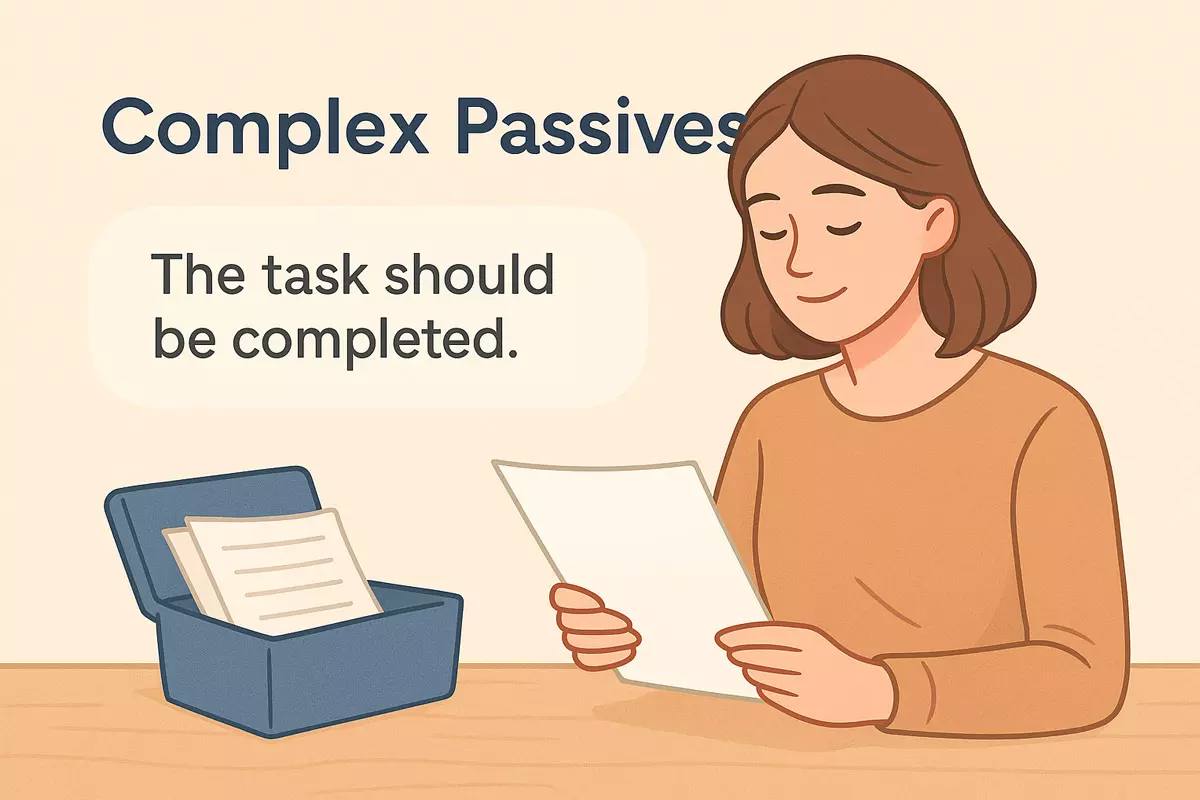
- Modal passives: Combine a modal verb (like can, must, should) with the passive. Example: The task should be completed.
- Perfect passives: Use the perfect aspect in the passive voice, often with have been + past participle. Example: The results have been analyzed.
- Multi-layered passives: Stack passive structures, especially in reported speech or causative constructions. Example: He was said to have been promoted.
- Get-passives: Use get instead of be for a more informal or agent-focused tone. Example: She got hired last week.
- Passive with infinitives: Common in formal writing and reporting. Example: The project is expected to be finished soon.
- Stative passives: Indicate a state rather than an action. Example: The door is locked.
- Impersonal passives: Often found with reporting verbs. Example: It is believed that...
- Double passives: Rare, but possible in some causative or reporting sentences. Example: The report was made to be filed by the secretary.
- Prepositional passives: The object of a preposition becomes the subject. Example: The bed has been slept in.
- Passive with question forms: For example, Has the application been submitted?
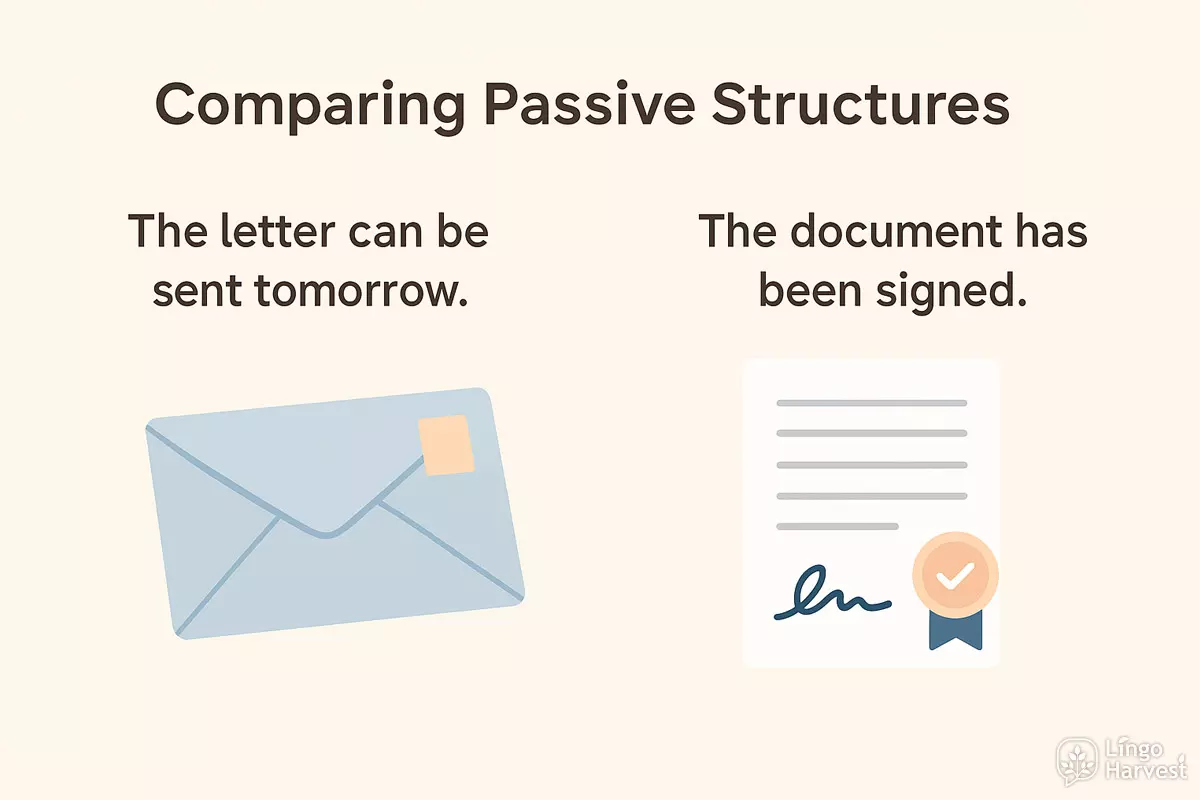
Comparing Passive Structures
| Structure | Example |
|---|---|
| Modal Passive | The letter can be sent tomorrow. |
| Perfect Passive | The document has been signed. |
| Modal + Perfect Passive | The work should have been finished by now. |
| Multi-layered Passive | She was reported to have been seen at the event. |
| Get-Passive | He got promoted last year. |
Key Functions and Usage Notes
These advanced passive forms allow for flexibility in focus, especially when the agent is unknown, unimportant, or deliberately omitted. Modal passives express possibility, necessity, or obligation. Perfect passives highlight completed actions. Multi-layered passives, though less common in everyday conversation, frequently appear in formal registers and academic writing, often to report information without direct attribution.
Mastering these variations helps writers and speakers achieve a more sophisticated and precise style, especially in contexts where the passive voice is preferred for clarity or objectivity.
Passive with modals: should be done, might be seen
Modal verbs like should, might, must, and can combine with passive forms to express necessity, possibility, obligation, or permission concerning actions received by the subject. Instead of focusing on the agent, these constructions highlight what is possible, necessary, or allowed to happen to someone or something. The structure is typically: modal + be + past participle (e.g., should be done, can be finished).
How modal verbs work with the passive voice
In these constructions, the modal verb remains unchanged, while the main verb shifts into the passive form. This allows speakers to discuss actions or events where the performer is unknown, unimportant, or obvious. For example, The rules must be followed emphasizes the necessity of following, rather than who follows.
- should be done – It is necessary for something to happen. (The work should be done by noon.)
- can be seen – There is a possibility for something to be observed. (This painting can be seen in the gallery.)
- must be completed – Obligation that something is finished. (All forms must be completed before entry.)
- may be chosen – Possibility that something will be selected. (A new leader may be chosen soon.)
- might be heard – Uncertainty about whether something will be heard. (His voice might be heard in the hall.)
- could be misunderstood – Possibility of being misunderstood. (The instructions could be misunderstood.)
- will be announced – Future passive event. (The results will be announced tomorrow.)
- would be accepted – Hypothetical acceptance. (Your application would be accepted if complete.)
- should not be ignored – Advice against ignoring. (These warnings should not be ignored.)
- cannot be repaired – Impossibility. (This device cannot be repaired.)
- must not be opened – Prohibition. (The box must not be opened.)
- might not be needed – Uncertainty of necessity. (Extra materials might not be needed.)
- can’t be solved – Impossibility. (This problem can’t be solved easily.)
- may not be delivered – Possible non-delivery. (The package may not be delivered on time.)
- should be explained – Recommendation. (The rules should be explained clearly.)
- could be found – Potential to be found. (The answer could be found online.)
- wouldn’t be noticed – Hypothetical scenario. (The change wouldn’t be noticed by most.)
- must be remembered – Obligation to remember. (Deadlines must be remembered.)
- may be asked – Possible request. (You may be asked for ID.)
- should be avoided – Recommendation to avoid. (Such mistakes should be avoided.)
Forming passives with modals: quick reference
| Active (with modal) | Passive (with modal) |
|---|---|
| People can see the comet. | The comet can be seen (by people). |
| They should finish the project. | The project should be finished (by them). |
| Someone might discover a solution. | A solution might be discovered (by someone). |
| We must follow the rules. | The rules must be followed (by us). |
Using modals in the passive voice allows for more flexible, impersonal, or diplomatic statements. It’s especially common in formal writing, instructions, and situations where the agent is unknown or less important than the action itself.
Perfect and continuous passive combinations
Understanding how the passive voice interacts with perfect and continuous forms is essential for mastering complex English sentences. These structures allow speakers and writers to convey nuanced meanings involving time, aspect, and agency, often layering different grammatical features within a single verb phrase.
How passive combines with perfect and continuous aspects
The passive voice can be merged with both perfect and continuous (progressive) aspects, creating forms such as “has been done” or “is being prepared.” When these are combined, we get sequences like “has been being done,” which are rare but grammatically valid. Each element adds a layer: the perfect aspect (“have/has/had”) emphasizes completion or relevance to the present/past, while the continuous aspect (“being”) signals ongoing action.
Common patterns and their uses
Writers and speakers often use these combinations to focus on processes or results, especially when the agent (the doer) is unknown or unimportant. Here are core patterns and typical contexts:
- Present perfect passive: has/have been + past participle
e.g., The documents have been signed. - Past perfect passive: had been + past participle
e.g., The cake had been eaten before we arrived. - Present continuous passive: am/is/are being + past participle
e.g., The room is being cleaned. - Past continuous passive: was/were being + past participle
e.g., The car was being repaired yesterday. - Present perfect continuous passive: has/have been being + past participle
e.g., The house has been being renovated for months. (rare) - Past perfect continuous passive: had been being + past participle
e.g., The problem had been being discussed for hours. (rare) - Future perfect passive: will have been + past participle
e.g., The work will have been completed by Friday. - Modal + perfect passive: modal + have been + past participle
e.g., The package could have been lost. - Modal + continuous passive: modal + be being + past participle
e.g., The issue may be being addressed. (uncommon) - Modal + perfect continuous passive: modal + have been being + past participle
e.g., The case might have been being investigated. (extremely rare)
Comparison of passive combinations
To clarify how these forms differ and how they are built, here’s a summary table:
| Form | Example |
|---|---|
| Present perfect passive | The letters have been sent. |
| Past continuous passive | The bridge was being inspected. |
| Future perfect passive | The building will have been finished. |
| Present perfect continuous passive | The room has been being painted. |
| Modal + perfect passive | The results could have been announced. |
Usage tips and cautions
Some of these combined forms, especially those involving both perfect and continuous aspects in the passive (like “has been being built”), are grammatically correct but rarely used in everyday English. They can sound awkward or overly complex. Prefer simpler structures when possible, unless clarity or emphasis truly requires these layers.
Summary
Layering passive voice with perfect and continuous aspects enables speakers to express subtle distinctions about when something happened, how long it lasted, and whether the focus is on process or result. Mastery of these combinations can help produce more precise and sophisticated sentences, especially in formal or academic writing.
Layered passives with reporting structures
Sentences that combine passive voice with reporting verbs create intricate grammatical layers. These constructions often appear in academic, journalistic, or formal writing when the agent is unknown, unimportant, or intentionally omitted. By embedding a reporting structure inside a passive form, English allows for nuanced expression of hearsay, beliefs, or generalizations.
How these structures work
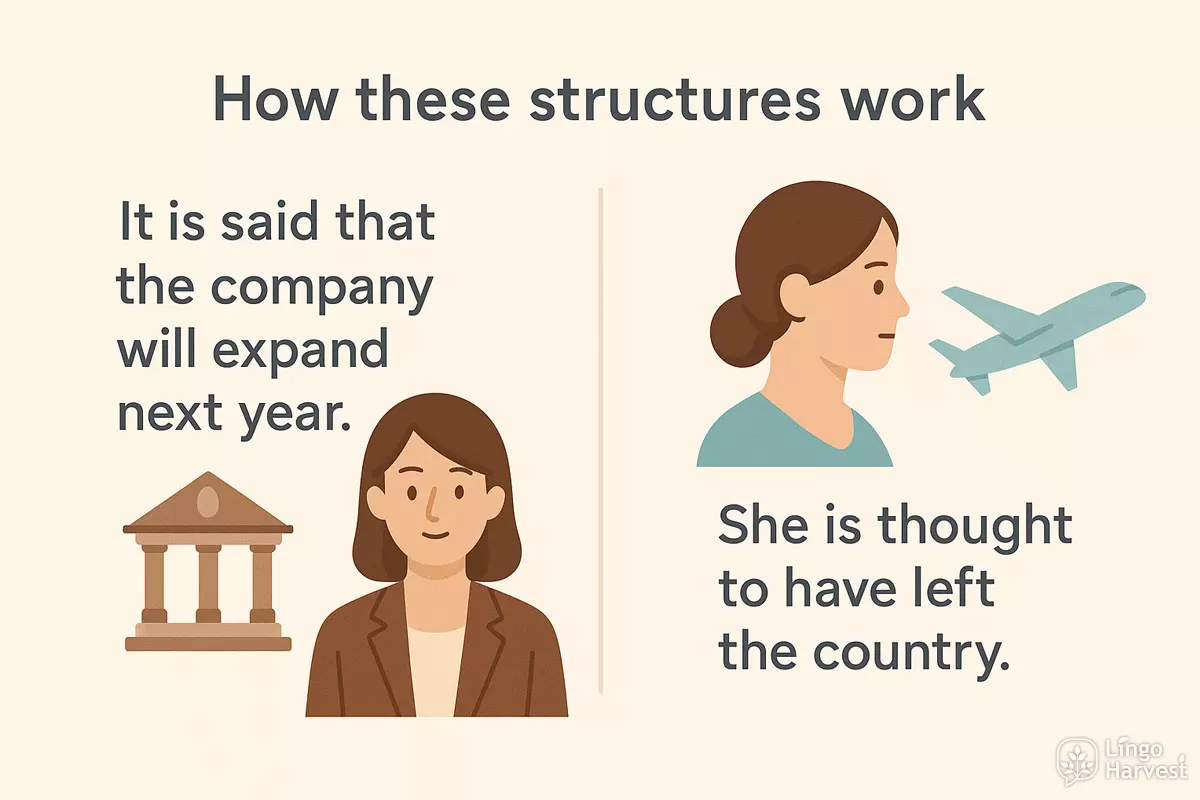
At their core, these sentences use a reporting verb (such as "say," "think," "believe," "report") followed by a clause. Instead of a direct statement, the reporting verb itself is placed into the passive, and then followed by an infinitive or that-clause. This produces a "double passive" or layered effect, distancing the information from a specific source.
- "It is said that the company will expand next year."
- "She is thought to have left the country."
- "The new policy is believed to be effective."
- "He is reported to have broken the record."
- "The project is expected to finish early."
- "They are rumored to be moving abroad."
- "The suspect is understood to have confessed."
- "This painting is considered to be a masterpiece."
- "The results are known to be accurate."
- "The team is supposed to win easily."
- "The book is said to have been written in one month."
- "The event is reported to have attracted thousands."
- "She is believed to be living in Paris."
- "The negotiations are thought to have failed."
- "He is presumed to be innocent."
- "The species is known to inhabit this region."
- "The decision is expected to be announced soon."
- "The law is considered to be outdated."
Patterns and variations
There are two main patterns for these constructions:
- It + passive reporting verb + that-clause: "It is believed that..."
- Subject + passive reporting verb + to-infinitive: "The president is expected to..."
The choice depends on the subject’s prominence and sentence focus.
| Pattern | Example |
|---|---|
| It + passive reporting verb + that-clause | It is rumored that the artist will attend. |
| Subject + passive reporting verb + to-infinitive | The artist is rumored to attend. |
| Subject + passive reporting verb + perfect infinitive | The artist is rumored to have attended. |
| Present vs. past meaning | The artist is rumored to attend (present); is rumored to have attended (past). |
| Modal + be + past participle + reporting verb | The artist might be said to inspire others. |
Why writers use these forms
Writers often select these syntactic layers for objectivity, impersonal tone, or to avoid specifying sources. They also help emphasize the reported information rather than the person reporting it. This can be particularly effective in scientific, news, or official contexts where neutrality is valued. In summary, these multi-layered passives with reporting verbs allow for subtlety and flexibility, making them a key advanced feature of formal English expression.
Choosing between active and complex passive forms
Deciding whether to use an active construction or a complex passive depends on more than just grammar rules—it’s about clarity, focus, and the information you want to highlight. Complex passives, especially those with modals or perfect forms, serve particular functions in English. They often shift emphasis away from the agent (the doer) and onto the action or its recipient. This can be especially useful in academic, scientific, or formal writing, where the actor is unknown, irrelevant, or less important than the process or result.
When is the active voice preferable?
The active form is usually clearer and more direct. Use it when:
- The agent (doer) is important or needs emphasis.
- You want concise, straightforward sentences.
- The sentence risks becoming overly complicated or wordy in the passive.
- The context is informal or conversational.
Why opt for complex passives?
Complex passives are chosen for reasons such as:
- Focusing on the action or the recipient rather than the agent.
- Hiding the agent when unknown or unnecessary (“The documents must have been sent.”).
- Adding formality or objectivity, especially in reports or research (“The experiment is believed to have been conducted correctly.”).
- Creating distance or politeness (“Mistakes appear to have been made.”).
| Active Form | Complex Passive Equivalent |
|---|---|
| People say he lied. | He is said to have lied. |
| They must finish the work. | The work must be finished. |
| The company will announce results. | Results will be announced (by the company). |
| Someone should have told you. | You should have been told. |
| They are going to review the policy. | The policy is going to be reviewed. |
| The manager might have overlooked this. | This might have been overlooked (by the manager). |
| People believe she left early. | She is believed to have left early. |
| They had completed the task. | The task had been completed. |
| Someone can solve the problem. | The problem can be solved. |
| Experts are expected to find a solution. | A solution is expected to be found (by experts). |
Tips for making the right choice
Consider the following before transforming an active idea into a complex passive:
- Audience: Is your reader likely to prefer directness or formality?
- Agent relevance: If the doer matters, avoid hiding them behind a passive.
- Sentence length: Complex passives can make sentences longer and harder to follow.
- Focus: Decide if the action or the recipient is more important to highlight.
Making the appropriate selection between these forms helps your writing stay clear, purposeful, and suited to its context.
Practice: transform active sentences into complex passives
Working with complex passives can be challenging, especially when modals, perfect forms, or multiple passive layers are involved. To build confidence with these structures, practice is essential. Below you'll find a variety of active sentences. Your task is to rewrite each as a complex passive, paying attention to correct word order and auxiliary verbs.
Transform the following active sentences:
- People say that the company will launch a new product soon.
- Experts believe that she may have completed the project already.
- They expected the committee to have finished the report by now.
- We know that someone is repairing the road.
- Analysts estimated that the market could grow by 10% this year.
- People thought that the artist had painted the mural last month.
- They reported that the scientists might discover a new element.
- Journalists claim that the team has solved the mystery.
- Many assume that the manager will announce the changes tomorrow.
- Officials observed that the engineers were testing the equipment.
- They believe that someone has stolen the documents.
- The board expects that the CEO will resign soon.
- They suppose that the guests have left the hotel.
- People allege that the politician accepted the bribe.
- They consider that the process might have failed.
- It is said that the chef invented a new recipe.
- They thought that the player would break the record.
- People believe that the author is writing a sequel.
- They expect that the weather will improve next week.
- Analysts suggest that the company could have avoided the loss.
Show answers
- The company is said to be launching a new product soon. / It is said that the company will launch a new product soon.
- She is believed to have completed the project already.
- The committee was expected to have finished the report by now.
- The road is known to be being repaired.
- The market was estimated to be able to grow by 10% this year.
- The mural was thought to have been painted by the artist last month.
- A new element was reported to might be discovered by the scientists. / The scientists were reported to might discover a new element.
- The mystery is claimed to have been solved by the team.
- The changes are assumed to be announced by the manager tomorrow.
- The equipment was observed to be being tested by the engineers.
- The documents are believed to have been stolen.
- The CEO is expected to resign soon.
- The guests are supposed to have left the hotel.
- The politician is alleged to have accepted the bribe.
- The process is considered to might have failed.
- A new recipe is said to have been invented by the chef.
- The record was thought to be broken by the player.
- A sequel is believed to be being written by the author.
- The weather is expected to improve next week.
- The loss is suggested to could have been avoided by the company.
Patterns for forming complex passives
Some complex passives follow common patterns, especially with reporting verbs and modals. Here are useful structures to keep in mind:
- It + is/was + said/believed/thought + that + clause → Subject + is/was + said/believed/thought + to-infinitive
- Present perfect active (has/have + past participle) → has/have + been + past participle
- Modal verbs (can, may, might, should, etc.) + have + past participle → modal + have + been + past participle
- Continuous forms (is/are + -ing) → is/are + being + past participle
- Multi-layered passives: Passive reporting verb + passive main verb (e.g., "He is known to have been awarded the prize.")
Comparison of active and complex passive forms
| Active Sentence | Complex Passive Transformation |
|---|---|
| People say that the company will launch a new product soon. | The company is said to be launching a new product soon. It is said that the company will launch a new product soon. |
| Experts believe that she may have completed the project already. | She is believed to have completed the project already. |
| They expected the committee to have finished the report by now. | The committee was expected to have finished the report by now. |
| We know that someone is repairing the road. | The road is known to be being repaired. |
| Analysts estimated that the market could grow by 10% this year. | The market was estimated to be able to grow by 10% this year. |
Try transforming the remaining sentences using the patterns and examples above. Pay attention to tense, aspect, and modal verbs as you create the passive equivalents.