Advanced Conditional Alternatives: Supposing, Providing, If So / If Not

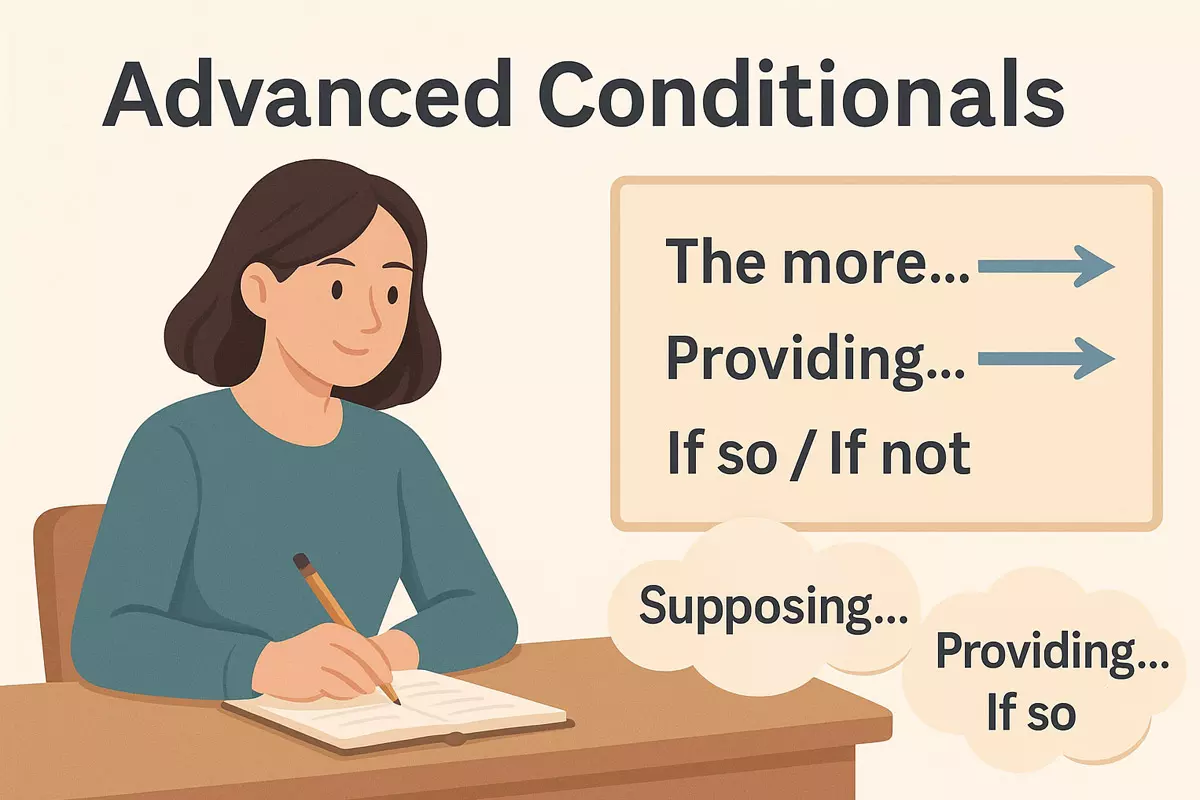 Here we advanced ways to express conditions in English, such as using supposing, provided, and providing. It also covers if so and if not, differences in formality, and how to rewrite basic conditionals using these alternatives.
Exploring nuanced ways to express hypothetical situations can enhance both the subtlety and precision of your communication. This article examines advanced structures such as supposing, providing, and similar phrases, illustrating how these expressions can enrich complex statements by introducing conditional meanings and allowing for greater flexibility. By mastering these forms, you can convey possibilities, suggestions, or alternative outcomes more effectively, ultimately making your language both clearer and more engaging.
Beyond if: alternative conditional markers
Exploring English conditionals reveals a wide range of expressions that go far beyond the simple use of "if." These alternative markers help speakers sound more natural, express nuances, and add variety to both spoken and written language. Mastering them allows for subtler, more precise meanings in hypothetical and real situations.
Common alternatives to "if"
Several words and phrases can introduce conditions, each with its own flavor or level of formality. Here are some widely used alternatives:
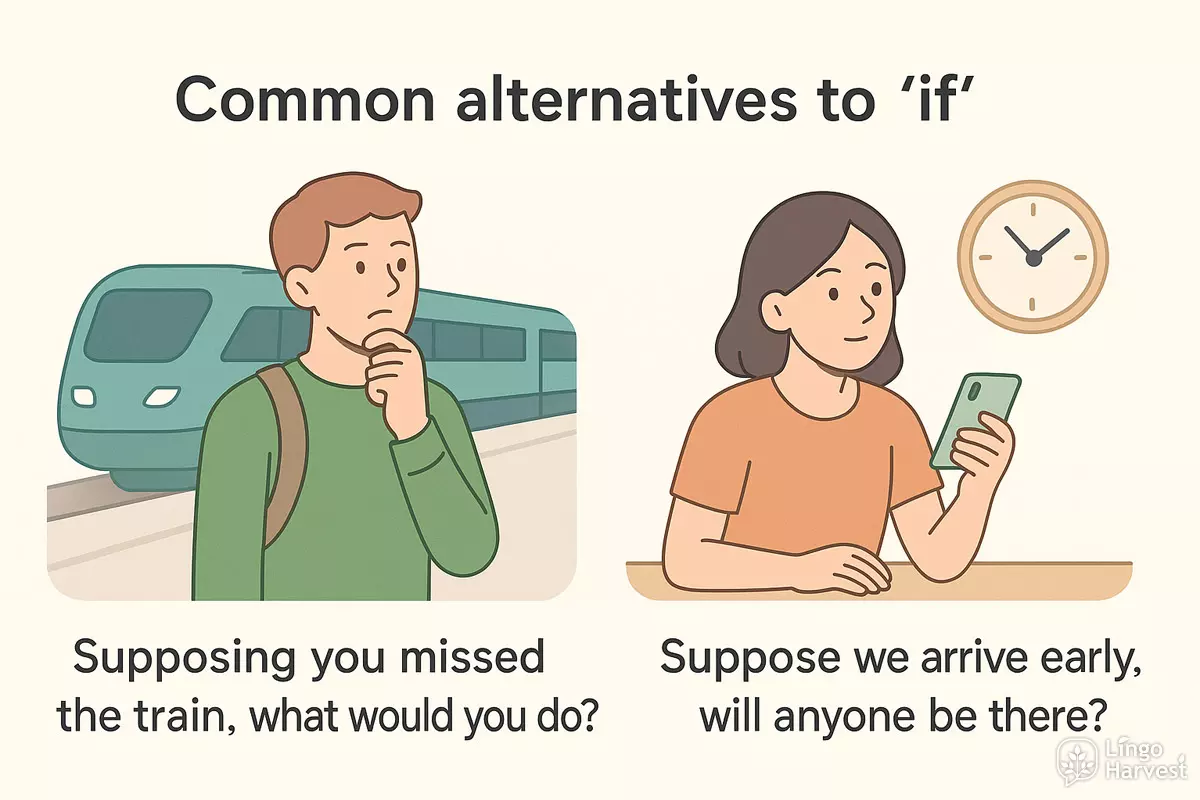
- Supposing you missed the train, what would you do?
- Suppose we arrive early, will anyone be there?
- Provided (that) you finish your work, you can leave early.
- Providing (that) the weather is good, we’ll go hiking.
- As long as you pay attention, you’ll understand.
- On condition that everyone agrees, we’ll proceed.
- Unless you call, I’ll assume you’re not coming.
- In case you need help, call me.
- Even if it rains, the match will go on.
- Only if you apologize will I forgive you.
- Whether or not you like it, the rules apply.
Using "if so" and "if not"
These phrases are often used for concise reference to previous conditions, especially in conversations or instructions. Instead of repeating the full condition, "if so" means "if that is the case," while "if not" refers to the opposite.
- Will you be joining us? If so, let me know by Friday.
- Have you finished the report? If not, please update me on your progress.
Comparing conditional markers
The choice between markers can subtly alter the meaning or tone of a sentence. Here’s a structured overview of some alternatives and their typical uses:
| Marker | Meaning / Usage |
|---|---|
| Supposing / Suppose | Imagines a situation, often informally; similar to "if." |
| Provided (that) / Providing (that) | States a requirement that must be met for something to happen; more formal. |
| As long as | Emphasizes duration or ongoing condition; less formal. |
| Unless | Expresses a negative condition ("if not"). |
| In case | Indicates doing something as a precaution, not a direct condition. |
| Even if | Highlights that the result will be the same, whatever the condition. |
Tips for choosing the right marker
- Use supposing or suppose for hypothetical scenarios or when brainstorming.
- Choose provided (that) for formal writing or when setting strict requirements.
- As long as works well for casual speech and ongoing conditions.
- Unless is handy for stating exceptions or negatives.
- Apply if so / if not to avoid repetition and keep communication clear.
Experimenting with these conditional markers helps communicate with greater subtlety and precision, enriching both understanding and expression.
Patterns with supposing, provided, providing
When exploring advanced ways to express conditions, "supposing," "provided," and "providing" offer nuanced alternatives to the traditional "if." Each brings its own register and subtle meaning, allowing speakers and writers to add variety and precision to conditional statements.
How Each Term Functions in Conditional Sentences
"Supposing" introduces a hypothetical situation, often inviting the listener to imagine a scenario. "Provided" and "providing" both mean "on the condition that," but "provided" is more formal. "Providing" is slightly less formal and common in spoken English.
- Supposing you missed the train, what would you do?
- Provided he agrees, we can start the project tomorrow.
- Providing you finish the assignment, you may leave early.
- Supposing it rains, shall we cancel the picnic?
- Provided that all documents are complete, the visa will be issued.
- Providing that the weather holds, we’ll go hiking.
- Supposing they don’t answer, what’s our backup plan?
- Provided you pay in advance, you’ll get a discount.
- Providing everyone arrives on time, we can begin promptly.
- Supposing nobody objects, let’s proceed as planned.
- Provided that you return it by Friday, you may borrow the book.
- Providing that there are no delays, the delivery should arrive today.
Comparing Usage: Register and Flexibility
The following table summarizes the differences in formality, typical contexts, and example patterns for each conditional alternative:
| Expression | Register | Typical Context | Example Pattern |
|---|---|---|---|
| Supposing | Neutral, slightly informal | Hypothetical or imaginative | Supposing + subject + verb, … |
| Provided (that) | Formal | Official, written, rules, contracts | Provided (that) + subject + verb, … |
| Providing (that) | Neutral, less formal | Everyday speech, informal writing | Providing (that) + subject + verb, … |
Usage Tips
- Use "supposing" for open-ended, imaginative scenarios.
- Choose "provided" when you want to sound precise or are making formal agreements.
- "Providing" works well in casual conversation or less formal writing.
- Both "provided" and "providing" can often be followed by "that," but "that" is optional in speech.
These alternatives enrich conditional statements, letting you tailor your language to different audiences and contexts.
Follow-up references with if so and if not
Understanding how to continue a line of reasoning or clarify outcomes often relies on precise follow-up language. The phrases if so and if not are excellent tools for referencing previous conditions without repeating entire clauses. This makes writing and conversation more concise and clear, especially in complex or technical contexts.
How "if so" and "if not" function in context
These expressions act as shorthand responses, allowing speakers or writers to refer back to a conditional statement efficiently. Instead of restating the original scenario, you can simply say “if so” (meaning “if that is the case”) or “if not” (meaning “if that isn’t the case”). This technique is particularly helpful after conditional alternatives like “supposing” or “providing.”
Common usage patterns
You’ll often see these follow-ups in explanations, instructions, or discussions where multiple outcomes are possible. Here are some typical examples and structures:
- “Supposing he arrives early. If so, we’ll begin the meeting at 9.”
- “Providing the test passes, the feature will launch. If not, we’ll make adjustments.”
- “If you finish the report today, let me know. If not, please update me tomorrow.”
- “Check if the file exists. If so, proceed to the next step.”
- “The instructions might be outdated. If so, contact support.”
- “The weather may turn bad. If so, the event will move indoors.”
- “Supposing your application is successful. If not, you can reapply next year.”
- “If the answer is yes, continue. If not, review previous steps.”
- “If the payment has been received, the order will ship. If not, you’ll get a reminder.”
- “Providing the data is valid, we’ll publish the results. If not, further checks are required.”
- “If so, proceed as planned. If not, notify your supervisor.”
- “Should you have any questions, let us know. If not, you may close the ticket.”
- “Supposing the proposal is accepted. If so, we’ll need to prepare a contract.”
- “If so, congratulations! If not, don’t worry—there are alternatives.”
Advantages of using "if so" and "if not"
Using these referential phrases streamlines communication, especially when dealing with multiple branches in logic or outcomes. They help avoid redundancy, maintain flow, and make texts easier to follow. This is particularly valuable in technical documentation, business communication, and academic writing.
Comparison of extended patterns
Sometimes, nuanced alternatives appear alongside these expressions. Here is a comparison of common forms and their typical uses:
| Pattern | Usage Example |
|---|---|
| If so | “Is the equipment calibrated? If so, start the test.” |
| If not | “If not, please recalibrate before proceeding.” |
| Otherwise | “Submit the form by Friday. Otherwise, your application will be delayed.” |
| In that case | “Supposing you qualify. In that case, you’ll receive an email.” |
| Failing that | “Provide documentation. Failing that, your claim cannot be processed.” |
When to avoid overuse
While these follow-up references are efficient, overusing them can make writing mechanical. It’s best to alternate with other cohesive devices or rephrase when clarity requires. Carefully balancing these expressions enhances readability and ensures logical flow.
Formality and conversational differences
When choosing between advanced conditional alternatives like "supposing," "providing," "if so," and "if not," speakers naturally shift tone depending on the context. Some expressions tend to appear in formal writing or official speech, while others are more at home in everyday conversation or casual dialogue.
Formal vs. informal usage
"Supposing" and "providing" often signal a more thoughtful or precise approach, with "providing" (or "provided that") typically reserved for legal, academic, or policy statements. In contrast, "if so" and "if not" are straightforward and frequently used in both spoken and written communication, including emails and informal discussions.
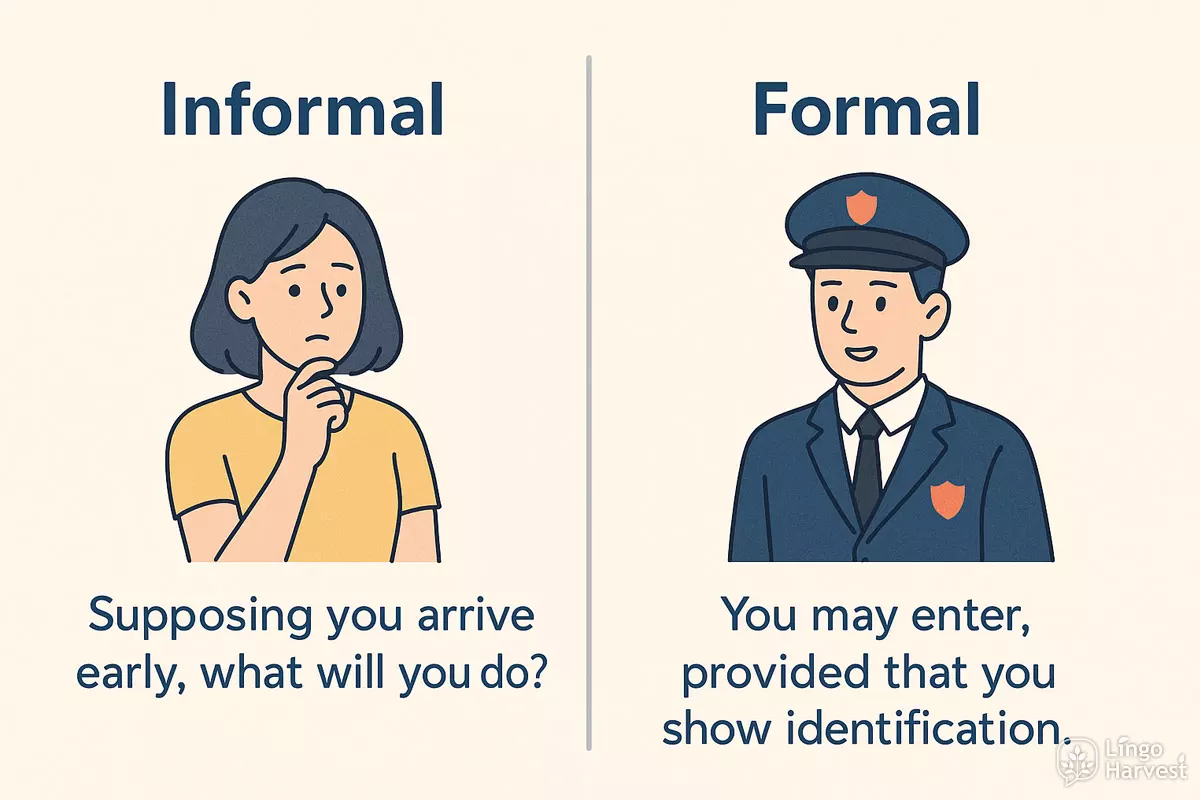
- "Supposing": Slightly formal, often used to introduce hypothetical scenarios. ("Supposing you arrive early, what will you do?")
- "Providing" / "Provided that": Formal, common in contracts and regulations. ("You may enter, provided that you show identification.")
- "If so": Neutral, clear, and common in both written and spoken English. ("Will you attend? If so, let us know.")
- "If not": Similarly neutral, used in clarifying consequences or alternatives. ("Is it raining? If not, we can go for a walk.")
- "Assuming (that)": Used in both formal and informal contexts, often to introduce a premise. ("Assuming you agree, we’ll proceed.")
- "In case": Slightly informal, anticipates possible situations. ("Take an umbrella in case it rains.")
- "Unless": Neutral, expresses exception. ("You can’t enter unless you’re a member.")
- "Imagine (that)": Informal, often in conversation or storytelling. ("Imagine you win the lottery—what then?")
- "On condition that": Formal, used in rules and agreements. ("You may borrow the car on condition that you return it by six.")
- "Even if": Neutral, emphasizes contrast or unexpected outcomes. ("Even if it rains, we’ll go outside.")
Shifts in tone and clarity
Choosing the right conditional phrase can subtly change the perceived politeness, authority, or directness of a statement. "Supposing" or "on condition that" can soften a demand or suggestion, while "if so / if not" keeps things concise and to the point. In presentations or negotiations, opting for more formal alternatives can signal seriousness or professionalism.
Summary comparison
| Expression | Typical Context | Formality | Example |
|---|---|---|---|
| Supposing | Hypotheticals, polite inquiry | Moderately formal | Supposing he calls, what should I say? |
| Providing / Provided that | Legal, academic, official rules | Formal | You may leave early, provided that you finish your work. |
| If so / If not | Emails, instructions, spoken English | Neutral | Is the meeting at 2? If so, I’ll join online. |
| Imagine (that) | Stories, informal dialogue | Informal | Imagine you’re the boss—what would you change? |
Overall, understanding these distinctions helps speakers and writers match their language to the situation—whether aiming for informality and ease or precision and formality.
Combining advanced alternatives in extended texts
Writers often need to integrate multiple conditional expressions—such as "supposing," "providing," and "if so / if not"—within longer passages for clarity and nuance. Using these structures thoughtfully can help to present layered arguments, show hypothetical reasoning, or clarify dependencies between events or ideas.
Using advanced conditional forms for clarity
When constructing extended arguments or narratives, combining different conditional alternatives can help avoid repetition and enhance readability. For example, instead of repeating "if" repeatedly, you might alternate with "supposing" or "providing that" to keep the text engaging and precise.
- Supposing we finish early, we could review the results.
- Providing the weather holds, the event will proceed outdoors.
- If so, we should notify the participants immediately.
- If not, the plan will need to be revised.
- Assuming you agree, we can move forward.
- On the condition that all criteria are met, approval is granted.
- Presuming resources are available, expansion is possible.
- In the event that funding is secured, construction will begin.
- Given that everyone participates, the results will be more reliable.
- Unless otherwise stated, the deadline remains unchanged.
- Should any issues arise, report them promptly.
- In case of delays, inform the team leader.
- Provided the test succeeds, further trials will be scheduled.
- Suppose the proposal fails—what then?
- Only if the system passes inspection will it be deployed.
- Even if costs increase, the project must continue.
- As long as support continues, progress is assured.
- Whether or not approval is granted, preparations continue.
Comparing conditional alternatives in context
In extended writing, choosing the right alternative depends on the relationship between the ideas being linked. Some forms emphasize a condition as likely or routine, while others suggest uncertainty or exception. Notice how each structure can subtly shift the meaning or emphasis:
| Conditional Form | Example in Extended Context |
|---|---|
| Supposing | Supposing the shipment arrives on time, we can launch the campaign next week; if not, we must adjust our schedule accordingly. |
| Providing / Provided that | Provided that all documents are signed, the contract becomes valid. If so, notify the finance department. |
| If so / If not | The team may complete the task today. If so, bonus payouts will be processed; if not, the deadline will be extended. |
| Assuming | Assuming demand remains high, production will increase. Otherwise, resources will be allocated elsewhere. |
| Unless | Unless further issues arise, the process should remain uninterrupted. |
Tips for integrating alternatives smoothly
To keep long texts clear and cohesive, alternate between different conditional phrases. This minimizes monotony and clarifies the logical relationships between statements. Reserve "if so/if not" for referencing previously mentioned conditions, and use "supposing," "providing," or "assuming" to introduce new hypothetical scenarios. This approach ensures extended writing remains both precise and engaging.
Practice: rewrite basic conditionals using advanced forms
Working with advanced conditional structures can help your writing and speech sound more natural and sophisticated. Instead of always using simple "if" statements, try alternatives like "supposing," "providing," or "if so / if not." Below you'll find practical exercises and examples to help you transform standard conditional sentences into more nuanced forms.
Transforming Basic If-Clauses
Start by looking at the following basic conditional sentences. Your task is to rewrite them using advanced alternatives. Consider replacing "if" with "supposing" (for hypothetical ideas), "providing/provided (that)" (for formal or specific conditions), or using "if so" / "if not" for concise referencing.
- If you see John, tell him to call me.
- If it rains tomorrow, the match will be canceled.
- If you finish early, you can leave.
- If you don't agree, let me know.
- If you want more information, visit our office.
- If you are ready, we can begin.
- If they have any questions, they should ask.
- If you need help, just ask.
- If he calls, let me know.
- If you don't understand, I'll explain again.
- If the weather improves, we will go hiking.
- If she arrives before noon, give her this note.
- If you are interested, sign up here.
- If the offer still stands, I'd like to accept it.
- If you can't attend, please inform us.
Matching: Advanced Conditional Forms
Match the sentences on the left (basic) with their advanced equivalents on the right.
| Basic Conditional | Advanced Alternative |
|---|---|
| If you finish early, you can leave. | Provided you finish early, you can leave. |
| If you see John, tell him to call me. | Supposing you see John, tell him to call me. |
| If you want more information, visit our office. | Should you want more information, visit our office. |
| If it rains tomorrow, the match will be canceled. | In case it rains tomorrow, the match will be canceled. |
| If you don't agree, let me know. | Let me know if not. |
| If you need help, just ask. | Should you need help, just ask. |
| If the offer still stands, I'd like to accept it. | Supposing the offer still stands, I'd like to accept it. |
| If you are ready, we can begin. | Provided you are ready, we can begin. |
| If he calls, let me know. | Let me know if so. |
| If you can't attend, please inform us. | If not, please inform us. |
Rewrite: Practice Tasks
Try rewriting the following sentences using supposing, providing, should, or concise "if so/if not" forms:
- If they have any questions, they should ask.
- If the weather improves, we will go hiking.
- If she arrives before noon, give her this note.
- If you are interested, sign up here.
- If you don't understand, I'll explain again.
Show answers
- Should they have any questions, they should ask.
- Supposing the weather improves, we will go hiking.
- Provided she arrives before noon, give her this note.
- Should you be interested, sign up here.
- If not, I'll explain again.
Tips for Using Advanced Conditional Forms
- Supposing is best for imagining scenarios or making suggestions.
- Providing/Provided (that) adds formality and emphasizes the necessity of the condition.
- If so / if not are useful for avoiding repetition when referring to a previously mentioned condition.
- Should (inversion) creates a formal, hypothetical tone.
Practice rewriting your own sentences with these alternatives to become more comfortable with nuanced conditional language.