Theme–Rheme Organization: Controlling Information Flow in Paragraphs

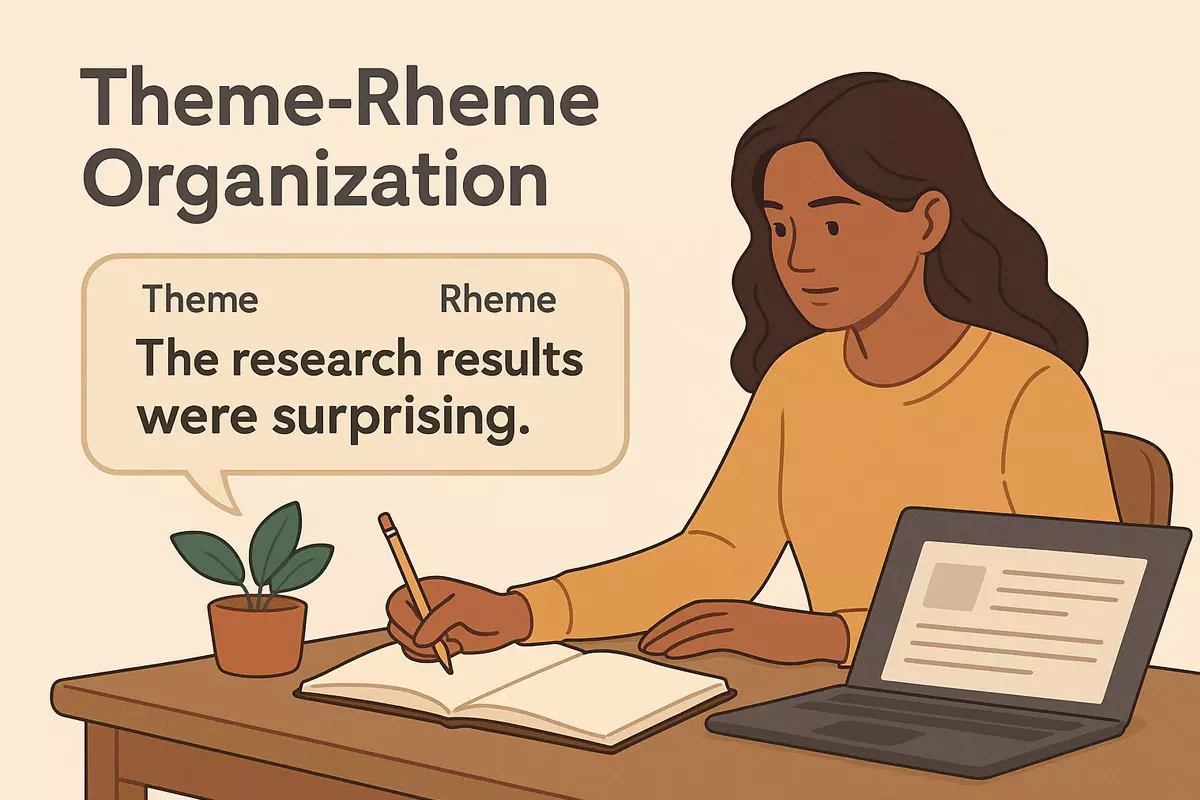 Here we the concepts of theme and rheme in discourse, strategies for choosing effective sentence themes, linking themes within a paragraph, placing new information in the rheme, and improving coherence through theme–rheme control and practice.
Effectively shaping how ideas unfold within a paragraph can greatly enhance both clarity and engagement for readers. When writers thoughtfully balance familiar information with new concepts, they help readers follow the flow of thought without becoming confused or overwhelmed. This careful management of known and new details not only makes complex information more accessible but also sustains the reader's interest throughout the text, ultimately improving the overall quality and impact of the writing.
Concepts of theme and rheme in discourse
Understanding how information is structured within sentences and across paragraphs is central to effective written communication. In linguistics, the notions of theme and rheme help explain how writers and speakers guide readers through new and given information, shaping the flow of ideas and supporting coherence. The theme typically refers to what the sentence is about—often familiar or previously mentioned content—while the rheme introduces new, prominent, or focused information.
Theme: The Starting Point
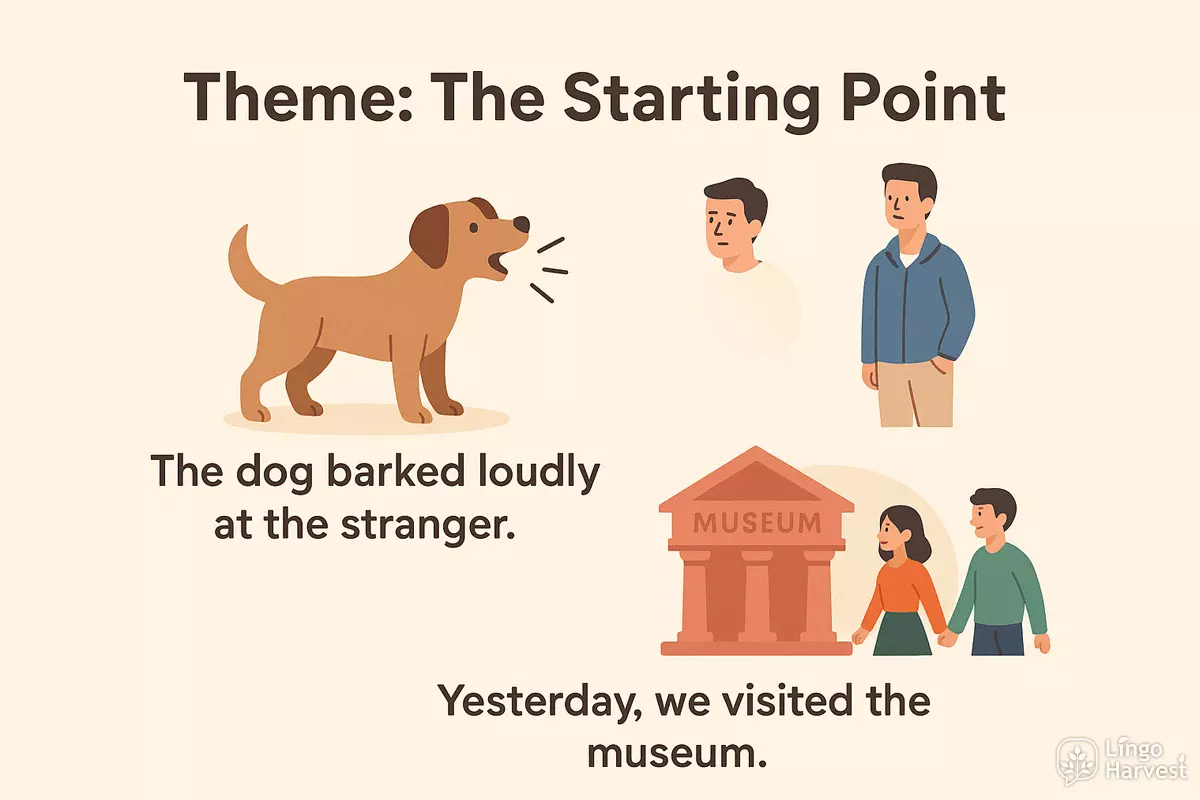
Writers often use the theme to anchor the sentence in context. This can be the grammatical subject, but not always. Thematic elements help maintain continuity and ensure that readers can follow the progression of ideas. For example:
- The dog barked loudly at the stranger.
- Yesterday, we visited the museum.
- Regarding the proposal, several concerns have arisen.
In these examples, the bolded phrases set the stage, referencing known or contextually relevant information.
Rheme: Presenting New Information
The rheme generally follows the theme and delivers the core message or new details. It carries what is most informative or unexpected in the sentence. Consider these cases:
- The dog barked loudly at the stranger.
- Yesterday, we visited the museum.
- Regarding the proposal, several concerns have arisen.
Here, the emphasized portions introduce what is new or important for the reader.
Theme–Rheme Patterns in Paragraphs
Writers can control the flow of information in paragraphs by skillfully managing the sequence of themes and rhemes. Common patterns include:
- Constant Theme: Each sentence begins with the same theme, reinforcing a central topic.
- Linear Theme: The rheme of one sentence becomes the theme of the next, creating a chain of ideas.
- Split Theme: A theme is divided into parts, each elaborated in subsequent sentences.
- Derived Theme: Several sentences share a theme that derives from a broader topic introduced earlier.
Key Functions and Examples
The interplay between starting points and new information serves several communicative purposes. Here are some practical examples of how these elements function:
- Maintaining topic continuity across sentences
- Highlighting shifts in focus or argument
- Clarifying relationships between ideas
- Supporting reader comprehension by organizing details logically
- Allowing for emphasis and contrast
- Enabling smooth transitions between sentences and paragraphs
- Framing background versus foregrounded information
- Signaling topic changes or developments
- Managing old versus new information
- Structuring explanations, narratives, or arguments
Comparing Theme and Rheme
| Aspect | Theme | Rheme |
|---|---|---|
| Position in sentence | Usually initial | Follows the theme |
| Information type | Given, familiar, or contextually relevant | New, prominent, or focused |
| Function | Sets the topic, provides a starting point | Delivers the main message or detail |
| Example | The committee decided | to postpone the event |
Effective management of these elements allows writers to guide the reader’s attention and clarify the relationships between ideas, enhancing both clarity and coherence in academic, professional, and everyday writing.
Choosing effective sentence themes
Setting up clear, purposeful themes at the start of each sentence helps readers follow your line of thought and see how ideas build on each other. In the context of theme–rheme organization, the “theme” is the part of the sentence that sets the stage for the information to come; it’s often what the sentence is about or what connects it to the previous one. Thoughtful selection of these themes can control the flow of information, making your paragraphs more cohesive and easier to understand.
What makes a theme effective?
- Relevance: The theme should relate to the main topic of the paragraph or to the preceding sentence.
- Clarity: Use clear, straightforward language for readers to quickly grasp the connection.
- Contextual fit: Good themes often refer back to known information, anchoring new ideas in familiar ground.
- Consistency: Maintaining a consistent theme across sentences can help introduce a topic and explore it in depth.
Common types of sentence themes
- Topic continuity: Repeating or rephrasing the main subject.
- Pronoun reference: Using “this,” “these,” “it,” etc., to refer back to prior information.
- Bridging phrases: “In contrast,” “Similarly,” or “As a result,” to signal connections.
- Time or place: “Yesterday,” “In the laboratory,” “Later in the process.”
- Agent or actor: Focusing on who is performing the action.
- Process or event: Starting with what is happening or changing.
- Passive structures: “The experiment was conducted…” to foreground the process or result.
- Conditional or hypothetical: “If this occurs, then…”
- Summary or evaluation: “This finding suggests…”
- Contrast or comparison: “On the other hand,” “Unlike the previous method…”
- Enumeration: “First,” “Second,” “Finally.”
- Causal connection: “Because of this,” “Therefore.”
- Examples or illustrations: “For instance,” “Such as…”
- Questions: “How does this affect…?”
- Negation: “No evidence suggests…”
- Emphasis: “It is important to note…”
- Generalization: “Most researchers agree…”
- Specific detail: “In one recent study…”
Comparing theme choices
| Theme Type | Example Sentence |
|---|---|
| Topic continuity | The new policy aims to reduce emissions. This initiative is expected to have significant environmental benefits. |
| Pronoun reference | Researchers found several patterns. These were most evident in the control group. |
| Bridging phrase | However, not all participants responded positively. |
| Time or place | During the second phase, results began to diverge. |
| Agent/actor | The committee approved the proposal after careful review. |
| Passive structure | The samples were analyzed using advanced techniques. |
| Causal connection | As a result, productivity improved significantly. |
| Enumeration | First, the data were collected; second, the analysis was conducted. |
Tips for selecting themes
- Review the previous sentence: Pick up on elements that can serve as a launching point for the next idea.
- Consider your paragraph’s purpose: Are you introducing, elaborating, contrasting, or concluding?
- Avoid abrupt shifts: Sudden, unrelated themes can confuse readers and disrupt flow.
- Vary your approach: Don’t rely on a single type of theme; mix methods for a more engaging style.
By thoughtfully structuring sentence openers, you can guide readers through complex arguments and ensure your paragraphs build meaning smoothly from start to finish.
Linking themes across a paragraph
To create cohesive and readable paragraphs, writers need to guide readers smoothly from one sentence to the next. This is often achieved by cleverly managing thematic progression—how each sentence connects to the previous one. By carefully controlling which ideas appear at the start of each sentence (the "theme"), a writer can keep the flow logical and help readers follow the argument or narrative.
Why thematic linkage matters
When the beginning of each sentence refers back to information already introduced, the paragraph feels connected and easy to follow. If new sentences start with entirely new topics, readers may feel lost or have to work harder to make sense of the text.
Common methods for connecting themes
Writers use several techniques to ensure sentences within a paragraph are linked. Some of the most effective approaches include:
- Repeating key terms from earlier sentences to maintain focus
- Using synonyms or pronouns to refer back to previous subjects
- Employing transition words like “however,” “therefore,” or “in addition”
- Restating main ideas in slightly different ways
- Introducing a new idea as part of the old (known as “theme–rheme progression”)
- Echoing sentence structures to reinforce relationships
- Building on cause and effect for logical progression
- Summarizing before moving forward
- Using parallelism for rhythm and clarity
- Explicitly stating connections (“This process,” “Such concerns,” etc.)
- Referring to previous sentences with demonstratives (“this,” “these”)
- Establishing a sequence (“first,” “next,” “finally”)
- Providing clarifying details about earlier points
- Setting up contrasts or exceptions
Types of thematic progression
Writers can use different patterns to organize the flow of ideas within a paragraph. The three most common are:
- Linear progression: Each rheme (new information) becomes the theme (starting point) of the next sentence.
- Constant theme: Each sentence begins with the same theme, developing it further each time.
- Split theme: The theme splits into two or more sub-themes, each followed in subsequent sentences.
Example patterns
Consider how these patterns shape the way information unfolds:
- Linear: “Solar panels convert sunlight into energy. This energy powers homes. These homes reduce reliance on fossil fuels.”
- Constant: “Solar panels are efficient. Solar panels are environmentally friendly. Solar panels require little maintenance.”
- Split: “Renewable energy includes solar and wind power. Solar power uses panels to capture sunlight. Wind power relies on turbines to harness air movement.”
Placing new information in the rheme
In effective paragraph construction, introducing novel details at the end of a clause or sentence helps guide readers smoothly from familiar ground to new concepts. This principle is rooted in the theme–rheme structure, where the “theme” provides a starting point—something already known or easy to process—while the “rheme” delivers the main message or fresh insight. By positioning unfamiliar or significant content in the rheme, writers ensure that the reader’s attention naturally lands on what matters most.
Why introduce unfamiliar details in the rheme?
Placing fresh content at the end of a sentence makes it more noticeable and memorable. Readers expect the conclusion of a sentence to carry the key point or the latest development. This pattern supports comprehension and smooths the transition between ideas. When the rheme contains what’s new, the following sentence can then use that information as its theme, creating a clear chain of reference throughout the paragraph.
Common patterns for managing information flow
Writers often repeat this structure to keep paragraphs coherent. Here are some ways to introduce new elements at the end of a sentence:
- Use pronouns or definite descriptions for known information at the start, followed by new facts.
- Begin with a familiar subject, then add a phrase or clause that introduces new data.
- Reserve the end of the sentence for technical terms, results, or unexpected details.
- Build momentum by stacking related clauses, saving the most important or novel point for last.
Examples of rheme placement in sentences
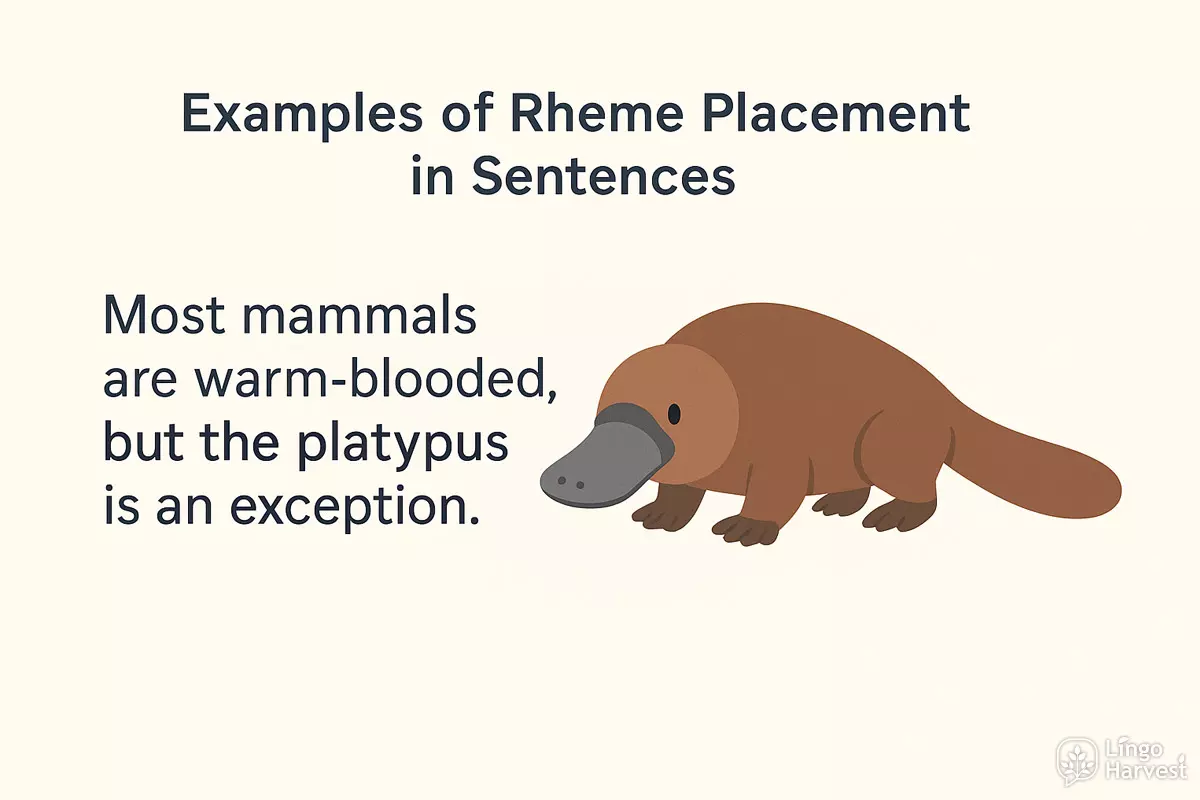
The following list demonstrates how sentences can be structured to highlight new information in the rheme:
- “The experiment was conducted in a controlled environment, which revealed a surprising trend.”
- “Most mammals are warm-blooded, but the platypus is an exception.”
- “These findings challenge previous assumptions about climate change.”
- “He opened the mysterious box, discovering a set of ancient coins.”
- “The city has many historical landmarks, including the old fortress.”
- “Researchers have debated this theory for years, yet no consensus has emerged.”
- “She completed the marathon, setting a new personal record.”
- “The committee reviewed all applications, selecting five finalists.”
- “The software update introduced several features, one of which is voice recognition.”
- “He invested in renewable energy, anticipating future growth in the sector.”
- “The report concludes with a recommendation, calling for immediate action.”
- “Their study focused on urban areas, where pollution levels are highest.”
- “The artist displayed her new collection, inspired by the city’s skyline.”
- “We examined various solutions, but none proved effective.”
- “The proposal was well received, especially by younger voters.”
- “The team launched its campaign, hoping to raise awareness.”
- “After months of negotiation, an agreement was finally reached.”
- “The lecture ended with a question, prompting lively discussion.”
Benefits of this approach
Organizing information in this way does more than just clarify meaning; it also creates a natural rhythm and progression in writing. Readers are less likely to lose track of the central thread, and transitions between sentences become more fluid. This technique is especially useful in academic, technical, and professional contexts, where clarity and logical flow are essential. When writers consistently introduce novel content in the rheme, paragraphs become easier to follow and more engaging, helping audiences retain the most important information.
Improving coherence through theme–rheme control
Clear information flow relies on how sentences introduce and develop ideas. By strategically guiding readers from what is known (theme) to what is new (rheme), writers can help readers follow the argument or narrative without confusion. This intentional structuring is especially important in academic and technical writing, where logical progression is crucial.
How theme–rheme organization supports logical connections
Each sentence typically starts with a theme—usually familiar information or a reference to the previous sentence—then moves to the rheme, which presents new or important details. When writers consistently manage this pattern, readers can more easily see how points relate, reducing ambiguity and making the text feel cohesive.
- Theme repetition: Reinforces the main topic by starting consecutive sentences or clauses with the same subject.
- Theme progression: Shifts the theme in each sentence to build a chain of related ideas.
- Split rheme: Breaks new information into separate sentences, each focusing on a part of the rheme.
- Thematic bridges: Uses pronouns or synonyms as themes to link back to earlier content.
- Rheme highlighting: Emphasizes important points at the end of sentences.
- Referential ties: Connects themes to previous rhemes to maintain continuity.
- Contrastive themes: Introduces a new perspective while referencing previous topics.
- Topic chaining: Maintains a logical thread through repeated or reformulated themes.
- Implicit themes: Uses context to imply the theme, relying on reader inference.
- Parallel structure: Aligns themes and rhemes across sentences for rhythmic flow.
- Subordinate clause themes: Places secondary information up front to prepare for key rhemes.
- Elliptical referencing: Omits repeated themes or rhemes to streamline prose.
- Enumeration: Lists themes or rhemes explicitly to organize complex information.
- Contrast markers: Signals shifts in theme or rheme using words like "however" or "on the other hand".
- Temporal progression: Orders themes or rhemes chronologically for narrative flow.
- Cause–effect linking: Aligns rhemes with resulting themes to show logical outcomes.
- Spatial referencing: Uses location as a thematic anchor to describe physical arrangements.
- Question–answer pattern: Poses a question as theme, answers as rheme.
- Conditional structures: Sets up hypothetical themes with corresponding rhemes.
- Summative themes: Begins with a summary phrase to introduce a detailed rheme.
Common pitfalls in theme–rheme management
Writers sometimes lose coherence by shifting themes too abruptly, burying the key information, or failing to establish clear links between sentences. Awareness of these pitfalls can help avoid reader confusion:
- Sudden topic changes without thematic bridges
- Ambiguous references in themes or rhemes
- Overloading sentences with multiple new elements
- Neglecting to refer back to previous information
Examples of effective theme–rheme patterns
To illustrate, here are several patterns that demonstrate how managing the start and end of sentences shapes understanding:
| Theme (Starting Point) | Rheme (New Information) |
|---|---|
| The experiment | revealed unexpected results. |
| These results | suggest a need for further research. |
| Further research | could clarify the underlying mechanisms. |
| The underlying mechanisms | remain poorly understood. |
| Understanding them | may improve practical applications. |
By consciously managing the transition from theme to rheme, writers can ensure that paragraphs progress smoothly, topics unfold logically, and readers are guided efficiently through the text’s argument or narrative.
Practice: analyze and revise paragraph information flow
Mastering the movement of information within a paragraph is key to clear writing. Below, you’ll find practical exercises to help you recognize and improve the way sentences connect and flow. These tasks focus on the effective use of theme–rheme organization, which guides readers smoothly from known to new information.
Task 1: Identify and Improve Information Flow
Read the following paragraph. Highlight any places where the connection between sentences is weak or confusing. Then, suggest how to revise it for smoother flow.
Many cities have invested in public transportation. Buses and trains are often crowded during rush hour. Pollution is a major concern for urban planners. Solutions must be found to reduce emissions from vehicles. Some cities have introduced electric buses.
Show answers
- Weak connection: The third sentence ("Pollution is a major concern for urban planners.") jumps to a new topic.
- Revision suggestion: Link the idea of crowded transportation to pollution: "Because buses and trains are often crowded during rush hour, many vehicles are on the road, increasing pollution—a major concern for urban planners."
- Improved flow: End with solutions, such as the introduction of electric buses, to maintain logical progression.
Task 2: Spot Theme–Rheme Patterns
Below are pairs of sentences. For each pair, decide whether the second sentence continues the previous idea (good flow) or introduces new information abruptly (poor flow).
- A. The river floods every spring. B. This causes damage to nearby farms.
- A. Bees are important pollinators. B. The weather was cold last week.
- A. Renewable energy sources are gaining popularity. B. Solar panels are becoming more affordable.
- A. The museum recently opened a new exhibit. B. Visitors can see ancient artifacts from Egypt.
Show answers
- 1. Good flow (the second sentence explains the effect of the river flooding).
- 2. Poor flow (the second sentence is unrelated to bees or pollination).
- 3. Good flow (solar panels as a type of renewable energy—logical development).
- 4. Good flow (visitors' experience connects to the new exhibit).
Task 3: Revise for Cohesion
Choose one of the following sentences to start a short paragraph. Add two more sentences that maintain clear progression from known to new information.
- The city’s recycling program has expanded.
- Online learning has changed education.
- Electric cars are gaining popularity.
Show answers
- Recycling program example: The city’s recycling program has expanded. Residents can now recycle more types of plastic and paper. As a result, waste sent to landfills has decreased.
- Online learning example: Online learning has changed education. Students can access courses from anywhere in the world. This flexibility has made higher education more accessible.
- Electric cars example: Electric cars are gaining popularity. Many manufacturers are introducing new models each year. These vehicles help reduce air pollution in urban areas.
Useful Theme–Rheme Revision Moves
Writers use several strategies to create logical progression within paragraphs. Here are some common techniques for improving sentence connections:
- Repeat or echo key terms from the previous sentence.
- Use pronouns to refer back to earlier ideas (this, these, such).
- Employ transitional phrases (as a result, for example, however).
- Start with familiar information before introducing new concepts.
- Summarize before moving to details.
- Specify general ideas (e.g., "This problem" → "This traffic congestion").
- Use parallel structures to reinforce connections.
- Vary sentence openings to avoid monotony.
- Clarify ambiguous references.
- Maintain consistent point of view and tense.
- Group related ideas together.
- Break up overly long sentences for clarity.
- Use cause-and-effect links.
- Introduce examples to support claims.
- Employ summary statements when shifting topics.
Self-Check: Paragraph Flow Checklist
Before finalizing a paragraph, use this checklist to assess information movement:
- Does each sentence build on what came before?
- Are transitions clear and purposeful?
- Is the main idea easy to follow from start to finish?
- Are pronoun references unambiguous?
- Is there a logical progression from general to specific, or from known to new information?
Consistent theme–rheme organization not only clarifies your point but also keeps your reader engaged. With regular practice, analyzing and revising the flow of information will become an integral part of your writing process.