Advanced Cohesion Techniques: Pronoun Chains, Reference, and Clarity

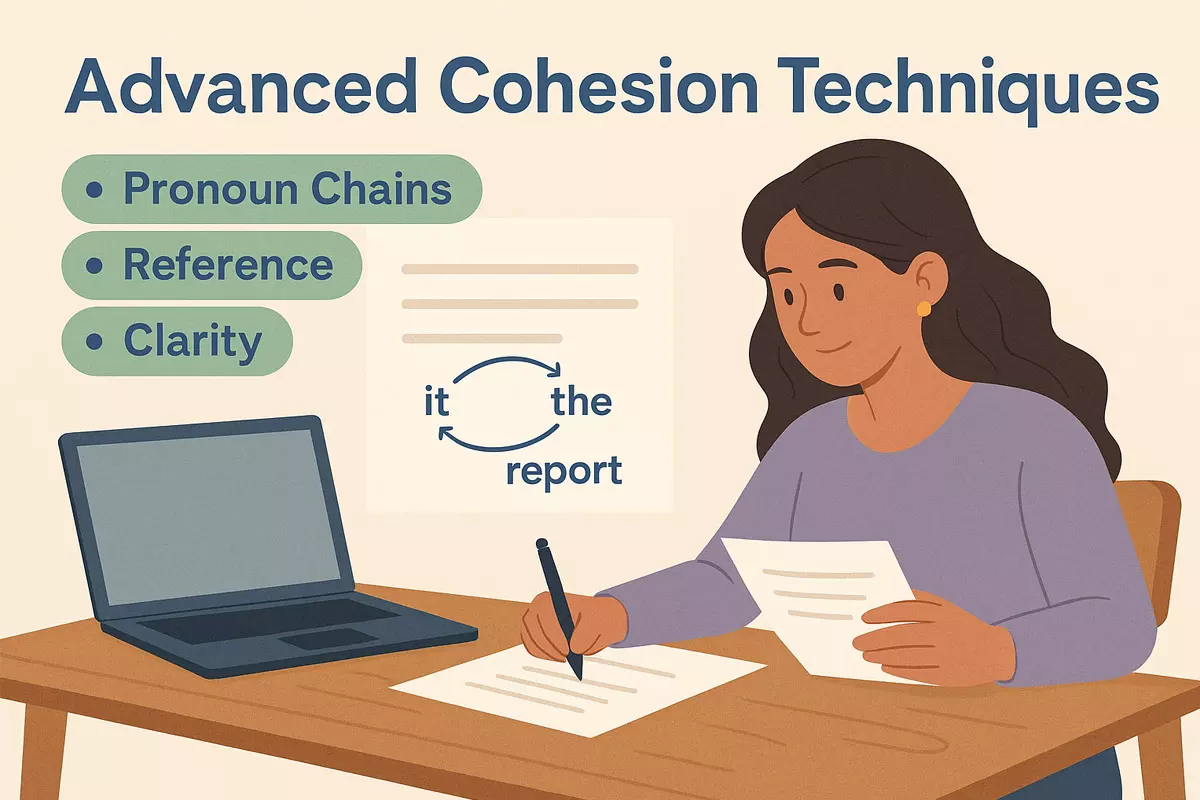 This article explains how to use reference for cohesion, create clear pronoun chains, and avoid vague references. It also covers using repetition and substitution, maintaining cohesion across sentences and paragraphs, and practicing cohesion repair.
Achieving flow and precision in writing depends on effectively connecting ideas through techniques like careful use of pronouns, consistent referencing, and clear sentence structure. These methods help writers avoid ambiguity and ensure that readers can easily follow the intended meaning. When such elements are skillfully applied, they enhance both the readability and coherence of the text, making the writing more engaging and accessible. Ultimately, mastering these strategies is essential for producing clear, well-organized, and effective written communication.
Role of reference in cohesion
Reference is fundamental for maintaining unity and flow within a text. By signaling connections between words, phrases, or larger sections, reference guides readers through the information being presented. Pronouns, demonstratives, and definite descriptions all help to avoid unnecessary repetition and clarify relationships among ideas. This makes reading smoother and helps prevent confusion, especially in longer or more complex passages.
Types of referencing expressions
Writers typically use several referencing devices to achieve textual unity. These include:
- Personal pronouns (he, she, it, they, etc.)
- Demonstratives (this, that, these, those)
- Comparatives (other, same, such)
- Definite noun phrases (the book, the results)
- Relative pronouns (who, which, that)
- Possessive pronouns (his, her, their, its)
- Ellipsis (omitting repeated elements)
- Substitution (using one/ones, do/so)
- Cataphoric reference (referring forward)
- Anaphoric reference (referring backward)
- Zero reference (implied subject or object)
How referencing supports textual unity
References serve as bridges between sentences and ideas. When a pronoun replaces a previously mentioned noun, or when a demonstrative points to an entire preceding argument, the reader is cued to connect the dots. This process reduces redundancy and strengthens ties across the text, enhancing both readability and clarity.
Common challenges and solutions
Writers often encounter issues such as ambiguous pronoun use or unclear antecedents. These problems can disrupt the reader’s understanding and weaken cohesion. To minimize confusion:
- Ensure each pronoun clearly refers to only one antecedent
- Avoid placing pronouns too far from their referents
- Use explicit noun phrases when context is complex
- Reread for possible multiple interpretations
- Vary referring expressions to maintain clarity and avoid monotony
Reference in different text types
The use of referencing varies with genre and purpose. Academic writing often relies on precise noun phrases and careful pronoun chains, while narratives may use more pronouns for natural flow. Technical manuals might favor explicit repetition to prevent ambiguity.
| Referential Device | Example in Context |
|---|---|
| Personal pronoun | Maria finished the report. She sent it to her manager. |
| Demonstrative | The meeting was long. That surprised everyone. |
| Comparative | This solution is better than the other one. |
| Definite noun phrase | Several theories were discussed. The most popular theory was supported by evidence. |
| Relative pronoun | The scientist who led the project won an award. |
| Cataphoric reference | This is what I think: we need a new plan. |
| Anaphoric reference | We need a new plan. This will improve results. |
| Zero reference | He wanted to leave, but ∅ stayed anyway. |
Summary
Effective use of reference links sentences and ideas, guiding readers smoothly from one point to the next. Mastering these techniques is essential for anyone aiming to produce clear, cohesive, and reader-friendly writing.
Building and maintaining pronoun chains
Effective text cohesion often depends on how smoothly pronouns connect back to their referents. When readers can easily follow references from one sentence to the next, comprehension improves and ambiguity is reduced. A well-managed sequence of pronouns—sometimes called a pronoun chain—ensures clarity, especially in longer passages where multiple entities may be introduced.
What makes a cohesive pronoun chain?
A strong chain relies on consistency, clarity, and strategic repetition. Each pronoun should unambiguously refer to a specific noun or noun phrase (the antecedent), and shifts between referents must be handled with care. Ambiguous or broken chains can confuse readers and disrupt the flow of ideas.
- Begin with an explicit noun before introducing pronouns.
- Maintain the same referent for each chain unless a clear transition is signaled.
- Use the fewest pronouns necessary; excessive use can lead to confusion.
- Repeat the noun occasionally in longer or complex passages for clarity.
- Signal referent changes with transitional phrases or restating the noun.
- Check for potential ambiguity when two or more possible referents are present.
- Vary pronoun forms appropriately (he/she/they/it/this/that/these/those).
- Use demonstratives with care; ensure "this" or "that" clearly points to the intended idea.
- In dialogue, clarify who is speaking if multiple characters are involved.
- Keep consistency in gender and number; avoid switching from singular to plural unintentionally.
- Review each paragraph for pronoun clarity during editing.
Common pitfalls and how to avoid them
Pronoun reference errors often occur when multiple subjects are present or when the referent is distant from the pronoun. To maintain cohesion:
- Reintroduce the noun if more than two sentences have passed without it.
- Use names or titles if pronouns become unclear.
- Check each pronoun’s antecedent; if it’s not immediately obvious, revise.
- Be wary of gender-neutral or plural forms; match the antecedent in both number and gender.
Examples: Clear and unclear pronoun chains
| Example | Comment |
|---|---|
| Sarah gave Anna her book. She thanked her. | ❌ Ambiguous: "her" and "she" could refer to either person. |
| Sarah gave Anna her book. Anna thanked Sarah. | ✅ Clear: Each pronoun and noun clearly identifies the referent. |
| The committee discussed the proposal. They approved it unanimously. | ✅ Clear: "They" refers to "the committee," "it" to "the proposal." |
| Alex met with Sam after he finished work. | ❌ Ambiguous: It's unclear who finished work. |
| Alex met with Sam after Sam finished work. | ✅ Clear: The referent is specified. |
Tips for sustaining reference chains in complex texts
When working with academic, technical, or narrative writing where multiple entities are involved, it helps to map out reference chains during revision. Ask yourself: Can a reader unfamiliar with the context follow each pronoun back to its source? If not, clarify by restating the noun or restructuring the sentence. This attention to detail supports both reader understanding and overall textual cohesion.
Avoiding vague or ambiguous reference
Clear, precise reference is vital for readers to follow your meaning without confusion. When a pronoun or noun phrase could point to more than one thing—or doesn’t clearly connect to its antecedent—readers may misunderstand your intent or lose track of the argument. To prevent misunderstanding, writers need to anticipate possible sources of ambiguity and resolve them with explicit language.
Common pitfalls that lead to unclear reference
Writers often slip into unclear reference by overusing pronouns, placing referents too far apart, or introducing multiple possible antecedents. Consider these frequent issues:
- Using "it," "this," or "they" without a clear noun nearby
- Referring to abstract ideas with vague terms like "which" or "these"
- Allowing several nouns between a pronoun and its intended antecedent
- Switching topics mid-paragraph without clear transitions
- Assuming the reader shares your context or background knowledge
Strategies for clarity in reference
Writers can use several techniques to ensure each reference is unmistakable:
- Repeat key nouns when a pronoun might be confusing
- Rephrase sentences to bring the referent and reference closer together
- Use demonstratives with nouns (e.g., "this result" instead of just "this")
- Limit the number of possible antecedents in a sentence or paragraph
- Introduce new subjects clearly before using pronouns
- Break up long sentences to reduce ambiguity
- Check each pronoun’s referent during proofreading
- Ask a peer to read and identify unclear references
- Avoid unnecessary pronoun chains when a noun would be clearer
- Clarify with appositives if two entities share a name or function
Examples of ambiguous and clear reference
Below is a comparison of sentences with unclear and improved reference. Notice how small adjustments can eliminate confusion.
| Unclear Reference | Clear Reference |
|---|---|
| When Sarah met Emily, she was late. | When Sarah met Emily, Sarah was late. |
| The committee rejected the proposal, which disappointed them. | The committee was disappointed when it rejected the proposal. |
| He put the vase on the table and broke it. | He put the vase on the table and broke the vase. |
| They told the students that they would succeed. | The teachers told the students that the students would succeed. |
| Put the bag in the box and close it. | Put the bag in the box and close the box. |
| John gave his dog a bath, then he brushed him. | John gave his dog a bath, then John brushed the dog. |
| The glass was next to the plate, but it was empty. | The glass was next to the plate, but the glass was empty. |
| She told her mother she was tired. | She told her mother that she herself was tired. |
| After the book was placed on the shelf, it fell. | After the book was placed on the shelf, the book fell. |
| Jack and Tom went to his house. | Jack and Tom went to Jack’s house. |
Final checks for precise reference
Before finalizing your text, reread sections with pronouns or demonstratives and ask yourself if their meaning is unmistakable. If any reference could be misread, revise for greater specificity. This extra step ensures your writing remains cohesive and easy to follow, even in complex or technical material.
Using repetition and substitution effectively
Writers often rely on repeating words or replacing them with substitutes (such as pronouns or synonyms) to ensure coherence across sentences and paragraphs. These strategies help readers track subjects and ideas, reducing confusion and enhancing clarity. Striking the right balance between repeating key terms and introducing alternatives is crucial for advanced cohesion, especially in complex texts.
When to Repeat and When to Substitute
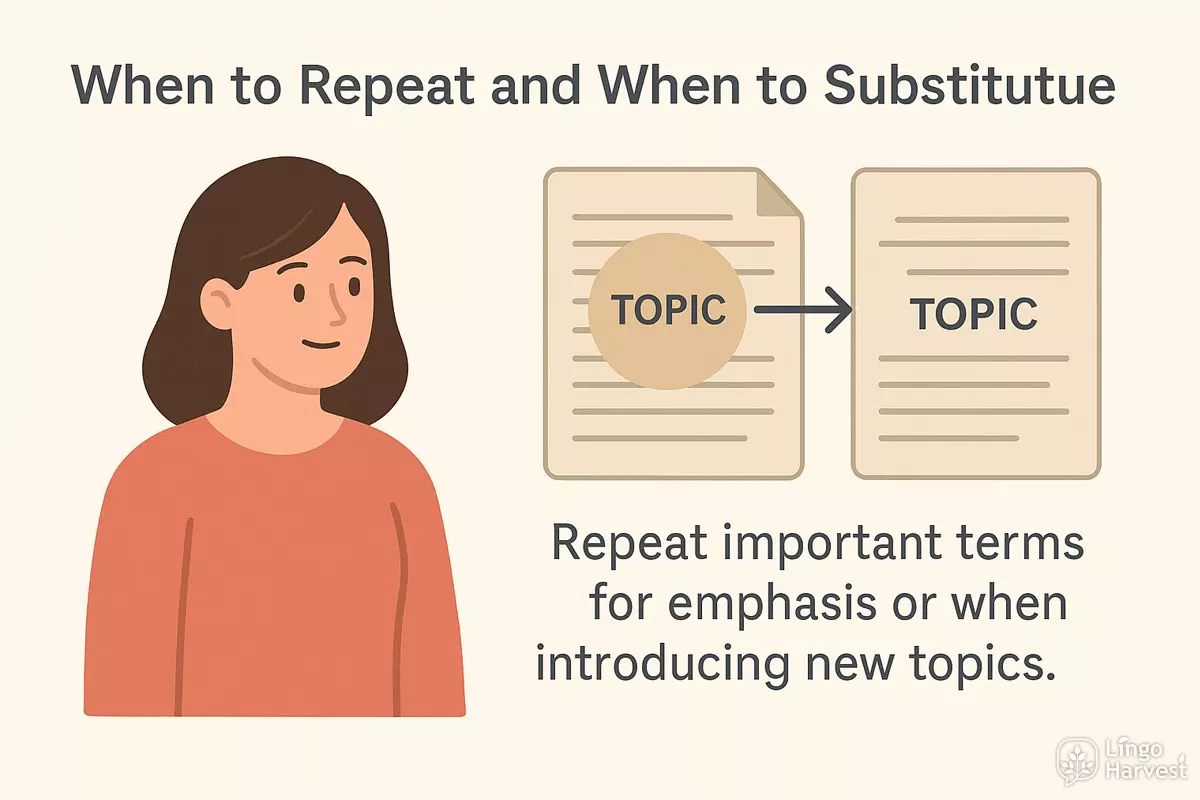
Repetition is valuable when you want to reinforce a main concept or avoid ambiguity. However, excessive repetition can feel redundant. Substitution, on the other hand, maintains flow and avoids monotony, but careless use can obscure meaning if the reference is unclear. Consider these guidelines:
- Repeat important terms for emphasis or when introducing new topics.
- Use pronouns or synonyms once referents are clear to maintain variety.
- Alternate between repetition and substitution in longer passages to aid reader orientation.
- Avoid substituting too early; establish the referent first.
- Check that each substitute unambiguously refers back to its antecedent.
Types of Substitution
Writers can choose from several substitution techniques to strengthen cohesion:
- Pronouns: Replace nouns with he, she, it, they, etc.
- Synonyms: Use words with similar meanings to avoid repetition (e.g., "car" and "vehicle").
- Superordinate terms: Refer to a more general category ("furniture" for "chair").
- Demonstratives: Use this, these, that, those to point to previous ideas.
- Ellipsis: Omit repeated information when it is understood from context.
- Substitution words: Use "one," "do," or "so" as replacements ("I prefer the red one.").
Common Pitfalls and Solutions
Losing track of referents or overusing substitutions can lead to confusion. Watch for these issues:
- Vague pronouns: Ensure every pronoun clearly refers to a specific noun.
- Overlapping substitutes: Avoid switching between too many synonyms without clear links.
- Unnecessary repetition: Streamline repeated words unless they serve a specific purpose.
Expanded Examples of Repetition and Substitution
Below are varied ways to maintain cohesion through repetition and substitution:
- Lisa finished her report. She submitted it on time.
- The conference was well-attended. The event drew experts from across the field.
- Tom likes apples. He eats the fruit every day.
- There are several museums in Paris. These attract millions of visitors.
- The committee reviewed the proposal. Its members suggested revisions.
- Sara bought a new bike. The bicycle is blue.
- She ordered a sandwich. So did her friend.
- The students discussed climate change. This topic sparked debate.
- We visited the library. It was recently renovated.
- Several policies were proposed. Some were controversial.
- He prefers the old model. The new one is too complex.
- The cat chased the mouse. The animal was quick.
Summary Table: Repetition vs. Substitution
| Technique | Best Use | Potential Issue | Example |
|---|---|---|---|
| Repetition | Emphasizing key terms, ensuring clarity | Monotony, redundancy | The experiment showed positive results. The experiment was repeated. |
| Pronoun substitution | Maintaining flow once referent is established | Ambiguity if referent is unclear | Maria read the article. She summarized it. |
| Synonym substitution | Adding variety, linking related ideas | Loss of precision, confusion | The painting was beautiful. The artwork attracted attention. |
| Demonstrative reference | Pointing to previous ideas or groups | Vagueness if context is weak | Several solutions were suggested. These were discussed at length. |
Thoughtful use of both repetition and substitution not only tightens your writing but also makes complex information more accessible. Aim for variety, but always prioritize reader understanding.
Cohesion across sentences and paragraphs
When writing longer texts, maintaining logical flow between ideas is essential. This is achieved by using advanced tools such as pronoun chains, reference words, and clear transitions. Pronouns like “he,” “she,” “it,” or “they” help link information from one sentence to the next, but overuse or unclear reference can confuse readers. Effective usage ensures each pronoun unmistakably points to its antecedent.
Reference and Repetition for Clarity
Writers often use reference words—such as “this,” “that,” “these,” or “those”—to connect thoughts. Combining these with selective repetition of key terms can reinforce the subject and prevent ambiguity. For example, repeating a noun after several sentences rather than relying solely on pronouns helps the reader track the topic.
Pronoun Chains in Practice
A pronoun chain is a sequence where each pronoun continues to refer clearly to the same entity. If the chain becomes too long or involves multiple subjects, confusion may arise. Consider the following list of potential pitfalls and best practices:
- Introduce the noun before using a pronoun.
- Avoid using “it” or “they” if multiple possible references exist.
- Restate the noun after several sentences to remind the reader.
- Vary sentence openings to avoid repetitive patterns.
- Use demonstrative pronouns (“this,” “those”) with nouns when context is unclear (e.g., “this process”).
- Be cautious with “he” or “she” in texts involving several people.
- Check each pronoun’s reference during editing.
- Balance pronouns and full noun phrases for rhythm and clarity.
- Use transitions such as “however,” “for example,” or “additionally” to guide the reader.
- Summarize or preview main points at paragraph boundaries.
- Employ parallel structure for related ideas.
- Signal shifts in topic with clear phrases (“In contrast,” “On the other hand”).
- Ensure reference words are close to their antecedents.
- Limit the use of “this” or “that” alone; pair with a noun for precision.
- Rephrase sentences if backtracking is required to identify a pronoun’s meaning.
Comparing Reference Devices
Writers can choose among several devices to maintain unity in their text. The table below compares common strategies for linking ideas across sentences and paragraphs:
| Technique | Purpose / Example |
|---|---|
| Pronoun Reference | Links to previously mentioned nouns. Example: “Sara finished the project. She was relieved.” |
| Lexical Repetition | Restates key terms for emphasis. Example: “The experiment was successful. The experiment demonstrated…” |
| Demonstrative Reference | Uses “this/that/these/those” to connect ideas. Example: “The results were surprising. This finding suggests…” |
| Transition Signals | Indicates relationships between sentences or paragraphs. Example: “However, …” or “In addition, …” |
Ensuring Smooth Flow
Rather than relying on a single method, skilled writers blend these techniques. Alternating between pronouns, repeated terms, and transition words helps maintain a natural rhythm and keeps the reader oriented. By carefully managing references and transitions, you ensure that ideas connect logically from one sentence to the next and from paragraph to paragraph.
Practice: repair cohesion problems in short texts
Developing skill with cohesion often means learning to spot and fix unclear or weak references, pronoun chains, and abrupt shifts in short passages. Below, you'll find a range of practical tasks to strengthen your ability to clarify meaning, maintain reference, and ensure smooth connections in writing.
Identify and Revise Weak Cohesion
Read these sentences and decide what is unclear or disconnected. Rewrite each one to improve reference and flow.
- Maria dropped the bowl on the floor. It broke. This upset her.
- The committee finished the report. They sent it to the director. He read it quickly.
- Tom and Greg went to the concert. He enjoyed the music a lot.
- When the dog chased the cat, it ran very fast.
- I love reading novels. It helps to relax.
- Susan told Anna that she needed to study more.
- John gave Mike his jacket because it was cold.
- The teacher praised the student because she worked hard.
- The manager talked to the employee after he arrived late.
- Sarah called Emma while she was cooking dinner.
Show answers
- Maria dropped the bowl on the floor, and the bowl broke. This upset Maria.
- The committee finished the report and sent it to the director, who read the report quickly.
- Tom and Greg went to the concert. Tom enjoyed the music a lot. (Or specify Greg.)
- When the dog chased the cat, the cat ran very fast.
- I love reading novels. Reading helps me relax.
- Susan told Anna that Anna needed to study more. (Or specify Susan if intended.)
- John gave Mike John’s jacket because it was cold outside.
- The teacher praised the student because the student worked hard.
- The manager talked to the employee after the employee arrived late.
- Sarah called Emma while Sarah was cooking dinner.
Common Cohesion Problems: Quick Reference List
- Unclear pronoun reference (ambiguous "he/she/it/they")
- Missing antecedents for pronouns
- Vague use of "this," "that," or "it"
- Broken or interrupted pronoun chains
- Sudden topic shifts without transition
- Repetition of nouns where pronouns would clarify
- Overuse of pronouns leading to confusion
- Reference to whole ideas instead of specific nouns
- Inconsistent subject within a paragraph
- Failure to restate or clarify key terms
- Use of synonyms without clear connection
- Overloaded sentences with multiple possible referents
Pronoun Chain Repair: Multiple Sentences
Read the following passage, then improve the cohesion by repairing pronoun chains and clarifying references.
"Susan met with Emily before she left for the airport. She gave her the tickets. Later, she called her to confirm the time."
Show answers
"Susan met with Emily before Emily left for the airport. Susan gave Emily the tickets. Later, Susan called Emily to confirm the time."
Reference and Clarity: Select the Best Option
Choose the sentence with the clearest reference.
- After Lisa spoke to Sarah, she left the room.
- After Lisa spoke to Sarah, Sarah left the room.
- After speaking to Sarah, Lisa left the room.
Show answers
- Sentence 2 and 3 are both clear, but Sentence 2 specifies "Sarah," while Sentence 3 specifies "Lisa." Sentence 1 is ambiguous.
Summary Table: Cohesion Repair Strategies
| Problem Type | Repair Strategy |
|---|---|
| Ambiguous pronoun | Replace pronoun with noun or clarify antecedent |
| Broken pronoun chain | Maintain consistent reference through the passage |
| Vague reference ("this," "it") | Specify what "this/it" refers to |
| Sudden topic shift | Add transitions or restate the subject |
| Overuse of synonyms | Use pronouns or repeat key nouns for clarity |
Practicing these revision tasks will help you spot and fix cohesion issues in your own writing, making your texts clearer and more professional.