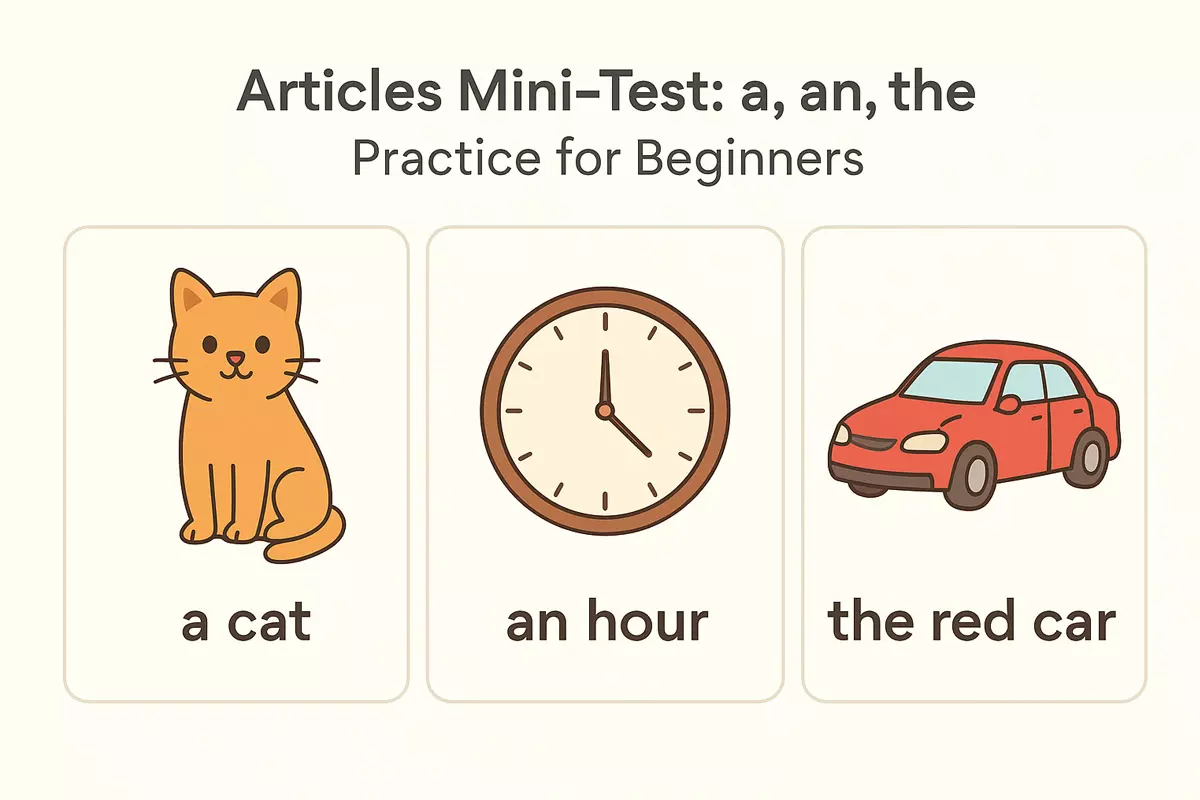
Articles Mini-Test: a, an, the Practice for Beginners

 The article reviews English articles, explains when to use a, an, and the, and points out common mistakes. It also provides practice sentences for you to fill in the correct articles and check your understanding.
Are you ready to improve your understanding of English articles? This brief exercise is designed to help beginners practice selecting the correct articles in various sentences, which will make your communication clearer and more precise. By working through these examples, you can develop greater confidence in using articles correctly and enhance your overall English skills. Try the following questions and see how much your accuracy improves as you practice.
Quick Review of Articles
Understanding how to use English articles correctly is essential for clear and accurate communication. There are three articles in English: a, an, and the. Each has a specific function and is used in different situations. Here, you'll find a brief overview, key rules, and practical examples to help you master these basic elements of grammar.
Types and Usage
- A is used before singular, countable nouns that begin with a consonant sound (e.g., a cat, a book).
- An is used before singular, countable nouns that begin with a vowel sound (e.g., an apple, an hour).
- The is used for specific nouns, whether singular or plural, when both the speaker and listener know which one is meant (e.g., the sun, the red car).
Key Points to Remember
- Use a or an when mentioning something for the first time or when it is not specific.
- Use the when referring to something already mentioned or something unique.
- No article is used with most plural or uncountable nouns when speaking generally (e.g., Dogs are friendly. Milk is healthy.).
Common Patterns and Examples
| Article | Example Sentence |
|---|---|
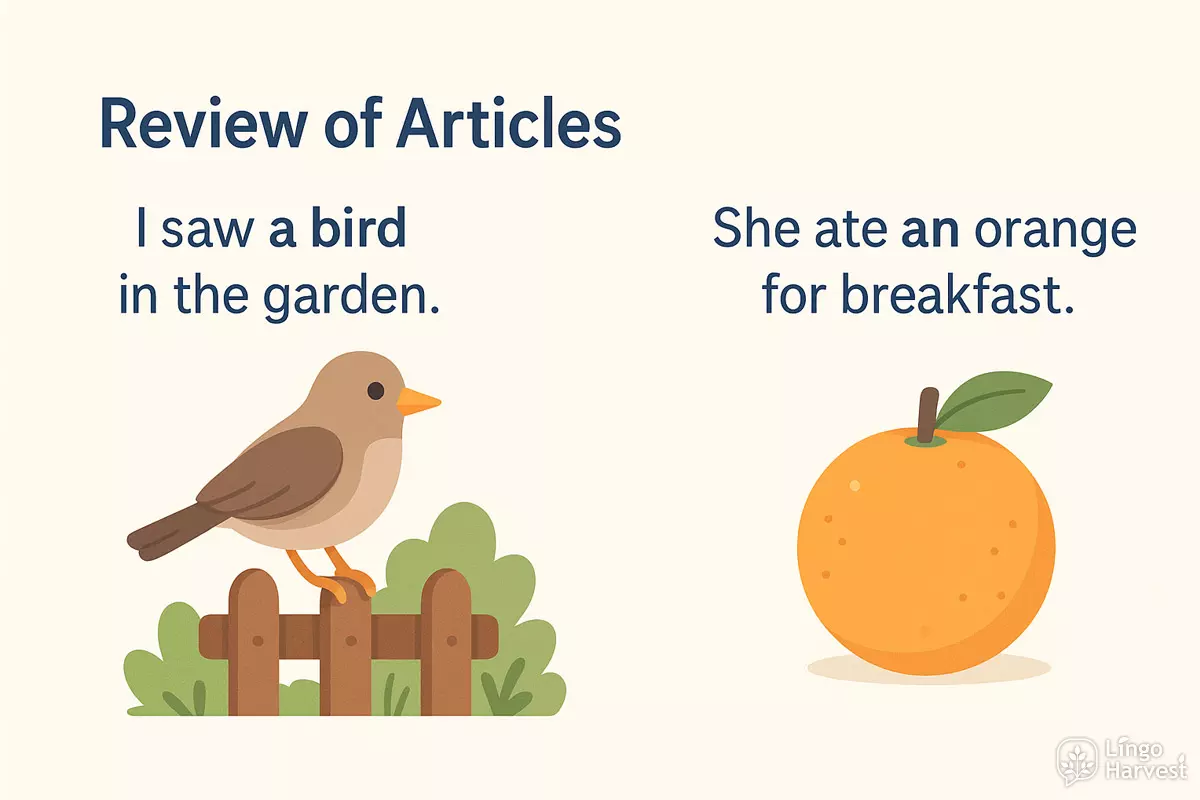
| A | I saw a bird in the garden. |
| An | She ate an orange for breakfast. |
| The | Close the window, please. |
| (No article) | Water is essential for life. |
Mini Practice: Choose the Correct Article
- ___ elephant is a large animal.
- Can you open ___ door?
- I need ___ umbrella because it’s raining.
- ___ books on the table are new.
- ___ sun rises in the east.
- Lisa has ___ interesting idea.
- He wants to buy ___ car.
- ___ apple a day keeps the doctor away.
- She doesn’t like ___ milk.
- We visited ___ museum yesterday.
Show answers
- An elephant is a large animal.
- Can you open the door?
- I need an umbrella because it’s raining.
- The books on the table are new.
- The sun rises in the east.
- Lisa has an interesting idea.
- He wants to buy a car.
- An apple a day keeps the doctor away.
- She doesn’t like (no article) milk.
- We visited the museum yesterday.
Tips for Beginners
- Remember: use a before consonant sounds, an before vowel sounds.
- Use the when both you and your listener know what you are talking about.
- Don’t use any article with general statements about uncountable or plural nouns.
With regular practice, recognizing when to use each article will become more intuitive. Review these examples and try to create your own sentences to build confidence.
When to Use a/an
The indefinite articles a and an are used before singular, countable nouns when referring to something for the first time, or when the exact identity is not known. Choosing between a and an depends on the sound that begins the next word, not only the letter.
General Rules
- Use a before words that start with a consonant sound: a cat, a house, a university (the "u" sounds like "you").
- Use an before words that start with a vowel sound: an apple, an hour, an honest person (the "h" is silent).
Notice that the choice is about pronunciation. For example, “an umbrella” (because “umbrella” starts with a vowel sound), but “a uniform” (because “uniform” starts with a “y” sound).
Common Examples
- a dog
- a teacher
- a European country (the “Eu” sounds like “you”)
- an orange
- an engineer
- an hour (the “h” is silent)
- a university
- an idea
- a one-way street (the “o” sounds like “w”)
- an honest answer
- a pencil
- an elephant
- a hotel
- an egg
- a user (the “u” is pronounced as “you”)
Special Cases
Some words might seem tricky. For example, use an before abbreviations or acronyms starting with a vowel sound: an MRI, an MBA. Also, sometimes the written letter is not the deciding factor—focus on the first sound.
If you are unsure, say the word aloud and listen to the first sound. This will help you decide whether to use a or an.
When to Use the
English uses the to show that both the speaker and listener know exactly what is being talked about. This definite article helps specify a particular person, place, or thing. It’s not used with every noun—only when the context makes it clear which one you mean.
Common Situations for Using "the"
- Something already mentioned: “I saw a dog. The dog was very friendly.”
- Unique items: “The sun is bright today.”
- Only one in context: “Can you close the door?” (There’s only one door in the room.)
- Superlatives and ordinals: “She is the best student.” / “He was the first to arrive.”
- With some place names: “The United States,” “The Amazon,” “The Alps.”
- With groups: “The elderly need support.”
- With musical instruments: “She plays the piano.”
- With inventions: “The telephone changed the world.”
- With certain public places: “I’m going to the bank.”
- With things that are obvious in the situation: “Pass me the salt, please.”
Quick Reference Table
| Type of Noun | Example Sentence |
|---|---|
| Already mentioned | I saw a cat. The cat was hungry. |
| Unique object | The moon looks beautiful tonight. |
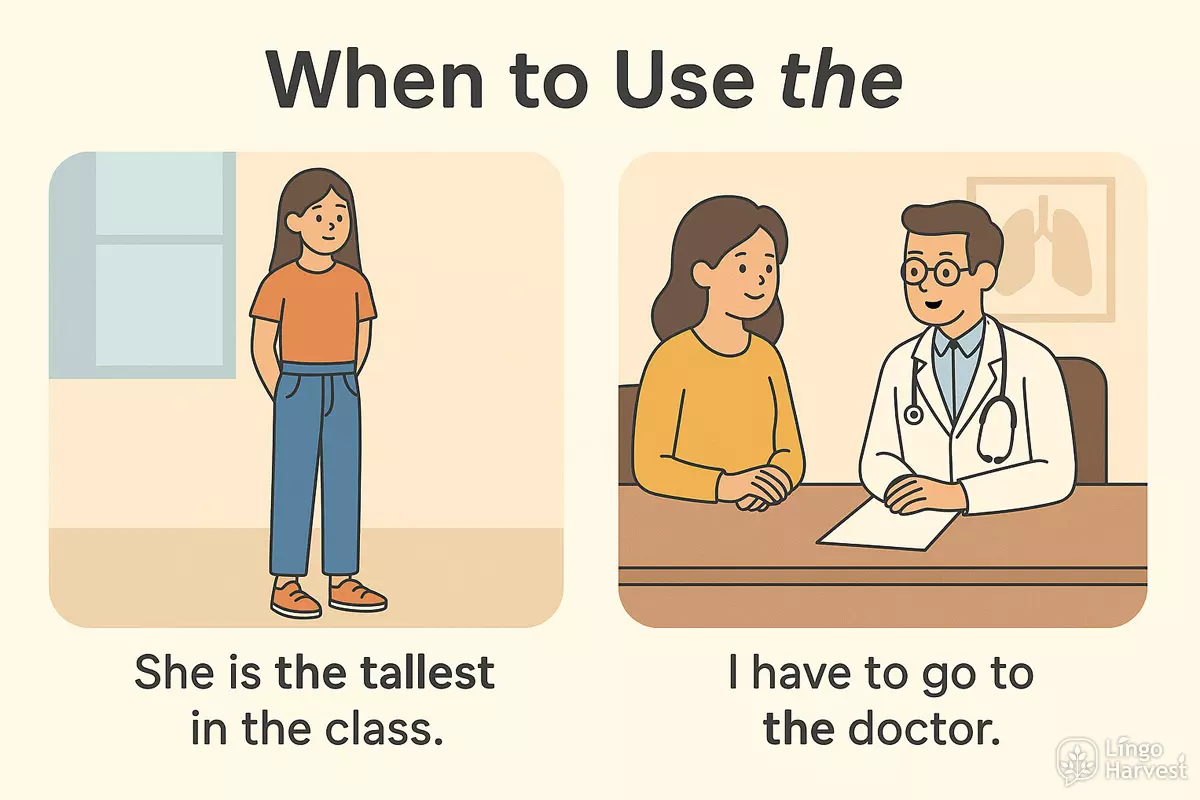
| Superlative | She is the tallest in the class. |
| Musical instrument | He plays the guitar. |
| Organizations/places | He visited the Louvre. |
| Groups of people | The unemployed need help. |
| Obvious context | She’s in the kitchen. |
| Public services | I have to go to the doctor. |
| Oceans, rivers, deserts | They crossed the Sahara. |
| Ordinal numbers | He was the second person in line. |
Remember, the is not used for general ideas or when speaking about things in general (use no article or "a/an" instead). Practice recognizing when something is specific and known, and you’ll use the definite article more naturally.
Common Mistakes in Usage
Learners often struggle with choosing the correct article, especially when moving between languages that do not use articles at all. The most frequent errors stem from misunderstanding when to use “a,” “an,” or “the,” and when to leave out the article completely. Below, we break down some of the most typical pitfalls and how to avoid them.
Mixing Up “a/an” and “the”
A very common slip is using “the” when introducing something for the first time, or forgetting to switch to “the” for something already mentioned. Remember: “a” or “an” is for something new or not specific, while “the” is for something specific or already known.
- We saw a movie last night. The movie was exciting. (✅ Correct order)
- We saw the movie last night. The movie was exciting. (❌ Not correct unless both speaker and listener know which movie in advance)
Forgetting to Use an Article
Omitting articles where English requires them is another frequent issue, especially after words like “have,” “see,” or “buy.” Here are examples of mistakes with missing articles:
- I have dog. (❌ Should be “a dog”)
- She wants apple. (❌ Should be “an apple”)
- He read book. (❌ Should be “a book” or “the book”)
Using an Article When It’s Not Needed
Sometimes, articles are added where they don’t belong, especially before plural or uncountable nouns used in a general sense.
- She likes the music. (❌ Use “music” when speaking generally: She likes music.)
- Children play the games. (❌ Use “games” for a general statement: Children play games.)
Confusing “a” and “an”
“A” is used before words that start with a consonant sound, while “an” is placed before words that begin with a vowel sound. This rule is based on pronunciation, not just spelling.
- a cat, a university (sounds like “yoo-niversity”), a house
- an apple, an hour (silent “h”), an umbrella
Summary Table: Typical Article Errors
| Incorrect Example | Corrected Version |
|---|---|
| I saw movie yesterday. | I saw a movie yesterday. |
| She is teacher. | She is a teacher. |
| He bought an orange car. The car is orange car. | He bought an orange car. The car is orange. |
| The water is important for life. (in general) | Water is important for life. |
| I have an university degree. | I have a university degree. |
Watch Out for These!
- Using “an” before words that start with a consonant sound (e.g., an university → a university)
- Leaving out “the” when talking about something already mentioned
- Adding articles before names (e.g., the John → John)
- Using “the” with countries that don’t need it (e.g., the France → France)
- Forgetting “the” with unique objects (e.g., Sun → the Sun)
By paying attention to these patterns and reviewing your sentences, you can avoid the most frequent slip-ups with articles. Practice and awareness are key to mastering their correct use.
Practice: Fill in Articles in Sentences
Ready to test your skills with English articles? Below, you'll find a series of sentences with missing articles. Your task is to decide if “a,” “an,” or “the” (or sometimes no article at all) fits best. This exercise will help you recognize when and how to use each form correctly.
Fill in the blanks with “a,” “an,” or “the” (or leave blank if none is needed):
- ____ apple a day keeps ____ doctor away.
- She saw ____ elephant in ____ zoo.
- Can you pass me ____ salt, please?
- I have ____ idea for ____ new project.
- They live in ____ old house near ____ river.
- He is ____ engineer and she is ____ artist.
- ____ sun rises in ____ east.
- We went to ____ park after ____ lunch.
- Is there ____ university in this city?
- ____ Mount Everest is ____ highest mountain in ____ world.
- Would you like ____ cup of tea?
- ____ books on ____ table are mine.
- She bought ____ umbrella because it was raining.
- He is ____ honest man.
- ____ water in this bottle is cold.
- They have ____ dog and ____ cat.
- ____ Pacific Ocean is very large.
- He didn’t make ____ mistake on his test.
- Can I ask ____ question?
- ____ cars parked outside are new.
Quick Reference: When to Use “a,” “an,” and “the”
- a – before words starting with a consonant sound (a cat, a dog)
- an – before words starting with a vowel sound (an apple, an hour)
- the – when talking about something specific or already mentioned (the car, the sun)
- No article – with most plural or uncountable nouns when speaking in general (Books are useful. Water is important.)
Show answers
- An apple a day keeps the doctor away.
- She saw an elephant in the zoo.
- Can you pass me the salt, please?
- I have an idea for a new project.
- They live in an old house near the river.
- He is an engineer and she is an artist.
- The sun rises in the east.
- We went to the park after (no article) lunch.
- Is there a university in this city?
- Mount Everest is the highest mountain in the world.
- Would you like a cup of tea?
- The books on the table are mine.
- She bought an umbrella because it was raining.
- He is an honest man.
- The water in this bottle is cold.
- They have a dog and a cat.
- The Pacific Ocean is very large.
- He didn’t make a mistake on his test.
- Can I ask a question?
- The cars parked outside are new.
Common Mistakes with Articles
- Using “a” with vowel sounds: Incorrect – a apple; Correct – an apple
- Forgetting “the” with unique things: Incorrect – Sun is hot; Correct – The sun is hot
- Adding “the” before general plurals: Incorrect – The dogs are friendly (when speaking about dogs in general); Correct – Dogs are friendly
- Omitting “an” before silent ‘h’: Incorrect – a honest man; Correct – an honest man