Zero Article in Academic Writing (B2 focus)

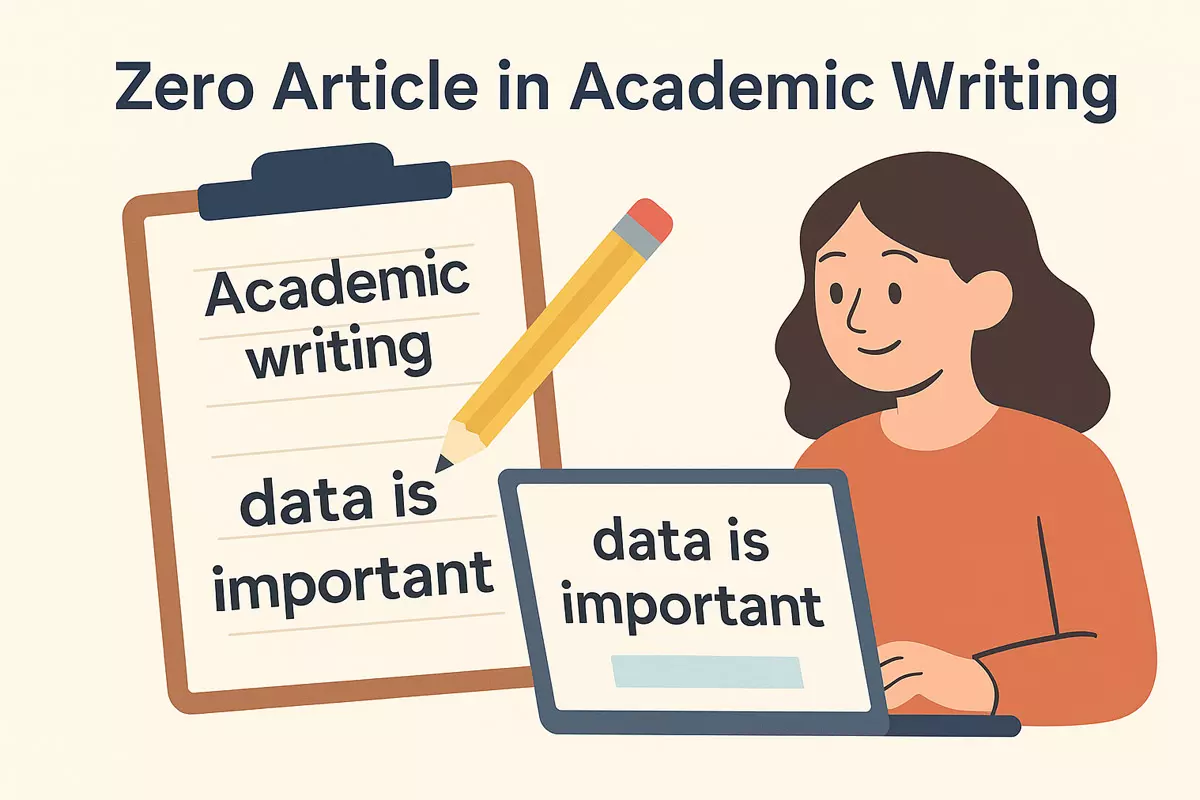 This article explains when academic English omits articles, focusing on abstract nouns, general concepts, research processes, and proper nouns. It also highlights frequent article errors and provides practice with real examples.
- What Zero Article Means in Academic English
- When Zero Article Is Used with Abstract Nouns
- General Concepts and Fields of Study without Articles
- Zero Article in Research Descriptions and Processes
- Proper Nouns and Institutions without Articles
- Common Mistakes with A/An/The in Academic Contexts
- Practice: Add or Remove Articles in Sample Sentences
Many students struggle with knowing when to omit articles such as "a" or "the" in research papers, which can make their writing less precise and professional. Recognizing situations where articles are unnecessary—such as with general statements, uncountable nouns, or plural nouns in a broad sense—can significantly improve clarity and style. Mastering this aspect is particularly important for learners at the B2 level, as it helps their academic writing appear more fluent and advanced, allowing ideas to be communicated more effectively.
What Zero Article Means in Academic English
Zero article refers to the absence of any article (a, an, the) before a noun. In academic English, this omission is not random—it follows specific rules and signals particular meanings. Recognizing when to omit articles is essential for clarity, precision, and a natural academic style.
Typical Contexts for Zero Article Usage
Writers often leave out articles before certain types of nouns in formal texts. This usually happens with uncountable nouns, plural countable nouns when speaking in general terms, and names of languages or academic subjects. Consider these common cases:
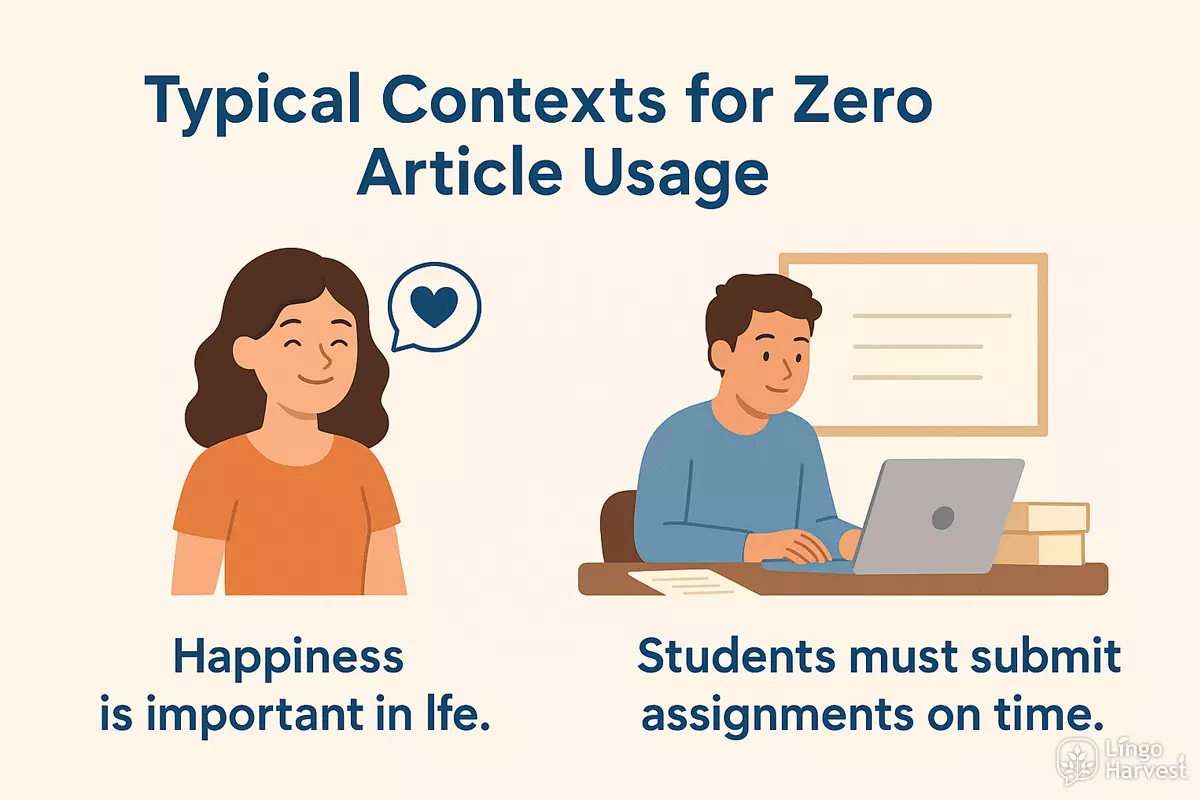
- Abstract nouns used generally: Happiness is important in life.
- Plural countable nouns in general statements: Students must submit assignments on time.
- Names of academic subjects: He studies mathematics and biology.
- Languages: French is spoken in many countries.
- Meals: We discussed the topic after lunch.
- Most countries and cities: Research was conducted in Canada and Germany.
- Sports: She plays tennis professionally.
- Means of transport (with by): Data was collected by train.
- Days, months, holidays: Classes begin Monday.
- Institutions (when used for their primary purpose): Children go to school at 8 a.m.
- Illnesses (in general): He has flu.
- Materials: Glass is fragile.
- Most proper nouns: Einstein developed the theory.
- Titles and positions (when used with a name): Professor Smith will present.
- Times of day (with at, by): The experiment finished at midnight.
- Organizations (sometimes): She works for UNICEF.
- Magazines/newspapers (sometimes): He reads Time regularly.
- Activities or processes: Research is ongoing.
Why Is Zero Article Important in Academic Texts?
Using or omitting articles changes meaning and formality. For example, "The research" refers to specific studies, while "Research" covers the entire field. The zero article helps generalize, categorize, and maintain objectivity—traits valued in scholarly writing.
Zero Article vs. Definite/Indefinite Articles
To clarify how the zero article differs from "the," "a," and "an," see the structured comparison below:
| Form | Example | Typical Use in Academic English |
|---|---|---|
| Zero Article | Science advances rapidly. | Used for generalizations, uncountable nouns, and academic subjects. |
| Definite Article ("the") | The experiment was successful. | Refers to specific items or known information. |
| Indefinite Article ("a/an") | A hypothesis was proposed. | Introduces new, non-specific singular countable nouns. |
Summary
Mastering the use of the zero article allows writers to express concepts more precisely and naturally. In academic English, understanding when to leave out articles is just as important as knowing when to include them. This subtlety can make your writing clearer and more professional.
When Zero Article Is Used with Abstract Nouns
Abstract nouns—such as "happiness," "research," or "information"—often appear in academic writing without an article. This is because they refer to general concepts or ideas rather than specific, countable items. Using no article (zero article) helps to express these nouns in a broad or non-specific sense.
Typical Situations for Zero Article with Abstract Nouns
Writers commonly omit articles with abstract nouns in the following situations:
- Talking about concepts in general: Justice is important in every society.
- Describing fields or areas of study: Mathematics can be challenging for some students.
- Discussing qualities or emotions: Honesty is valued in academic work.
- Referring to processes or activities: Learning requires effort and dedication.
- When the noun is uncountable and unspecific: Information was gathered from various sources.
Common Abstract Nouns Used Without Articles
Here are some frequently used abstract nouns that usually take zero article in academic contexts:
- Education
- Knowledge
- Research
- Progress
- Experience
- Development
- Freedom
- Health
- Success
- Advice
- Science
- Understanding
- Growth
- Truth
- Work
- Communication
- Creativity
- Violence
- Change
- Culture
Zero Article vs. Definite/Indefinite Articles with Abstract Nouns
Sometimes, abstract nouns can be used with "the" or "a/an" to specify a particular instance or type. Compare these patterns:
| Zero Article (General) | With Article (Specific) |
|---|---|
| Happiness is essential for well-being. | The happiness she felt was obvious. |
| Research improves our understanding. | A research conducted last year showed new results. |
| Violence should be avoided. | The violence during the protest shocked everyone. |
| Education benefits society. | The education he received was excellent. |
| Experience comes with time. | An experience like that changes people. |
Summary
In academic writing, omitting the article before abstract nouns is the norm when speaking about ideas, qualities, or fields in a general way. Adding an article changes the meaning to something more specific or particular. Understanding these patterns will help your writing sound more natural and precise.
General Concepts and Fields of Study without Articles
In academic writing, certain nouns are used without “a,” “an,” or “the.” This zero article usage is common with broad ideas, disciplines, and abstract concepts. Writers often refer to academic subjects, sciences, and general knowledge areas in this way to show they are speaking about the category as a whole, not a specific example. Mastering this pattern is helpful for clear, natural-sounding English in essays, reports, and research papers.
Disciplines and Academic Subjects
Names of fields such as mathematics, biology, or history do not take an article when used in a general sense. This applies to both sciences and arts. Using an article would suggest a particular branch or instance, which is usually not the intention.
- physics
- chemistry
- medicine
- philosophy
- engineering
- politics
- economics
- literature
- law
- psychology
- architecture
- linguistics
- geography
- art
- music
- sociology
- anthropology
- education
General Concepts: Abstract Nouns
Abstract nouns representing general ideas—like freedom, progress, or information—also appear without articles. This signals that the discussion is about the concept as a whole, not a specific example or instance.
- knowledge
- research
- development
- justice
- technology
- culture
- science
- truth
- experience
- communication
- society
- innovation
- theory
- nature
- energy
Usage Patterns and Examples
Writers often use the zero article with these types of words in academic sentences. Compare the following patterns:
| Correct Form (Zero Article) | Incorrect Form (With Article) |
|---|---|
| Students study mathematics at university. | Students study the mathematics at university. |
| Research shows new trends in education. | The research shows new trends in the education. |
| Technology is changing society. | The technology is changing the society. |
| Knowledge is essential for progress. | The knowledge is essential for the progress. |
Zero Article in Research Descriptions and Processes
When explaining research methods or summarizing academic procedures, writers often omit the definite or indefinite article before certain nouns. This practice, known as using the zero article, is especially common with uncountable nouns and plural countable nouns, as well as with general references to activities or materials. Understanding when to use no article helps your writing sound more precise and professional in an academic context.
Common Contexts for Zero Article Usage
Writers typically drop the article in these research-related contexts:
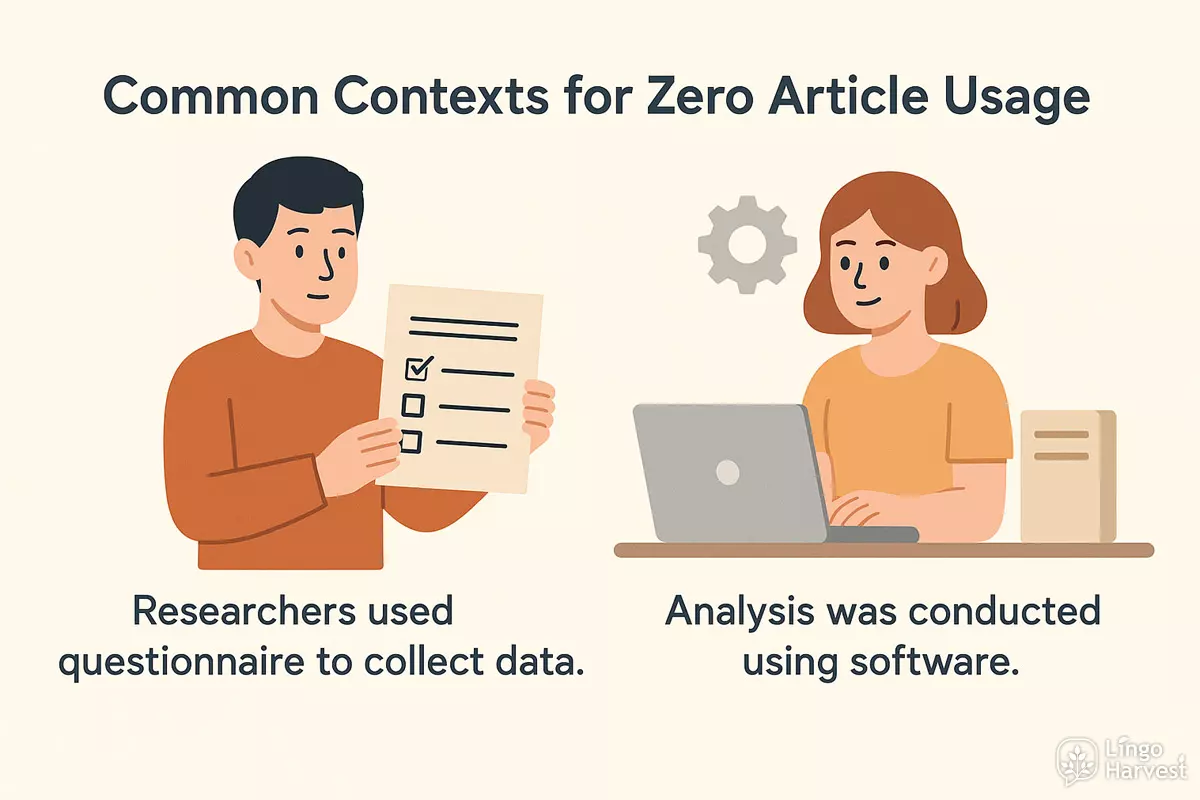
- Describing research methods: “Researchers used questionnaire to collect data.”
- Stating general procedures: “Analysis was conducted using software.”
- Referring to materials or equipment in a general sense: “Samples were placed in incubator.”
- Discussing processes: “Experiment involved observation and measurement.”
- Listing abstract concepts: “Study focuses on motivation, performance, and feedback.”
- Mentioning disciplines or fields: “Paper examines linguistics and psychology.”
- Describing data types: “Results based on survey data.”
- Referring to time or frequency: “Interviews conducted once per week.”
- Explaining variables: “Model includes control variables.”
- Reporting on stages: “Next step is analysis.”
- Introducing tools: “Researchers used SPSS for statistical analysis.”
- Generalizing findings: “Results suggest improvement in outcomes.”
- Describing roles: “Team included researchers and assistants.”
- Outlining procedures: “Procedure followed standard protocol.”
- Stating objectives: “Aim was to increase accuracy.”
Typical Patterns in Academic Writing
Omitting the article is frequent with plural and uncountable nouns when the meaning is general. For example:
- “Participants completed tasks under supervision.”
- “Research was conducted in laboratory.”
- “Authors highlight importance of collaboration.”
Zero Article vs. Article: Quick Comparison
It can be helpful to see how meaning changes when an article is added or removed. Here are some typical contrasts:
| Zero Article | With Article |
|---|---|
| Researchers collected data. | Researchers collected the data (specific data set). |
| Analysis was performed using software. | Analysis was performed using a software (unusual; “software” is uncountable). |
| Paper discusses implications for practice. | Paper discusses the implications (specific, already mentioned implications). |
| Study included interviews and questionnaires. | Study included the interviews and the questionnaires (specific set). |
Tips for B2 Learners
- Use zero article when describing procedures, materials, or general concepts.
- Insert “the” only when referring to something specific and previously mentioned.
- Remember: most academic nouns in general reference (methods, materials, processes) do not need an article.
- Check if the noun is uncountable or plural—these often take no article in research contexts.
Mastering zero article usage in describing study methods and research steps will make your academic writing clearer and more natural.
Proper Nouns and Institutions without Articles
When writing academically, certain names and institutions do not require an article ("a," "an," or "the") before them. This typically applies to unique names—such as specific people, cities, countries, organizations, and universities. Recognizing when the zero article is used can help your writing sound more natural and precise.
Personal Names and Geographical Locations
Personal names (like "Marie Curie" or "Albert Einstein") never take an article. The same rule applies to most cities, countries, and continents:
- Asia
- London
- Brazil
- Mount Everest
- Lake Baikal
- Oxford Street
However, some geographical names are exceptions, such as the United States or the Netherlands.
Institutions and Organizations
Major institutions and organizations usually appear without an article if their name is unique and specific:
- Harvard University
- Microsoft
- United Nations
- Cambridge University
- NASA
- World Health Organization
- Apple
- UNESCO
- Stanford University
- MIT
- European Union
- Oxford University
- World Bank
- Yale University
- Amazon
- BBC
- World Trade Organization
Common Patterns and Exceptions
Generally, you do not use an article with proper nouns unless the name includes a common noun with a descriptive phrase, or the official name starts with "the." Here is a summary of the patterns:
| Type | Example (Zero Article) |
|---|---|
| Personal Names | Marie Curie, Isaac Newton |
| Countries (most) | France, India, Japan |
| Universities/Institutions | Harvard University, NASA |
| Organizations | Google, UNESCO, Facebook |
| Geographical Features (single names) | Lake Victoria, Mount Fuji |
When in doubt, check if the proper name is unique and does not start with "the" officially. This approach helps keep your academic writing clear and correct.
Common Mistakes with A/An/The in Academic Contexts
Misusing articles is a frequent source of confusion in academic writing, especially for learners at the B2 level. The challenge often comes from differences between English and other languages, as well as the abstract nature of many academic subjects. Below are some typical errors and tips for avoiding them.
Omitting Articles When They Are Needed
Writers sometimes leave out "a," "an," or "the" where English requires them. This can make sentences unclear or grammatically incorrect. For example:
- Incorrect: Researcher found new evidence.
- Correct: A researcher found new evidence.
Remember that singular countable nouns almost always need an article or another determiner.
Using Articles with Uncountable or Abstract Nouns
Many academic terms are uncountable (e.g., "information," "evidence," "progress"). Adding "a" or "an" to these words is incorrect.
- ❌ An information was provided.
- ✅ Information was provided.
Confusing Definite and Indefinite Articles
Choosing between "the" and "a/an" depends on whether you mean something specific or general. This is particularly important in academic contexts, where clarity matters. For instance:
- The experiment = a specific experiment already mentioned.
- An experiment = any experiment, not specified.
Overusing "The" with General Concepts
Writers often add "the" to general or abstract nouns unnecessarily. In academic English, general statements about uncountable nouns or plural countable nouns usually do not take "the."
- ❌ The technology is advancing rapidly. (when talking about technology in general)
- ✅ Technology is advancing rapidly.
Typical Problem Patterns
Below is a structured overview of frequent article mistakes and their correct forms in academic writing:
| Incorrect Usage | Correct Usage |
|---|---|
| She is a good knowledge of biology. | She has good knowledge of biology. |
| We discussed about the climate change. | We discussed climate change. |
| This report contains an important information. | This report contains important information. |
| The students must submit the assignments by Friday. (when referring to assignments in general) | Students must submit assignments by Friday. |
| He is an expert in the mathematics. | He is an expert in mathematics. |
| They found the evidence to support the theory. (when evidence is mentioned for the first time) | They found evidence to support the theory. |
| We need a equipment for the experiment. | We need equipment for the experiment. |
| Researchers study the effects of pollution. (general statement) | Researchers study effects of pollution. |
Checklist for Article Use in Academic Writing
- Use "a/an" with singular, countable, non-specific nouns.
- Use "the" for specific nouns already mentioned or defined.
- Do not use articles with uncountable nouns when speaking generally.
- Avoid "the" with plural or abstract nouns unless specificity is clear.
- Check if the noun is countable or uncountable in English—this affects article use.
Developing an instinct for article usage takes practice. Review your writing for these patterns, and when in doubt, consult reliable academic examples or grammar references.
Practice: Add or Remove Articles in Sample Sentences
Understanding when to use or omit articles is essential for precise academic writing, especially at the B2 level. In this section, you'll work with sentences that require you to decide whether to add "a," "an," "the," or leave the article out entirely (zero article). Consider context, specificity, and countability as you make your choices.
Task 1: Decide Where to Use the Zero Article
Read the following sentences. Insert an article ("a," "an," "the") if needed, or leave the space blank if no article is required. Write your answers on a sheet or in your notes.
- ___ research shows that climate is changing rapidly.
- ___ information in this report is based on recent studies.
- Students often struggle to understand ___ academic vocabulary.
- ___ water is essential for life.
- He is ___ expert in data analysis.
- ___ education is important for economic growth.
- We conducted ___ experiment yesterday.
- ___ mathematics is difficult for many people.
- She wants to become ___ engineer.
- ___ technology has advanced significantly in recent decades.
Show answers
- Zero article (Research is uncountable and general.)
- The (Refers to specific information in the report.)
- Zero article ("Academic vocabulary" is general.)
- Zero article (Water is uncountable and general.)
- An (Expert begins with a vowel sound; first mention.)
- Zero article (Education in general.)
- An (First mention of "experiment," which starts with a vowel sound.)
- Zero article (Mathematics as a field.)
- An (First mention, starts with a vowel sound.)
- Zero article (Technology in general.)
Task 2: Article Errors – Spot and Correct
Some of these sentences contain unnecessary articles or are missing one. Identify and correct the mistakes.
- The knowledge is important for success.
- He is studying the biology at university.
- She gave a useful feedback after presentation.
- Pollution affects environment globally.
- A science helps us understand world.
Show answers
- Knowledge is important for success. (Remove "the" – general, uncountable noun.)
- He is studying biology at university. (Remove "the" – academic subject.)
- She gave useful feedback after the presentation. (Remove "a" – feedback is uncountable; add "the" for specific presentation.)
- Pollution affects the environment globally. (Add "the" – refers to the environment in general.)
- Science helps us understand the world. (Remove "a" before "science" – general; add "the" before "world" – specific.)
Common Nouns with the Zero Article in Academic Writing
Here are examples of nouns that typically do not take an article in scholarly contexts. Familiarize yourself with these patterns:
- Research
- Information
- Education
- Society
- Knowledge
- Technology
- Mathematics
- Science
- History
- Nature
- Health
- Environment
- Time
- Culture
- Progress
- Development
- Change
- Language
- Art
Summary Table: When to Use or Omit Articles
| Type of Noun/Context | Article Usage |
|---|---|
| Uncountable nouns (general meaning) | Zero article: "Knowledge is power." |
| Academic subjects | Zero article: "She studies mathematics." |
| Plural, general nouns | Zero article: "Computers are useful." |
| Specific reference (unique or previously mentioned) | Use "the": "The experiment was successful." |
| First mention of singular countable noun | Use "a/an": "A solution was proposed." |