The Definite Article “the”: First Introduction

 Here we when to use 'the', explains the difference between specific and general meanings, unique objects, and shared knowledge. It also discusses 'the' with places, common beginner mistakes, and includes practice exercises.
Mastering the small yet powerful word that identifies something specific in English can significantly improve the clarity of your communication. Although it may seem simple, using this word correctly allows you to clearly direct attention to a particular object or idea, making your speech or writing more precise. This concise guide aims to help you understand when and how to use it effectively, so you can express your thoughts with greater confidence and accuracy in everyday conversations and written work.
When 'the' is needed
The definite article “the” appears before nouns when a specific person, place, or thing is being referred to and the listener or reader can identify exactly what is meant. This small word signals that both the speaker and the audience know which noun is involved, either because it’s unique, previously mentioned, or clear from the context.
Before unique or well-known things
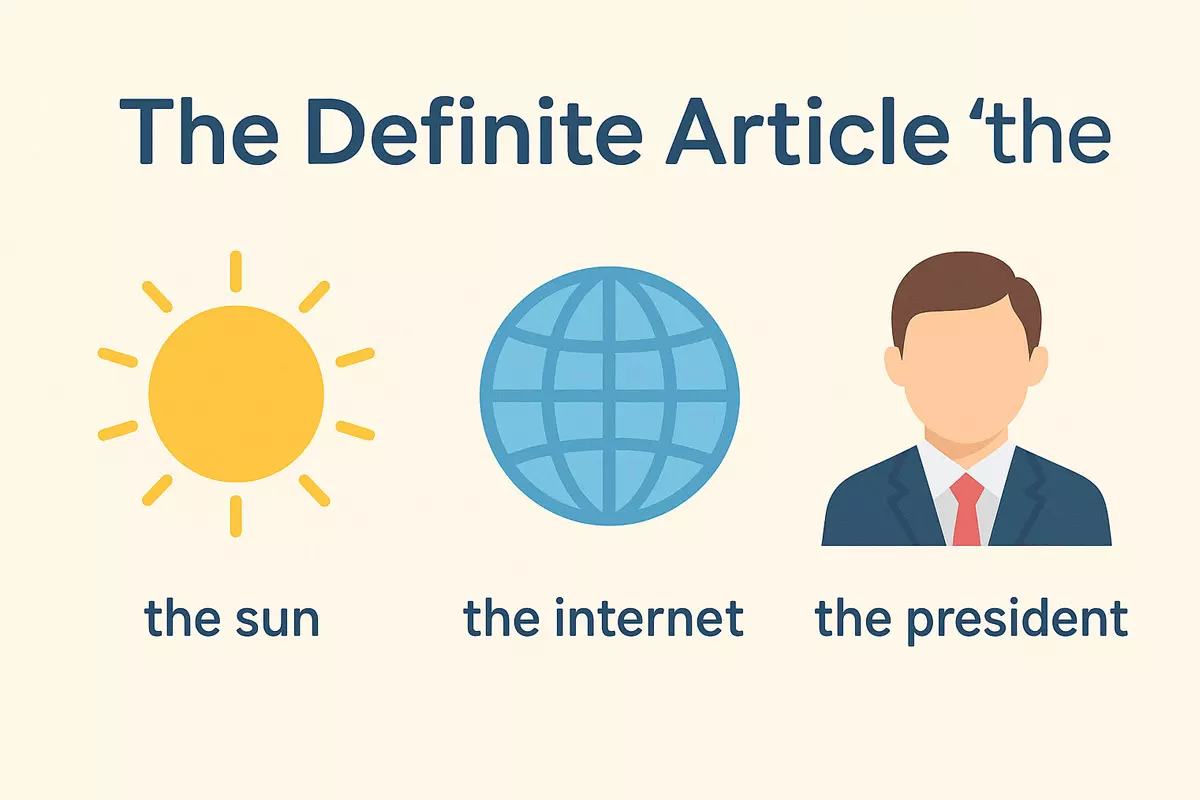
Use this article with nouns that refer to something one-of-a-kind or universally recognized. For example:
- the sun
- the internet
- the president
- the Eiffel Tower
- the equator
With previously mentioned nouns
If a noun has already been introduced earlier in the conversation or text, it’s common to use “the” when talking about it again. This shows you mean the same item or person.
- I saw a dog in the park. The dog was barking loudly.
- She bought a book. The book was expensive.
In context with limiting information
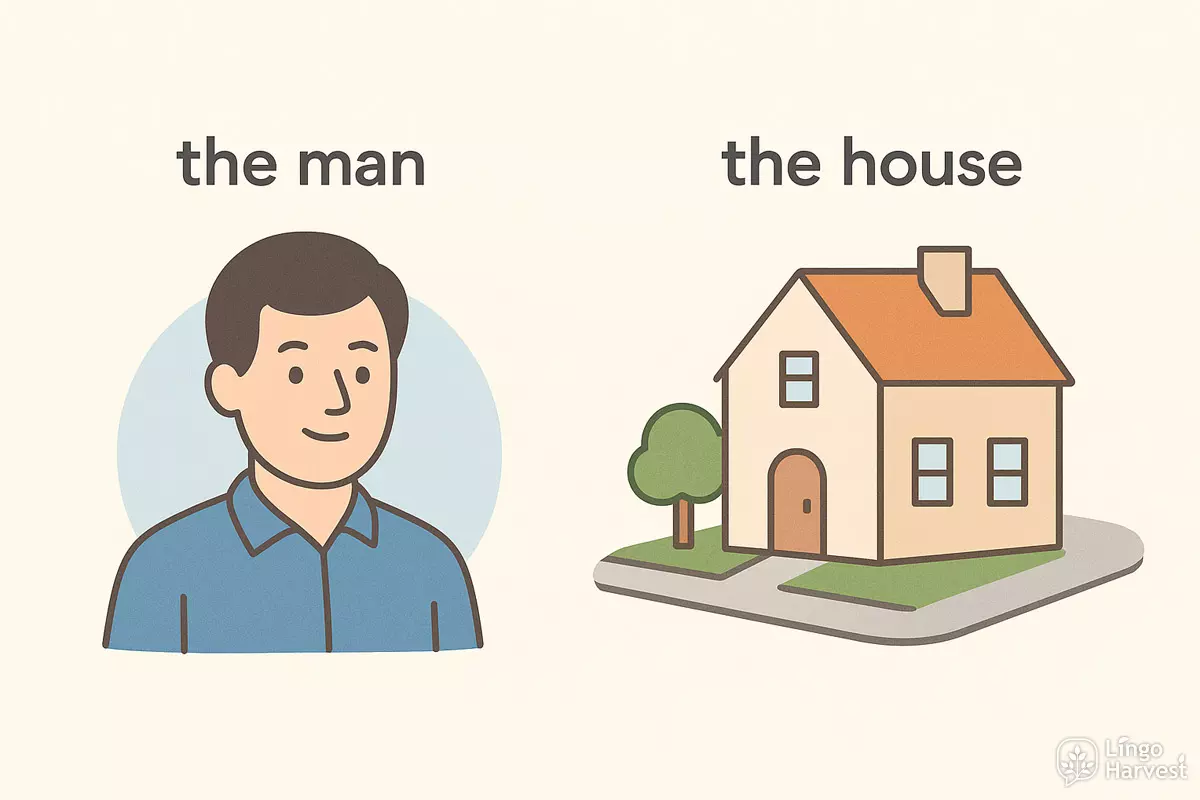
When a noun is made specific by a phrase or clause that follows, the definite article is used. This helps single out exactly which thing is meant.
- the man in the blue shirt
- the house on the corner
- the cookies you baked
With superlatives and ordinal numbers
Superlative adjectives and ordinal numbers always need “the” because they indicate something unique or ranked.
- the best solution
- the first time
- the most important rule
- the third chapter
In common phrases and expressions
Certain set phrases in English always take this article. Some useful examples include:
- in the morning
- at the moment
- on the left/right
- in the past/future
- in the middle
Before groups, instruments, and systems
When talking about whole groups (like species or nationalities), musical instruments, or systems, the definite article is standard.
- the French (meaning the French people)
- the piano
- the internet
- the environment
- the police
Summary Table: Specificity and “the”
| Situation | Example |
|---|---|
| Known from context | Can you close the window? (There is only one window in the room.) |
| Unique item | The moon looks beautiful tonight. |
| Previously mentioned | I saw a cat. The cat was black. |
| With superlatives | This is the biggest building in town. |
| With ordinal numbers | He was the second person to arrive. |
Choosing “the” is all about clarity and specificity. Whenever you want to make sure your listener knows exactly which person, thing, or place you mean, this article is the right choice.
Specific vs general meaning
When learning how to use “the,” it helps to compare situations where something is clearly identified versus those where things are more general or undefined. “The” points to one particular item or group already known to the speaker and listener. In contrast, when we speak in broad terms or about things in general, “the” is usually not needed.
Using “the” for particular reference
If both the speaker and listener know exactly which thing is meant, “the” is used. This could be because the item has been mentioned before, is unique, or is defined by context. For example:
- Can you pass the salt? (a specific item on the table)
- We visited the museum yesterday. (a particular museum known to both people)
- The sun rises in the east. (only one sun in our sky)
General reference: When “the” is not used
If you are talking about things in a broad sense, without pointing to a unique or previously mentioned thing, “the” is left out. Often, this means using the plural or uncountable form without any article. For example:
- Salt is important for health. (any salt, in general)
- Museums can be interesting places. (all museums, not a particular one)
- Children like to play outside. (children in general)
Comparison: Definite vs. General Reference
| Definite (using “the”) | General (no “the”) |
|---|---|
| The dog barked all night. ✅ | Dogs bark at strangers. ✅ |
| I finished the book you lent me. ✅ | Books are a great source of knowledge. ✅ |
| The water in this bottle is cold. ✅ | Water covers most of the Earth’s surface. ✅ |
| The teacher is absent today. ✅ | Teachers play an important role. ✅ |
| The apples on the table are fresh. ✅ | Apples are good for you. ✅ |
Quick tips for choosing “the” or no article
- Use “the” when referring to something unique, specific, or already mentioned.
- Omit “the” for statements about things in general, categories, or when there is no clear reference.
- Remember: some nouns, like countries or languages, generally don’t use “the” unless they have words like “kingdom,” “states,” or “republic.”
Understanding when to use this definite article and when to leave it out is essential for clear, precise English. With practice, these patterns become much more intuitive.
Unique objects and shared knowledge
When we use “the,” we often signal that something is either one-of-a-kind or already familiar to both the speaker and listener. This article is not just for objects that are unique in the world, but also for things known in the situation or context. For example, when someone says, “Please close the door,” it’s clear which door is meant—the one relevant to both people in the conversation.
One-of-a-kind items
The definite article is used for objects that are unique by nature or definition. This includes things that exist as single entities, such as celestial bodies or institutions. Some typical cases:
- the sun
- the moon
- the Earth
- the internet
- the government
- the White House
In all these examples, the item is unique, so “the” helps listeners immediately identify the subject.
Shared knowledge in conversation
Beyond true uniqueness, “the” is also used when both parties know what is being discussed, even if it’s not globally unique. For instance:
- the car (the one we both see or know about)
- the teacher (the one who teaches our class)
- the meeting (the one we mentioned earlier)
- the kitchen (the one in this house)
- the problem (the one we’re trying to solve)
Here, context or prior mention makes the reference clear.
Summary: Uniqueness vs. Familiarity
To clarify the difference between using “the” for uniqueness and for shared knowledge, here’s a comparison:
| Usage Type | Example with Explanation |
|---|---|
| Unique object | The sun rises in the east. (Only one sun for our planet.) |
| Shared situational knowledge | Can you pass me the salt? (Both know which salt is meant, e.g., on the table.) |
| Previously mentioned item | I saw a dog. The dog was barking. (“The dog” refers back to “a dog” just mentioned.) |
| Unique in context | She went to the bathroom. (Only one bathroom relevant in this setting.) |
Understanding these patterns helps learners use “the” correctly, signaling whether something is unique or simply known within the situation. The key is always considering what is obvious or shared between people in the conversation.
Using 'the' with places
When talking about locations, whether you need “the” depends on the type of place and how it is commonly used in English. Some names always require the definite article, while others never do, and a few depend on the context or the specific name.
Places that need "the"
Certain geographical names and landmarks are always used with "the." This is especially true for:
- Rivers: the Thames, the Amazon, the Nile
- Oceans and seas: the Pacific Ocean, the Mediterranean Sea, the Baltic Sea
- Mountain ranges: the Alps, the Rocky Mountains, the Andes
- Deserts: the Sahara, the Gobi Desert
- Groups of islands: the Maldives, the Philippines, the Bahamas
- Some countries with plural names or 'of': the United States, the Netherlands, the United Kingdom, the Republic of Ireland
- Regions: the Middle East, the Arctic, the Far East
- Hotels, cinemas, and some institutions: the Ritz, the Odeon, the British Museum
Places that do not need "the"
Many place names are used without the definite article. This is true for:
- Continents: Europe, Asia, Africa
- Most countries: France, Brazil, Japan
- Cities and towns: London, Cairo, Sydney
- Single mountains: Mount Everest, Mount Fuji
- Lakes: Lake Victoria, Lake Baikal
- Parks and streets: Hyde Park, Oxford Street
- Airports and stations: Heathrow Airport, Victoria Station
Common patterns and exceptions
Some places can be tricky. For example, islands as a group take "the" (the Canary Islands), but individual islands do not (Sicily, Corsica). The same goes for mountains versus ranges.
| Type of Place | Example with/without "the" |
|---|---|
| River | the Nile |
| Country (singular) | France |
| Group of islands | the Maldives |
| Mountain (single) | Mount Everest |
| Desert | the Sahara |
| City | Tokyo |
| Sea | the Mediterranean Sea |
| Lake | Lake Superior |
When in doubt, check if the place is a group, a region, or a feature (like a river or desert)—these usually take "the." In contrast, most cities, countries, and single natural features do not. Practice helps to make these patterns feel more natural over time.
Beginner mistakes with 'the'
Many learners find the use of "the" challenging because its rules differ from their native languages. Misunderstandings often arise from overusing or omitting this definite article in English sentences. Let’s look at the most typical pitfalls and how to avoid them.
Omitting "the" when it is needed
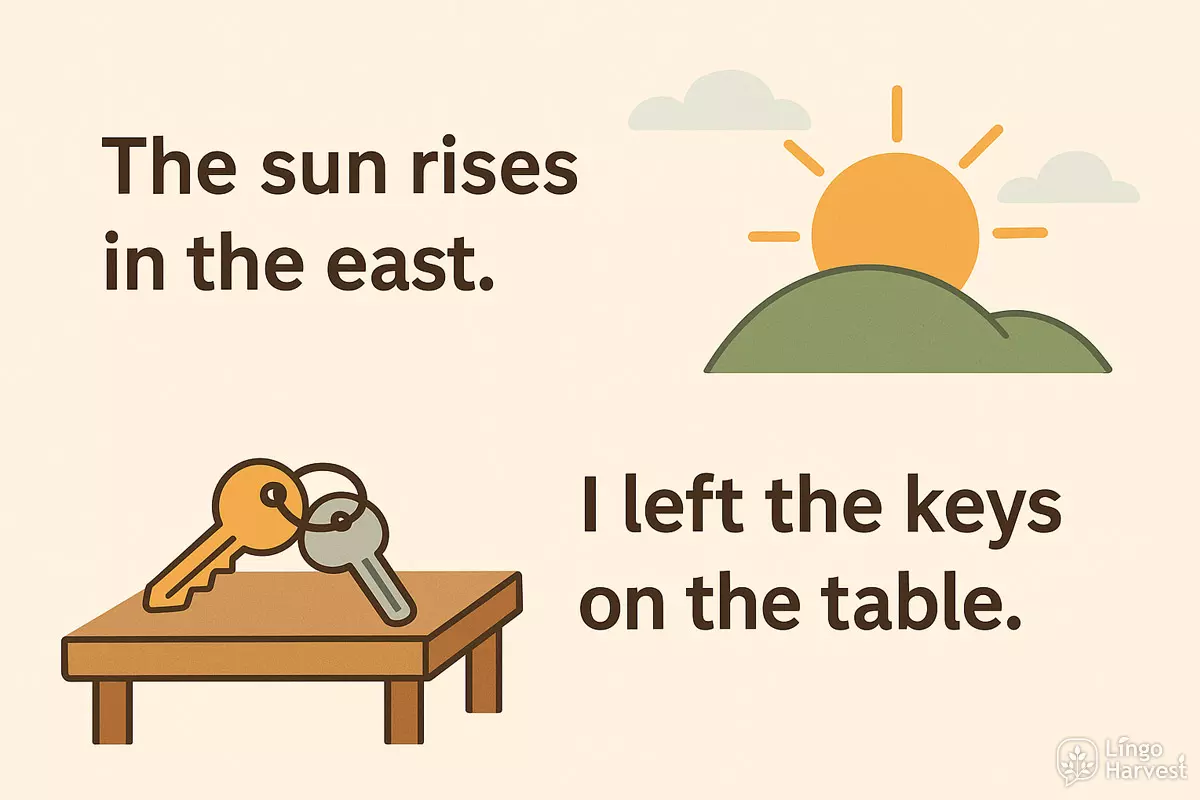
Sometimes, beginners forget to include "the" before specific nouns. This usually happens with unique objects, places, or when talking about something already known to both the speaker and listener. For example:
- Incorrect: Sun rises in east.
- Correct: The sun rises in the east.
- Incorrect: I left keys on table.
- Correct: I left the keys on the table.
Adding "the" where it is not needed
Another common error is inserting "the" before general or plural nouns, or with proper names that do not require it. English does not use "the" with most countries, languages, or when speaking generally:
- Incorrect: The cats are friendly animals. (when speaking about cats in general)
- Correct: Cats are friendly animals.
- Incorrect: The Mount Everest is the highest mountain.
- Correct: Mount Everest is the highest mountain.
- Incorrect: The English is difficult.
- Correct: English is difficult.
Confusing general and specific meaning
Choosing whether to use "the" depends on whether you are referring to something specific or general. Here are some examples to clarify:
| General (No "the") | Specific (Use "the") |
|---|---|
| Coffee is popular worldwide. | The coffee you made is delicious. |
| Books can be expensive. | The books on the table are mine. |
| Children need sleep. | The children in my class are noisy. |
| Cars are useful. | The car outside is new. |
| Water is essential. | The water in this bottle is cold. |
Common areas of confusion
Below is a list of situations where errors with this article often occur:
- Before names of people (never use "the": the John ❌)
- With most countries (the France ❌ vs. France ✅)
- Before meals (the breakfast ❌ vs. breakfast ✅)
- With languages (the Spanish ❌ vs. Spanish ✅)
- Before streets (the Oxford Street ❌ vs. Oxford Street ✅)
- With modes of transport (by the bus ❌ vs. by bus ✅)
- Before most holidays (the Christmas ❌ vs. Christmas ✅)
- With plural or uncountable nouns when speaking generally (the dogs are loyal ❌ vs. dogs are loyal ✅)
- Before academic subjects (the mathematics ❌ vs. mathematics ✅)
- With sports (the football ❌ vs. football ✅)
Summary
Understanding when to use or skip this definite article is essential for sounding natural in English. Focus on whether the noun is specific or general, and pay attention to set expressions and proper names. Over time, these patterns will become more automatic.
Practice for beginners
Let’s build your confidence with “the” by exploring its use in natural sentences. Understanding when to include this small but important word is a crucial step for new English learners. Below you’ll find simple activities to help you notice and practice definite article patterns.
Spot the definite article
Read the sentences below. Decide if “the” should be included in each blank. Write your answer in the space provided.
- ___ sun rises in the east.
- I saw ___ dog you told me about.
- ___ books on the table are mine.
- She likes ___ chocolate from Belgium.
- ___ Mount Everest is the highest mountain.
- We looked at ___ sky full of stars.
- He lives in ___ city center.
- She went to ___ doctor yesterday.
- They crossed ___ Pacific Ocean by ship.
- I left my keys on ___ kitchen table.
- ___ Earth goes around the sun.
- We listened to ___ news on the radio.
Show answers
- the
- the
- The
- the
- — (no article)
- the
- the
- the
- the
- the
- The
- the
Common uses of “the”
Here are typical cases where “the” is used. Review these to help you remember:
- When both speaker and listener know what is meant: the car outside.
- With unique things: the moon, the president.
- For superlatives: the best, the tallest.
- With names of rivers, seas, and some groups: the Amazon, the Pacific, the Netherlands.
- When referring to something already mentioned: I bought a book. The book is interesting.
- With ordinal numbers: the first day, the third chapter.
- With musical instruments: the piano, the guitar.
- For some public places: the bank, the station.
- With adjectives as nouns: the rich, the poor.
- With some geographical names: the Alps, the Sahara.
- For decades and centuries: the 1990s, the 21st century.
- With family names (plural): the Smiths.
Choose the correct sentence
Pick the correct option in each pair. Which sentence uses “the” correctly?
- a) I went to the school yesterday.
b) I went to school yesterday. - a) She visited the France last summer.
b) She visited France last summer. - a) The Nile is a long river.
b) Nile is a long river. - a) The cats are friendly animals.
b) Cats are friendly animals. - a) He went to the hospital to visit a friend.
b) He went to hospital to visit a friend. - a) The Mount Everest is the highest mountain.
b) Mount Everest is the highest mountain. - a) She opened the window.
b) She opened window. - a) Children love the chocolate.
b) Children love chocolate. - a) I am going to the bed now.
b) I am going to bed now. - a) The Amazon flows through several countries.
b) Amazon flows through several countries.
Show answers
- b
- b
- a
- b
- a
- b
- a
- b
- b
- a
Quick reference: When to use “the” and when not to
| Use “the” | Do NOT use “the” |
|---|---|
| When the noun is specific or unique: the sun, the only answer |
With names of most countries or cities: France, Tokyo |
| With rivers, seas, oceans, groups of islands/mountains: the Amazon, the Alps |
With meals, languages, or subjects: breakfast, English, history |
| When something is already mentioned: I saw a cat. The cat ran away. |
With most streets, parks, or lakes: Regent Street, Lake Michigan |
| With superlatives and ordinals: the best, the first |
With people’s names (singular): John, Professor Smith |
Keep practicing by listening and reading in English, and try to notice how “the” is used in different contexts. Over time, these patterns will become more natural and automatic.