Articles with Singular and Plural Nouns: Basic Patterns

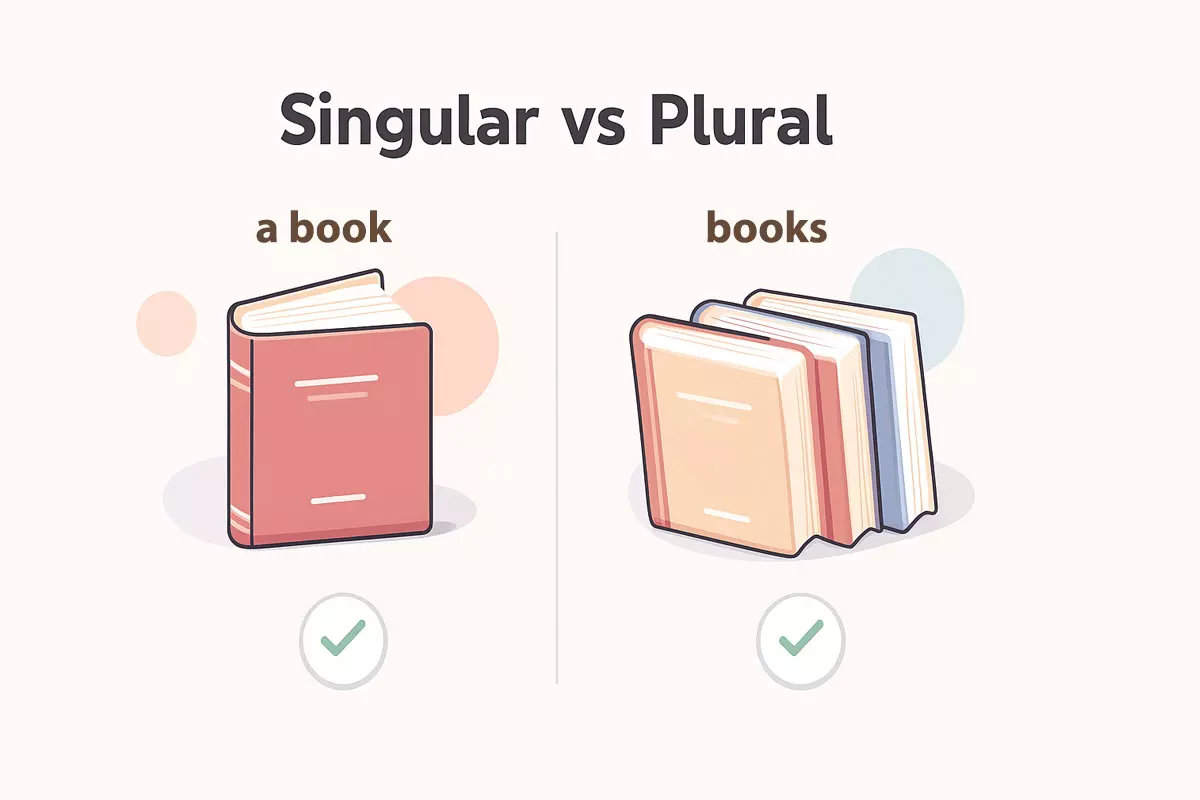 The article explains how to use articles with singular and plural nouns, discusses general versus specific meaning, and shows when to use no article with plurals. It also offers a pattern chart and practice activities for reinforcement.
Mastering when to use "a," "an," or "the" with singular and plural nouns can significantly improve your clarity and accuracy in English. "A" and "an" are indefinite articles used with singular nouns when referring to something not specifically identified; use "a" before words starting with a consonant sound and "an" before words starting with a vowel sound. "The" is a definite article used with both singular and plural nouns to refer to something specific or already mentioned. By applying these rules, you can express your ideas more precisely and avoid common mistakes in everyday communication.
Articles before singular nouns
When a noun is singular and countable, English grammar almost always requires an article before it. The main choices are “a/an” for indefinite reference and “the” for definite reference. Using no article with a singular, countable noun is generally incorrect. The selection depends on context, meaning, and whether the noun has been mentioned before or is unique.
Indefinite articles: "a" and "an"
Use “a” before words that begin with a consonant sound, and “an” before words that begin with a vowel sound. This signals that you are talking about any one example of the noun, not a specific one. For example:
- a cat
- an apple
- a book
- an hour (note the silent "h")
- a university (note the "ju:" sound)
- a dog
- an elephant
- a house
- an idea
- a teacher
Definite article: "the"
"The" is used when the listener or reader knows which specific thing is meant — because it was mentioned earlier, is unique, or is clear from context. For example:
- the sun
- the car we saw
- the answer
- the only solution
- the doctor (when it’s clear which doctor)
- the city center
- the movie we talked about
- the keys on the table
- the best option
- the man at the door
Comparing usage: indefinite, definite, and zero article
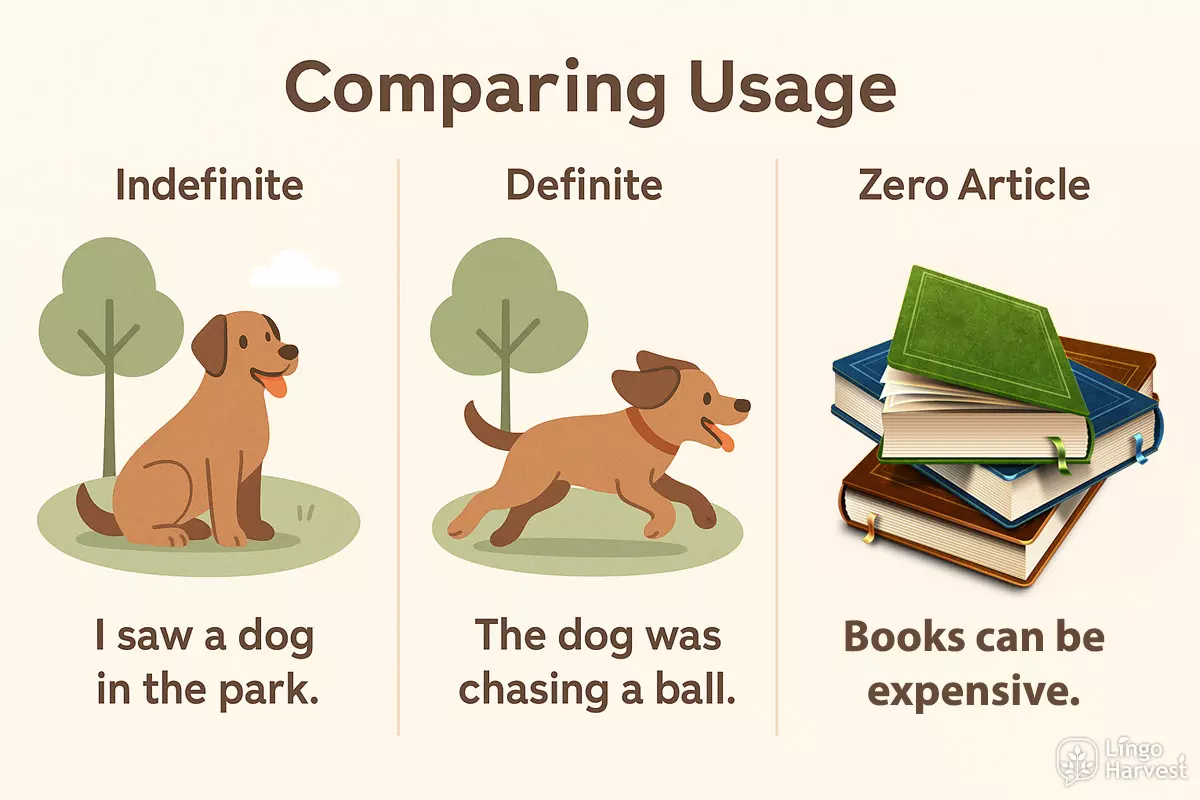
| Form | When used | Example |
|---|---|---|
| a / an | First mention, any one of a kind | I saw a dog in the park. |
| the | Specific or previously mentioned item | The dog was chasing a ball. |
| (no article) | Uncountable/plural nouns (not singular countable) | (Incorrect: I saw cat.) ❌ |
Special cases and common mistakes
Some singular nouns always need “the” because they refer to something unique (e.g., the earth, the president). Others, like job titles or roles, often use “a/an” when first introduced. Singular countable nouns almost never appear without an article; saying “I want apple” instead of “I want an apple” is incorrect in standard English.
Summary: essential points
- “A/an” for nonspecific, singular, countable nouns.
- “The” for something specific or unique.
- No article is used only with uncountable or plural nouns, not with singular countables.
- Pay attention to pronunciation for “a” vs. “an.”
- Context determines which form to use.
Articles before plural nouns
When using articles with plural nouns, English follows a few straightforward patterns. Generally, the definite article the is the only article used with plural nouns, while the indefinite article a/an is not used in these situations. In many cases, plural nouns appear without any article, especially when speaking in general terms.
When to use no article
Plural nouns usually do not require an article when referring to things in general. For example:
- Cats are independent animals.
- Books can be expensive.
- Cars pollute the environment.
- Teachers shape young minds.
- Mountains cover much of the country.
- Computers simplify our work.
- Apples are rich in vitamins.
- People need sleep.
- Ideas change the world.
- Rivers flow to the sea.
In these sentences, no article is used because the statements refer to all members of the group, not any specific ones.
When to use "the" with plurals
Use the before plural nouns when talking about specific groups that have already been mentioned or are known to the listener. For example:
- The books on the table belong to Sarah.
- The students in this class are very talented.
- The apples you bought are delicious.
- The dogs next door bark all night.
- The teachers at my school are friendly.
- The mountains we climbed were challenging.
- The computers in the lab are new.
- The people at the party were friendly.
- The ideas you proposed are interesting.
- The rivers in this region are polluted.
Here, the signals that we are talking about a particular set of items or people, not about them in general.
Quick reference: Plural noun patterns
| Pattern | Example |
|---|---|
| No article, general meaning | Dogs need exercise. ✅ |
| The + plural noun, specific group | The dogs in the park are friendly. ✅ |
| A/an + plural noun | ❌ Incorrect: “A dogs bark at night.” |
| Some + plural noun (optional for unspecified quantity) | Some dogs are noisy. |
Summary tips
- Use the for specific plural nouns already known or identified. - Omit the article when talking about things or people in general. - Never use a/an with plural nouns. - Some can be used before plural nouns to express an unspecified number, but it is not always necessary. Understanding these patterns will help you use articles correctly with plural forms, making your English clearer and more natural.
General vs specific meaning
When choosing articles for singular or plural nouns, the intended meaning—whether we refer to things in a broad, all-encompassing way or highlight particular items—plays a major role. English uses articles to signal if we’re talking about things in general or about something definite and known.
How articles show broad or narrow reference
No article is used when we talk about things in a general sense, especially with plural or uncountable nouns:
- Cats are independent animals. (all cats in general)
- Water is essential for life. (all water, not a specific sample)
But when we add "the," we’re narrowing our focus:
- The cats in my house are friendly. (a particular group)
- The water in this glass is cold. (a specific quantity)
Singular nouns: a, an, the, or no article?
Singular countable nouns almost always need an article or determiner. "A" or "an" is used for a non-specific instance, while "the" points to something known or previously mentioned.
- I saw a dog in the yard. (any dog, not particular)
- The dog was barking. (now we know which one)
Plural and uncountable nouns: article use
Plural and uncountable nouns generally omit the article for general reference:
- Books can teach us a lot. (in general)
- Information travels fast. (all information)
But add "the" for specific groups or items:
- The books on the shelf are new. (not all books, just these)
- The information you gave was helpful. (particular details)
Comparing article patterns for general vs. specific reference
| Type of Reference | Example & Article Use |
|---|---|
| General, plural noun | Dogs are loyal. ✅ |
| Specific, plural noun | The dogs next door are loud. ✅ |
| General, singular noun | A dog makes a good pet. ✅ |
| Specific, singular noun | I fed the dog this morning. ✅ |
| General, uncountable noun | Music relaxes me. ✅ |
| Specific, uncountable noun | The music at the party was loud. ✅ |
Quick guide: When to use or omit articles
- Use no article for general statements with plurals or uncountable nouns.
- Use a/an with singular countable nouns for non-specific reference.
- Use the for specific, known, or previously mentioned nouns (singular or plural, countable or uncountable).
Understanding these patterns helps you express whether you mean all things in a category or a particular set, making your communication clearer and more precise.
Zero article with plurals
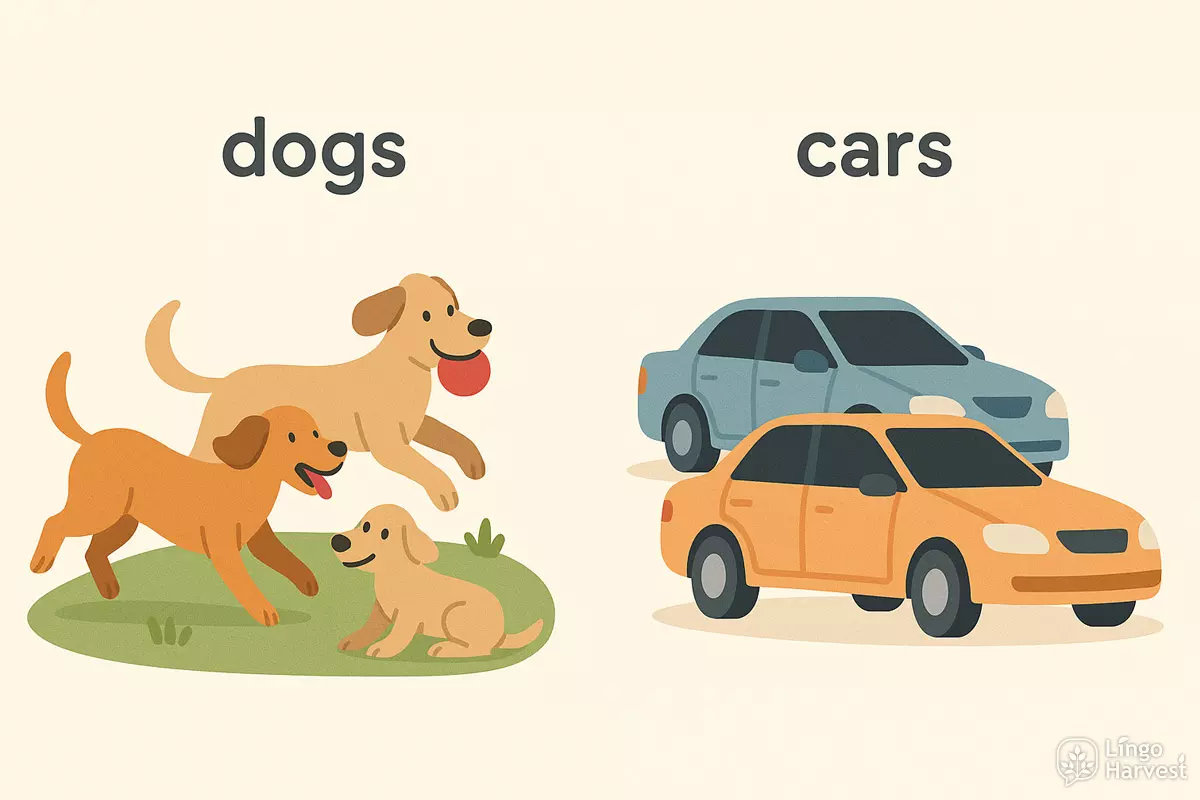
When talking about general ideas or categories, English usually drops the article before plural nouns. This means we say "Cats are friendly" rather than "The cats are friendly" when referring to all cats, not a specific group. This pattern helps speakers make broad statements, discuss habits, or refer to groups in general rather than particular individuals.
Common uses for plural nouns without articles
This structure appears in several useful contexts:
- To express general truths: Dogs love to play.
- Describing categories: Cars are expensive.
- Discussing professions: Doctors help people.
- When talking about food in general: Apples are healthy.
- With abstract or uncountable meanings: Ideas change society.
- Making recommendations: Vegetables are good for you.
- Speaking about types: Computers are useful tools.
- Referring to people as a group: Students need motivation.
- With sports or activities: Games improve teamwork.
- For scientific statements: Planets orbit stars.
- Describing frequently occurring events: Holidays bring families together.
- In headlines or notes: Prices rise.
- With general rules or laws: Rules apply to everyone.
- Expressing likes/dislikes in general: Children dislike broccoli.
- Talking about plural objects in a category: Books are expensive.
Comparing: article vs. no article with plural nouns
The presence or absence of an article changes the focus from general to specific. The following table demonstrates how meaning shifts depending on whether you use an article:
| Form | Meaning |
|---|---|
| No article: Dogs bark. | All dogs (in general) bark; a general statement. |
| The: The dogs bark. | Specific dogs (already mentioned or known); not all dogs. |
| No article: Students study hard. | All students in general; a broad claim. |
| The: The students study hard. | Particular students (for example, in this class). |
In summary, omitting the article before a plural noun helps you make statements about things in general, rather than narrowing your focus to a particular group. This is a fundamental pattern in English grammar and is used frequently in both spoken and written communication.
Simple pattern chart
Understanding how articles work with both singular and plural nouns can be much easier when you look at common sentence patterns. English often follows predictable structures for using “a,” “an,” “the,” or no article at all depending on the noun form and context. Below, you’ll find a clear overview of the main patterns, followed by examples that illustrate how articles pair with singular and plural nouns in everyday language.
Key patterns for articles with nouns
The use of articles in English depends on two main things: whether the noun is countable or uncountable, and if it is singular or plural. Here are some essential structures you’ll encounter:
- a/an + singular countable noun (a cat, an apple)
- the + singular or plural noun (the book, the books)
- No article + plural or uncountable noun when speaking generally (dogs bark, water boils)
- the + uncountable noun when it’s specific (the information you gave)
Article usage with singular and plural nouns
To make the distinctions more visual, here is a structured summary of how articles are used with different noun forms:
| Noun Form | Common Patterns | Example | Notes |
|---|---|---|---|
| Singular, countable | a/an + noun the + noun |
a dog, the dog | Use “a/an” for non-specific, “the” for specific. |
| Plural, countable | no article + noun the + noun |
dogs, the dogs | No article for general groups, “the” for specific ones. |
| Uncountable | no article + noun the + noun |
water, the water | No article for general reference, “the” when specified. |
Useful examples for practice
Here are various examples to help you see how these patterns appear in real sentences:
- a chair → the chair
- an apple → the apple
- cats like milk
- the cats in the garden
- books are useful
- the books on the table
- milk is healthy
- the milk in this cup
- a child
- the children
- information (general, no article)
- the information you need
- an egg
- the eggs
- cars pollute
- the cars outside
These patterns and examples make it easier to recognize when to use each article with singular and plural nouns. Practice with these structures can help you gain confidence and accuracy in everyday communication.
Practice activities
Understanding how to use articles with both singular and plural nouns is best achieved through varied exercises. Below, you’ll find several interactive tasks designed to reinforce your ability to choose the correct article or omit it where necessary. These activities focus on real-world usage and encourage you to notice patterns and exceptions.
Fill in the Blanks
Insert a, an, the, or leave the space blank where no article is needed.
- ______ apple a day keeps ______ doctor away.
- She saw ______ birds in the garden.
- ______ computer on the desk is new.
- He doesn’t like ______ milk.
- They visited ______ museum yesterday.
- Can you close ______ window, please?
- My sister is ______ engineer.
- We went to ______ park near our house.
- She wants to buy ______ umbrella.
- ______ people usually enjoy warm weather.
Show answers
- An apple a day keeps the doctor away.
- She saw — birds in the garden.
- The computer on the desk is new.
- — milk.
- The museum yesterday.
- The window.
- An engineer.
- The park.
- An umbrella.
- — people.
Identify the Correct Article
Choose the correct option for each sentence.
- He wants to buy (a / an / the) umbrella.
- (A / An / The) dogs barked all night.
- Can you pass me (a / the / —) salt?
- (A / An / The) oranges are sweet this season.
- I saw (a / an / the) elephant at the zoo.
- She is (a / an / the) artist.
- They walked along (a / the / —) river.
- He needs (a / an / the) information.
- We live in (a / the / —) city center.
- Can you open (a / an / the) door?
Show answers
- an umbrella
- The dogs
- the salt
- The oranges
- an elephant
- an artist
- the river
- — information
- the city center
- the door
Common Article Patterns with Nouns
The table below summarizes frequent article usage with singular and plural nouns to help visualize basic patterns:
| Type of Noun | Correct Article Usage | Example |
|---|---|---|
| Singular, countable | a/an (first mention), the (specific) | a cat, the cat |
| Plural, countable | the (specific), — (general) | the cats, cats |
| Uncountable | the (specific), — (general) | the water, water |
| Singular, unique | the only | the sun, the president |
Quick Correction
Some of the following sentences contain mistakes with articles. Underline the error and write the correct form.
- She has a amazing idea.
- We saw lions at a zoo.
- The water is essential for life.
- He is reading the interesting book.
Show answers
- a amazing idea → an amazing idea
- a zoo (correct), no change needed
- The water (correct if specific), but if general: water is essential for life
- the interesting book (correct if the book is known); if not, use: an interesting book
Try reading sentences aloud and noticing where articles appear or are omitted. This kind of repetition will help you internalize the basic patterns and avoid common errors with singular and plural nouns.