Articles with Animals and Everyday Objects

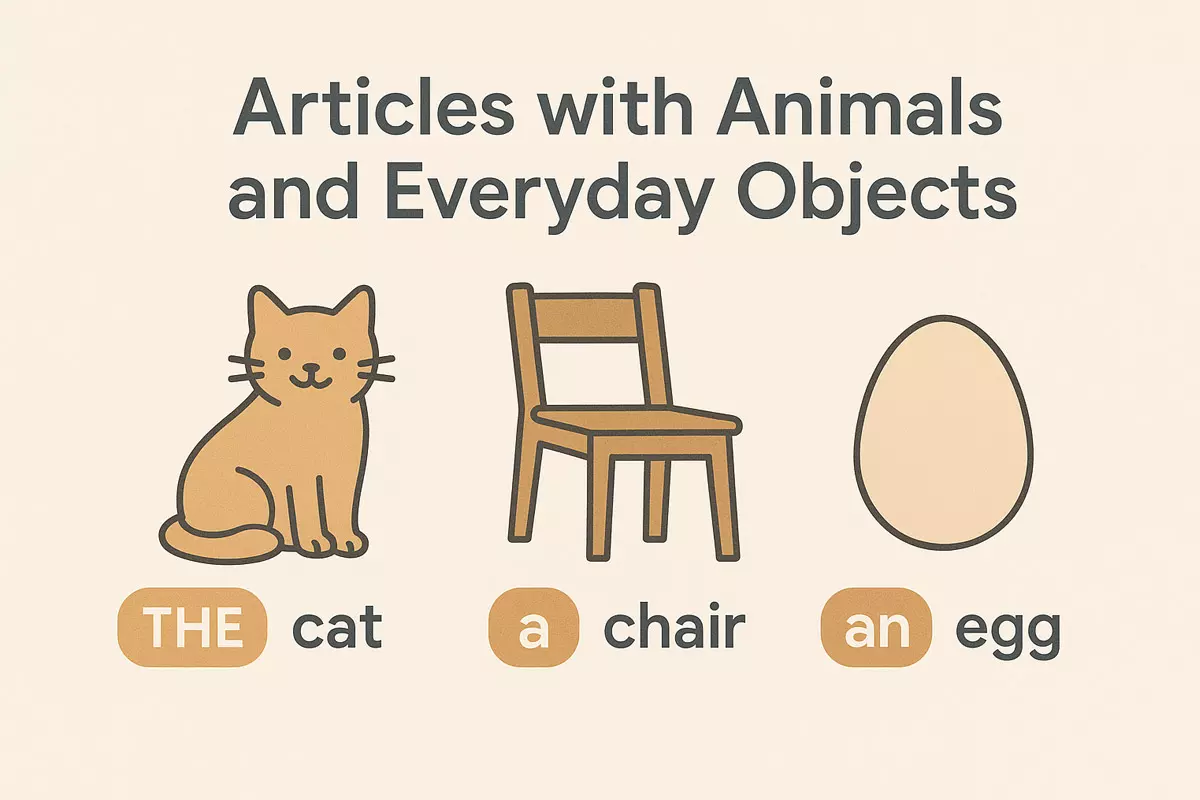 Here we rules for using articles with objects and animals, explains when to use a, an, the, or no article, and shows the difference between general and specific references. It also includes a practice exercise.
Discovering how we use words such as a, an, and the when referring to everyday creatures and objects can greatly improve our English. These small yet essential parts of language, known as articles, help us communicate more clearly and sound more natural. By paying attention to when and how to use these words, we can make our speech and writing easier to understand and more fluent, which is especially helpful for anyone learning English as a second language.
General rules for objects
When deciding whether to use articles with everyday items, the context and specificity play a major role. In English, articles help distinguish between a general mention and a particular example of an object. Most inanimate things, such as “a cup,” “the table,” or “an apple,” follow predictable patterns, but exceptions can arise depending on usage.
Using “a” and “an” with objects
The indefinite articles “a” and “an” are applied when referring to a non-specific item. If you introduce an object for the first time or mean any example of that object, use these forms. For example:
- a chair
- an umbrella
- a pencil
- a window
- an orange
- a book
- a bottle
- an egg
- a bag
- a clock
- an eraser
- a spoon
Using “the” with objects
“The” is used for specific objects that are already known to the listener or reader, or have been mentioned before. This definite article assumes a shared understanding of which item is meant. For instance:
- the lamp (when it’s clear which lamp is meant)
- the door (if there is only one in the room)
- the keys (after mentioning them previously)
- the phone (if it’s the only one present)
When articles are omitted
Some everyday objects do not require an article at all. This typically occurs with:
- Plural objects in a general sense: “Cars are expensive.”
- Uncountable nouns: “Milk is on the table.”
- Fixed expressions: “Go to bed,” “at home,” “by car.”
Article choice: summary comparison
| Article Type | Usage Example | When to Use |
|---|---|---|
| a / an | a pen, an apple | Introducing an object for the first time; any single unspecified item |
| the | the pen, the apple | A specific object already known or mentioned |
| (no article) | Milk, cars | General statements, uncountable or plural nouns, set phrases |
Common mistakes with articles and objects
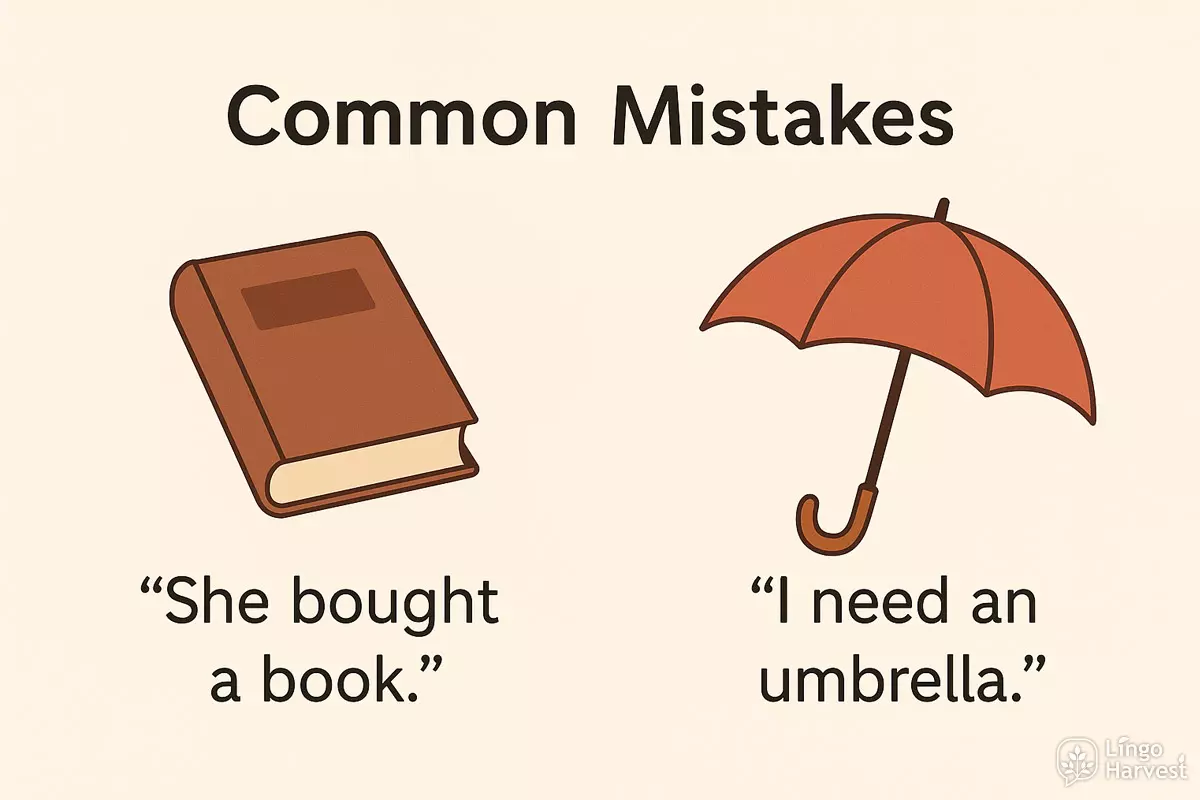
- ❌ “She bought book.” → ✅ “She bought a book.”
- ❌ “I need umbrella.” → ✅ “I need an umbrella.”
- ❌ “The sugar is sweet.” (general statement) → ✅ “Sugar is sweet.”
To sum up, article use with everyday objects depends on specificity, countability, and whether the item is being introduced or already known. By paying attention to these basic principles, you can improve your accuracy and fluency in describing daily items in English.
Animals in general vs specific animals
When talking about animals, the way we use articles often depends on whether we mean all members of a species or a particular individual or group. In English, using a definite or indefinite article can change the meaning of a sentence from a general statement to a specific reference.
Referring to animals in a general sense
To express something true about an entire species or about animals as a group, English offers several options:
- No article: "Dogs are loyal." (all dogs in general)
- The + singular noun: "The elephant is endangered." (the species as a whole)
- Plural noun: "Cats love to nap." (general truth about cats)
Talking about a particular animal or group
If you want to mention one animal or a specific set, articles help clarify your meaning:
- A/an: "A cat sat on the mat." (one unspecified cat)
- The: "The dog barked loudly." (a known or previously mentioned dog)
- The + plural: "The elephants at the zoo look healthy." (specific group of elephants)
Common patterns and examples
Here are some typical ways articles interact with animal names in daily English:
- A lion can sleep up to 20 hours a day. → any lion, not a particular one
- The lion is a symbol of courage. → lions in general, as a species
- Lions live in Africa and Asia. → all lions
- I saw a tiger at the wildlife park. → one specific, but unknown to the listener
- The tiger you saw is rare. → that exact animal
- Elephants are intelligent animals. → all elephants
- The elephants in this sanctuary are rescued. → particular group
- A rabbit hopped across the road. → one rabbit, not specified
- The rabbit in my yard eats clover. → a specific, familiar rabbit
- Rabbits have long ears. → general fact
Summary of article usage with animals
| Form | Usage Example |
|---|---|
| No article (plural or uncountable) | Dogs are friendly. (all dogs in general) |
| The + singular noun | The whale is the largest mammal. (the species) |
| A/an + singular noun | A parrot can mimic sounds. (any parrot, not specific) |
| The + specific noun or group | The parrots in the cage are noisy. (these particular parrots) |
Understanding how to use articles correctly helps distinguish between talking about animals as a whole and referencing particular creatures or groups. This distinction is essential for clear and accurate communication, especially in contexts involving both animals and everyday objects.
A/an for first mention
When talking about animals or everyday objects for the first time, English speakers typically use the indefinite articles "a" or "an." This signals that the listener or reader is not yet familiar with the specific thing being discussed. For instance, if you see a new animal or pick up an object you've never held before, you would introduce it with "a" or "an" rather than "the."
How to Choose Between "A" and "An"
Use "a" before words that begin with a consonant sound, and "an" before words that begin with a vowel sound. This helps the sentence flow smoothly.
- a cat
- an elephant
- a dog
- an orange
- a chair
- an umbrella
- a book
- an apple
- a table
- an iguana
- a pen
- an owl
- a horse
- an ant
- a lamp
- an egg
- a rabbit
- an insect
Why Use Indefinite Articles for First Mention?
Introducing something new with "a" or "an" lets your listener know you are not referring to a specific, previously mentioned item. For example:
- I saw a dog in the park. (First mention)
- The dog was chasing a ball. (Now it’s clear which dog)
This pattern is the same for both living creatures and inanimate items.
Common Mistakes to Avoid
- Don’t use "the" for new topics: ❌ I saw the cat on the street. (Unless both know which cat)
- Don’t omit the article: ❌ I bought new car. (Should be: I bought a new car.)
- Watch for vowel sounds: ❌ a apple → an apple
Examples: Animals and Objects Introduced for the First Time
| Sentence | Article Used |
|---|---|
| She saw a rabbit in the garden. | a |
| He bought an umbrella yesterday. | an |
| We found a wallet on the bench. | a |
| I met an owl during our hike. | an |
| There’s a spider on the wall. | a |
| She adopted an iguana last week. | an |
The for specific reference
When we want to talk about a particular animal or object—one that both the speaker and listener can identify—we use "the" before its name. This definite article signals that we mean a specific example, not just any item in general. In daily conversations, this is common when the context makes the item unique or previously mentioned.
Using "the" with animals
We use "the" when referring to a certain animal that’s already known or has been introduced. For instance, if you say, "I saw a dog in the yard," and then continue, "The dog was barking," the listener knows you are talking about that same dog. This applies to pets, wild animals, or even animals in stories.
- The cat on the sofa is sleeping. (a particular cat, not any cat)
- Have you fed the goldfish today? (a specific pet goldfish)
- The horse in the stable belongs to our neighbor.
- Did you see the owl in the tree last night?
Using "the" with everyday objects
For objects, "the" helps pinpoint a certain item out of many. This is especially useful when the object is unique in the setting or has been discussed before.
- The keys are on the table. (the specific keys you need)
- Please close the window. (the only window, or the one already mentioned)
- I found the book you were looking for.
- The phone is ringing. (the one in this room or context)
Comparing "the" and "a/an" in context
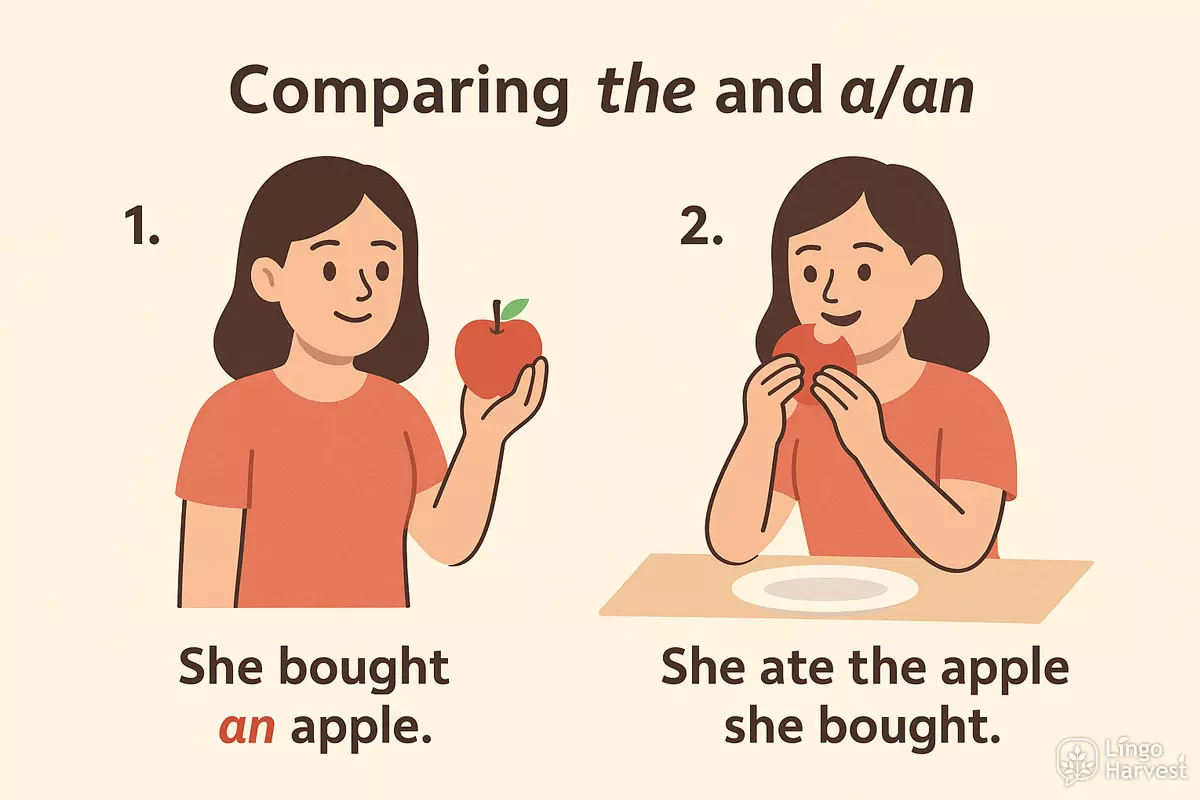
Choosing between "the" and "a/an" can change the meaning of a sentence. Here’s a structured look at how the choice signals whether we’re speaking about something specific or general:
| General (a/an) | Specific (the) |
|---|---|
| A cat sat on a mat. | The cat sat on the mat. (everyone knows which cat and mat) |
| She bought an apple. | She ate the apple she bought. (the specific apple mentioned earlier) |
| There is a car outside. | The car outside is blocking the driveway. (a particular car) |
| I need a pen. | Can you pass me the pen on the desk? (the only pen in sight) |
| He saw an elephant at the zoo. | He took a photo of the elephant. (the same one just mentioned) |
Common situations for definite reference
- When both people know which item is meant (shared knowledge)
- After mentioning the animal or object once before
- When something is unique in the context (the sun, the door)
- For superlatives or only one of its kind (the biggest dog, the only umbrella)
Using "the" in these ways helps listeners understand exactly which animal or object you mean, making your communication clearer and more precise in daily situations.
Zero article in general statements
When discussing animals or everyday items in a broad, non-specific sense, English often omits articles entirely. This is especially common when making generalizations about a whole category or class. For example, we say "Cats are independent animals" rather than "The cats are independent animals" when we mean cats as a species, not particular cats.
Usage patterns
No article is used before plural countable nouns and uncountable nouns when speaking about things in general. This applies to both animals and common objects. Here are some typical structures:
- Dogs make great pets. (all dogs in general)
- Water is essential for life.
- Computers have changed the world.
- Books can be expensive.
- Elephants live in Africa and Asia.
- Cars pollute the air.
- Milk is nutritious.
- Birds fly south for the winter.
- Apples grow on trees.
- Chairs are made of wood or plastic.
- Snakes can be dangerous.
- Money can't buy happiness.
- Lions hunt in groups.
- Trains run on tracks.
- Cheese is made from milk.
- Pens are used for writing.
Common mistakes to avoid
- ❌ The dogs are friendly. (only correct if you mean specific dogs)
- ❌ A water is important. (incorrect; “water” is uncountable and general)
Remember, when you are not talking about a specific item or individual, but about a whole group or substance, skip the article. This helps your English sound more natural and accurate.
Quick comparison table
| With Zero Article (General statement) |
With Article (Specific reference) |
|---|---|
| Cats hate water. | The cats in my house hate water. |
| Dogs are loyal animals. | The dog next door is very loyal. |
| Books provide knowledge. | The book you gave me is interesting. |
| Milk is good for you. | The milk in the fridge is old. |
In summary, omitting the article is standard when making broad statements about animals or objects. This rule helps distinguish between talking about a type or substance in general, versus something specific.
Practice task
Now it's time to check your understanding of using articles with words for animals and common objects. The following exercises will help you notice when to use a, an, or the in context. Read each sentence and fill in the blank with the correct article, or choose none if no article is needed.
Fill in the blanks
- ___ elephant is drinking water at the river.
- I saw ___ cat and ___ dog in the yard.
- Can you pass me ___ salt, please?
- ___ apple on the table looks fresh.
- She bought ___ umbrella because it was raining.
- ___ sun rises in the east.
- We found ___ interesting book about birds.
- ___ chair in the corner is broken.
- He has ___ old bicycle in his garage.
- ___ cows are grazing in the field.
Show answers
- An
- a, a
- the
- The
- an
- The
- an
- The
- an
- The
Choose the correct article
For each sentence, select the best article from the options. If no article is needed, choose "none."
- ___ owl hunts at night. (a / the / none)
- She put ___ orange on her desk. (a / an / the)
- I bought ___ new phone yesterday. (a / an / the)
- ___ moon was very bright last night. (a / an / the)
- He wants to become ___ engineer. (a / an / the)
- Can you close ___ window, please? (a / an / the)
- We saw ___ stars in the sky. (a / the / none)
- She never drinks ___ coffee in the evening. (a / the / none)
- ___ Amazon River is one of the longest in the world. (a / an / the)
- He is reading ___ interesting article. (a / an / the)
Show answers
- An
- an
- a
- The
- an
- the
- — (none)
- — (none)
- The
- an
Common animals and objects: article patterns
Here is a chart showing typical ways articles are used with some everyday animals and objects. Review the examples to spot the patterns:
| Word | Example with Article |
|---|---|
| cat | a cat, the cat |
| dog | a dog, the dog |
| apple | an apple, the apple |
| elephant | an elephant, the elephant |
| table | a table, the table |
| umbrella | an umbrella, the umbrella |
| sun | the sun |
| moon | the moon |
| book | a book, the book |
| cow | a cow, the cow |
Practice using these patterns by making your own sentences about animals and household items, paying attention to the articles. For extra challenge, try explaining why you chose each article.