Quick Practice: Choose a, an, the or Zero

 Here we how to choose the correct article in English, offers fast decision-making steps, points out common beginner mistakes, and includes a short exercise, a story-based practice, and an answer key for checking your answers.
Learning when to use articles such as a, an, the, or when to omit them can be challenging, even for advanced English learners. Practicing with targeted exercises is an effective way to develop your intuition and improve your accuracy in selecting the correct article or deciding when none is needed. By consistently working on these skills, you will gain greater confidence in your English writing and speaking, making your communication clearer and more natural in various contexts.
How to choose the correct article
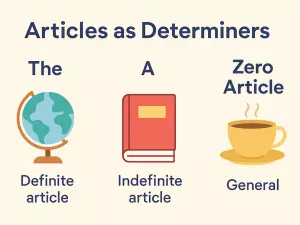
Selecting the right article in English depends on context, the type of noun, and whether you’re speaking generally or specifically. Articles include a, an, the, and the "zero article" (when no article is used). Knowing when to use each one helps make your sentences clear and natural.
Understanding the Options
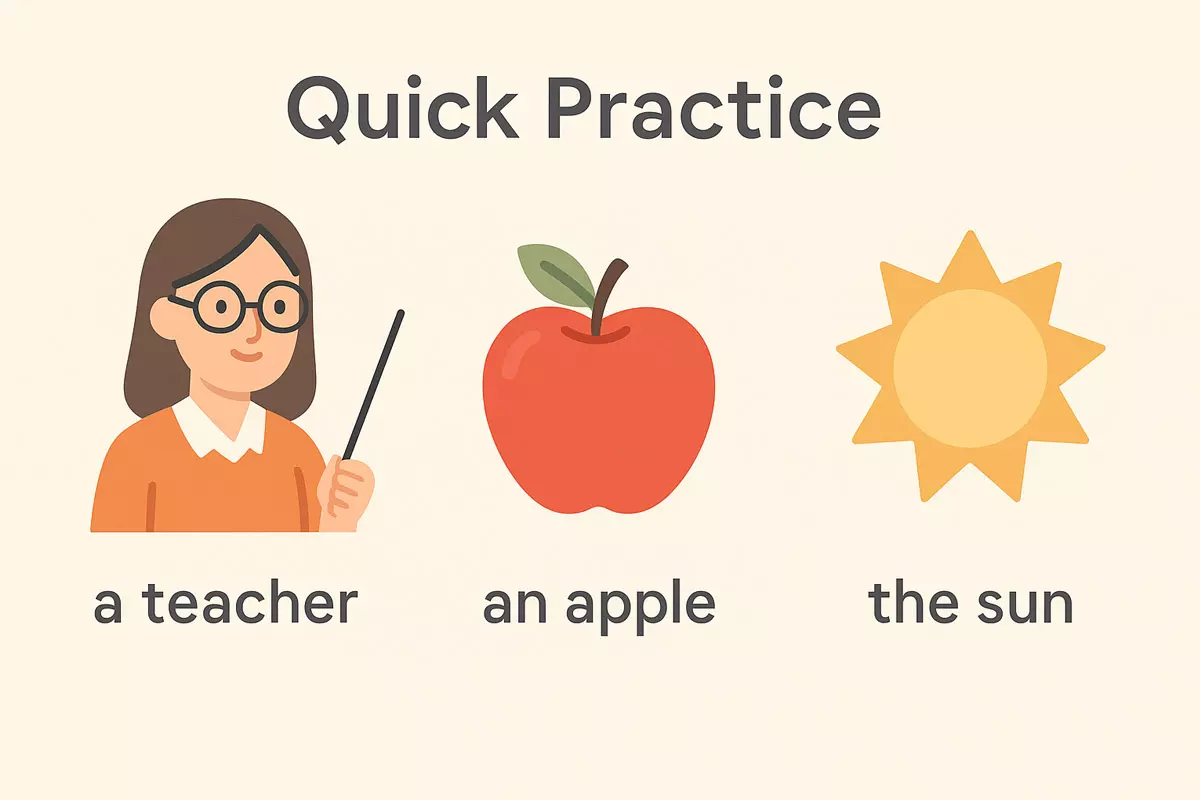
- A is used before singular, countable nouns that start with a consonant sound, when referring to something non-specific. Example: a dog.
- An is used before singular, countable nouns that start with a vowel sound, also for non-specific things. Example: an apple.
- The is for both singular and plural nouns when talking about something specific or already known to the listener. Example: the book you lent me.
- Zero article means using no article, often with plural or uncountable nouns when speaking generally. Example: Books are useful.
Common Patterns and Tips
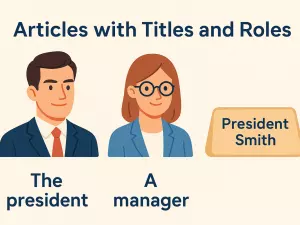
- Use the with unique things: the sun, the president.
- Use a/an when mentioning something for the first time.
- Omit the article for general statements about plural or uncountable nouns: Water is essential.
- Use the with superlatives: the best, the most interesting.
- No article with meals, languages, or most countries: have lunch, speak English, visit France.
- Use the with instruments: play the piano.
- Use the for things mentioned earlier: I saw a cat. The cat was black.
- No article with most street names, parks, or lakes: on Baker Street, in Hyde Park.
- Use the with groups of islands, rivers, and mountain ranges: the Bahamas, the Nile, the Alps.
- Use a/an with jobs or professions: She is a doctor.
- No article with academic subjects: study mathematics.
- Use the for things that are unique in the context: the door (in a particular room).
Quick Reference Table
| Article | Usage Example | When to Use |
|---|---|---|
| a | a car, a teacher | Singular, countable, non-specific, starts with consonant sound |
| an | an apple, an hour | Singular, countable, non-specific, starts with vowel sound |
| the | the book, the sun | Specific or previously mentioned, unique items |
| Zero article | Dogs bark, Milk is white | Plural or uncountable nouns (general statements) |
When in doubt, think about whether you’re speaking generally or specifically, and whether your noun is countable or uncountable. Practice with real examples to build your confidence in choosing the right form.
Steps for quick decision-making
When you need to choose between "a," "an," "the," or using no article at all (zero article), start by identifying the type of noun and the context. This makes the process much faster and more accurate. Here’s a practical approach to streamline your choices:
1. Determine if the noun is countable or uncountable
If the noun is uncountable (like "water" or "information"), articles are often omitted unless you’re being specific. For countable nouns, move to the next step.
2. Check if the noun is singular or plural
Singular countable nouns almost always require an article ("a dog," "the house"), while plural nouns and uncountable nouns often don’t ("dogs," "milk"), unless you’re talking about something specific.
3. Decide if you are talking about something specific or general
- General, singular, countable: Use "a" or "an" (e.g., "a book," "an apple").
- Specific: Use "the" (e.g., "the book on the table").
- General, plural, or uncountable: Often no article is needed ("Books are useful," "Milk is healthy").
4. Quick reference: Article selection patterns
| Situation | Common Choice |
|---|---|
| First mention, any singular countable noun | a / an |
| Known or previously mentioned item | the |
| General plural or uncountable noun | (zero article) |
| Unique objects (sun, moon, sky) | the |
| Jobs, professions (singular) | a / an |
| Meals, languages, subjects | (zero article) |
| Superlatives, ordinals | the |
5. Practice: Fast checks with common examples
Keep these typical phrases in mind:
- a car, an hour, a university
- the teacher, the answer, the Eiffel Tower
- milk, information, happiness (zero article)
- English, breakfast, history (zero article)
- the best, the first, the only
- a doctor, an engineer, a student
- the sun, the sea, the Internet
- cats (zero article), the cats (specific group)
- a pen, the pen you gave me
- the United States, the Alps
6. Final tip: Listen for natural phrasing
When in doubt, consider how native speakers use these forms in similar situations. With practice, making these choices will become almost automatic.
Common traps for beginners
Choosing between a, an, the, or leaving a blank (zero article) often causes confusion for English learners. Many errors come from overgeneralizing rules or translating directly from other languages. It's helpful to recognize the most frequent mistakes and learn how to avoid them.
Mixing up definite and indefinite articles
A frequent misstep is using the when introducing something for the first time, or forgetting to use the for something already mentioned. For example:
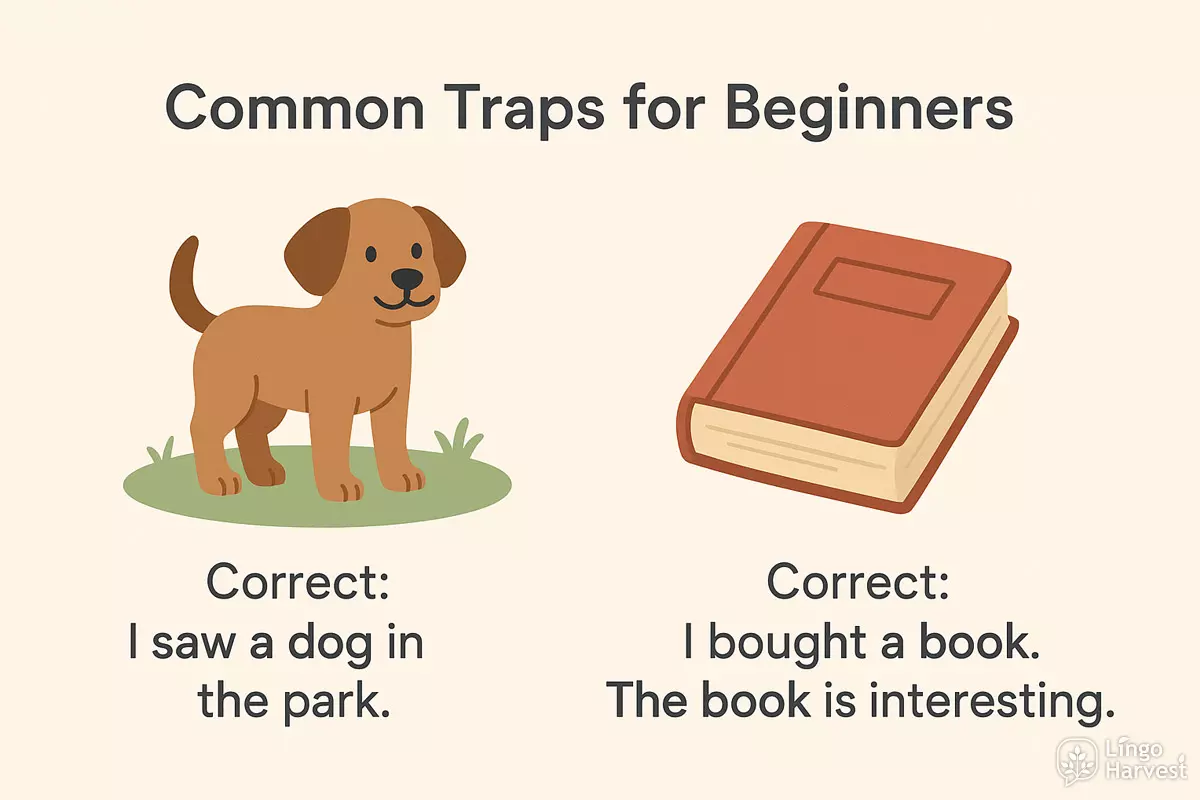
- Incorrect: I saw the dog in the park. (Which dog? If the dog is not known, use a.)
- Correct: I saw a dog in the park.
- Incorrect: I bought a book. A book is interesting. (After first mention, use the.)
- Correct: I bought a book. The book is interesting.
Zero article confusion
Learners often forget that some nouns do not take any article in English, especially with generalizations or certain places and meals. Notice these patterns:
- She goes to school every day. (No article for institutions when used for their primary purpose.)
- I like coffee. (No article for uncountable nouns in general sense.)
- We ate breakfast at 8. (No article before meals.)
Using articles with proper nouns
Names of people and most cities don’t take an article, but some geographical names do. Here’s a quick comparison:
| Type | Article Needed? |
|---|---|
| Mount Everest | No |
| The Nile | Yes |
| Asia | No |
| The United States | Yes |
| London | No |
| The Alps | Yes |
Other common mistakes to watch for
- Using an before words that start with a consonant sound (e.g., an university❌ should be a university✅)
- Forgetting to use an before words that start with a vowel sound (e.g., a apple❌ should be an apple✅)
- Adding an article before plural or uncountable nouns used in a general sense (The cats like milk❌ should be Cats like milk✅)
- Using the before names of languages, meals, or sports (The English is difficult❌ should be English is difficult✅)
- Applying a/an to uncountable nouns (a water❌ should be just water✅)
- Omitting the when it’s needed for something unique or already mentioned (Sun rises in east❌ should be The sun rises in the east✅)
- Using the with possessives (the my car❌ should be just my car✅)
- Using articles before titles when not needed (The Queen Elizabeth❌ should be Queen Elizabeth✅)
- Forgetting that some country names use the (e.g., The Netherlands, The Philippines)
- Adding the before streets or parks (The Oxford Street❌ should be Oxford Street✅)
Mastering article use takes practice and attention to these typical pitfalls. Reviewing real-life examples and patterns can help you internalize the differences.
Short controlled exercise
Let's practice choosing between a, an, the, or no article at all (zero article). Read the sentences below and decide which option fits best in each blank. Pay attention to whether the noun is general or specific, countable or uncountable, and whether it starts with a vowel sound.
Fill in the blanks
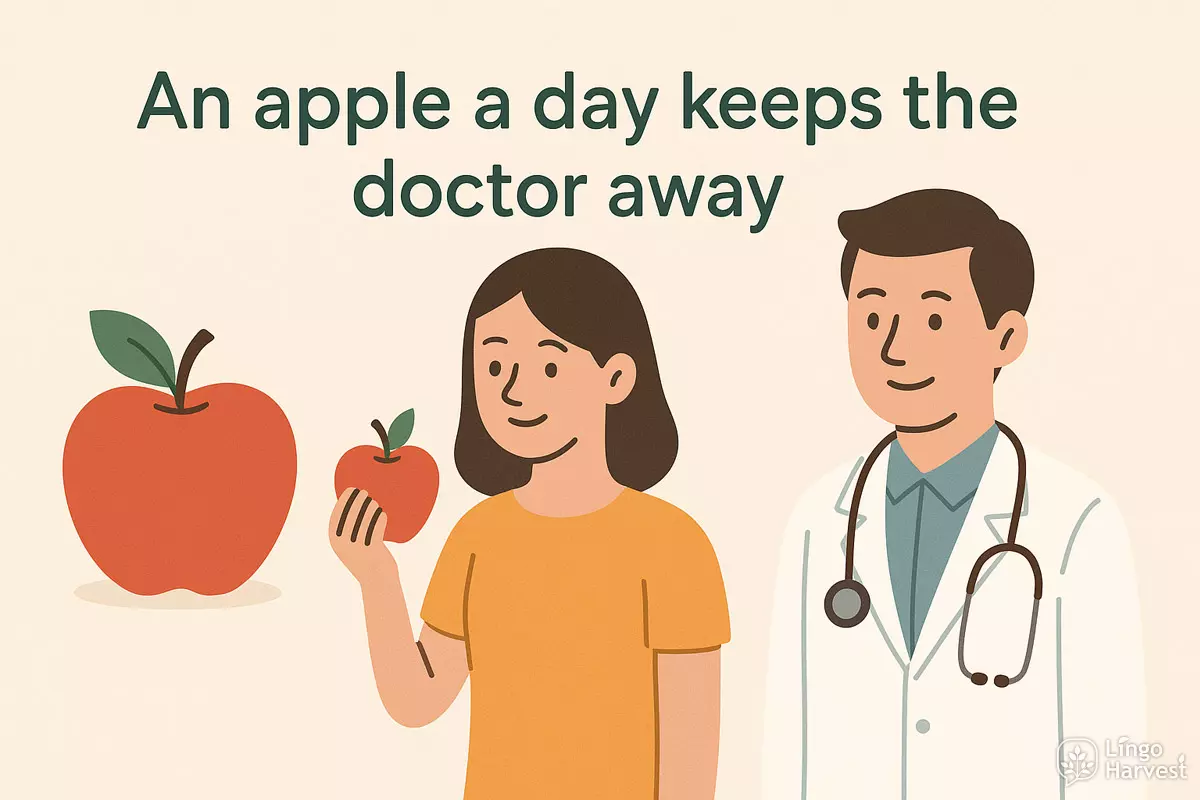
- ___ apple a day keeps ___ doctor away.
- I saw ___ interesting movie last night.
- Can you pass me ___ salt, please?
- She is ___ engineer.
- ___ Mount Everest is the highest mountain in ___ world.
- They live in ___ small village near ___ coast.
- He doesn’t like ___ coffee.
- ___ books on the table are new.
- We visited ___ museum yesterday.
- ___ children play in the park every afternoon.
- ___ information you gave me was helpful.
- I need ___ umbrella. It’s raining.
- This is ___ best restaurant in town.
- ___ water in this bottle is cold.
- She bought ___ kilo of oranges.
Show answers
- An apple a day keeps the doctor away.
- An interesting movie
- The salt
- An engineer
- Mount Everest; the world
- A small village; the coast
- Zero article (no article: He doesn’t like coffee.)
- The books
- The museum
- The children
- The information
- An umbrella
- The best restaurant
- The water
- A kilo
Common article patterns
Review some typical patterns for using articles. This can help you choose the right option more easily in future exercises.
- a/an + singular, countable noun (when mentioning for the first time): a cat, an idea
- the + something already known or unique: the sun, the teacher
- Zero article with uncountable or plural nouns when speaking in general: water, books
- the + superlative adjectives: the biggest, the most interesting
- a/an with jobs: a doctor, an engineer
- the with names of rivers, seas, oceans: the Nile, the Pacific
- Zero article with most meals: have lunch, eat breakfast
- the with ordinal numbers: the first, the second
- Zero article with most countries and cities: France, London
- the with some countries (plural or with "kingdom", "states"): the Netherlands, the United States
- the with musical instruments: play the piano
- a/an for one of many: a book (one of many books)
- Zero article with languages: speak English, learn Spanish
- the with families: the Smiths
- a/an with expressions of frequency: once a week, twice a day
Quick identification
Try matching each noun with the correct article use. This table summarizes some article choices for different noun types and contexts.
| Noun/Context | Typical Article Use |
|---|---|
| Singular, countable, first mention | a / an |
| Specific, known or unique noun | the |
| Uncountable or plural, general meaning | Zero article |
| Superlatives, only one exists | the |
| Most country/city names | Zero article |
Story-based practice
Let’s explore how articles (a, an, the, or no article) work in the context of a short story. Reading in context helps you see how native speakers naturally choose articles in everyday situations. Below is a simple narrative. As you read, notice the blanks where you need to decide which article fits best. After the story, try the questions and check your understanding.
Read and fill in the blanks
Maria woke up early. She looked out of ___ window and saw ___ cat sitting on ___ roof. She remembered that she had ___ important meeting at ___ office. After ___ quick breakfast, she grabbed ___ umbrella because ___ weather forecast said it might rain. On her way, she met ___ old friend. They talked for ___ few minutes before Maria hurried to ___ bus stop.
- Should you use a, an, the, or no article for each blank? Read carefully and think about why.
- Write your answers before checking them below.
Show answers
- the window
- a cat
- the roof
- an important meeting
- the office
- a quick breakfast
- an umbrella
- the weather forecast
- an old friend
- a few minutes
- the bus stop
Common article choices in stories
Writers use articles to clarify if something is specific, general, or mentioned for the first time. Here are typical situations and which article is usually used:
- a/an: introducing something new or not specific (a book, an idea)
- the: referring to something specific or already mentioned (the door, the teacher)
- Zero article: with plural or uncountable nouns when speaking generally (Dogs are friendly, Information is useful)
Practice: Choose the correct article
Select the right article for each sentence below:
- She went to ___ supermarket to buy ___ milk.
- ___ sun was shining brightly in ___ sky.
- Do you have ___ pen I can borrow?
- ___ honesty is important in ___ relationship.
- We saw ___ elephant at ___ zoo.
- He wants to buy ___ new laptop from ___ store near his house.
- They adopted ___ dog from ___ animal shelter.
- ___ water in this bottle is cold, but ___ bottle on the table is warm.
- She read ___ interesting article in ___ newspaper yesterday.
- ___ children in this class are learning about ___ space.
Show answers
- the supermarket, some milk / — milk
- The sun, the sky
- a pen
- — honesty, a relationship
- an elephant, the zoo
- a new laptop, the store
- a dog, the animal shelter
- The water, the bottle
- an interesting article, the newspaper
- The children, space (— space)
Quick reference table: Article use in stories
| When to use | Example |
|---|---|
| First mention (singular, countable) | She saw a bird in the garden. |
| Specific or previously mentioned | The bird flew away quickly. |
| General, uncountable or plural | — Water is essential. — Cars can be expensive. |
| Unique objects | The moon looks beautiful tonight. |
| Jobs and roles (singular) | He is a doctor. She is an engineer. |
Practicing with stories helps you understand article choice in real contexts. Try making your own mini-stories and filling in the blanks for extra practice.
Answer key
Understanding which article to use—“a,” “an,” “the,” or no article at all—depends on the context and the noun’s specificity or countability. Below, you’ll find explanations and correct choices for common patterns. Use these examples to check your practice and understand the reasoning behind each selection.
Correct Usage Examples
- I saw a cat in the garden. (First mention, any cat.)
- She is an engineer. (Job title, starts with a vowel sound.)
- Could you pass me the salt? (Specific item, known to both.)
- We had zero article breakfast at 8 a.m. (Meals, in general context.)
- He lives in the city center. (Unique location, specific.)
- There is a book on the table. (Non-specific, first mention.)
- My mother is an artist. (Profession, vowel sound.)
- They visited the Louvre. (Unique place, only one Louvre.)
- Children like zero article chocolate. (General statement.)
- She bought a new car. (Non-specific, countable noun.)
- He is afraid of zero article spiders. (General, plural noun.)
- She traveled by zero article train. (Transport, general sense.)
- Let’s go to the cinema. (Unique place in a town/city.)
- He is an honest man. (Vowel sound: “honest” starts with a silent “h”.)
- I have the answer you need. (Specific answer.)
- We saw a movie last night. (Non-specific, first mention.)
- She wants to be an astronaut. (Profession, vowel sound.)
- He plays the piano. (Musical instruments.)
- I never drink zero article coffee at night. (General, uncountable noun.)
- They climbed the Alps. (Mountain ranges, always with “the”.)
Quick Reference Table: When to Use Each Article
| Article | Typical Usage |
|---|---|
| a / an | First mention of a singular countable noun; jobs; one of many; “an” before vowel sounds. |
| the | Specific/unique items; second mention; superlatives; only one exists (the sun, the president). |
| zero article | General statements with plurals/uncountables; meals; most places (at home, at work); transport (by car, by train). |
Common Mistakes to Avoid
- Don’t use “a/an” with plural or uncountable nouns (e.g., a informations ❌).
- Avoid “the” with general plural or uncountable nouns (e.g., the music is relaxing only if you mean specific music).
- Remember: “the” is needed for things already mentioned or known to listener/reader.
Review these patterns to reinforce your understanding of article usage. Practice and context are key to mastering this area of English grammar.