Articles with Titles and Roles: the president, a manager, President Smith

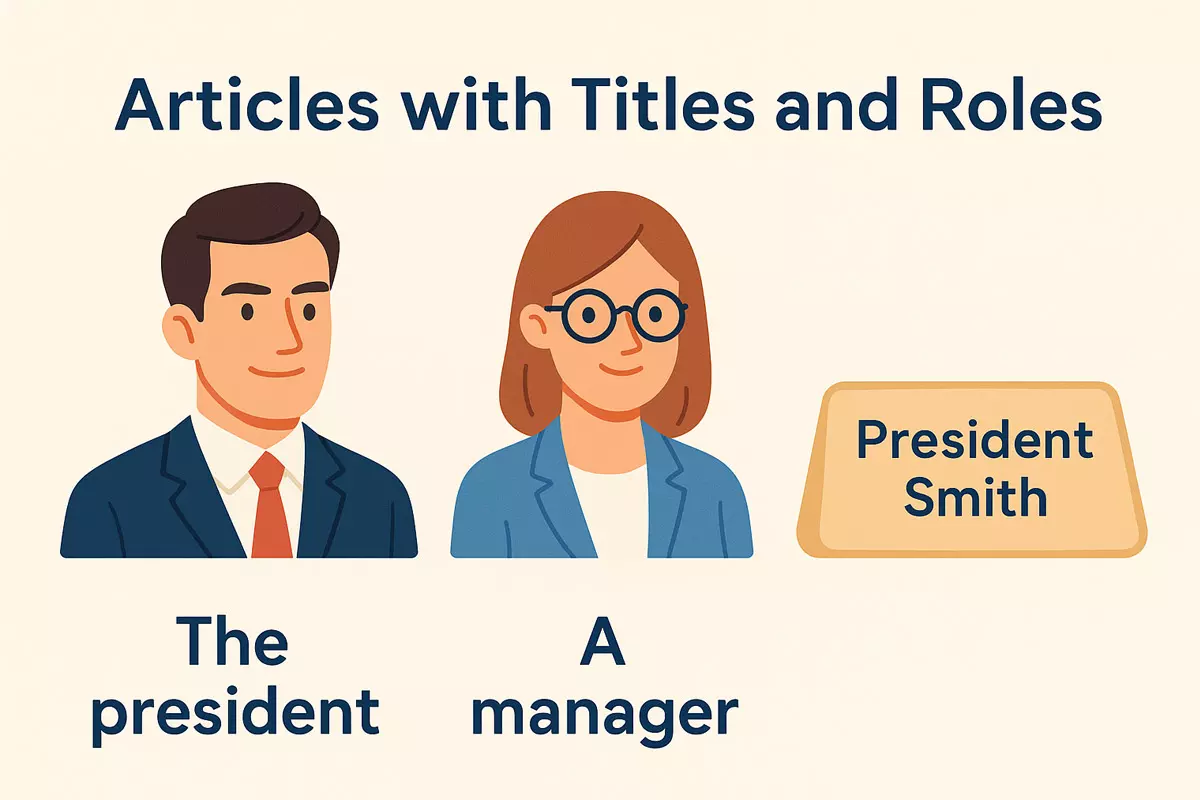 The article explains when to use articles with English job titles, like the difference between the president and President Smith. It covers using a or an with roles, regional and style differences, common C1-level errors, and offers practice exercises.
Knowing when to use definite and indefinite articles before job titles or names can be challenging, particularly in phrases such as the head of state, a supervisor, or Director Johnson. The choice of article depends on whether you are referring to a specific individual or any person in that role. For example, use the when referring to a particular position that is unique, like the president, and a or an when talking about any member of a group, such as a manager. Understanding these subtle grammar rules enhances the clarity and professionalism of your writing.
Titles with and without articles in English
Choosing whether to use an article with a title or role in English depends on context and sentence structure. Sometimes, titles appear with "the" or "a/an", and sometimes they stand alone. Understanding when to include an article helps make your meaning clear and your English sound more natural.
When to use articles with titles
Articles are often needed when you refer to a role or title in a general sense, or when describing someone’s job rather than naming a specific person. For example, you would say "the president" when talking about the president of a country in general, or "a manager" when you mean any manager, not a specific one.
- The president will address the nation tonight. (Refers to a specific president, e.g., of a country.)
- A manager should be able to solve this problem. (Any manager, not a particular one.)
- The director approved the changes. (A specific director, possibly previously mentioned.)
- The teacher explained the lesson. (A known or previously mentioned teacher.)
When not to use articles with titles
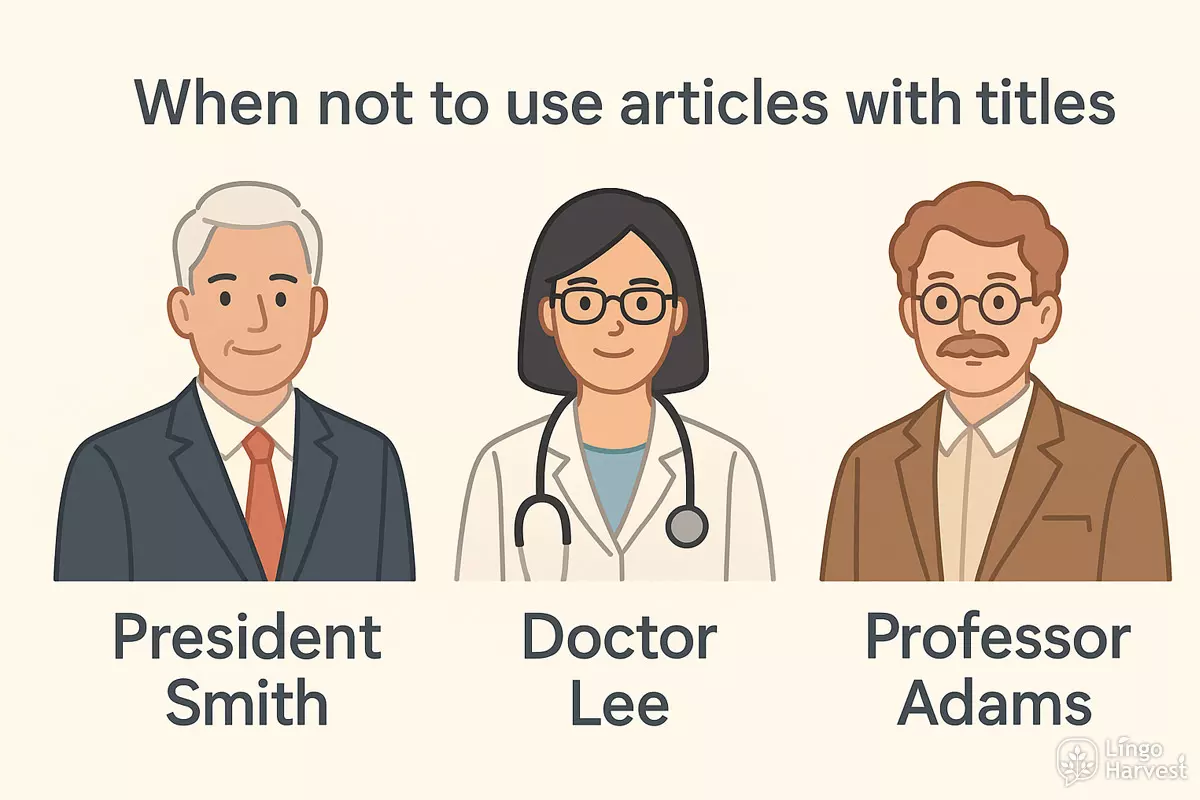
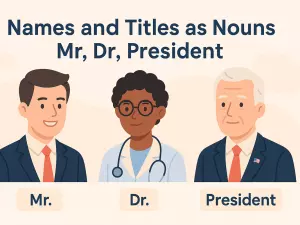
Titles are used without articles when they directly precede a person’s name, or in certain formal contexts. For example, "President Smith" or "Doctor Lee" do not take "the" or "a/an" before the title.
- President Smith arrived this morning. (Title + name, no article.)
- Doctor Lee will see you now. (No article before the title.)
- Professor Adams wrote the textbook. (Title directly before name.)
- Queen Elizabeth was loved by many. (Monarch or official title + name.)
Common patterns: articles, titles, and names
The choice between using an article or not can be summarized in a few typical patterns:
- When the title stands alone and refers to a specific or known person: use "the" (the manager, the president).
- When the title is used generally: use "a/an" (a manager, a teacher).
- When the title is immediately before a name: do not use an article (President Harris, Doctor Lee).
- When the title is used as a direct address: often no article (Good morning, Professor!).
- When talking about the role in general: use "the" or "a/an" (The teacher is important in society. A president has many duties.).
Comparison of title usage
| Example | Usage & Explanation |
|---|---|
| The president | Refers to a specific, known president (e.g., of a country or organization). |
| A manager | Any manager; used when the manager is not specified. |
| President Adams | Title immediately before a name; no article is used. |
| The director of the school | Specific position, often followed by an "of" phrase. |
| Doctor Lee | Title + surname, no article needed. |
| The Queen | Refers to a specific queen known to all (e.g., The Queen of England). |
| Professor Adams | Title + name, no article. |
| A teacher | Any teacher, not a specific individual. |
Quick tips
- Use "the" with a title when it is clear who you mean.
- Use "a/an" with a title for any member of a group.
- Never use an article before a title immediately followed by a name.
- In direct address, titles usually appear without articles.
Understanding these patterns helps you communicate clearly about roles and titles in all kinds of English contexts.
When we say the president vs President Smith
Choosing between phrases like "the president" and "President Smith" depends on whether we are being specific or general, and whether a title is used as a job description or as a personal address. This distinction is important in both formal writing and everyday conversation, as it affects clarity and respect.
General Role vs. Specific Person
We use "the president" when referring to the office or role itself, without naming the individual. This is common when discussing the position in an abstract or general sense: "The president has many responsibilities." In contrast, we use "President Smith" when we are directly naming or addressing the person who holds the office: "President Smith will attend the meeting." Notice that "the" is dropped before the title plus name.
Patterns and Usage Examples
- The president signs the law. → Refers to whoever holds the office.
- President Smith signed the law. → Refers to a specific individual.
- The president of the company announced changes. → General reference to the role.
- President Lee announced changes. → Naming the person in the role.
- She spoke with the president about the project. → No name, just the job title.
- She spoke with President Carter about the project. → Directly referencing the individual.
- The manager is responsible for scheduling. → Any manager, not named.
- Manager Patel is responsible for scheduling. → Specific person named.
- The mayor will attend the opening. → Referring to the office.
- Mayor Johnson will attend the opening. → Referring to a specific mayor.
- The doctor is on call tonight. → General position.
- Doctor Kim is on call tonight. → Specific doctor.
Capitalization and Articles
Titles used with names, like "President Thompson," are capitalized and do not take an article. When referring to the office in general, use the article "the" and lowercase: "the president." This applies to many roles: the manager, the director, the mayor, etc.
Quick Reference Table
| Form | Usage Example |
|---|---|
| the president | The president will give a speech. (general office) |
| President Thompson | President Thompson will give a speech. (specific person) |
| the manager | The manager approved the budget. (role, not named) |
| Manager Patel | Manager Patel approved the budget. (named individual) |
| the director | The director is responsible for hiring. (position) |
| Director Lee | Director Lee is responsible for hiring. (named) |
| the chairperson | The chairperson will lead the meeting. (general) |
| Chairperson Gomez | Chairperson Gomez will lead the meeting. (specific) |
Understanding these patterns helps ensure your writing and speech are clear and respectful, whether you’re talking about officials, company roles, or other titled positions.
Countable roles with a/an: a manager, a director
When talking about job titles or positions that represent one of many possible people, we use the indefinite articles a or an. This usage signals that the role is countable and not unique. For instance, if you say "a manager," you mean any manager, not a specific one known to the listener. This pattern is common in English when referring to roles in a general or non-specific way.
When to use "a" or "an" with job titles
We use "a" before words that start with a consonant sound, and "an" before words that start with a vowel sound. This applies to many professions and positions. The indefinite article shows that you are talking about one example out of many possible holders of that position.
- a manager
- a director
- a teacher
- a doctor
- a lawyer
- a nurse
- a technician
- a pilot
- a chef
- a designer
- a student
- a consultant
- an engineer
- an accountant
- an artist
- an editor
- an assistant
- an architect
- an analyst
- an intern
Typical sentences using indefinite articles with roles
Here are some example sentences that show how to use indefinite articles with job titles and positions:
- She works as a manager in a large company.
- He wants to become an engineer one day.
- They hired a director for the new project.
- I spoke to a consultant about my options.
- We need an assistant to help with paperwork.
Comparing "a/an" with "the" and no article
The choice between "a/an," "the," or no article depends on whether you mean any member of a group, a specific one, or the role as a unique concept. Here is a quick comparison:
| Form | Example | Meaning |
|---|---|---|
| a/an + role | a manager | any manager, one of many |
| the + role | the manager | the specific manager known to both speaker and listener |
| role (no article) | President Smith | used as a title with a name, no article needed |
Protocol, style, and regional variation
The way titles and roles are presented with articles in English—such as "the president," "a manager," or "President Smith"—depends on context, tradition, and sometimes regional usage. These conventions help clarify formality, specificity, and respect, especially in professional or governmental settings.
Choosing Definite, Indefinite, or No Article
Writers select between "the," "a," or omitting the article based on whether they refer to a specific individual, a general type, or the role as a title. For example, "the president" refers to a known, specific person (often the leader of a country or organization), while "a manager" could indicate any person in that role.
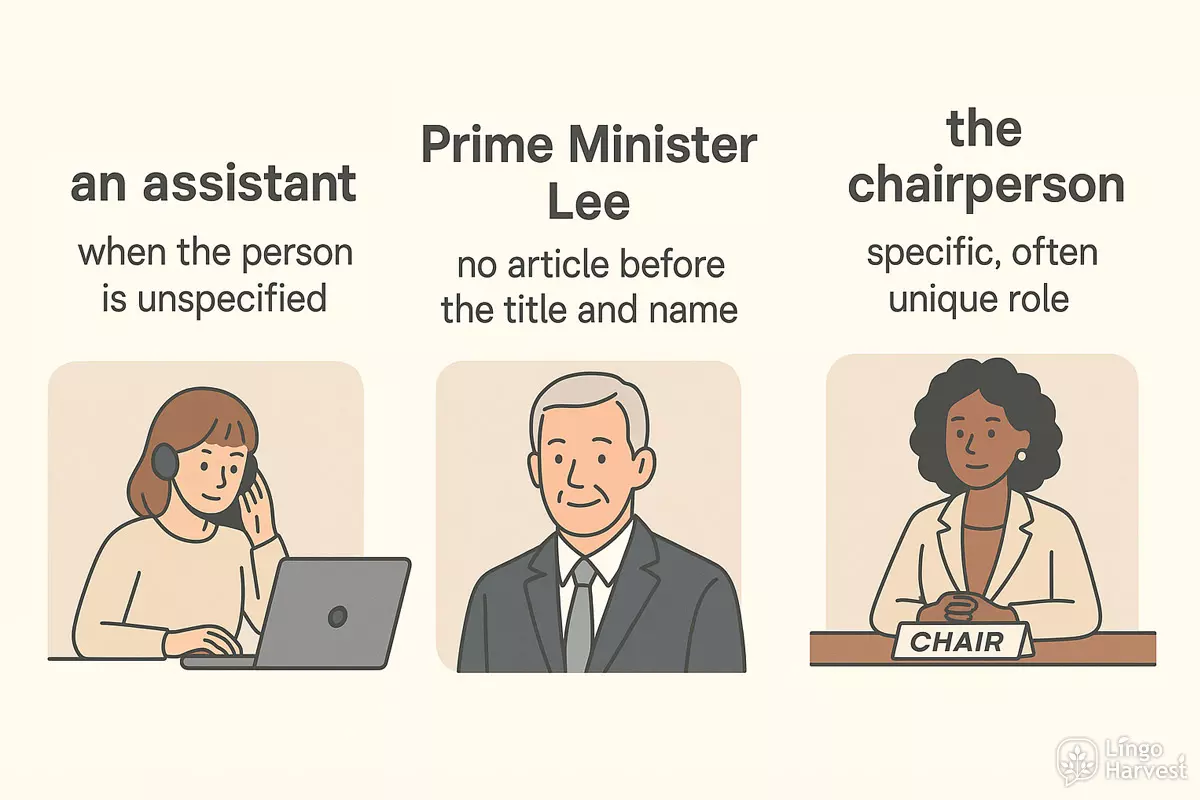
- the president — when referring to a specific, known leader
- a manager — when talking about any manager, not a particular one
- President Smith — when using the title as part of a name (no article)
- the CEO — for a unique position within an organization
- a director — for one among several possible directors
- Director Patel — title used directly before a name
- the governor — if the identity is clear from context
- an assistant — when the person is unspecified
- Prime Minister Lee — no article before the title and name
- the chairperson — specific, often unique role
- a supervisor — general reference
- Supervisor Kim — direct title before name
- the director of finance — specific role within a department
- a vice president — one among several VPs
- Vice President Harris — no article when preceding a name
Forms and Formality Across Regions
There are notable differences between British and American English in the use of articles with titles. American English often omits "the" before titles in headlines or formal lists, while British English may retain it more frequently. Protocol in diplomatic or official contexts may also dictate how titles are used, especially when addressing or referring to dignitaries.
| Form | Typical Usage | Example |
|---|---|---|
| Definite article + title (role) | Refers to a specific, known individual in a role | the president, the manager |
| Indefinite article + title (role) | Any member of a group or type | a president, a manager |
| Title + Name (no article) | Direct address or reference by title and name | President Carter, Manager Lee |
| Title alone (no article) | Used as a form of address, sometimes capitalized | President, Manager |
Special Considerations and Nuances
Protocol may require capitalizing titles when they precede a name but not when they stand alone or follow the name ("President Smith" vs. "Smith, the president"). In some regions, the definite article is used more conservatively, and in formal writing, titles are often capitalized to convey respect. Cultural expectations can also influence whether a title is used at all, especially in less formal environments. Understanding these variations ensures clear, respectful, and effective communication in both spoken and written English.
Typical C1-level mistakes with titles
Learners at an advanced-intermediate level often struggle with article usage before titles and roles, especially when switching between general and specific references. These errors can make speech sound less natural and occasionally cause confusion about meaning. Understanding when to use "the," "a," or no article at all is crucial for clear communication, particularly in professional and academic contexts.
Common pitfalls with articles and titles
Mixing up definite and indefinite articles is a frequent issue. For example, people sometimes add "the" where it isn't needed, or omit it when it's essential. Here are some recurring slip-ups:
- Using "the" before titles with names: the President Smith ❌ instead of President Smith ✅
- Dropping the article in general references: manager should approve ❌ instead of a manager should approve ✅
- Adding "a" before unique roles: a president of the United States ❌ instead of the president of the United States ✅
- Using "the" with plural roles/titles: the managers are responsible (sometimes correct, but often should be managers are responsible when speaking generally)
- Confusing job titles with descriptions: She is the president (correct if there’s only one; otherwise, She is a president)
- Using articles with titles in direct address: the manager, can you help? ❌ instead of simply Manager, can you help? ✅
- Omitting articles in set phrases: He was elected president (correct), but He was elected the president changes the meaning
- Using articles with titles in headlines or lists: The President, The Manager (not needed in most cases)
- Incorrectly combining articles and possessives: the my manager ❌
- Generalizing with "the" when meaning is indefinite: the manager can be helpful (should be a manager)
Comparing article use with titles and roles
It's helpful to contrast correct and incorrect forms to highlight patterns. Notice how article choice changes with context:
| Incorrect ❌ | Correct ✅ |
|---|---|
| the President Smith | President Smith |
| a President of France | the President of France |
| the manager should decide | a manager should decide |
| She is the manager (in a company with many managers) | She is a manager |
| the my supervisor | my supervisor |
| the Queen Elizabeth | Queen Elizabeth |
| Manager the John | Manager John |
Tips for mastering articles with titles
- Omit "the" or "a" before titles plus names ("President Smith", not "the President Smith").
- Use "the" with unique roles or when the context is specific (the president of the company).
- Use "a" for non-specific references (a manager, a president).
- Do not combine articles with possessives (my manager, not the my manager).
- Remember: in direct address, skip the article (Manager, can you help?).
Awareness of these patterns helps avoid awkward or ambiguous phrasing. With practice, article choice before titles and roles becomes more intuitive and natural.
Practice: correct titles and roles in short texts
Understanding when to use articles with professional titles and roles can be challenging. Let’s work through some practical exercises to reinforce the rules. Pay attention to whether a title is used generically, with a name, or as a role. This will help you decide when to use "the," "a," or no article at all.
Choose the correct article
Read each sentence and select the appropriate article (“a,” “the,” or no article) for the blank. Consider whether the title is specific, generic, or used with a name.
- ___ president will address the nation tonight.
- ___ President Johnson attended the meeting.
- She was promoted to ___ manager last year.
- Did you speak to ___ manager yesterday?
- ___ Prime Minister Trudeau spoke at the summit.
- He wants to become ___ doctor.
- ___ doctor who treated me was very kind.
- ___ Professor Smith is on sabbatical.
- ___ professor explained the theory well.
- We met ___ engineer from Germany.
Show answers
- The
- No article
- a
- the
- No article
- a
- The
- No article
- The
- an
Correct the sentences
Some sentences below use titles or roles incorrectly. Rewrite each sentence so that articles and capitalization are correct.
- the President Johnson will arrive soon.
- She is the engineer in our team.
- Manager Brown approved the budget.
- He spoke with a President of the company.
- a professor Smith published a new book.
- The Queen Elizabeth visited the museum.
- She met the Dr. Smith at the conference.
- They promoted the director Johnson last year.
- A king Charles was crowned in a ceremony.
- The captain Miller gave a speech.
Show answers
- President Johnson will arrive soon.
- She is an engineer in our team.
- The manager, Brown, approved the budget. OR Manager Brown approved the budget.
- He spoke with the president of the company.
- Professor Smith published a new book.
- Queen Elizabeth visited the museum. OR The Queen visited the museum.
- She met Dr Smith at the conference. OR She met Dr. Smith at the conference.
- They promoted Director Johnson last year. OR They promoted the director last year.
- King Charles was crowned in a ceremony. OR The king was crowned in a ceremony.
- Captain Miller gave a speech. OR The captain, Miller, gave a speech.
Patterns for titles and roles
Here are some common patterns for articles with titles and roles. Use these as a reference for writing and editing:
- the + role/title: used when referring to a specific or previously mentioned person in a role (e.g., the manager, the president).
- a/an + role/title: used for introducing an unspecified person in a role (e.g., a manager, an engineer).
- No article + Title + Name: used when addressing or mentioning someone by their title and name (e.g., President Carter, Professor Brown).
- No article + role/title (in general sense): “Doctors are important” (referring to all doctors).
- the + role/title + of + organization: “the president of the company”.
- a/an + role/title + in/of + organization: “an engineer in the team”.
- the + only one in context: “the Queen of England”.
- No article in headlines: “President Visits City”.
- No article with plural roles in general: “Managers are responsible for staff.”
- the + role/title (unique in context): “the director will sign the contract.”
Summary Table: Article Use with Titles and Roles
| Usage Context | Example |
|---|---|
| Title + Name (no article) | President Williams, Professor Lee |
| Role (specific person) | the manager, the president |
| Role (unspecified person) | a manager, an engineer |
| Title of organization | the president of the club |
| Plural/general (no article) | Managers are busy. |