Common Beginner Mistakes with Articles (and How to Fix Them)

 Here we common mistakes with English articles, including mixing up a, an, and the, confusion about when to use no article, and errors with jobs or places. It explains how to fix these mistakes and provides practice to reinforce correct usage.
Many English learners struggle with the correct use of a, an, and the, which often causes confusion or results in awkward sentences. Mastering these small but important words is essential for clear and effective communication. The articles a and an are used with singular, countable nouns when mentioning something for the first time or when it is not specific, while the is used when referring to something specific or already known to the listener. Paying attention to these rules will help you write and speak more naturally in English.
Most frequent article mistakes
English learners often stumble when using "a," "an," and "the." These errors can make sentences confusing or even change their meaning. Below, you'll find the most typical pitfalls, why they happen, and how to avoid them.
1. Omitting Articles Where They Are Needed
Many beginners leave out articles altogether, especially if their native language doesn’t use them. For example:
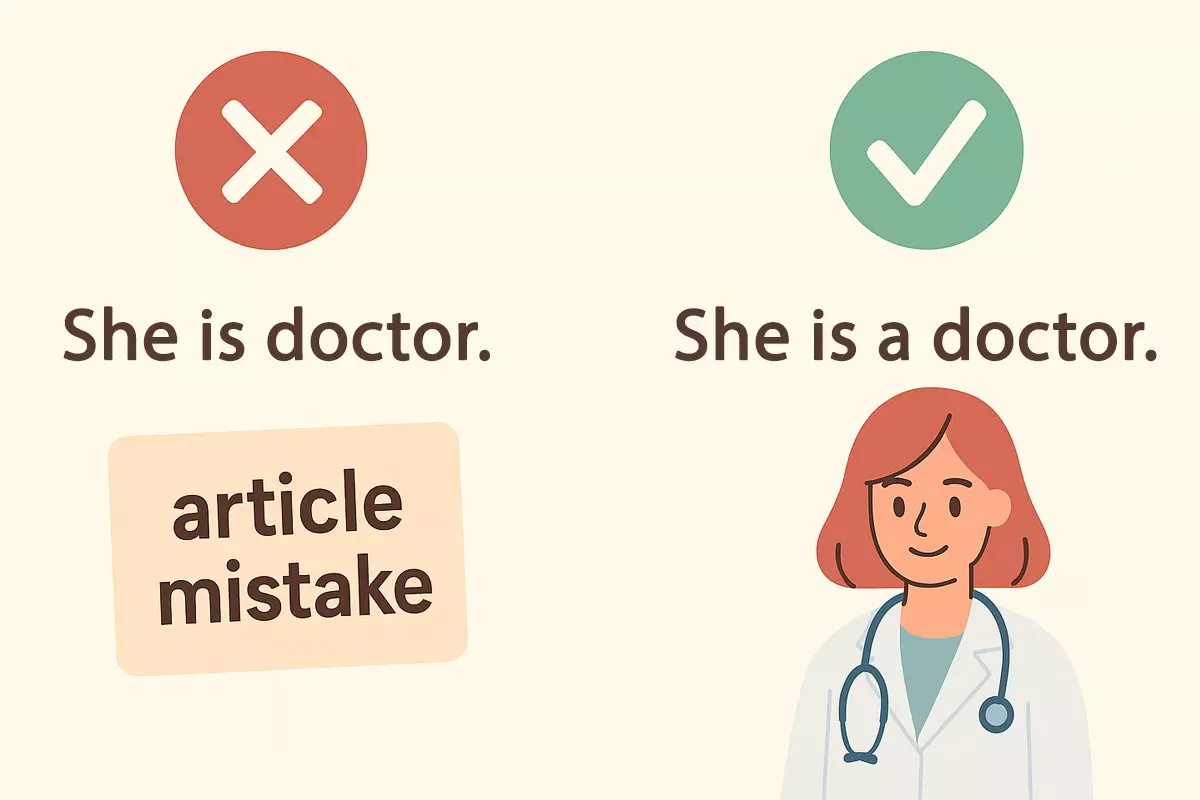
- ❌ She is doctor.
- ✅ She is a doctor.
- ❌ He is teacher.
- ✅ He is a teacher.
- ❌ I am student.
- ✅ I am a student.
- ❌ This is good idea.
- ✅ This is a good idea.
- ❌ She bought car yesterday.
- ✅ She bought a car yesterday.
- ❌ It is big problem.
- ✅ It is a big problem.
- ❌ We have meeting today.
- ✅ We have a meeting today.
- ❌ There is cat in the garden.
- ✅ There is a cat in the garden.
Always remember: singular, countable nouns usually need an article or another determiner.
2. Adding Articles Where They Don’t Belong
Sometimes, learners insert "the" or "a" before proper nouns or uncountable nouns:
- ❌ I visited the London.
- ✅ I visited London.
- ❌ She speaks the English very well.
- ✅ She speaks English very well.
- ❌ We had a lunch at one o’clock.
- ✅ We had lunch at one o’clock.
- ❌ I need the information about this word. (general)
- ✅ I need information about this word.
- ❌ They enjoy listening to the music. (general)
- ✅ They enjoy listening to music.
- ❌ He lives near the Mount Everest.
- ✅ He lives near Mount Everest.
- ❌ She works at the Microsoft.
- ✅ She works at Microsoft.
- ❌ I spoke to the Professor Smith.
- ✅ I spoke to Professor Smith.
Proper names, languages, and most uncountable nouns (like "information") do not take an article.
3. Confusing "a" and "an"
Use "a" before words that begin with a consonant sound, and "an" before words with a vowel sound:
- a cat
- a dog
- a house
- a university (starts with a /juː/ sound, a consonant sound)
- a European city
- an apple
- an orange
- an hour (because "hour" starts with a vowel sound)
- an engineer
- an elephant
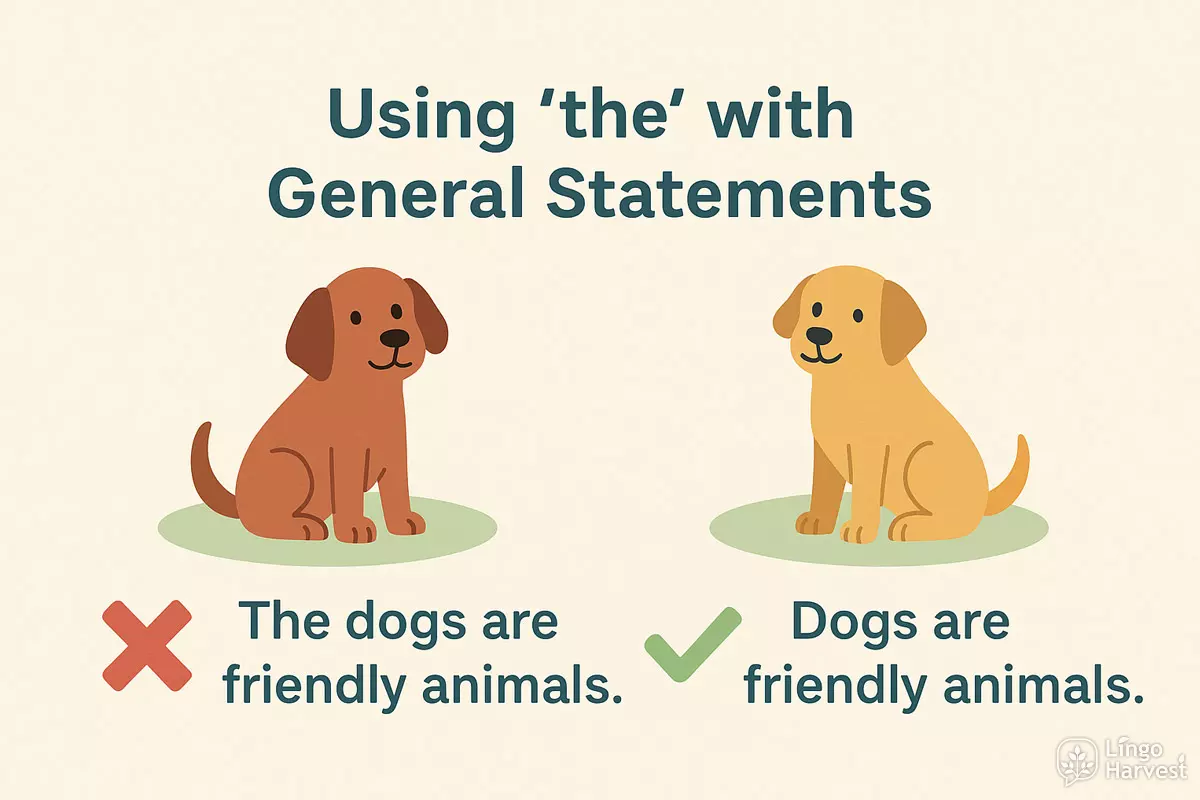
4. Using "the" with General Statements
Beginners often incorrectly add "the" when talking about things in general:
- ❌ The dogs are friendly animals.
- ✅ Dogs are friendly animals.
- ❌ The cats like to sleep a lot.
- ✅ Cats like to sleep a lot.
- ❌ The children learn languages quickly.
- ✅ Children learn languages quickly.
- ❌ The people need fresh air.
- ✅ People need fresh air.
- ❌ The teachers are important in society.
- ✅ Teachers are important in society.
- ❌ The cars are dangerous.
- ✅ Cars can be dangerous.
- ❌ The computers are useful tools.
- ✅ Computers are useful tools.
- ❌ The smartphones have changed our lives.
- ✅ Smartphones have changed our lives.
When you mean "all" of something in general, drop the article.
5. Forgetting to Use "the" for Specific References
On the other hand, some learners forget "the" when they are talking about something specific and known to the listener:
- ❌ Close window, please.
- ✅ Close the window, please.
- ❌ Pass me salt, please.
- ✅ Pass me the salt, please.
- ❌ Turn off light in the kitchen.
- ✅ Turn off the light in the kitchen.
- ❌ Open door for me.
- ✅ Open the door for me.
- ❌ Where is remote?
- ✅ Where is the remote?
- ❌ I cleaned kitchen this morning.
- ✅ I cleaned the kitchen this morning.
- ❌ She is in garden.
- ✅ She is in the garden.
- ❌ He parked in front of house.
- ✅ He parked in front of the house.
6. Using Articles with Plural and Uncountable Nouns Incorrectly
Articles are not used with plural or uncountable nouns in general statements:
- ❌ She likes the books. (general)
- ✅ She likes books.
- ❌ I need a water.
- ✅ I need water.
- ❌ He listens to the music every day. (general)
- ✅ He listens to music every day.
- ❌ They sell the cars in this shop. (talking about cars in general)
- ✅ They sell cars in this shop.
- ❌ She enjoys the coffee. (general)
- ✅ She enjoys coffee.
- ❌ I like the dogs. (general)
- ✅ I like dogs.
- ❌ Students need the information. (general)
- ✅ Students need information.
- ❌ She doesn’t eat the meat. (general)
- ✅ She doesn’t eat meat.
7. Misusing Articles with Superlatives and Ordinals
Superlative adjectives and ordinal numbers usually require "the":
- the best student
- the first chapter
- the most interesting book
- the longest day
- the oldest building
- the worst idea
- the last page
- the second lesson
- the highest mountain
- the youngest child
8. Inconsistent Use with Geographical Names
Geographical names have special rules. Study these patterns:
| Type | Correct Article Usage |
|---|---|
| Countries (most) | No article: France, Japan |
| Countries (with "kingdom," "states," etc.) | With "the": the United States, the United Kingdom |
| Mountains | No article: Mount Everest |
| Mountain ranges, rivers, seas | With "the": the Alps, the Nile, the Pacific |
| Streets, cities | No article: Oxford Street, Paris |
9. Overusing "the" with Meals and Days
Meals and days of the week don’t need "the" unless you are being specific:
- We have breakfast at 8.
- I will see you Monday.
- But: The breakfast we had yesterday was delicious.
10. Not Noticing Fixed Expressions
Some phrases simply never use articles. Examples include:
- go to school / go home
- by car / by train
- at night / at work
Careful attention to these common slip-ups will help you sound more natural and accurate in English. Practice with real examples and check your writing to catch these patterns.
Mixing a/an/the
Many English learners get confused about when to use "a," "an," or "the." The confusion often comes from the differences between general and specific meanings, as well as pronunciation rules for choosing "a" or "an." Misusing these small words can make sentences sound awkward or unclear.
Common Confusions and How to Avoid Them
The most frequent errors involve using the wrong article or leaving it out completely. Here are some typical mistakes:
- Using "a" before a vowel sound: a apple ❌ instead of an apple ✅
- Forgetting "the" for specific things: I went to store ❌ instead of I went to the store ✅
- Adding "the" where it’s not needed: The life is beautiful ❌ instead of Life is beautiful ✅
- Using "an" before a consonant sound: an banana ❌ instead of a banana ✅
Quick Guide: Choosing "a," "an," or "the"
| Article | When to Use |
|---|---|
| a | Before singular, countable nouns starting with a consonant sound Example: a dog, a university |
| an | Before singular, countable nouns starting with a vowel sound Example: an egg, an hour |
| the | For specific nouns, already known to the listener/reader Example: the book on the table |
| (no article) | With plural or uncountable nouns when speaking generally Example: Cats are curious. Water is essential. |
Examples: Spot the Difference
To see how article errors change meaning, compare these pairs:
- I saw a movie. (Any movie, not specified)
- I saw the movie. (A particular movie you both know about)
- She is an engineer. (Her profession, general)
- She is the engineer who called you. (Specific person)
- He wants an orange. (Any orange)
- He wants the orange on the table. (A specific orange)
- Coffee is delicious. (Coffee in general)
- The coffee is delicious. (Specific coffee, probably this cup)
Tips for Getting It Right
- Listen for vowel or consonant sounds, not just letters, when choosing "a" or "an."
- Remember: "the" points to something specific, already mentioned, or unique.
- General statements about things in general (not specific) often use no article.
- Practice by reading and noticing how native speakers use articles in context.
Paying attention to these patterns will help you sound more natural and avoid common mistakes with English articles.
Zero article confusion
One of the most common stumbling blocks for English learners is knowing when to use no article at all. Unlike “a,” “an,” or “the,” the so-called “zero article” appears when we simply leave an article out. This isn’t random—there are clear patterns and rules, but they can be tricky to spot at first.
When do we use no article?
The absence of an article is common in several situations. Beginners often add unnecessary articles, especially with plural and uncountable nouns. Here are some typical cases where you should leave the article out:
- Talking about things in general: Books are expensive. (Not: The books are expensive.)
- Uncountable nouns in a general sense: Information is important.
- Meals, languages, and subjects: We have lunch at noon. She speaks Spanish. I study math.
- Most countries, cities, and continents: He lives in Canada. Paris is beautiful.
- Names of people, companies, months, days: Microsoft released a new product in June.
- Sports and games: She plays tennis. They love chess.
- Transport with “by”: They travel by train. I go by car.
- After prepositions with certain places: He is at home. She went to school.
- With most abstract nouns: Freedom is essential. Happiness comes from within.
- With most diseases: She has flu. He caught malaria.
Common mistakes with the zero article
Learners often add “the” or “a/an” when they shouldn’t. Compare these correct and incorrect forms:
| Incorrect | Correct |
|---|---|
| I like the music. | I like music. |
| She plays the tennis. | She plays tennis. |
| He goes to the work every day. | He goes to work every day. |
| They studied the mathematics at university. | They studied mathematics at university. |
| I have a lunch at 1pm. | I have lunch at 1pm. |
| She speaks the Spanish. | She speaks Spanish. |
| He lives in the Canada. | He lives in Canada. |
| Freedom is the important. | Freedom is important. |
How to fix zero article mistakes
To avoid errors, notice when nouns are used in a general sense, especially with plurals and uncountables. Ask yourself: Am I talking about something specific or in general? If it’s general, the zero article is often the right choice. Practice by reading simple English texts and noticing where articles are left out.
Finally, don’t be afraid of making mistakes—over time, patterns will become clearer, and your article usage will feel more natural.
Wrong article with jobs or places
One of the most common mistakes English learners make is using the wrong article when talking about professions or locations. In English, the rules for articles with jobs and places are often different from many other languages, so confusion is understandable.
Jobs: When to Use “a/an” and When to Omit
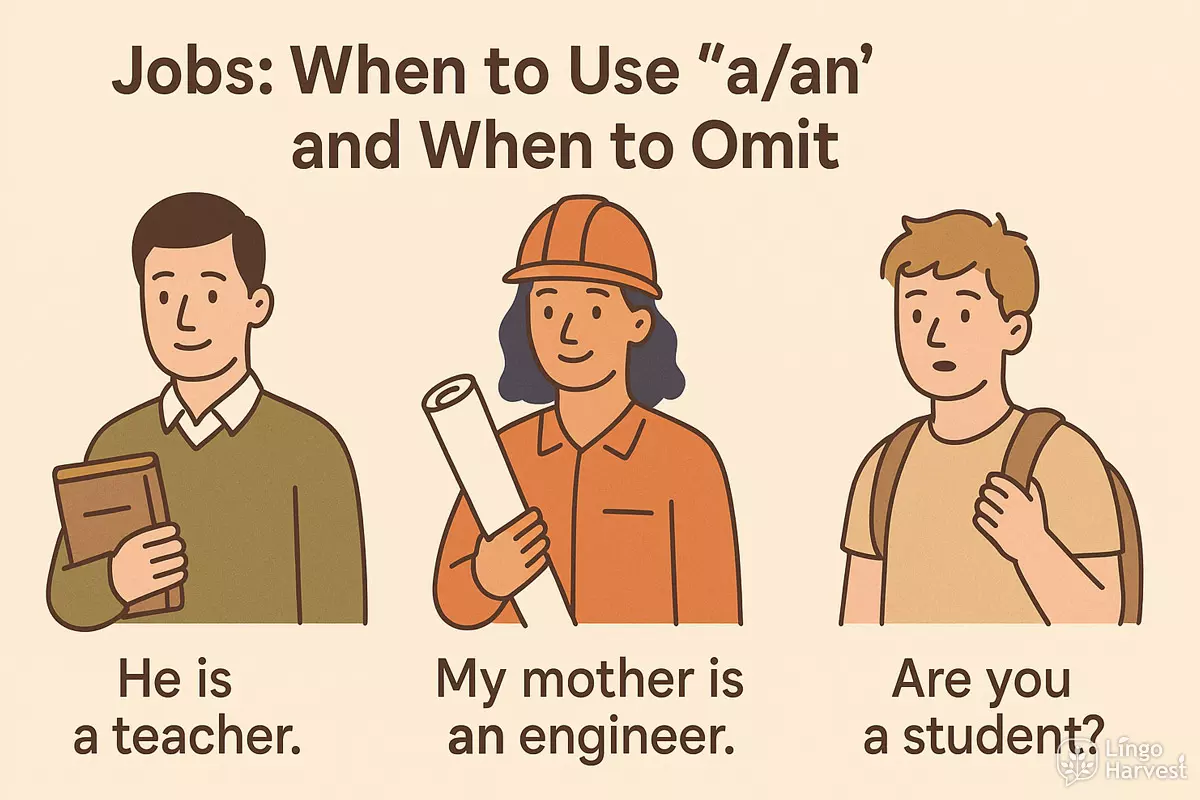
When you describe someone’s profession, you usually need the indefinite article “a” or “an”. Saying “She is doctor” is incorrect; the correct form is “She is a doctor.” This pattern applies to almost all singular job titles:
- He is a teacher.
- My mother is an engineer.
- Are you a student?
- She wants to be a pilot.
- He became an artist.
- My father is a manager.
- Julia is an accountant.
- He works as a chef.
- She’s a designer.
- My uncle is a driver.
Omitting the article is a frequent error: “He is engineer” ❌ instead of “He is an engineer” ✅. Remember, use “a” before consonant sounds and “an” before vowel sounds.
Places: Article Usage with Common Locations
Talking about places can be tricky, because some locations require an article, while others do not. Here are some general guidelines:
- Do not use an article with most places like “home”, “school”, “work”, “church”, “bed”:
“I’m going to school.”
“She is at work.”
“He went to bed.” - But you do use “the” when you specify or talk about a particular place:
“She is at the school (the specific building).”
“He’s cleaning the church (the building itself).” - Use “the” with places like “cinema”, “theatre”, “bank”, “hospital” (in British English when visiting as a patient, no article):
“I went to the cinema.”
“She is in the hospital.” - Do not use an article with “at home”, “in prison”, “at university” (British English usage):
“He is in prison.”
Comparison Table: Correct vs. Incorrect Usage
| Incorrect | Correct |
|---|---|
| She is teacher. | She is a teacher. |
| He is engineer. | He is an engineer. |
| I’m going to the home. | I’m going home. |
| She is in the school (when meaning as a student). | She is at school. |
| He went to the bed. | He went to bed. |
| I’m at the work. | I’m at work. |
| He is in hospital (meaning as a patient, US English). | He is in the hospital. |
| She is a university (meaning as a student). | She is at university. |
Learning these patterns will help you sound more natural and avoid mistakes that can confuse listeners. When in doubt, check if the noun is a job (add “a/an” for singular) or a place (think about whether the article is needed based on meaning and context).
How to fix each mistake
The best way to avoid common errors with "a," "an," and "the" is to learn the patterns behind their correct usage. Start by identifying which type of article mistake you’re making—such as omitting articles, using the wrong one, or adding unnecessary articles. Here’s how you can address each of these issues and improve your accuracy.
1. When to use "a" and "an"
Use "a" before words that begin with a consonant sound, and "an" before words that start with a vowel sound. This rule applies to pronunciation, not just spelling. For example:
- a cat
- an apple
- a university (the "u" sounds like "you")
- an hour (the "h" is silent)
If you’re unsure, say the word out loud and listen for the first sound.
2. When to use "the"
"The" is needed when you are talking about something specific or already mentioned. If both you and your listener know which thing you mean, use "the." For example:
- Pass me the salt. (There is only one salt on the table.)
- I saw the movie you recommended. (A specific movie.)
3. When to omit articles
No article is used with general ideas, plural nouns, or most uncountable nouns when speaking generally. Examples:
- She likes music.
- Cats are cute.
- Information is important.
If you’re not talking about a specific thing, leave out articles.
4. Common corrections at a glance
If you want a quick reference, compare common errors and their corrections below:
| Incorrect | Correct |
|---|---|
| I have dog. | I have a dog. |
| She is artist. | She is an artist. |
| Give me pen. | Give me the pen. |
| The life is short. | Life is short. |
| He has the blue eyes. | He has blue eyes. |
| I want to be a engineer. | I want to be an engineer. |
| She went to the school yesterday. | She went to school yesterday. |
5. Practice and self-correction tips
- Read sentences aloud to check if an article sounds natural.
- Focus on the difference between general and specific nouns.
- Review your writing for missing or extra articles.
- Notice patterns in authentic texts, such as news articles or stories.
With regular practice and attention to these guidelines, you’ll gradually reduce mistakes and gain confidence using articles accurately.
Practice to reinforce learning
Building confidence with English articles takes repeated exposure and varied exercises. Below you’ll find a mix of activities and focused drills to help you recognize and correct the most frequent mistakes. Work through the tasks actively—don’t just read the examples, but try to explain your reasoning.
Quick identification: Spot the mistake
Decide if each sentence uses articles correctly. If not, identify the error.
- She has dog and cat.
- I saw an elephant at zoo.
- Can you pass me salt, please?
- Mount Everest is the highest mountain in world.
- He is engineer.
Show answers
- Should be: a dog and a cat. (Missing articles)
- Should be: at the zoo. (“The” is needed for specific places)
- Correct. (“Salt” is uncountable and specific here.)
- Should be: in the world. (“The” before “world”)
- Should be: an engineer. (Article needed before professions)
Article selection: Fill in the blanks
Choose a, an, the, or leave blank if no article is needed.
- I’d like ____ apple from that basket.
- He is ____ honest man.
- ____ water in this glass is cold.
- My mother is ____ doctor.
- ____ Mount Fuji is in Japan.
Show answers
- an
- an
- The
- a
- — (no article needed before most proper nouns)
Common confusion: When to use “the”
Here’s a table to help clarify when “the” is used versus when no article is needed. Review the pattern and examples:
| Use “the” | No article |
|---|---|
| When talking about something specific (the book on the table) |
With plural or uncountable nouns in general (Books are useful. Water is important.) |
| With unique objects (the sun, the internet) |
With most proper names (Asia, Mount Everest) |
| With superlatives (the best day, the tallest building) |
With languages and meals (She speaks Spanish. We had breakfast.) |
| With certain place names (the United States, the Netherlands) |
With most streets, parks, or airports (Oxford Street, Hyde Park, Heathrow Airport) |
Self-check: Article errors in context
Read each short paragraph. Underline any article mistakes you notice.
- Yesterday I visited museum in city center. Museum had exhibition about history of chocolate. After that, I went to cafe and drank coffee.
- My friend bought new phone yesterday. Phone has amazing camera. She showed me pictures she took in park near her house.
- We stayed at hotel near beach. Hotel had pool and restaurant with great food. In evening, we walked along shore and watched sunset.
- In morning, I drank tea and read book that my sister gave me. Book was about life of famous explorer. Later, I went to supermarket to buy milk.
- At school today, we had test in English. Test was difficult, especially part about grammar. After class, I talked to teacher about some questions I didn’t understand.
Show answers
- 1.
- museum → the museum
- city center → the city center
- Museum → The museum
- exhibition → an exhibition
- history → the history
- cafe → a cafe
- 2.
- new phone → a new phone
- Phone → The phone
- amazing camera → an amazing camera
- pictures → OK (plural general)
- park → the park (specific one near her house)
- 3.
- hotel → a hotel
- beach → the beach (specific location near hotel)
- Hotel → The hotel
- pool → a pool
- restaurant → a restaurant
- shore → the shore
- 4.
- morning → the morning (specific morning today)
- tea → OK (uncountable)
- book → the book (known, sister gave it)
- Book → The book
- life → the life (specific person's life)
- supermarket → the supermarket (specific familiar place) or a supermarket (any) — both acceptable
- 5.
- test → a test (first mention)
- Test → The test
- part → the part (specific section of the test)
- teacher → the teacher (specific teacher for this class)
Extra practice: Article challenge list
Try to correct the article usage in these short phrases. Some may be correct already.
- Go to bed early.
- Play the piano.
- He is best student in class.
- She’s an university student.
- We visited a Eiffel Tower.
- Life is beautiful.
- I love the nature.
- She’s a teacher.
- Listen to music.
- The Mount Everest is high.
Show answers
- Correct.
- Correct.
- the best student (needs “the” for superlative)
- a university student (“a” not “an” as “university” starts with “juː” sound)
- the Eiffel Tower (unique landmark)
- Correct.
- nature (no article for general concept: “I love nature.”)
- Correct.
- Correct.
- Mount Everest is high. (No article before most mountain names)
Regularly reviewing and practicing these points will help you use articles more naturally in your writing and speech.