Articles in Questions and Short Answers

 Here we how to use a, an, and the in questions, explains the difference between specific and general nouns, and points out typical errors. It also includes short answer practice with answer checks for better learning.
Mastering the use of a, an, and the is essential for clear and natural English communication, particularly when asking questions and giving short answers. These small words, known as articles, help specify whether we are talking about something specific or something more general. For example, we use a or an when mentioning something for the first time or something not previously known to the listener, and we use the when referring to something already mentioned or known. Developing a good grasp of articles will make your conversations sound more fluent and accurate.
Using articles in questions
When forming questions in English, choosing the correct article—a, an, or the—can subtly change the meaning of what you ask. Articles help specify whether you mean any item, a particular one, or something already known to both speaker and listener. In many cases, omitting or misusing them can cause confusion or make a question sound unnatural.
General versus specific reference
Questions with a/an usually ask about any member of a group, while the refers to something specific. Consider:
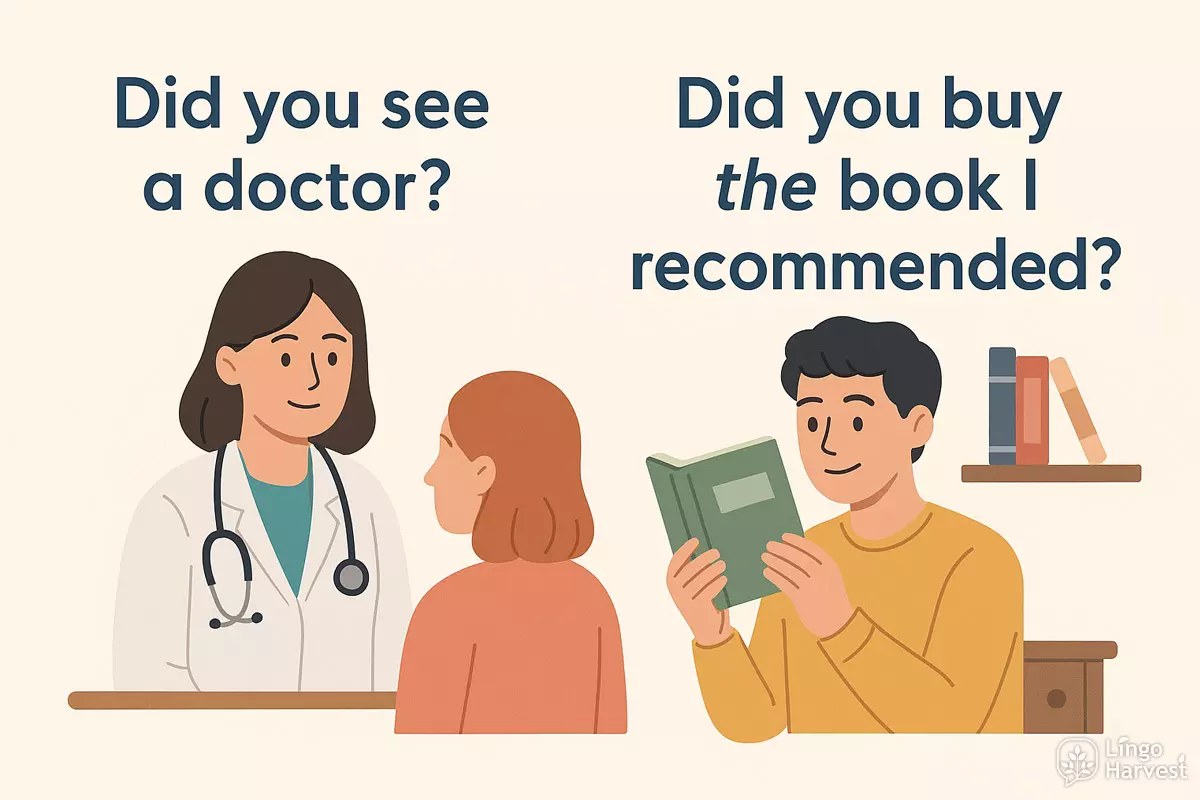
- Did you see a doctor? (any doctor, not specified)
- Did you see the doctor? (the one we both know about)
Common patterns in questions
Articles appear in various question structures. Here are typical patterns and how they affect meaning:
- Is there a problem?
- Did you buy the book I recommended?
- Can I have an apple?
- Where is the nearest station?
- Have you ever seen a shooting star?
- Do you remember the time we met?
- Is this the answer?
- Would you like a cup of tea?
- Did you hear the news?
- Did you get an invitation?
- What is the capital of France?
- Is there a reason for this?
- Who is the manager here?
- Could you hand me an umbrella?
- Did you find the keys?
- Is that a good idea?
Short answers and article agreement
When replying to questions, short answers often echo the article used in the question. Matching the article keeps the conversation clear and natural.
| Question | Short Answer |
|---|---|
| Did you see a movie? | Yes, I saw a movie. |
| Did you see the movie? | No, I didn't see the movie. |
| Is there an email for me? | Yes, there is an email. |
| Where is the cat? | The cat is outside. |
Omitting articles in questions
Some questions don’t require articles, especially when asking about plurals or uncountable nouns in general:
- Do you like apples?
- Is there water on the table?
- Are dogs friendly?
Understanding when to include or exclude articles in interrogative forms helps your questions sound natural and precise.
Asking about specific vs general nouns
When forming questions in English, the choice between using "a," "an," "the," or no article at all depends on whether you're talking about a particular thing or things in general. This affects how clear your question is and what kind of answer you expect. If you want to know about one particular item or person, definite articles like "the" are used. For general inquiries, indefinite articles ("a," "an") or no article might be more suitable. The listener can tell from your question whether you expect them to identify a specific object or if you're speaking more broadly.
How articles change the focus of a question
Using an article can signal whether you’re asking about something unique or just any example. For example:
- Did you see the doctor? (a specific doctor, likely previously mentioned or known to both people)
- Did you see a doctor? (any doctor, not a particular one)
Leaving out the article, especially with plural or uncountable nouns, usually makes the question about things in general:
- Do you like chocolate? (chocolate in general, not a particular piece)
- Are apples good for you? (apples as a type of fruit, not some specific apples)
Typical patterns in questions and short answers
Here are some common question forms with articles and how they signal general or specific intent:
| Question | Meaning/Focus |
|---|---|
| Is there a cat in the garden? | Any cat (not a particular one); indefinite |
| Is the cat in the garden? | Specific cat, likely known to both speakers |
| Do you want an apple? | Any apple; not specific |
| Do you want the apple? | A particular apple, possibly visible or already mentioned |
| Do you like apples? | Apples in general (no article with plural noun) |
| Did you see a movie last night? | Any movie, not a specific one |
| Did you see the movie? | A particular film, known to both people |
| Have you read the book? | One specific book, likely previously mentioned |
| Have you read books about space? | Any books about space, not specific ones |
| Is water important? | Water in general (uncountable noun, no article) |
Tips for forming clear questions
- Use "the" if both you and the listener know which thing you mean.
- Use "a" or "an" for any example, not a known one.
- Omit the article for general ideas with plural or uncountable nouns.
- Short answers often echo the article: Yes, I saw the movie. / No, I didn’t see a movie.
Understanding how articles guide the meaning in questions helps you get the information you want and avoid confusion. This awareness is especially important in short answers, where the article can change the meaning entirely.
Articles in short answers
When replying briefly to questions in English, the use of articles ("a," "an," "the") often follows the same principles as in longer sentences, but the context can make their inclusion or omission less obvious. Typically, if the noun in the answer is mentioned for the first time or is not specific, an indefinite article is used. If the noun is already known to both speakers, the definite article is appropriate. Sometimes, no article is needed at all, especially with plural or uncountable nouns.
Patterns for using articles in brief responses
- Yes, I have a dog. (introducing a dog for the first time)
- No, I don’t have a car. (general mention of any car)
- Yes, I saw the movie. (referring to a specific, previously mentioned movie)
- No, I haven’t read the book. (the book both know about)
- Yes, there’s an apple on the table. (first mention, singular, starts with a vowel sound)
- No, there aren’t any apples. (plural, no article needed)
- Yes, I drank the milk. (specific milk, known context)
- No, I don’t need sugar. (uncountable noun, no article)
- Yes, I met a teacher. (any teacher, not specified)
- No, I didn’t see an elephant. (general, first mention)
- Yes, I have the tickets. (specific tickets both know about)
- No, I haven’t got a pen. (any pen, not specific)
- Yes, I bought the bread. (specific bread, already discussed)
- No, I don’t have time. (uncountable noun, no article)
- Yes, I found a solution. (one solution, not specified)
- No, I haven’t seen the answer. (specific answer)
Common mistakes in short answers
- Omitting the article when one is needed: “Yes, I have cat.” ❌ → “Yes, I have a cat.” ✅
- Using an article with uncountable nouns unnecessarily: “I need a water.” ❌ → “I need water.” ✅
- Forgetting the definite article for known items: “I locked door.” ❌ → “I locked the door.” ✅
Comparison of article use in short answers
| Example Answer | Explanation |
|---|---|
| Yes, I have a ticket. | Indefinite article: First mention, not specific. |
| Yes, I have the ticket. | Definite article: Both know which ticket. |
| No, I don’t have tickets. | No article: Plural, not specific. |
| No, I don’t need milk. | No article: Uncountable noun, general sense. |
Understanding when to use or omit articles in short replies improves clarity and shows attention to detail in English communication. Practice recognizing whether the noun is specific, general, countable, or uncountable, and choose the correct article accordingly.
Typical errors
Learners often struggle with forming articles correctly in questions and short answers. Misplacing or omitting the article can lead to confusing or ungrammatical sentences. This is especially common when switching between statements and interrogative forms, or when providing concise replies. Below are some frequent issues and misconceptions to watch for:
Common mistakes in questions
- Leaving out the article: “Is this pen yours?” → “Is this a pen yours?” (incorrect)
- Using the wrong article: “Do you have the car?” when asking about any car, not a specific one (incorrect)
- Adding an article where none is needed: “Is he a your friend?”
- Placing the article after the noun: “Is book the on the table?”
- Forgetting to use “an” before vowel sounds: “Is it a apple?”
Short answer pitfalls
- Repeating the noun instead of using an article: “Is this a cat?” – “Yes, it is cat.”
- Dropping the article in echo answers: “No, it isn’t pen.”
- Overusing the definite article: “Is this your pen?” – “Yes, it’s the pen.” (when not distinguishing from others)
- Mixing up “a” and “an”: “Yes, it is an dog.”
Comparison of correct and incorrect forms
| Incorrect Usage | Correct Usage |
|---|---|
| Is this book yours? | Is this a book? |
| Do you have umbrella? | Do you have an umbrella? |
| Is this a apple? | Is this an apple? |
| Yes, it is cat. | Yes, it is a cat. |
| No, it isn’t pen. | No, it isn’t a pen. |
| Yes, it’s the pen. | Yes, it’s a pen. (if not specific) |
Other frequent problems
- Confusing zero article (no article) situations, e.g., “Do you go to school?” vs. “Do you go to the school?”
- Omitting the article after “what” or “such”: “What beautiful day!”
- Using articles with uncountable nouns inappropriately: “Is this a water?”
- Incorrect word order in short responses: “Is it a car? – Yes, is it.”
- Forgetting to match the article to the noun’s count/number: “Is this an apples?”
Awareness of these patterns will help produce clearer, more natural questions and answers. Practice and mindful correction are key to mastering article usage in these contexts.
Quick Q&A practice
Practicing with short questions and answers is a practical way to master the use of articles in English interrogatives. Below you'll find a range of sample exchanges, typical mistakes to watch for, and a mini-quiz to check your understanding. Focus on how articles like a, an, and the are used—or omitted—in both questions and brief responses.
Common question and answer patterns
- Is there a book on the table? – Yes, there is a book.
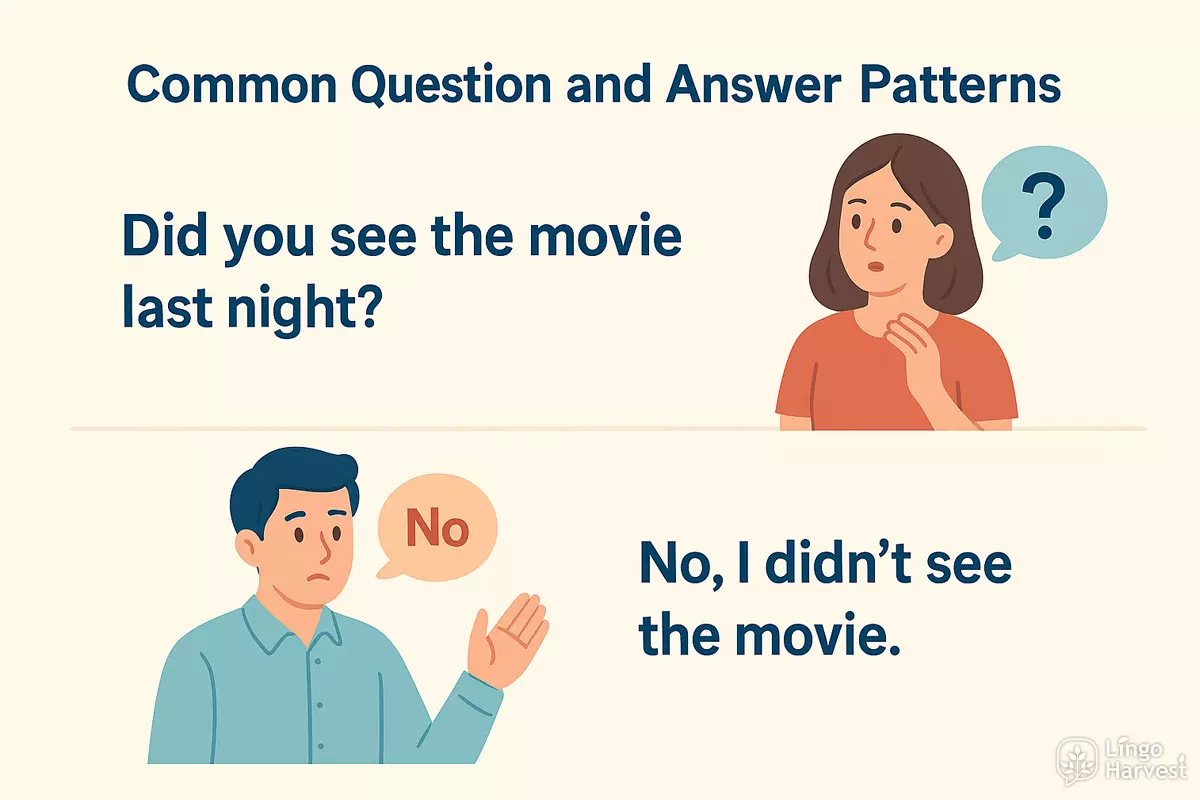
- Did you see the movie last night? – No, I didn't see the movie.
- Do you have an umbrella? – No, I don't have an umbrella.
- Is the teacher here? – Yes, the teacher is here.
- Have you got a pen? – Yes, I've got a pen.
- Is this the right answer? – Yes, it is the right answer.
- Did he buy a car? – Yes, he bought a car.
- Is there an apple in the bag? – No, there isn't an apple.
- Do you want a sandwich? – Yes, I'd like a sandwich.
- Was the weather nice? – No, the weather was terrible.
- Did she find the keys? – Yes, she found the keys.
- Is he an engineer? – Yes, he is an engineer.
Spot the error
Review these short answers and identify which ones have incorrect article usage:
- Is there apple in the fridge? – Yes, there is apple.
- Did you see movie? – No, I didn't see movie.
- Have you got a pencil? – No, I haven't got pencil.
- Is the dog barking? – Yes, dog is barking.
- Do you have umbrella? – No, I don’t have umbrella.
- Is she an engineer? – No, she is not engineer.
- Did he buy car? – Yes, he bought car yesterday.
- Is there information about event? – Yes, there is information.
- Do you hear noise? – No, I don’t hear noise.
- Is that the solution? – No, that is not solution.
- Did you eat egg? – Yes, I ate egg.
- Is he the best player? – No, he is not best player.
- Did they visit the museum? – No, they didn’t visit museum.
- Is this your phone? – No, that is not phone.
- Do we have time? – No, we don’t have time.
Show answers
- 1: Missing "an" – Should be "Is there an apple..." and "there is an apple."
- 2: Missing "the" – Should be "Did you see the movie?" and "see the movie."
- 3: Missing "a" – Should be "I haven't got a pencil."
- 4: Missing "the" – Should be "Yes, the dog is barking."
- 5: Missing "an" – "Do you have an umbrella?" and "I don’t have an umbrella."
- 6: Missing "an" – "She is not an engineer."
- 7: Missing "a" – "He bought a car yesterday."
- 8: Correct (uncountable noun) – No article needed.
- 9: Missing "a" – "I don’t hear a noise."
- 10: Missing "the" – "That is not the solution."
- 11: Missing "an" – "I ate an egg."
- 12: Missing "the" – "He is not the best player."
- 13: Missing "the" – "They didn’t visit the museum."
- 14: Missing "a" – "That is not a phone."
- 15: Correct (uncountable noun) – No article needed.
Articles in question and answer forms: comparison table
| Question | Short Answer |
|---|---|
| Is there a cat in the room? | Yes, there is a cat. |
| Did you see the doctor? | No, I didn't see the doctor. |
| Do you have an idea? | Yes, I have an idea. |
| Is the bus late? | No, the bus is on time. |
| Did she find a solution? | Yes, she found a solution. |
| Has he read the article? | No, he hasn't read the article. |
Mini quiz: choose the correct article
Select the correct article (a, an, the, or none) for each blank:
- Is there ___ orange on the table?
- Did you read ___ instructions?
- Is she ___ artist?
- Have you seen ___ stars tonight?
- Did he buy ___ umbrella?
- We don’t have ___ time to finish this.
- He is ___ best player on the team.
- She works in ___ office near the station.
- They went to ___ school early this morning.
- Can you pass me ___ salt, please?
Show answers
- 1: an
- 2: the
- 3: an
- 4: the
- 5: an
- 6: none (no article) – time is uncountable here
- 7: the
- 8: an
- 9: none (no article) – school in general function
- 10: the
Regular practice with these patterns will help you use articles naturally in both questions and concise responses. Pay attention to context—definite articles refer to known or specific things, while indefinite articles introduce something new or unknown.
Check your answers
Reviewing how articles are used in questions and short answers helps reinforce your understanding. Compare your responses with the explanations and examples below to see where you might need clarification. Pay close attention to the placement and omission of "a," "an," and "the" in each type of sentence.
Common Patterns in Questions and Short Answers
- Is there a book on the table? → Yes, there is a book.
- Did you see the movie? → Yes, I saw the movie.
- Is this an apple? → No, it’s a pear.
- Do you have a pen? → Yes, I have a pen.
- Is the teacher here? → No, the teacher isn’t here.
- Is there an answer? → Yes, there is an answer.
- Are you reading the instructions? → No, I’m reading a magazine.
- Did she buy a car? → Yes, she bought a car.
- Is this the right address? → Yes, this is the right address.
- Do you need a spoon? → No, I need a fork.
- Were you at the party? → Yes, I was at the party.
- Did they find an error? → No, they didn’t find an error.
- Is there a message for me? → No, there isn’t a message.
- Did you open the window? → Yes, I opened the window.
- Is she the new manager? → Yes, she is the new manager.
- Do you have an umbrella? → Yes, I have an umbrella.
- Is it a problem? → No, it isn’t a problem.
- Are these the keys? → No, these are not the keys.
Typical Mistakes to Watch For
- Omitting articles where they are needed (e.g., "Is there book?" instead of "Is there a book?")
- Using "the" when introducing something for the first time ("Did you see the cat?" when the cat hasn’t been mentioned before)
- Forgetting to change "a" to "an" before vowel sounds ("Is this an apple?" not "Is this a apple?")
Quick Reference: Articles in Questions and Answers
| Question | Short Answer |
|---|---|
| Is there a cat? | Yes, there is a cat. |
| Did you see the dog? | No, I didn’t see the dog. |
| Is this an orange? | Yes, it’s an orange. |
| Are these the documents? | No, those aren’t the documents. |
| Do you have a question? | Yes, I have a question. |
Examine your work against these examples and notes. If your sentences match the patterns, you’re applying articles correctly in both questions and brief responses. Remember, context and whether the noun is specific or general will guide your choice of article.